
by James A. Bacon
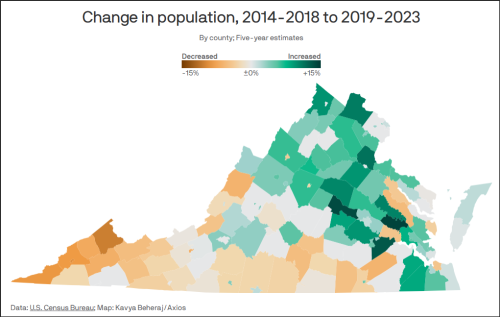
The Richmond metropolitan area continues to dominate population growth in Virginia, as shown by this map published by Axios-Richmond. (Click here to access interactive features.) This represents a sustained reversal of a decades-long trend in which population growth had been dominated by Northern Virginia.
What’s going on?
Axios doesn’t speculate about what’s driving this growth, but Old Dominion University’s 2024 State of the Commonwealth report provides some context.
Between July 1, 2020, and June 30, 2023, the Richmond Metropolitan Statistical Area population grew 2.5%, exceeded only by 3.0% in the Winchester MSA. That compared to 1.0% nationally and 0.9% statewide. Metro Washington and Hampton Roads population growth slowed to a crawl, while Roanoke and Blacksburg lost population.
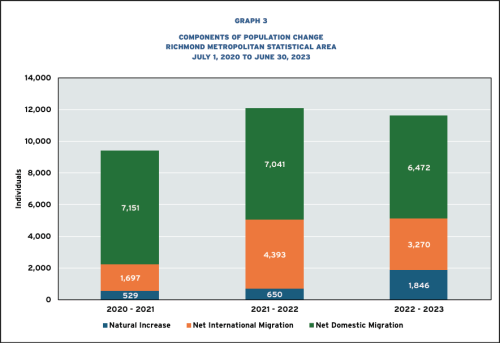
This graph from the ODU report shows the components of the Richmond MSA growth for each of those three years. Natural population increase was positive but a secondary factor. What’s noteworthy to me, as a Richmond-area resident for nearly 40 years, is the significant contribution from international migration. Richmond is hardly what one could call an immigration gateway, but it is becoming more ethnically diverse with more Hispanics, East Asians and South Asians.
The largest growth component is domestic migration, the movement of people within the country. The region has been gaining about 7,000 domestic in-migrants per year.
Contrast that to the pattern seen in Hampton Roads.
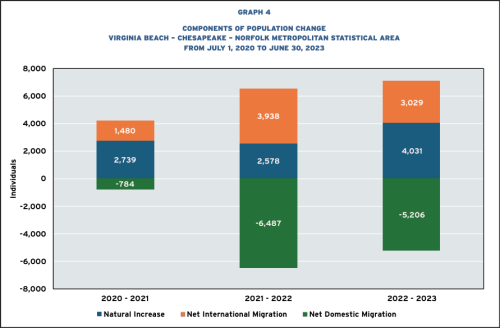
Hampton Roads has experienced healthy natural increase (births over deaths) and some international in-migration but is suffering from significant domestic outmigration.
What’s driving the growth in Richmond? I’d like to think that it’s our vibrant, dynamic economy. ODU doesn’t look at job creation, but it does track change in gross domestic product. That tells a very different story.
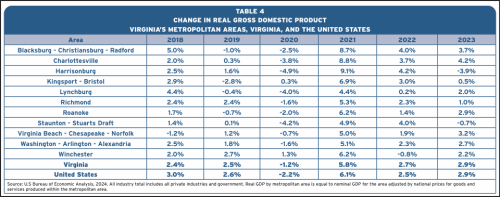
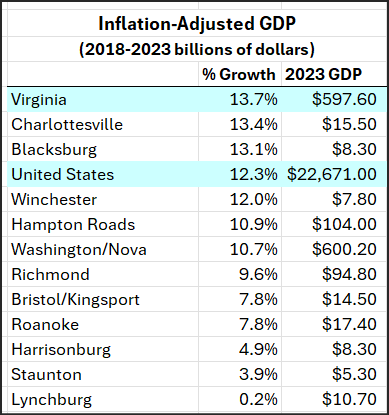
As seen in the table below (extracted from the ODU data above), Charlottesville, Blacksburg and Roanoke led the way in inflation-adjusted GDP growth between 2018 and 2023 (despite Blacksburg and Roanoke losing population between 2020 and 2023).
Richmond GDP growth (9.6%) lagged behind the national GDP growth (12.3%), Virginia GDP growth (13.7%), and even Washington metro and Hampton Roads GDP growth.
It would be interesting to see if Richmond is creating jobs at a faster rate than the other metros, even in the absence of a booming GDP. My hunch is that Richmond is attracting a lot of Northern Virginia refugees seeking less expensive housing and better quality of life. I’d also wager that a lot of these people are working remotely. I just don’t see a lot of business dynamism in the region to explain the population growth.
Perhaps the most interesting finding from the table above is the fact that Virginia GDP grew faster (13.7%) than any of its metropolitan statistical areas. The implication is that the state’s non-metropolitan areas — its rural/small town localities — grew at a faster rate than the state average.
The logical conclusion is that the economies of Virginia’s rural areas — or at least the economies of some of them — were growing like gangbusters during this five-year period. This is a finding that’s worth exploring. Does the pattern apply to all non-metro areas in Virginia, or just a fortunate few? What’s behind the GDP growth? And what can we learn from it?


Leave a Reply
You must be logged in to post a comment.