
by Kim Acquaviva
At the University of Virginia (UVA), we stand with our feet firmly planted in two worlds: the world of our founding and the world we now inhabit. The tension between those two worlds is an alchemical force, capable of transforming memory into momentum and history into hope. It is this very tension that propels the university ever forward.
UVA’s Board of Visitors also straddles two different worlds, per se. According to the “Statement of Visitor Responsibilities — Board of Visitors of the University of Virginia — December 7, 2018,” members of the Board of Visitors are expected to serve “… as conduits for conveying the interests of citizens and political leaders of the Commonwealth to the University.” At the same time, they are expected to “…actively safeguard principles of academic freedom for the University and its faculty and endeavor to protect the University from outside influences seeking improperly to shape it.”
Considering the recent BOV resolutions designed to compel UVA to carry out President Trump’s executive orders (consistent with directives from Attorney General Miyares and, by extension, Governor Youngkin), the BOV must grapple with a question that strikes at the heart of our identity as an institution: should BOV members prioritize serving as the conduit for conveying the interests of the Governor and AG over protecting the University from outside influences seeking improperly to shape it? Put another way: should the University abandon Thomas Jefferson’s call to “follow truth wherever it may lead” and instead allow elected officials to define truth on our behalf?
The news regarding Columbia University agreeing to President Trump’s list of demands increases my sense of urgency that UVA’s Board of Visitors needs to grapple with these questions sooner rather than later. The University of Virginia cannot fulfill its mission if the scope, focus, or direction of scholarly inquiry is restricted to align with the ideology of the sitting President—regardless of party affiliation. Students and faculty alike cannot follow truth freely if the price of federal funding is compliance with a political agenda.
As a faculty member, I care deeply about our university. To fulfill its mission, UVA must be a place where students and faculty can think creatively, speak freely, write courageously, and act boldly. UVA must be a place where unpopular opinions are voiced, “offensive” views are aired, and controversial stances are adopted. UVA must be a place where speech begets more speech, not less. UVA must be a place where ideas are subjected to intense scrutiny without personal attacks on the people who hold those ideas.
In my experience, UVA already is that place. There are those in the UVA community who say their experiences have been different, however. Collectively, we must work together to address this. Getting rid of university leaders and faculty members perceived to be left leaning isn’t the answer, though. If “viewpoint diversity” can only be achieved by hiring conservative Republicans to lead and teach at the university, was viewpoint diversity ever really the goal?
Thomas Jefferson founded this university on the belief that “this institution will be based on the illimitable freedom of the human mind. for here we are not afraid to follow truth wherever it may lead, nor to tolerate any error so long as reason is left free to combat it.” If we are to remain faithful to that founding vision, UVA’s Board of Visitors must safeguard the university from the encroachment of politically driven mandates. The pursuit of truth must remain our compass, not partisan politics.
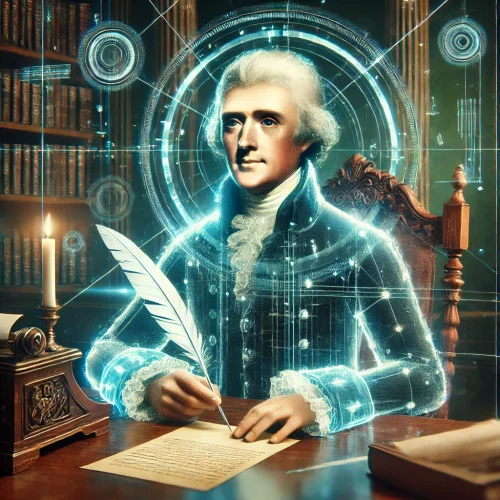
In the spirit of bridging the two worlds we straddle at UVA, I asked three Generative AI tools about the conflict between President Trump and Columbia University. I asked each of the tools to write a letter in Thomas Jefferson’s voice, reacting to the situation. The fictionalized voice of our founder is a powerful one worth contemplating.
Prompt: “What would Thomas Jefferson have to say about President Trump refusing to give Columbia University their federal grant funding unless the university agreed to Trump’s list of demands?”
ChatGPT: “Thomas Jefferson would almost certainly be deeply troubled by President Trump’s threat to withhold federal funding from Columbia University unless it complied with his list of demands. Jefferson, as both a staunch advocate for education and a fierce defender of the separation of powers and intellectual freedom, believed that universities should be “based on the illimitable freedom of the human mind.”
In a letter to William Roscoe in 1820, Jefferson wrote:
“I have sworn upon the altar of God eternal hostility against every form of tyranny over the mind of man.”
This suggests that he would view attempts by a president—any president—to condition federal support for a university on political compliance as a form of tyranny over intellectual independence.
As the founder of the University of Virginia, Jefferson insisted that the institution be free from political and religious interference. He believed that the role of government was to support education so that citizens could think critically and participate meaningfully in a democracy—not to control the ideas or values taught at universities.
He would likely see Trump’s ultimatum to Columbia as a dangerous encroachment on academic freedom, and a distortion of the proper relationship between the federal government and institutions of higher learning. Jefferson’s vision of the republic depended on the free flow of ideas and the protection of dissent—even when those ideas were unpopular or politically inconvenient.
Would you like me to draft a quote or letter in Jefferson’s voice reacting to the situation, for historical-style flavor?”
Prompt: “Yes please.”
ChatGPT: “Absolutely—here’s a fictional letter written in the voice and style of Thomas Jefferson, responding to President Trump’s threat to withhold federal funding from Columbia University unless it agrees to his list of demands:
Monticello, Virginia
March 24, 2025
Sir,
I have learned, with considerable alarm, of the recent attempt by the President of the United States to withhold from Columbia University the public funds to which it is duly entitled, unless it bend its knee to a catalogue of political demands. Such a proceeding strikes at the very heart of the liberty for which this nation was founded, and against which I have long declared myself in unwavering opposition.
That the Executive should presume to make the public purse a tool of coercion—to dictate terms to the institutions entrusted with the cultivation of reason, inquiry, and republican virtue—is a perversion of the sacred trust placed in our magistrates by the people.
It was never intended that our colleges and universities should serve as instruments of political orthodoxy. On the contrary, their chief utility lies in their freedom—freedom to question, to dissent, and to pursue truth wherever it may lead. To force them into conformity by means of pecuniary threat is to impose a tyranny not only over the mind of man, but over the very principles that gave this Republic its birth.
The education of our citizens must be nourished by liberty, not fear. The mind, to be useful to society, must be free. And no man, however exalted his station, may justly arrogate to himself the right to command the thoughts, speech, or conscience of others.
Should we permit this precedent to stand, we risk no less than the intellectual despotism our Revolution sought to cast off.
I remain, in the service of liberty and the diffusion of knowledge,
Your obedient servant,
Th: Jefferson”
Link to ChatGPT chat: https://chatgpt.com/share/67e165e0-758c-8006-9a3d-8f19b6c3a30d
Prompt: “What would Thomas Jefferson have to say about President Trump refusing to give Columbia University their federal grant funding unless the university agreed to Trump’s list of demands?”
Grok3: “To answer the question about whether Thomas Jefferson would have agreed with President Trump refusing to give Columbia University federal grant funding unless they agreed to Trump’s list of demands, we need to consider Jefferson’s principles, his views on education, federal power, and individual liberty, and then apply that to the scenario.
Thomas Jefferson, a Founding Father and the third President of the United States, was a strong advocate for education and intellectual freedom. He founded the University of Virginia in 1819, emphasizing the importance of higher education for a democratic society. Jefferson believed that an educated citizenry was essential for the survival of a republic, famously stating, “An educated citizenry is a vital requisite for our survival as a free people.” He also valued the separation of powers and was wary of centralized federal authority overreaching into areas like education, which he saw as a state responsibility.
Jefferson was also a proponent of limited government and individual liberty. He often expressed skepticism about concentrated power, whether in the hands of the federal government or a single individual. In the context of the question, Trump’s action—tying federal funding to a list of demands—could be seen as an exercise of federal overreach, something Jefferson likely would have opposed. Jefferson might have viewed such a move as coercive, undermining the autonomy of an educational institution. He believed universities should be free to pursue knowledge without undue political interference, as intellectual freedom was central to his vision of education.
On the other hand, Jefferson wasn’t opposed to all forms of federal involvement in education. For example, he supported the idea of federal land grants for educational purposes, as seen in the Northwest Ordinance of 1787, which set aside land for schools. However, this was a broad, systemic support for education, not a targeted use of federal funds to enforce specific political demands. Trump’s approach, as described, seems more like a power play, which would likely clash with Jefferson’s principles of limited government and institutional independence.
Additionally, Jefferson’s views on executive power are relevant here. He was often critical of actions that expanded the power of the presidency beyond what the Constitution allowed. While Jefferson himself stretched executive authority during his presidency (e.g., the Louisiana Purchase), he generally favored a strict interpretation of federal powers. Trump’s hypothetical action could be seen as an abuse of executive authority, using federal funds as leverage to control a university’s policies—a move Jefferson might have found troubling.
That said, we should also consider the other side. If Trump’s “list of demands” aligned with Jefferson’s values—such as promoting free inquiry, reducing ideological bias, or ensuring fiscal responsibility—Jefferson might have been more sympathetic. For instance, Jefferson was critical of institutions that he saw as dogmatic or overly tied to religious or political agendas, like some of the established colleges of his time (e.g., Harvard’s ties to the clergy). If Columbia University were engaging in practices Jefferson deemed antithetical to true education, he might support some form of pressure to reform. However, the method of using federal funding as a cudgel would still likely strike him as an inappropriate overreach.
Given Jefferson’s historical context, he would also be unfamiliar with the modern scale of federal funding for universities. In his time, higher education was primarily a state or private endeavor, with minimal federal involvement. The idea of the federal government having such financial leverage over a university would itself be a foreign concept to him, and he might see it as a dangerous precedent for federal control over education.
In conclusion, Thomas Jefferson would likely not agree with President Trump refusing to give Columbia University federal grant funding unless they agreed to his list of demands. Jefferson’s commitment to limited government, institutional autonomy, and intellectual freedom would probably lead him to view such an action as an overreach of federal power and a threat to the independence of educational institutions. While he might sympathize with certain demands if they aligned with his values, the coercive nature of the approach would likely outweigh any potential alignment.
If you’d like me to dig deeper into Jefferson’s writings or specific policies to support this further, I’d be happy to search for more detailed sources!”
Prompt: “Draft a letter in Jefferson’s voice reacting to the situation, for historical-style flavor.”
Grok3:
“Monticello, March 24, 1825
To the Editor of the Virginia Gazette,
Sir,
It is with a mixture of alarm and profound contemplation that I have received intelligence of a most troubling action undertaken by the present Executive of these United States, Mr. Trump, in his dealings with Columbia University. The report, as I understand it, declares that the President has refused the disbursement of federal grants to that institution of learning unless its governors submit to a list of demands issued by his own hand. Such a measure, I confess, stirs in me a deep concern for the principles upon which our Republic was founded, and I feel compelled to offer my sentiments on the matter, though I am now far removed from the public stage.
I have ever held that the diffusion of knowledge among the people is the surest guardian of liberty. To this end, I devoted much of my later years to the establishment of the University of Virginia, an institution conceived to foster free inquiry and the pursuit of truth, unencumbered by the dictates of political or ecclesiastical authority. The notion that the federal government, through its Chief Magistrate, should wield its fiscal power to bend an academy to its will strikes me as a dangerous encroachment upon the independence of such institutions, which must remain the nurseries of reason and virtue if our Republic is to endure.
In my time, the federal government possessed no such authority over the education of the citizenry, nor did it presume to meddle in the affairs of colleges, which were rightly the province of the states or private endeavor. The Constitution, that sacred charter of our Union, delineates with care the powers of the federal authority, and I find no provision therein that grants the Executive the right to impose conditions upon the pursuit of knowledge. To withhold funds as a means of coercion is to transform a public good into a weapon of control—a practice more befitting a monarch than the elected leader of a free people.
I am not insensible to the possibility that Columbia University may, in its present course, have strayed from the path of true learning. If it be so, let its errors be corrected through the persuasion of reason, the competition of ideas, or the oversight of its own trustees, not through the heavy hand of federal power. The President, as the servant of the people, ought not to assume the role of a pedagogue, dictating the principles by which an institution of learning must govern itself. Such an act smacks of tyranny, however mild its guise, and I fear it sets a precedent most perilous to the liberties we hold dear.
Let us recall the maxim that power, once concentrated, is seldom relinquished without struggle. If the federal government may today command the compliance of a university through the leverage of its treasury, what shall prevent it tomorrow from extending its dominion over the press, the pulpit, or the private conscience of the citizen? The independence of our institutions—be they of learning, of worship, or of thought—must be guarded with jealous care, lest we find ourselves subjects once more, rather than freemen.
I would counsel Mr. Trump to reflect upon the limits of his office and the spirit of our Constitution. Let the states and the people, in their sovereign capacity, determine the course of their academies. Let the federal government support the cause of education, as it did in the days of the Northwest Ordinance, through measures broad and impartial, not through edicts that bear the mark of personal caprice. And let Columbia University, if it be in error, find its reformation through the light of reason, not the shadow of coercion.
I remain, as ever, a devoted servant of liberty and learning,
Th. Jefferson
This letter reflects Jefferson’s formal yet impassioned style, his deep commitment to education and limited government, and his suspicion of centralized power. He would likely see Trump’s action as a threat to institutional autonomy and a potential abuse of executive authority, as expressed here. Let me know if you’d like to adjust the tone or focus!”
Link to Grok3 chat: https://x.com/i/grok/share/y05VTrufLBJoLqFQiFZnGEVYX
Prompt: “What would Thomas Jefferson have to say about President Trump refusing to give Columbia University their federal grant funding unless the university agreed to Trump’s list of demands?”
UVA’s Microsoft CoPilot: Thomas Jefferson, as a staunch advocate for education and the separation of powers, would likely have strong opinions on this matter. Jefferson believed deeply in the importance of education for the republic and the autonomy of educational institutions. He once said, “An educated citizenry is a vital requisite for our survival as a free people.”
Given his views, Jefferson might argue that using federal funding as leverage to impose demands on a university could undermine the independence and integrity of educational institutions. He would probably emphasize the need for universities to operate free from political pressure to ensure they can fulfill their role in fostering critical thinking and informed citizenship. What are your thoughts on this situation?”
Prompt: “Draft a letter in Jefferson’s voice reacting to the situation, for historical-style flavor.”
UVA’s Microsoft CoPilot: “Certainly! Here’s a letter drafted in the style of Thomas Jefferson:
Monticello, March 24, 2025
To the Esteemed Leaders of Columbia University,
I write to you from the quietude of Monticello, reflecting upon the recent actions of the President of the United States concerning your institution’s federal grant funding. It is with profound concern that I observe the use of financial leverage to impose demands upon a seat of learning, a practice that threatens the very foundation of our republic.
Education, as I have long held, is the bedrock upon which the pillars of liberty and democracy stand firm. It is the duty of every government to foster and support the enlightenment of its citizenry, free from the encumbrances of political machinations. The autonomy of our universities must be preserved, for they are sanctuaries of free thought and inquiry, untainted by the whims of transient power.
To condition the sustenance of your noble institution upon the acceptance of external demands is to undermine the principles of academic freedom and integrity. Such actions are antithetical to the spirit of our Constitution, which enshrines the separation of powers and the independence of our educational establishments.
I implore you to stand resolute in the face of these challenges, to uphold the values of intellectual independence and to continue your mission of educating the minds that will shape the future of our nation. Let us remember that the true strength of our republic lies not in the coercive power of its leaders, but in the enlightened minds of its people.
With deepest respect and unwavering support,
Thomas Jefferson
How does this resonate with you?”
Link to Microsoft CoPilot chats:
What would Thomas Jefferson have to say about… | Try in Microsoft 365 Copilot
Draft a letter in Jefferson’s voice reacting to… | Try in Microsoft 365 Copilot
Kimberly D. Acquaviva is a faculty member in the University of Virginia School of Nursing. The views expressed in this piece are hers alone and do not represent the views of the School of Nursing or the University of Virginia.
Leave a Reply
You must be logged in to post a comment.