
And how much is driven by DEI? UVA won’t say.
Open the Books has published a new report, “Transparency Crisis,” examining the percentage of research funding devoted to university overhead. Nationally, 50% to 60% of federal research grants go to overhead, which is meant to cover university and departmental infrastructure and support. “Recent reports,” states Open the Books, “have suggested exorbitant overhead spending feeds into bloated university administrations that distract from academic inquiry, including through roles and spending related to diversity, equity and inclusion.”
The report did in-depth analyses of five universities, including the University of Virginia. I have excerpted the UVA section below. — JAB
University of Virginia only gave Open the Books salary data for the years 2019, 2021, and 2024, although we asked for data from 2013, 2015, and 2017 as well. It is unclear why we did not receive the complete data that we asked for, but lack of transparency prevents the public from understanding historic trends in spending and staffing.
Additionally, UVA was selected for this report because they had previously provided salary spending databases that included both departments and titles when Open the Books investigated the university in 2024. Having staff salary data that includes departmental information is essential for counting DEI-related positions. This time, UVA only provided titles with no department connection. Therefore, Open the Books cannot include DEI-related staffing as part of this analysis.
From 2019-2023 UVA received $1.5 billion in federal R&D grants, or about $300 million per year. Grants came mostly from the Department of Health and Human Services ($1 billion). The Department of Defense (now referred to as the Department of War) and the National Science Foundation followed with about $180 million each.
Because there is no public dataset with all overhead rates, the public relies on universities to post the rates themselves. UVA, unlike many universities, does not post their overhead rate on their website.
Total university staff increased by about 2,000 over the five years of available data: from 9,799 in 2019 to 11,783 in 2024. Salary spending likewise grew from $966 million in 2019 and $1.3 billion in 2024.
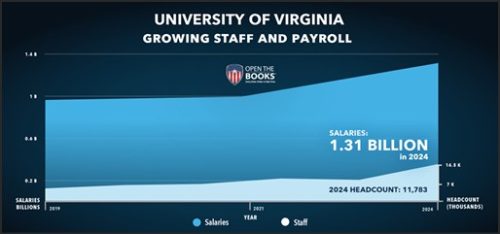
Of the new hires since 2019, 459 had the title “professor,” “lecturer,” or “instructor.” That is less than a quarter of the total number of staff added.
Because the data was unexpectedly incomplete, we cannot see how DEI staff numbers changed over time. Previous Open the Books reporting1 shows that in 2023 the University of Virginia spent an estimated $20 million annually on 235 part-time and full-time employees with DEI-related roles. That amount is roughly equivalent to 1,000 first-year student tuition payments.
This count includes staff identified in 2023 UVA-provided payroll records who work for the Office for Diversity, Equity and Inclusion, Office of Diversity & Engagement, Center for Diversity, Equity Center and Multicultural Student Services, among others.
Since then, the university has undergone major changes in its DEI infrastructure. In March 2025 the UVA Board of Visitors voted to dismantle its DEI office and eliminate all DEI programs and roles. An equity plan was also scrapped, which included targets for the racial makeup of staff. The Trump Department of Justice pressured the university for proof that it had truly undertaken those reforms and was not just hiding DEI programs under new names.
But, as demonstrated throughout this report, the federal government in previous administrations has had a hand in encouraging the growth of DEI infrastructure at universities, and UVA is no exception. A look through UVA’s recent NSF grants illustrates how DEI became embedded in research funding, even within projects that are totally unrelated to DEI topics:
- $265,1613 for a chemical engineering project for “optimizing interfacial electrokinetics” that also funds “STEM outreach programs to K-12 students from diverse groups and low-income families through handson demonstrations” and recruits “undergraduate summer interns from underrepresented minority groups…to work on this project.”
- $239,0934 for an astronomy project on studying supernovae that also will work “to increase the number of members of underrepresented groups in STEM…[T]he lead investigators will collaborate with two different programs (one, Girls Exploring the Universe, a summer program for middle school girls in Virginia, and the other at a high school in East Lansing, MI) to involve their students in different research projects.”
Leave a Reply
You must be logged in to post a comment.