
by James A. Bacon
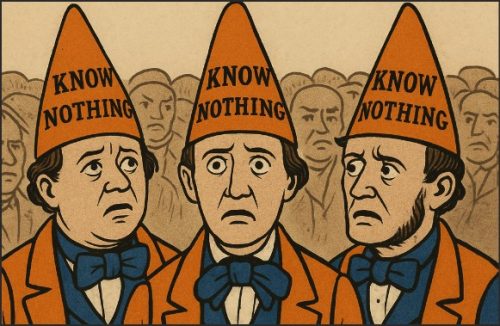
There is a new player in the struggle for the soul of the University of Virginia: Wahoos4UVA, which describes itself as a group of “proud alumni, students, parents, faculty, staff, and friends” of the University. Its stated mission is to defend UVA from an “orchestrated campaign of misinformation and political pressure.”
Who is conducting this alleged misinformation campaign? The signature-raising letter published by Wahoos4UVA refers to a “small, unrepresentative group of alumni,” which you can be certain is none other than the Jefferson Council (on whose executive committee I serve). The name of our organization, like that of Lord Voldemort, presumably is too heinous for Wahoos4UVA to actually utter.
These self-professed defenders of UVA President Jim Ryan regard the Jefferson Council as thoroughly reprehensible. Our tactics, states the letter, consist of “lies, personal attacks, and public disrespect” and “stand in direct opposition to the Honor Code and the values that define UVA.” Furthermore, asserts the letter, we circulate “false claims and distortions.”
Wahoos4UVA offers zero evidence to back up its claims. Not one lie. Not one personal attack. Not one false claim. Not one distortion. This is the kind of bilious rhetoric normally found in letters to the editor penned by cranky old men. But I feel compelled to respond, for the group does appear to be backed by significant resources — enough to set up a well-designed website, file incorporation papers in Delaware, and publish full-page ads in newspapers across Virginia — and has won instant credibility with local media. Inevitably, people will hear what they have to say.
The “overwhelming majority of alumni” are proud of the progress UVA has made under President Jim Ryan’s leadership, asserts the letter without providing the slightest documentation of what alumni think. It might be more accurate to say that an overwhelming majority of Wahoos4UVA letter signatories are proud of UVA’s progress under Jim Ryan. That the authors of the Wahoos4UVA screed assume they represent a majority tells us more how rarely they encounter divergent views in their cosseted social milieus than anything about the opinions of UVA alumni as a whole.
The letter goes on to cite more than a dozen factoids that put UVA in a favorable light. There is much good to be said about UVA, which the Jefferson Council would happily affirm. We would not expend our time and effort to salvage the University were there not much worth saving. But most of Wahoos4UVA’s cherry-picked factoids are devoid of context or they credit President Ryan with achievements that belong to his predecessors.
Nowhere, not in its website or its letter, do Wahoos4UVA address the charges leveled by the Jefferson Council based upon research and interactions with the UVA community over more than four years. Rather, Wahoos4UVA has parachuted into the ongoing controversy, uncritically adopted Ryan-administration talking points, and positioned itself as an adjunct propaganda arm providing cover for UVA’s 54-person communications team and the rah-rah-UVA messaging of the UVA Alumni Association. There is no indication from its website that it has made any effort to understand the Jefferson Council’s critique before reflexively rejecting it.
I will address a few of Wahoos4UVA’s assertions now and, to spare readers an excessively long read, save other observations for a future post.
Assertion: We are ranked #3 in the nation for best value among public universities.
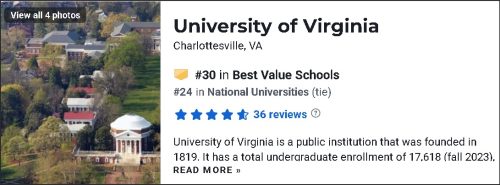
There are numerous rankings of U.S. colleges and universities, each one generating results based upon a proprietary methodology. Wahoos4UVA doesn’t tell us which ranking it is citing here. Presumably, it is referring to the U.S. News & World-Report 2025 annual Best Colleges ranking, which pegs UVA 4th (not 3rd) among public schools, 24th among “national universities, and 30th in “best value schools.” UCLA, Berkeley and the University of Michigan hold the top spots for public universities.
The U.S. News No. 4 ranking for public universities is down from the No. 2 spot in 2017, the year before Ryan became president. Among all institutions, the University ranked 24th that year, as reported at the time by UVA Today.
By way of comparison, the Princeton Review ranks UVA 30th in 2025. The Wall Street Journal rates UVA 33rd — behind No. 19 Virginia Tech!!!! And Forbes’s America’s Top Colleges survey ranks UVA 34th nationally.
Clearly, Wahoos4UVA cherry picked the survey and category that casts UVA in the most positive light. UVA has been a top-ranked public university for decades. Since Ryan took over the presidency, the University has been treading water, maintaining the same national ranking and falling two slots among public institutions during his tenure.
Is that a disaster? Not necessarily. The Jefferson Council has never pointed to college rankings, which give insufficient weight to the factors that we find important, as a measure for judging President Ryan. But let no one delude himself that UVA’s public-college ranking by U.S. News represents any great achievement on his part.
Assertion: Since 2018, undergraduate applications are up 60% — including a 75% increase in applications from first-generation students in the past four years.
Of all Wahoos4UVA claims about UVA, this may be the silliest. The fact is, due to the introduction of the online Common App, which made it cheaper and easier for everyone to apply to college, applications have soared nationally.
Numerade, an online learning platform, has crunched the application numbers compiled by the National Center for Educational Statistics. Nationally, the company says, applications increased steadily year over year between 2015 and 2019, dipped slightly due to the COVID pandemic in 2020, and rebounded sharply in 2021-22.
UVA’s 60% increase was nothing to brag about. The growth fell far short of what it took to rank among the top 50 colleges in application growth highlighted by Numerade. No. 50 was Bethune-Cookman University in Daytona Beach, Fla., which saw applications soar by 81% since 2019.
Clemson University, a member of the Atlantic Coast Conference like UVA, experienced 81.7% growth. The California Institute of Technology, also an elite public university, saw 98.7% growth. Applications at Regent University, a private university based in Virginia Beach, rocketed 198.2% over the same period.
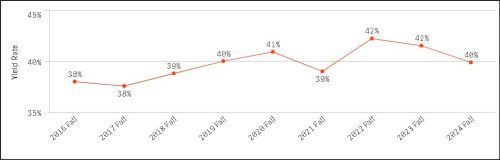
For the purpose of judging how UVA is perceived in the higher-ed marketplace, the metric to pay attention to is “yield” — the percentage of students who, once accepted to UVA, choose to enroll.
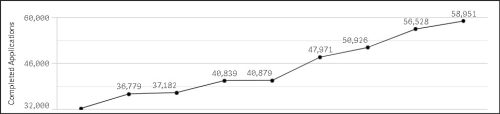
This chart, based on data published by UVA’s Institutional Research & Analytics office, shows the increase in applications since 2016:
This shows the yield:
It’s possible to dig deeper, but to do that one must consult statistics published by the State Council of Higher Education for Virginia (SCHEV), which breaks down yield for in-state and out-of-state students. That data looks like this:
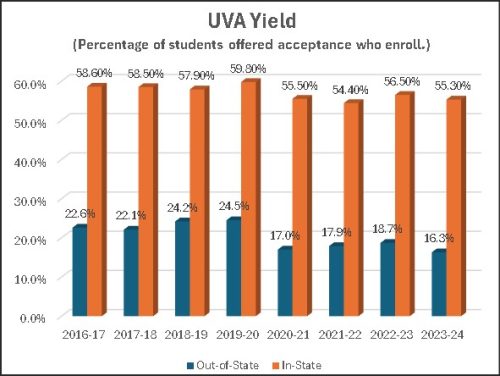
It turns out that the story is very different for in-state and out-of-state students. The yield for in-state students, among whom UVA has a reputation as Virginia’s flagship university and for whom the state subsidizes tuition, is much higher and has fallen only modestly. The yield for out-of-state students, where UVA competes nationally on both reputation and price, has fallen sharply during Ryan’s tenure.
One can debate my interpretation of these trends. I’m open to discussion. But reasonable people can agree that it’s important to dig beneath the surface data in order to get at the complexities. There is no sign that Wahoos4UVA, which accuses us of “lies” and “distortions,” has a clue of what those complexities are.
Assertion: This year, 10,000 first-generation students applied to UVA.
As far as I know, this number is accurate. But it begs many questions, all of which elude Wahoos4UVA.
UVA is Virginia’s flagship university. It is part of a state public higher-ed system that encompasses nationally recognized institutions such as Virginia Tech and the College of William & Mary, three large “state U” institutions in Virginia’s major urban areas, HBCUs, and other smaller institutions appealing to regional markets, and is designed to work as a system, not a grab-bag of individual universities pursuing whatever goals they wish. UVA’s policy of prioritizing first-gen recruitment puts it in direct competition with Virginia institutions that lack UVA’s prestige but have long geared their academic standards and campus cultures to the academic and social needs of first-gens.
People of good will can debate whether UVA’s first-gen emphasis is appropriate. But Wahoos4UVA citation of 10,000 first-gen applicants as a bragging point shows no awareness that an issue even exists.
As a flagship university, UVA sets higher academic standards than most other universities. (With grade inflation rampant at UVA, Tech and W&M might beg to differ.) Dipping deeper into the applicant pool to admit more first-gens runs the risk of enrolling some students who lack the preparation to thrive academically. Overall, UVA does have the lowest dropout rate of any public university in the country — a well-deserved bragging point that goes back decades. But what is the dropout rate for first-gen students? Do first-gens gravitate to the easiest, least cognitively demanding majors? Do they feel like they “belong”? Do they experience a higher incidence of stress, anxiety and depression? How many transfer out?
These are questions the Ryan administration has shown no interest in asking, much less answering. Needless to say, the same can be said of Wahoos4UVA.
Is the Jefferson Council guilty of “public disrespect” of UVA by raising these issues? I’d suggest the very opposite. By offering independent analysis, we make a valuable contribution to the discussion of governance issues at UVA, which is the highest form of respect. By painting our analysis as lies and distortions, Wahoos4UVA are the ones who show no respect, either to us or to the institution they purport to love.
There are many more Wahoos@UVA factoids to discuss, but I’ve gone on long enough. I’ll address their fusillade of mis-aimed bullet points in future posts.
James A. Bacon serves on the executive committee of the Jefferson Council.
Leave a Reply
You must be logged in to post a comment.