
(And by “All,” We Mean Cats, Dogs, Spotted Owls, Snail Darters….)
by James A. Bacon
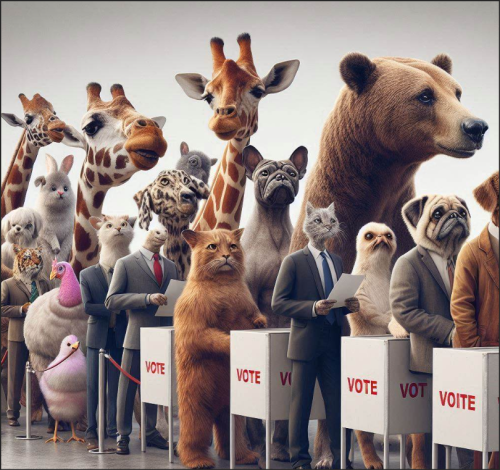
There exists on the fringe of the environmental movement a proposition so crazy that some who first hear of it will think it a spoof: Nature has rights that should be granted legal standing in laws and representation in systems of government.
But the Rights of Nature (RoN) philosophy is not a Babylon Bee parody. It is making inroads in the real world. The high court of the Indian state of Uttarakhand, for instance, has recognized the Ganges and Yamuna rivers as legal entities with rights. Colombia courts have done much the same for the Atrato River and Mexico’s with the Rio Atoyac and Rio Papaloapan rivers. New Zealand has granted legal personhood to the Whanganui River, which the Maori revere as a living ancestor. Ecuador’s constitution grants nature the right to exist, persist, maintain and regenerate its vital cycles, while Bolivia has passed the Law of the Rights of Mother Earth. In Australia, a 12-person council has been established to advocate on behalf of the Yarra River. And in the United States, according to the Matador Network, “dozens” of communities across the United States have codified rights-of-nature laws.
Endowing rivers, animals, plants, and ecosystems with legal and constitutional rights might sound deranged, but Noah M. Sachs takes the Rights of Nature ideology very seriously. Indeed, the University of Richmond law professor has published an essay in the Georgetown Environmental Law Review to critique the movement.
Sachs is a political progressive. He believes climate change is a threat to humans and nature alike. A supporter of social justice movements, he celebrated when the Confederate statues fell in Richmond; he even composed a folk song in honor of slave rebel Gabriel Prosser. But he regards the Rights of Nature as profoundly anti-democratic. The philosophical principles are vague, self-contradictory and hideously impractical to implement, he asserts. If somehow “Nature” could be given rights and representation, the legal mechanisms could be easily co-opted by groups speaking in Nature’s name to advance their own self-serving aims.
Full disclosure: Noah is a friend of mine. I like to think of him as a “sane” environmentalist: one with whom I can have a rational conversation. He’s far more distressed by climate change than I am, and we’ve had some entertaining discussions on the topic. But when he writes about, say, the dangers posed by inadequate storage of toxic chemicals in Virginia, he raises issues that warrant serious consideration.
The Rights of Nature movement, he writes in the law-review essay, goes too far. “Widespread recognition of rights for all living beings would shift immense power to courts and would straitjacket representative institutions, making them less responsive and less effective for solving social and environmental problems.”
Rights of Nature philosophes argue that liberal democracies are doing a terrible job of protecting the environment. Existing institutions cater to human interests and protect private property. Nature has no voice within democracies, which are based on “one-species representation.” These critiques, notes Sachs, are typically accompanied by anti-capitalist views and calls to rein in corporations or abolish private property.
Rights of Nature theorists propose a radical overhaul of human institutions to take into account the interests of other species… or ecosystems…. depending on the situation. It’s all a bit amorphous, Sachs notes. “Most RoN legislation expresses nature’s rights in vague terms, such as a ‘right to exist’ or ‘flourish.’” Some commentators advocate giving rights to individual organisms. Others wish to bequeath rights to entire lakes, rivers, forests, and other ecosystems.
“Each component of nature, potentially down to microscopic beings, would gain a right of refusal, positioned to reject (through lawsuits) laws and democratic initiatives that are deemed harmful to nature,” writes Sachs.
However, there is no consensus about how stringent this right of refusal would be. Are the Rights of Nature inviolate, or would the new world order allow for tradeoffs between humans and nature? If humans proposed to build a road deep into a forest, for instance, whose rights would prevail? Those of the species living in the forest, or the species for whom habitat would be opened up? In such a regime, how much weight would be given to nature’s interests and how much to humans’?
Some in the RoN movement reject the privileging of human rights at all, Sachs notes, quoting one activist as saying, “As evolutionary companions, we all have a right to exist, thrive and evolve.”
When it comes to conferring rights upon aggregates of living and non-living things such as lakes, rivers and lagoons, Sachs asks, how are the ecosystems to be delineated? Where does one begin and the other end? Which ecosystem should prevail over the other? What happens to an ecosystem in transition? Should humans act to maintain the particular cluster of animals and plants in stasis so they can “flourish,” or should the ecosystem be allowed to evolve so a different set of organisms can supplant them?
That’s just the beginning of the conceptual incoherencies that Sachs details.
“Remarkably, RoN proponents have not addressed how many living organisms (or non-living things) would participate in the new governance structures they seek to build. The numbers are staggering,” Sachs writes. There are between eight million species and, if microbes are included, one trillion species on Earth. “RoN proponents never discuss these numbers as an administrative hurdle.”
How, then, do RoN advocates envision nature being protected? The nostrums are vague and conflicting. Some see a judicially driven approach, others a legislative approach, and others a mix of the two. Whatever the remedy, it would be unwieldly to the point of paralysis.
“Every legislative act has some impact on the physical world,” Sachs argues, “so the straitjacketing of legislatures under this system would be comprehensive, affecting every aspect of political and social life. … Legislatures could barely act under such a system.”
There are two irreducible problems with the Rights of Nature approach. First, the interests of animals, plants and microorganisms are not all the same. The lion’s interest is in being able to feast upon the antelope; the antelope’s interest is not becoming the lion’s dinner. Some forest species might have an interest in maintaining a stable, ecological climax; other species would benefit from allowing the forest to burn down so the land can be repopulated with pioneer species.
Sachs makes the point succinctly: “Living beings compete in Darwinian struggle, so the interests of living organisms, including their interest in having a “right to exist,” will frequently — perhaps always — conflict.”
The second irreducible problem is that animals, plants and microorganisms are incapable of articulating their legal and political interests (even if they could agree). Decision-makers must be authorized to sort out the competing demands of millions of organisms and balancing them with humans’ rights. By necessity, only humans can act as decision-makers — and they will be subject to all the frailties of human nature. The foreseeable outcome under a RoN regime is that humans will develop rationales and philosophies that purport to align nature’s interests with their own.
Some RoN theorists suggest endowing the judiciary with powers to sort out the inevitably tangled issues. But what grounds are there to think that judges will do any better than legislatures? The same temptations to conflate nature’s self-interests with one’s own preferences still would exist.
“Legally trained elites would steer the RoN governance project, with courts and lawyers at the center of societal transformation,” Sachs writes. “Unable to identify accurately which organisms are affected by a democratic initiative or what these organisms’ conflicting interests require, judges would be well-positioned to manipulate outcomes simply by changing the scale of nature they examine. This indeterminacy poses a grave and obvious potential for authoritarianism and judicial power grabs.”
Here, I would add one thought to Sachs’ critique. Who would select the judges? Who would oversee them to ensure they were doing their jobs properly? Obviously, the RoN theorists see the judges as people like themselves being appointed by people like themselves. In their fantasies, perhaps they see themselves in charge.
RoN theory is not only anti-democratic, as Sachs suggests, but I would argue that it is inescapably authoritarian, if not outright totalitarian. In a world in which human activity, nature, and climate are inextricably entwined, anyone could argue that any human activity has repercussions on the natural world. What principle of logic would stop RoN judges from proclaiming everything from gas stoves to internal-combustion engines, from air-conditioning to urban sprawl, to be an assault on nature and justification for any kind of sweeping institutional change that the judge would like to see?
Sachs agrees with RoN enthusiasts that democratic societies have not done enough to protect the environment. “I share the concern and alarm … regarding our impacts on the natural world,” he writes. “Humans are overwhelming ecosystems, deforesting land, draining aquifers, crashing fish populations, and causing a mass extinction of species.”
But Sachs also believes in liberalism. “One of the hallmarks of liberalism is the acceptance of pluralism, with individuals and interest groups pursuing their aims within a procedural framework,” he concludes. “Liberalism does not dictate a single ‘correct” lifestyle or viewpoint.” Representative democracies may have their limitations, but the battle for human rights has been won over centuries of struggle and should not be casually abandoned.
“We have choices,” Sachs writes. “We can recognize the seriousness of the environmental crisis and respond to it through law, policy and grassroots action. We can imagine a different human relationship to the natural world without establishing a set of vague, enforceable rights for all living beings.”
Leave a Reply
You must be logged in to post a comment.