
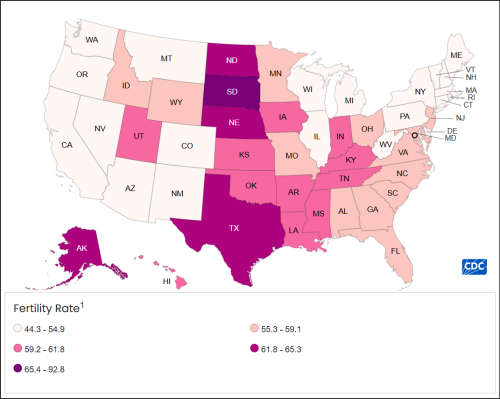
Following up on yesterday’s post showing the variation in birth rates by Virginia locality… the National Center for Health Statistics map above provides a breakdown of fertility rates by state. Virginia falls in the middle of the pack (but bottom half) with a fertility rate for women aged 15–44 with 55.3 births per 1,000. It ranks 29th in the country. Meh.
University of Virginia sociologist Brad Wilcox (a rare conservative at UVA) puts his spin on the data in this article published by the Institute for Family Studies (a rare conservative nonprofit headquartered in Charlottesville).
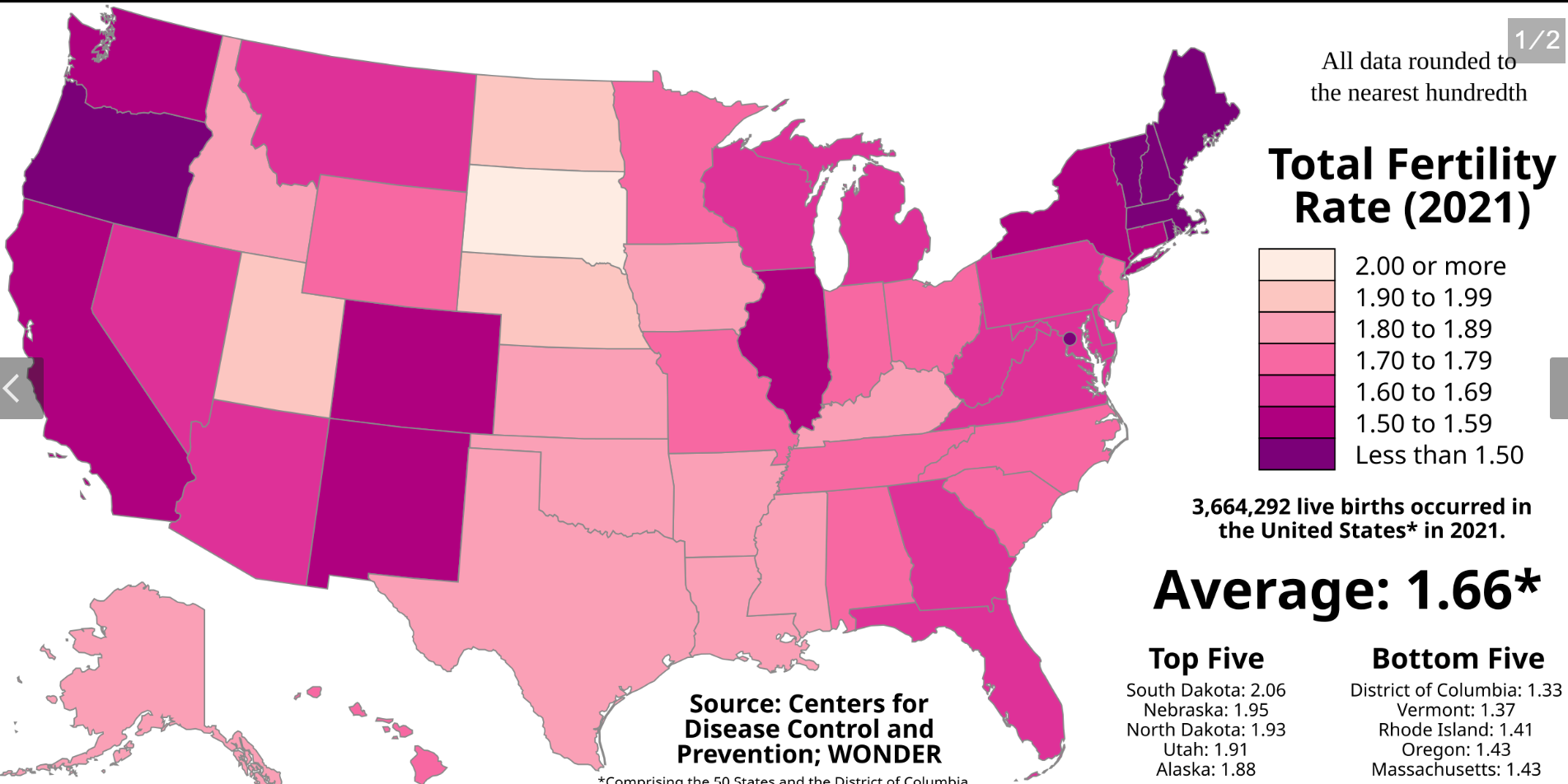
The 10 states with the highest birth rates are red while the 10 states with the lowest birth rates are blue. The birth rate for deep-red South Dakota is 2.01 births per woman. The birth rate for deep-blue Vermont is 1.3.
Wilcox argues that left-of-center policies to encourage fertility — government incentives and subsidies — don’t work very well. Families with children are moving out of blue states into red states. What matters more, he suggests, are job opportunities, cost of living (especially housing) and family-friendly culture.
“Culturally, red states are more likely to prioritize marriage and family life, offer parents more educational choices and show a greater commitment to law and order, which are plusses to many family minded Americans,” Wilcox theorizes.
But the differences in culture actually go deeper.
Writes Wilcox:
The “new” commitments to education and career and expressive individualism —what we call the “Midas Mindset” found in many young men and women today — are more likely to dominate blue states. This mindset encourages young adults to delay or forego forming families and pushes blue states in the direction of the “no family” model. By contrast, many red states, especially ones where religious faith is strong (like Utah), prioritize the value of getting married and focusing on your family rather than putting most of your eggs in the baskets of work and self. Evidence suggests that religious fathers and husbands — more likely to be found in red states — prioritize marriage and family life, including housework, in ways that make family life more appealing to the women in their lives.
In regional sub-cultures that treat family and children as a natural and integral part of life, families are likely to have more children. In regional sub-cultures where children are seen as impediments to career and personal development and more akin to luxury goods, families will have fewer children and have them later in life.
— JAB


Leave a Reply
You must be logged in to post a comment.