
Two Democratic Governors Join Federal School Choice Tax Credit Program While Virginia’s State Program Faces Sunset
by Todd Truitt
Two Democratic governors have now chosen to participate in a new federal school choice tax-credit scholarship program. New York Governor Kathy Hochul announced this week that her state will opt in, following Colorado Governor Jared Polis. In addition, North Carolina Governor Josh Stein said he plans to opt-in once the federal government issues regulations on the program later this year. While only two Democratic governors have said they will not participate, most of the rest are undecided.
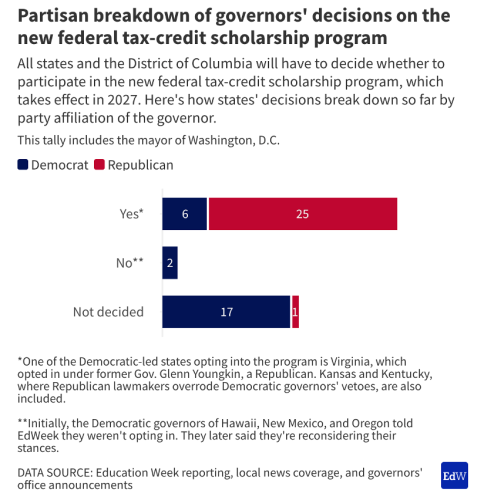
Former Governor Glenn Youngkin opted the Commonwealth into the program in January 2026 before leaving office. As the program’s 2027 launch date approaches, many are watching Governor Abigail Spanberger to see whether she will maintain participation.
The federal program, part of the One Big Beautiful Bill Act passed last year, allows individual taxpayers to claim a dollar-for-dollar nonrefundable federal tax credit of up to $1,700 for donations to qualified nonprofit scholarship-granting organizations (SGOs). These organizations can then provide scholarships for private school tuition, tutoring, educational materials, or other approved K-12 expenses. Participation requires no state funding, but states must actively opt in for residents to access the benefits.
As part of her K-12 agenda, Gov. Spanberger, a former congresswoman and parent of three children in Virginia public schools, has emphasized strengthening public education funding, upholding academic excellence and rigor, and preparing students with advanced academic programs and career-ready skills, among other things. Her K-12 campaign platform, though, rejected diverting public education dollars to private school vouchers.
Virginia’s situation is distinctive. The new federal program will start around the same time a Virginia state private school choice credit sunsets—Virginia’s Education Improvement Scholarships Tax Credits (EISTC) program. Established in 2012, the EISTC offers donors a 65% state tax credit for contributions to approved scholarship foundations, which provide aid primarily to lower-income students or those with special needs attending private schools or certain pre-K programs.
The state program has operated with an annual cap of $25 million. During the 2023-24 school year, 5,820 students received scholarships as part of the program with an average account value of $2,141. Lawmakers have unsuccessfully attempted several times in the past five years to remove its sunset clause. Without legislative action, the state program will end after 2027.
At the federal level, Senator Mark Kelly (D-AZ) has introduced legislation to repeal the new federal tax-credit scholarship program. The bill has more than 30 Democratic cosponsors, including Virginia Senator Tim Kaine. Senator Mark Warner has not joined as a cosponsor.
Gov. Spanberger’s forthcoming decision on this issue raises tricky political issues. When Gov. Youngkin opted the Commonwealth in, the Virginia Education Association (VEA) strongly criticized the move and encouraged Spanberger to evaluate the program carefully once federal rules are finalized. The VEA had previously urged the General Assembly to pass legislative prohibiting a Virginia’s governor from opting in.
Some have drawn parallels to the political situation that Virginia Republicans endured during their prolonged resistance to the Affordable Care Act’s Medicaid expansion, a stance that became a rallying issue for Democrats in multiple election cycles—prompting questions about whether Gov. Spanberger and Virginia Democrats might now face their own political risks if they choose to opt out of this no-cost federal education tax-credit scholarship program.
Opting in does not mean a governor is supporting private school choice. As Michigan State University Professor (and prominent private school choice opponent) Josh Cowen stated:
Governor Spanberger’s upcoming decision on continued participation in the federal initiative could shape not only educational options for Virginia families, but also her future political options after her governorship.
Leave a Reply
You must be logged in to post a comment.