
by David J. Toscano
If a car runs a red light and is about to hit you, you don’t just complain that the driver violated the rules–you do something! When Texas and other Republican legislatures across the country, at Donald Trump’s request, enacted unprecedented mid-decade redistrictings designed to ensure GOP control of the U.S. House after this year’s midterm elections, a response was necessary. Virginia voters now have the chance to be part of that response.
The vote on Virginia’s redistricting constitutional amendment in the next month could influence who controls Congress and whether the Trump administration faces any meaningful accountability in the next several years. A “YES” vote on April 21 improves those odds.
Virginia’s redistricting commission
After years of effort, Virginia voters in 2020 overwhelmingly approved a constitutional amendment designed to end partisan redistricting in the Commonwealth. The amendment created a redistricting commission to draw state and Congressional electoral districts, becoming fifteenth state to do so. If the commission could not agree, the state Supreme Court would determine the districts.
In its inaugural effort in 2021, the commission deadlocked, and the state Supreme Court, as required by the amendment, intervened to draw lines. Even so, the court’s maps won praise as fair, if not politically impartial. Supporters of nonpartisan redistricting hoped Virginia’s example would inspire similar reforms elsewhere. Instead, key Republican-controlled states took Trump’s direction to create new districts for partisan advantage.
Less than six months into his second term, Trump urged the Texas legislature to redraw its congressional districts — an extraordinary move with almost no precedent in modern American politics. His goal: to gain five additional Republican seats heading into the 2026 midterms. Few Republican leaders objected to changing the rules for Trump. Missouri, North Carolina, and Utah then began their own plans to increase Republican Congressional districts in their states, and Florida will soon call a special session to do the same.
The courts have done nothing to stop this power grab. In fact, the U.S. Supreme Court has been removing obstacles to hyper-partisan gerrymanders for more than a decade. In Shelby County v. Holder (2013), SCOTUS eliminated the previous requirements of the Voting Rights Act that required southern states to submit redistricting plans to DOJ for “pre-clearance” before they took effect. And their decision in Rucho v. Common Cause (2019) barred challenges to partisan gerrymandering from being heard in federal courts. Not surprisingly, when Texas’s new maps came before the Court — despite evidence that race was improperly factored into their design — they were allowed to stand.
If this “Trump-packing” of Congressional districts was to be countered, then, it would come from states where Democrats controlled the legislature. That is why California voters got the chance to approve a constitutional amendment to allow mid-cycle redistricting if Texas proceeds—and why Virginia voters are now voting on a similar change.
An administration without a check
With Congress firmly in Republican control, Trump has had free rein to exercise executive power on a scale not seen in decades, issuing order after order to bend government and our institutions to his will. Lawyers have been silenced, universities strong-armed, and ICE agents unleashed on Democratic cities. FBI agents and military top brass have been purged, and criminal investigations have been opened against Trump’s political opponents. Trump’s DHS seized voter files in Fulton County, Georgia and threatened similar action in Arizona. Respect for the rule of law has been undermined by pardons of 1,500 convicted or charged in January 6 attacks on our Capitol, including people who violently assaulted the police.
Throughout it all, Trump has evaded accountability. Some federal courts have pushed back against the administration’s most aggressive actions. But the Supreme Court—apart from its tariffs ruling—appears firmly in Trump’s camp.
Congress has largely abdicated its constitutional responsibility to check the excesses of the executive. It did not challenge the tariffs, the immigration raids, or the attacks on voting rights. The President’s personal financial enrichment during his presidency — now estimated to exceed $4 billion — has drawn no serious legislative scrutiny. Congress shows little interest in questioning Trump’s war of choice in Iran. And even when our representatives have attempted limited oversight—such as over the Epstein files—the Justice Department has stepped in to obscure key facts.
This failure to check and balance the administration will continue unless Democrats win the House this November.
Trump understands this perfectly, explaining to his Republican colleagues how his gerrymandering strategy “will guarantee the midterms; If you don’t get it, big trouble, my opinion.”
If Democrats win the House, Trump’s legislative agenda will likely stall—and his administration will finally face real congressional oversight.
Virginia’s plan is unlike Texas — or Missouri, Florida, or North Carolina
The mid-cycle gerrymanders proposed in Texas, Missouri, Florida, and North Carolina are being enacted solely by state legislatures. Virginia’s approach is fundamentally different. Like California, which also has a redistricting commission, Virginia’s new maps require a much higher standard for enactment—a Constitutional amendment approved by a vote of the people. Californians overwhelming embraced their change on November 4, 2025. Virginia is voting right now; polls are open through April 21.
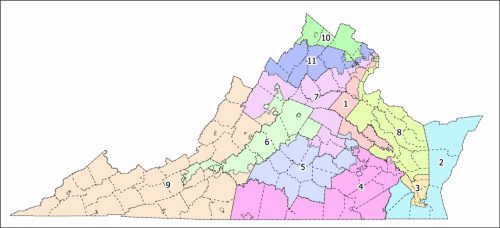
Virginia’s proposed redistricting amendment is narrow in scope. It permits the legislature to draw new lines mid-cycle only if other states do so. Like California’s new law, it does not eliminate our redistricting commission. Instead, the amendment only gives the General Assembly power to draw lines “until October 31, 2030.” “The Virginia Redistricting Commission would reassume the responsibility of drawing the congressional districts in 2031.” Just as importantly, voters will see the proposed map before casting their ballots. The people—not politicians alone—will make the final decision. For Charlottesville and Albemarle, the proposed map will give us a chance to elect a Democrat for the first time in almost two decades.
Under normal circumstances, a case could be made for preserving Virginia’s redistricting system exactly as designed. But these are not normal circumstances. Trump and his allies have already rewritten the rules.
Misleading the public

Several of my former colleagues in both parties oppose the amendment, arguing that it sets a troubling precedent and that the proposed map does not reflect the statewide partisan vote. Those are legitimate concerns.
Unfortunately, some within the opposition have also produced a stream of misleading—and at times racially insensitive—advertising. One ad falsely claims that Governor Abigail Spanberger opposes the amendment. She does not. Another mailer, apparently aimed at Black voters, warns that the new districts would disenfranchise them—an odd charge against a proposal that will itself be decided by voters statewide. Given the high stakes, President Obama has produced ads in support of the amendment.
Don’t guess — vote yes
Elections never occur in a vacuum, and the vote on Virginia’s constitutional amendment is no different. If Virginia’s amendment had been proposed a decade ago—before today’s wave of hyper-partisan GOP redistricting—the case for voting “no” would be stronger. But the political landscape has changed. Trump and his allies have already moved the goalposts.
Supporters of checks and balances cannot ignore that reality.
Voting “yes” on April 21 may not be perfect. But allowing one party to manipulate congressional maps across multiple states without a response would be worse. Approving the amendment is a pragmatic step toward restoring accountability to a federal government that urgently needs it.
P.S. Encouragement for your day
Over the past 14 months, Democrats have flipped 28 Republican-held state legislative seats across the country — including in Texas, Arkansas, and Mississippi — often by margins that make Republican leaders uneasy that they could lose control of the House, and maybe the Senate, in the midterms.
Not only that, but Democrats are participating at higher levels in primaries than in years past. In Texas, Democrats not only outnumbered Republicans in the recent Senate primary election, but the party’s primary had the highest number of people voting in it than in any other primary for statewide office in Texas history.
In Mississippi, Democratic vote in the Senate primaries almost equaled the Republican participation; the last time Mississippians voted in a Senate primary in a non-presidential year (2018), Republicans nearly doubled Democratic turnout.
David J. Toscano, a former Virginia House Minority Leader, publishes the Fights of Our Lives blog on Substack. This column is republished with his permission.
Leave a Reply
You must be logged in to post a comment.