

by Scott Dreyer
In a closely watched race nationwide, the “yes” side eked out a narrow win in Virginia over “no,” as of 9:30 p.m. last night by a 51.3% to 48.6% margin.
Polls closed at 7:00, and at one point early in the evening, as many smaller localities had posted their results, the No side was ahead by about 50,000 votes. By 8:20, however, the lead was narrowing, with the No lead only 50.22 (1,070,065) versus the Yes 49.78% (1,060,718).
By 8:27, as Gargantuan Fairfax County began to drop its numbers, Yes pulled ahead to 50.06% to No at 49.94%, and the trend line was established.
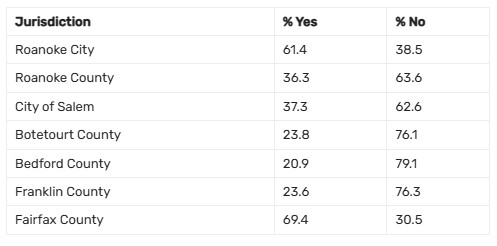
By contrast, even though Fairfax is only one of 133 counties in Virginia, it has nearly 1.2 million people, or about 13% of the state’s total. That is about twelve times the population of Roanoke City, which is the biggest urban area in the western half of the state.
In reality, for the Yes proponents, the election was not even supposed to be close, based on the facts that it was conducted on a rushed schedule, in the early spring when no one ever expects elections, had a misleadingly-worded ballot, and the funding–over 90% of which was from out-of-state–was so lopsided in favor of the Yes side.
Caught off guard, the No side got off to a slow, piecemeal start, struggling to find a coherent message, raise money, and get organized.
For example, last winter, the Yes side was already tweeting on X about their training sessions, and “vote yes for fairness” ads were ubiquitous, before the first No signs ever appeared on roadsides.
From the start, the Yes side framed their message as “Vote Yes For Fairness,” designed to imply that any No vote, or any disagreement at all, was by definition unfair.
From a merely linguistic point of view, that was brilliant marketing and hard to overcome.
For No to win, Rural and small-town Virginia needed to come out in huge numbers to offset the urban crescent, which had a mediocre early voting performance. However, on Election Day, traditional Democrat bastions turned out enough numbers to swamp rural areas downstate. Rural performance, though strong, was not strong enough.
Though Yes scored a clear win, its 3% margin can hardly be construed as a mandate.
“Rich Men North of Richmond” was a 2023 hit whose lyrics captured the frustration of those who try to be honest and work hard, but can never get ahead in a rigged system controlled by the wealthy and powerful.
One stanza goes:
Livin’ in the new world with an old soul
These rich men north of Richmond
Lord, knows they all just wanna have total control
Wanna know what you think, wanna know what you do
And they don’t think you know but I know that you do
‘Cause your dollar ain’t [expletive] and it’s taxed to no end
‘Cause of rich men north of Richmond.
With the results from the April 21 referendum to severely gerrymander the state’s 11 Congressional districts, however, some may argue “Rich Men North of Richmond” is now the unofficial State Song.
Among the top 30 richest counties in the US, three are in Northern Virginia, and delivered blue margins on April 21, as they now always do. According to Forbes, #1 is Loudoun, #3 is Fairfax, and #24 is Prince William, and this doesn’t include individual wealthy enclaves like Falls Church, Arlington, and Alexandria. Since the dawn of time, money and power have gone together, and that was on display again on April 21.
Since the new maps are designed to concentrate even more power in Northern Virginia and Richmond, it’s understandable that most residents would find that desirable.
Fairfax stands to regain its “Lord Fairfax” status, since the Yes vote includes splitting that one county among five congressional districts, in a pinwheel fashion, thus designed to overwhelm the votes coming from the geographically larger but less populous parts of each district. Specifically, the five districts that are anchored in Fairfax will extend hundreds of miles across the state, to envelope areas as far apart as the Shenandoah Valley, Goochland west of Richmond, and Williamsburg.
As former Attorney General Jason Miyares shared at a “vote No” rally at Montano’s in Roanoke on March 17, the new maps will probably allow five Congressmen to live within about twelve miles of each other, in Fairfax County.
Many state leaders shared their thoughts on the election’s outcome.
Richmond area State Senator Sturtevant posted to X: “Virginians fought hard today. Rural Virginia maxed out its voting power. They did what they were called on to do. But Northern Virginia shifted even further to the left to silence those rural voters. Now we move from the ballot box to the “jury box.” Will the Virginia Supreme Court protect the rights of millions of Virginians from being trampled like this? We all have our doubts, but keep hope and keep fighting.“
Governor Abigail Spanberger, despite promising during the 2025 campaign that she would not seek gerrymandering in Virginia, tweeted, “Virginia voters have spoken, and tonight they pushed back against a President who claims he is ‘entitled’ to more Republican seats in Congress.
“As we watched other states go along with those demands without voter input, Virginians refused to let that stand. We responded the right way: at the ballot box.“
Former Governor Glenn Youngkin tweeted: “Thank you to all the voters who turned out to vote against this egregious power grab. The race was much closer than the left expected because Virginians know a 10-1 map is not Virginia. I urge the Virginia Supreme Court to rule against this unconstitutional process that will disenfranchise millions of Virginians.“
Many expect that the litigation that began before the election will continue. The Yes side broke several state laws to push the vote.
For one, in order to give Virginians enough time to read and understand proposed amendments to the State Constitution, 90 days must pass between the General Assembly approving the language and it going to the voters. Since that first step didn’t happen till January 2026, voting should not have started until at least April 16. However, early voting started on March 6.
Two, State law 30-19.10 requires amendment proposals to use a “neutral explanation.“
Three, the Code of Virginia also requires redistricting to keep “communities of interest” as intact as possible.
The Shenandoah Valley, which is clearly a community of interest and is now in only Congressional District (CD) 6, is set to be split among four districts. Rural Augusta County is to be divided among three. Since the new CD 6 is heavily gerrymandered to create a Democrat-favored seat, Glenvar, Christiansburg, Vinton, and the counties of Roanoke, Bedford, Montgomery, Botetourt and others are to be split into different districts.
Former Attorney General Ken Cuccinelli tells more about the legal challenges here.
Carl Cannon, Washington editor for Real Clear Politics, claims in a podcast that the April 21 results will go to the US Supreme Court. He calls the ballot wording “Orwellian language, intended to deceive voters.” He explains that “restore fairness” may mean to Democrats, fairness on a national scale, where Virginia is the antidote to Texas, so “restore fairness” makes sense as a talking point when talking about a national scale.
Cannon continues: “But language like that in a Constitutional amendment, in a referendum, when you’re going there reading it, it’s intended to deceive voters. My guess is the court will look at this very closely, did voters really know what they were getting, because it is not intended in Virginia to restore fairness at all, it’s intended to abrogate fairness, it’s intended to be unfair.“
Roanoke resident Scott Dreyer leads a team of educators teaching English and ESL to a global audience. This article is republished with permission from The Roanoke Star.
Leave a Reply
You must be logged in to post a comment.