
By Steve Haner
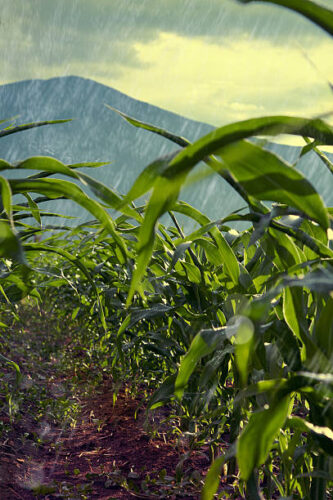
Virginia’s most prolific climate alarmist is back at the keyboard trying to scare people with normal weather. Despite his working now for a dedicated climate propaganda outlet, our friends at the Virginia Public Access Project are treating his output like straight reporting and included his most recent effort in their “news” feed for the capital crowd.
“A Combination of Heat and Drought Walloped Virginia Vegetable Farmers,” reads the headline from Inside Climate News, which is certainly as opinionated on the issue of so-called climate change as the various outlets that challenge the narrative, including Bacon’s Rebellion. Our posts offering contrary data to undercut this Gospel will never get shared by VPAP’s news service. I am reconciled to the bias but every now and then it still riles.
Author Sean Sublette, who is professionally trained as a meteorologist, was producing his “end is nigh” messaging for the Richmond Times-Dispatch and I don’t know why he no longer is. Now it relies mostly on wire copy, and outlets like the Associated Press are as heavily infected with a single point of view as Inside Climate News. So are most local “newspapers.”
The fact that Virginia rainfall for the year is running well ahead of the historical average, and even was for the months of May, July and August, fails to get noted in Sublette’s report. But June was extremely dry (making up for the wet spring) and by July parts of the state were showing up as in drought. By August those concerns were erased by rain in most of the localities, a recovery which he does report.
But he bases his scary headline on a handful of farmers in the small region hit the hardest. He quotes one farmer saying, “What feels different is that it is every year: that overall temperatures are higher and that rain events are fewer and stronger.” When the alarmists are focusing on “what feels different,” that is a dead giveaway the data is not backing the narrative.
No question some harvests suffered a bit. Later this year full production data will be worth a look. Just about any given summer will have some region of Virginia with a rainfall deficit for a period of time. The 1930s in the U.S. are called the Dust Bowl years due to prolonged (not one month) droughts. This is weather, not “climate,” which Sublette knows very well. It has nothing to do with “climate change.” To use the media’s new favorite dismissive word, the claim is baseless.
Let’s tell some truth about the summer of 2024 that you won’t find anywhere else, even though the data is readily available from a National Oceanographic and Atmospheric Administration website that is actually quite fun to use.
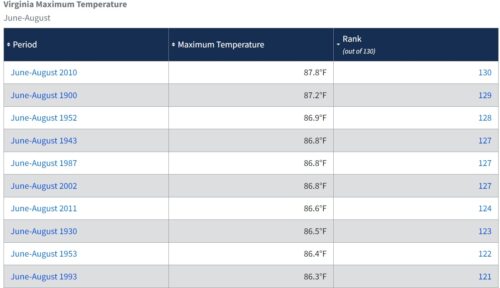
Despite world-wide media hype about 2024 being the “hottest summer evah!”, the data shows Virginia was indeed warmer than average, but well short of record warmth and fully within historical norms. This summer almost made it into the top ten for average maximum daily temperature for the June through August period (see above), but 2010 still holds as the warmest and as you can see above the top ten includes six readings from the 20th Century and one from the 19th Century (1900).
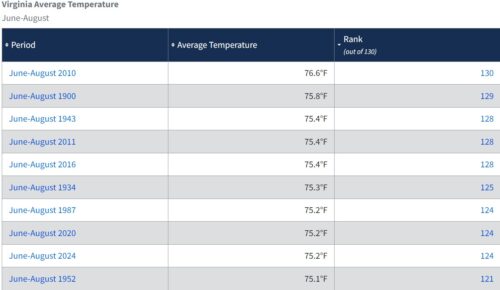
Virginia did make the top ten for warmest daily average minimum temperatures, tied with three other years for ninth place. In this case, more of the readings were 21st Century. Virginia’s average minimum was 75.2 degrees F and three more years were at 75.1, including 1952. The whole shebang hangs on those tiny, imperceptible differences of a tenth or two of a degree.
To the extent there is a warming trend overall, much of that is due to warmer overnight temperatures. Whether that is due to atmospheric gases or increased buildings, pavements and heat sources near the thermometers is an ongoing debate. Temperature compilations that avoid urban areas (and NOAA has such a measure) show little to no warming trend. If atmospheric CO2 is the control knob, there should be no urban-rural disparity.
So, if you look at summers 1895-2024, use the average temperature, and if you make the intellectual leap needed to assume all those years were measured to the same granularity and can be compared, Virginia’s summer of 2024 ranked number seven out of 130. It takes a leap of faith because NOAA had been accused of fudging data in the middle part of the 20th Century to make those years appear cooler and the current warming trend seem more significant.
But 20th Century Virginia had its hot summers whether you use raw or adjusted data. I reproduce that chart below, so you can see it still includes 1900, 1934, 1943 and 1987 as warmer than this summer. The CO2 levels cannot explain how they got there so that must be (dare one say it) just weather.
Sources such as Inside Climate and the skeptical Watts Up With That can both be fairly accused of pushing a narrative and of taking funding from people with a financial stake in the argument. I’ve had Virginia-focused posts reproduced on Watt Up With That but have no illusions that VPAP sees or would ever share them. There is no interest in today’s “news” establishment with challenging the Revealed Wisdom or even pretending any balance.
Leave a Reply
You must be logged in to post a comment.