
by James A. Bacon
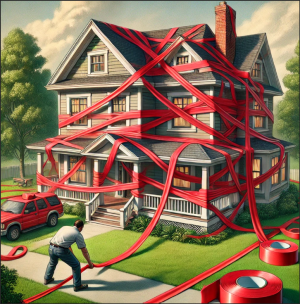
I’m beginning to think that Senator Schuyler VanValkenburg, D-Henrico, is my favorite Democrat. Admittedly, my list of Democrats whose policies I like is a short one, so it’s not a high bar to clear. But I’d go one step further. VanValkenburg is generating ideas to address affordable housing that could be — should be — coming from Republicans but aren’t.
The Henrico senator’s latest proposal is to encourage infill housing development by rethinking a regulation in the state building code that requires two staircases for mid-rise apartment buildings. Eliminating the second staircase would help developers maximize space on smaller parcels, making it easier to add new housing in dense areas, reports The Virginia Mercury.
I’ll get to the logic behind VanValkenburg’s proposal in a moment. But first let me stress how unconventional it is among Democrats, whose instinct for addressing every social problem in the universe is to (a) create a government program, (b) spend more money, and/or (c) enact more regulations.
A case in point is a bill (SB812) sponsored by Senator Aaron Rouse, D-Virginia Beach, to extend rent-payment grace periods. If signed by Governor Glenn Youngkin, the bill would increase the mandatory waiting period from five days to 14 days after landlords notify a tenant of nonpayment before pursuing termination of a rental agreement.
This bill is a win-lose remedy. It would provide marginal relief for tenants but it also would provide a new burden for landlords. Adding an extra nine days before a landlord can evict a non-paying tenant would reduce the incentive to provide housing to high-risk, lower-income renters. Is the bill the end of the world? Probably not. But it’s ripe with the potential for unintended consequences.
Sadly, VanValkenburg voted for that bill — he is a Democrat after all. What sets him apart is his willingness to also look for supply-side solutions to the soaring cost of housing. He grasps that the problem is bigger than greedy, heartless landlords. He understands that the supply of housing stock is not keeping pace with demand, and he acknowledges that government regulations — all created with the most noble of motives — are constricting supply.
This past session, VanValkenburg submitted multiple bills to address affordable housing, a couple of which weren’t so great, but two of which would have addressed the supply side of the equation. One bill would cut the red tape associated with getting plat approvals, a process that can delay greenfield development projects by months, thereby adding to developer costs. Another would have created by-right development of multifamily housing in areas zoned commercial, thus creating more options for converting commercial property into residential.
Miraculously, the plat-reform bill passed both the House and Senate, with only a handful of House Republicans voting against it. Unfortunately, the bill to encourage multifamily development in commercial districts failed — with Republicans in the Senate local government committee voting no, apparently on the logic that the statewide measure would undermine local control over land use.
Let me refresh the memory of Republican legislators. Once upon a time, Republicans believed in supply-side economics and the rolling back of government regulations. The dearth of affordable housing is a case study of a social crisis created by excess government regulation. Across urban and suburban Virginia, the problem is bad and it’s getting worse. It won’t go away by itself.
As long as the crisis persists, Democrats will be tempted to seek win-lose palliatives that stick it to developers and landlords and ultimately make the problem worse. Republicans need to come up with win-win supply-side alternatives. When a Democrat like VanValkenburg comes along who’s thinking the same way, GOP legislators should be siding with him, not voting against him.
Republicans might have a chance to redeem themselves if VanValkenburg submits legislation next year to eliminate the two-stairwell mandate in the building code.
The code requires two stairwells in multi-unit buildings higher than three stories to provide easier evacuation in case of fire. As the Mercury details, studies based on the experience of other states have shown that the requirement has made almost no difference to safety. Indeed, some other states are moving to eliminate it.
While Republicans twiddle their thumbs, allowing the housing crisis to fester, VanValkenburg vows to maintain his focus. He tells the Mercury, “I personally think (housing issues are) the biggest problem facing the state over the next decade, and so I plan on working that target bill pretty hard.”
Leave a Reply
You must be logged in to post a comment.