
by James A. Bacon
by James A. Bacon
Earlier this year, the University of Virginia Board of Visitors voted to change the name of the Alderman Library, which honored Edwin Alderman, the university president who led UVA through its institutional transformation into a modern university. Although Alderman championed public education, women’s rights and the pursuit of science, sadly for his reputation a century later, the “science” favored by political progressives in the early 20th century was eugenics. Repudiating his now-retrograde views on race, the university to which he devoted much of his life removed his name from the library that became one of his signature achievements.
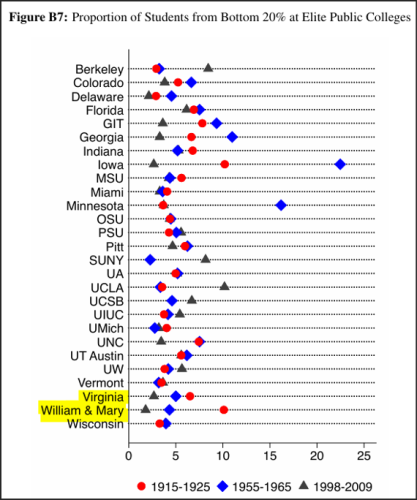
Now comes research on the socioeconomic composition of America’s elite universities in a study published by the National Bureau of Economic Research (NBER) that puts Alderman’s UVA in a more favorable light. It turns out that UVA during the Alderman era was less rigidly stratified from a socioeconomic perspective than it became in 1955-65 and in the modern era of 1998-2009.
(Lest William & Mary alums derive schadenfreude from UVA’s sins, be reminded that W&M has moved even more dramatically toward socioeconomic exclusivity than UVA over the past century.)
While more lower-income students manage to attend college thanks to the expanding number of colleges, the percentage of lower-income students at elite universities has changed little over the past century, contend the authors of “The G.I. Bill, Standardized Testing, and Socioeconomic Origins of the U.S. Educational Elite Over a Century.” These institutions have become more racially and geographically diverse but are as socioeconomically exclusive as ever. Two major policy changes thought to expand access to higher education — the G.I. Bill and the introduction of SATs — made little difference at top institutions over the long run.
I would postulate that UVA has become even more socioeconomically elitist since 1998-2009. Its high-tuition/high-aid business model is pricing out the middle class, especially among out-of-state students comprising a third of the undergraduate student body who pay Ivy League-level tuition & fees. UVA courts lower-income students through aggressive marketing and generous financial aid. But only a small fraction of lower-income students meet the University’s admission standards, so their numbers remain small.
In his book, We Have Never Been Woke, Musa Al-Gharbi explains how socioeconomic elites perpetuate their dominance in elite educational institutions. The elites (whom he refers to as symbolic capitalists) send their kids to posh private schools and prestigious public schools which, as a rule, are dominated by the “woke” discourse of intersectional oppression. Affluent kids master this discourse, which also predominates at elite higher-ed institutions. They are comfortable with the woke vocabulary and obsessions shared by admissions officers, and facility with this discourse puts them at an advantage over kids from non-elite schools where more traditional thinking prevails.
The theory of intersectional oppression places women, LGQBT+ people, and “people of color” at the apex of the oppression pyramid, which one might think would put children from privileged white families at a disadvantage in elite college admissions. But the number of oppressed categories has proliferated, Al-Gharbi observes. The fastest-growing categories are “disabled” and “neurodivergent.” The number of kids claiming to suffer from anxiety, depression, autism, OCD, dyslexia, or whatever, has skyrocketed. Now privileged White kids can play in the Oppression Olympics, positioning themselves as victims of fatphobia, hegemonic beauty standards, ableism, spectrum disorder, or some other social-justice flavor of the week. By contrast, kids from poor and working-class families are likely to find such conditions shameful and are far less likely to exploit them, even if they were equipped with the vocabulary to do so.
(In some classes at UVA, I hear, as many as 40% of the students claim special accommodations for project deadlines and exams on account of disabilities.)
Many of America’s elite colleges, including UVA, made submission of SAT scores voluntary on the grounds that they discriminated against students from traditionally marginalized backgrounds. But they replaced SATs, which measured academic aptitude, with other criteria that are inherently more subjective. Woke admissions officers conducting interviews and reviewing essays, one might suggest, are more partial to students conversant with woke vocabulary.
Al-Gharbi, a mixed-race Black/White American, is eviscerating in his critique of the woke elite. Virtue signaling serves mainly to bolster the status of faculty and administrators high in the academic hierarchy. Academic elites are never called upon to give up much themselves; all sacrifices are borne by others, particularly by relatively powerless working people untutored in woke discourse. While White elites have opened their ranks to Black and brown elites, little benefit has trickled down to the poor and working classes in whose name they justify their actions. Indeed, as documented by the NBER study, some universities have become more socioeconomically exclusive over the past century, not less.
Edwin Alderman may have presided over an institution that was closed to women and Blacks — a situation that thankfully was rectified decades ago — but it was more egalitarian than it is today. If buildings are ever erected to honor the leaders and benefactors of today’s UVA, and if there is any justice in the cosmos, one day a future generation will de-memorialize those who, whatever their other virtues, presided over the backsliding of UVA into an institution of unprecedented economic inequality.
James A. Bacon is contributing editor to The Jefferson Council. The views expressed here are his own.


Leave a Reply
You must be logged in to post a comment.