
(Second article in a series)
by Dick Hall-Sizemore
Immigrants are human beings.
The Old Testament of the Judeo-Christian tradition declares that God created human beings “in his own image.” One of the founding documents of the United States declares, “We hold these truths to be self-evident, that all men are created equal, that they are endowed by their Creator with certain unalienable rights, that among these are Life, Liberty and the Pursuit of happiness.”
It follows that immigrants are human beings, the same as all Americans, and that they have, like us, an inherent right to “life, liberty, ad the pursuit of happiness.”
“Immigrant” is a broad term. To be clear, in this article, when I refer to immigrants, I am addressing the undocumented immigrants already living in the country as well as those who come each year seeking asylum because they do not fit into one of the narrow categories that U.S. immigration law establishes.
This article will delve into how many there are, who they are, why they come, and how they got here.
How many there are
As of 2022, it is estimated that there were 11 million undocumented immigrants living in the United States. They constituted 23 percent of all immigrants in this country. An estimated 251,000 of this total lives in Virginia.
A large number of people continue trying to join those already in the United States. According to the U.S. Customs and Border Patrol (CBP), in FFY 2023 (ending in September 2023), there were almost 2.5 million encounters along the southwest border. “Encounter” is the official term used by the Border Patrol. It includes immigrants that fall into one of two categories:
- Apprehensions—These are people taken into custody, at least temporarily, under the provisions of the Title 8 of the U.S. Code, to “await a decision on whether they can remain in the country legally, such as by being granted asylum.”
- Expulsions—These are people who are “immediately expelled to their home country or last country of transit without being held in U.S. custody.” These actions were carried out under Title 42, that authorizes expulsions to prevent the spread of contagious diseases. The Border Patrol stopped using Title 42 in May 2023 after the United States declared an end to the COVID-19 public health emergency.
In addition to these encounters, the Congressional Budget Office (CBO) estimates there were 750,000 “got-aways” in FY 2023. These are people “who were directly or indirectly observed making an unlawful entry, who were not turned back or apprehended, and who are no longer being pursued by the Border Patrol.” Finally, the CBO estimates there were 110,000 people who entered the country undetected over the Southwest border in FY 2023.
It needs to be noted that not all those 2.5 million encounters got to stay in the United States and get added to the undocumented population already here. Almost 600,000 were immediately expelled under Title 42. Also, some of those detained temporarily would have been sent back upon determination they did not meet the criteria for asylum. Finally, there were other deportations during the year.
It is not the purpose of this article to reconcile the FY 2023 immigrant admissions and deportations to arrive at a net immigration number. The data is complex and such a reconciliation would be a separate article by itself. The purpose of citing the number of encounters, get-aways, and those coming in undetected is to illustrate the large number of people who are desperate to come to the United States.
Who they are
Traditionally, most of the immigrants coming over the southern border were single males from Mexico, usually young. However, the composition of the immigration stream has changed significantly in recent years.
Single adults still constitute the majority of encounters, but, based on CBP data, they accounted for only 61.2 percent of the encounters in 2023, down from 64 percent in 2021 and almost 70 percent in 2022. Individuals in family units made up a third of the encounters in 2023, with minors accounting for the remainder. Mothers with children are making up a larger portion of the family units appearing at the border seeking admission.
Mexico has long been the largest source of immigrants on the southern border. Beginning in the 1980’s, more immigrants from three Central American countries, El Salvador, Guatemala, and Honduras, joined the flow. In recent years, large number of Venezuelans have been making the trek. It has become much more of an international mix of people coming. Chinese are one of the fastest growing national groups among the immigrants. Recently, a group crossing the Darién Gap at the Panama/Colombia border included individuals from Haiti, Ethiopia, India, Democratic Republic of the Congo, Brazil, Peru, Ecuador, and Venezuela. According to the Migration Policy Institute, in 2020, only 12 percent of immigrants coming to the southern border were from countries other than Mexico, El Salvador, Guatemala, or Honduras. By 2023, that percentage had risen to 51 percent, more than half.
Why they come
Deep poverty and poor economies are the most persistent reason people choose to leave their countries. Much like the Irish in the 1840s who fled their country during the Potato Famine, families in Central America in recent years have been driven to look to the United States. The pandemic worsened already struggling economies. According to the World Bank, GDP fell by two percent in Guatemala, eight percent in El Salvador, and nine percent in Honduras. It has been reported that “more than half of Guatemalans and Hondurans and nearly 40 percent of Salvadorans lived in poverty” in 2020.
In addition to the poverty facing large segments of the population of Central America, there has been extensive violence that affected all segments of the populations of those countries. It started in earnest in the 1980s as military governments, supported by the United States, began cracking down on indigenous populations and any groups perceived to be in opposition to the government. Military units raided towns and remote villages, killing, raping, and torturing. (For a detailed, graphic description of this violence, see Jonathan Blitzer’s book, Everyone Who Is Gone Is Here.)
As the military violence abated somewhat, drug cartels and other gangs became the main source of violence driving families, as well as unaccompanied minors to the U.S. border. Although it has decreased recently due to a strong government push against gangs, the murder rate in El Salvador in 2016 was one of the highest in the world, with over 5,000 recorded homicides. Violence, rather than economic factors, has led to what migration experts are calling “the largest exodus of Mexican families in modern history.”
Although the bulk of those fleeing poverty and violence are from Mexico and Central America, sizable numbers from other countries have joined the stream. For example, hundreds of thousands of Venezuelans have come to the U.S. border, driven out of their country by a large-scale breakdown in its economy and by political repression.
When parents in Mexico, Central America, and other countries cannot find jobs; when they cannot earn enough to feed their children; when their children are recruited by drug gangs and threatened if they don’t join; when women and their daughters are subject to constant sexual attacks, they do what parents anywhere would do. They leave, looking for a place where they can raise their children in safety and provide a home and food for them.
How they get here
An immigrant’s journey to the U.S. border is long and perilous. Depending on where one starts in Central America, it can be 2,000 miles or more to the U.S. border. They cover that distance in many ways. Many walk, catching rides when they can. Their journeys may include riding on top of boxcars of a freight train. Those that have some money may hire a smuggler, or coyote, to guide them and provide transportation.
Many die trying to get to the United States. Some die in the deserts of the Southwest after crossing the border. Others drown in the Rio Grande. Others die at the hand of their smugglers. The Darién Gap claims many trying to cross. An untold number are murdered by members of drug cartels and other gangs.
La Bestia is a network of freight trains stretching from the Guatemala/Mexico border to the United States. There are no passenger cars; nevertheless every year, hundreds of thousands of Central American immigrants ride the trains in their effort to get to the U.S. They clamber on when the train stops or slows down. They ride on top of the cars hanging on or tied down. In addition to the dangers of falling off a car or falling and being maimed while trying to board a moving train, the immigrants are preyed upon by gangs and lone assailants.
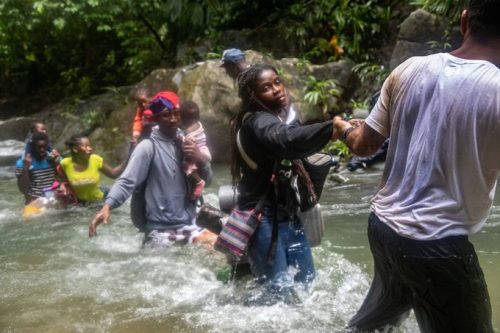
The Darién Gap is a roadless wilderness on both sides of the border between Colombia and Panama. It is the only overland route connecting Central and South America. Immigrants from Haiti, Venezuela, South America, and Africa trying to reach the U.S. are confronted here with sixty miles of dense rain forest, steep mountains, and vast swamps. The area is so inaccessible that it constitutes the only gap in the Pan American Highway that stretches from Alaska to the southern tip of Argentina.
Notwithstanding the difficulty and danger, half a million or more men, women, and children annually make the journey through the Gap. In recent years, organized gangs have taken control of the Gap, guiding groups of immigrants along semi-improved trails, while indigenous residents along the way offer to help the immigrants carry their belongings or children and provide food and water, all for a price.
If the immigrants survive the journey through the Gap, they are then faced with a journey of more than 2,000 miles to the United States.
Drug cartels and other organized crime organizations dominate each phase of an immigrant’s journey. Whereas, in the past, immigrants would contract with individual coyotes who would pay “license fees” to the cartel that controlled a specific area, the cartels have now coopted the coyotes and taken over the multi-billion dollar immigrant smuggling business. In addition, immigrants are subject to being robbed, beaten, and murdered by gangs along the way. One method used by the gangs is to kidnap immigrants and demand ransom from relatives in the U.S. George Mason University researcher Guadelupe Correa-Cabrera, a specialist in drug trafficking and migration, observed, “They [immigrants] don’t report them [gangs] because they threaten them if they do so and they don’t know who to turn to. Most kidnappers have ties to the authorities so it’s virtually impossible that they’ll take action against them. It is the perfect business.”
U.S. policy in recent years has resulted in a large portion of immigrants appearing at the border seeking asylum being returned to Mexico to wait there for processing. The result has been thousands of immigrants stuck at the border with no protection from the U.S. or Mexico. As Jovier Osorio, an expert on cartel violence with the University of Arizona, explained, “(Migrants) stay in Mexico for weeks and months, which makes them sitting ducks to be targeted by criminal gangs who want to extort them or offer opportunities.”
Immigration is big business in Mexico. According to one estimate, immigrants from El Salvador, Honduras, and Guatemala alone spend $2.2 billion annually to get to the United States. That may be an underestimate. Homeland Security Investigations, a federal agency, estimates that organized crime in Mexico brings in $13 billion in revenue from all its immigrant transporting activities. It seems that U.S. immigration policy has resulted in a cash boom for organized crime in Mexico.
Regardless of the hardships and dangers, the immigrants are not deterred. Even after failing to enter the U.S. or after being deported, they continue to try. After being kidnapped by gangs on his trek to the U.S., a Honduran immigrant was convinced they were going to kill him. However, he managed to escape, turned himself in to Border Patrol, and was eventually deported to Honduras. Back in his home village, he was hoping to raise enough money to pay a coyote and try again despite the risks. As he explained, “I’d go back, because I know that in America I could get something and die with dignity. Honduras only gives enough to survive, not live.”
These are people who have the courage and determination to give up all they have and undertake a long, hard, and dangerous journey to get to the United States and a better life for themselves and their families. Those that make it to our border have shown resilience in the face of great adversity. It would seem that any country would be eager to welcome such people to its ranks.
Furthermore, the Judeo-Christian tradition of our county holds that it is the right thing to do. In Leviticus, the third Book of Moses, the Jews are enjoined, “When a stranger sojourns with you in your land, you shall not do him wrong. You shall treat the stranger who sojourns with you as the native among you, and you shall love him as yourself, for you were strangers in the land of Egypt: I am the Lord your God.” (Leviticus 19: 33-34). And Paul wrote, “Therefore welcome one another as Christ has welcomed you, for the glory of God.” (Romans 15:7).
(Next article in series: The objections)
Leave a Reply
You must be logged in to post a comment.