
by David Botkins
On July 4, 1826, Americans gathered across a still‑young republic to celebrate a milestone some believed we’d never reach: the fiftieth anniversary of independence. Church bells rang. Cannons fired. Citizens reflected on how far the country had come since that audacious summer in 1776.
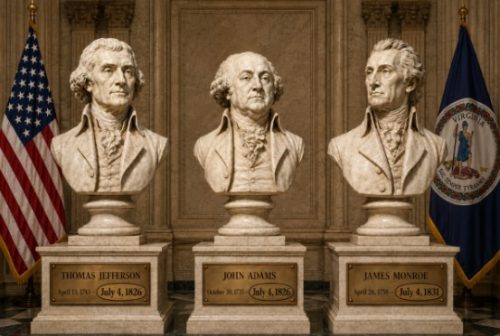
Then the news spread. Thomas Jefferson was dead. Hours later came another report. John Adams was dead as well.
Two architects of the American experiment, gone on the same day the nation marked its birth. Five years later, on July 4, 1831, James Monroe — another president, another founder — also died.
Three Founders. Three presidents. One date.
Whether one sees coincidence, providence, or simply one of history’s remarkable convergences, the symbolism is hard to ignore. The timing reads like a passing of the torch from the founding generation to the nation they helped create.
Jefferson gave America its language of liberty. Adams gave the cause its fierce defense. Monroe guided the republic through its formative years and left a foreign‑policy doctrine that shaped American statecraft for generations. Their personalities clashed. Their visions diverged. Yet each devoted himself to an unprecedented experiment in self‑government.
That is why their connection to Independence Day still captures our imagination two centuries later. The story reminds us that America was never the work of one individual. Not Washington alone. Not Jefferson alone. Not Adams or Monroe alone. The republic was built by imperfect men and women who argued, disagreed, compromised, and still managed to move the nation forward.
That lesson feels especially relevant now.
Modern politics encourages us to view public life through personalities, campaigns, controversies, and daily combat. The Founders thought in longer time horizons. They understood institutions matter. Ideas matter. Character matters. Citizenship matters. The survival of the republic depends on far more than any single election or any single leader.
And now, in 2026, as America marks its 250th birthday, we have every reason to celebrate what previous generations achieved. The American experiment has endured civil war, economic depression, world wars, social upheaval, and international conflict. It has expanded freedom to millions. It has generated opportunity on a scale the Founders could scarcely imagine. It has become one of history’s greatest engines of innovation and human flourishing.
But anniversaries matter only if they prompt reflection. The question is not merely what Jefferson, Adams, and Monroe accomplished. The question is what we will do with the inheritance they left behind?
Future generations will not judge us by how eloquently we commemorate the founding era. They will judge us by whether we strengthened self‑government, preserved constitutional principles, and passed on a healthy republic.
Virginia has a special connection to this story. Jefferson and Monroe were sons of the Commonwealth. Their lives were shaped by Virginia’s institutions, its debates, its ideals, and its sense of public duty. Along with Washington, Madison, Mason, Henry, Wythe, and Marshall, they helped establish a tradition of leadership that influenced not only a nation, but the world.
That history should inspire humility. The Founders were imperfect, yet they understood something every generation must relearn: liberty is not self‑sustaining. Freedom requires stewardship. Self‑government requires participation. The work of citizenship is never finished.
On July 4, Americans will once again gather beneath fireworks, flags, and familiar traditions. We should enjoy every bit of it. But perhaps we should also pause to remember the extraordinary symbolism attached to this day.
Three Founders. One day. One destiny.
Two hundred and fifty years after independence, the question is no longer what Jefferson, Adams, and Monroe accomplished. History has already answered that. The question is whether we will prove worthy of the republic they entrusted to us.
That answer remains unwritten.
David Botkins serves on the Jamestown-Yorktown Foundation Board of Trustees and the Board of Managers of the Sons of the Revolution in Virginia. This column has been republished with permission from The Jefferson Forum.
Leave a Reply
You must be logged in to post a comment.