
by James A. Bacon
by James A. Bacon
It’s been four years since Virginia public schools canceled their Standards of Learning (SOL) exams in response to the COVID-19 epidemic. When the SOLs resumed in the spring of 2021, they exposed massive learning loss across all categories of students. This spring — three years later — exams showed that students had clawed part of the way back to the pre-COVID status quo.
A breakdown of SOL scores by race/ethnicity offers a few rays of hope, but the big takeaway is the persistence of the same racial/ethnic disparities that existed before the epidemic.
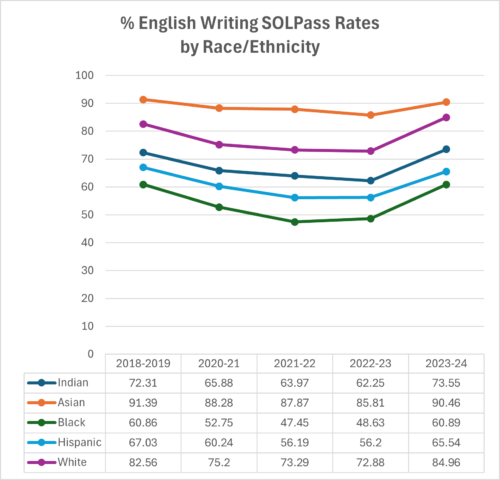
The happiest news that can be gleaned from the test scores occurs in the English Writing exams. Pass rates for Whites and Blacks in 2023-24 both exceed those of the pre-pandemic 2018-19. Those scores were nothing to brag about — 85% for Whites and 61% for Blacks — but I’m highlighting them because we’re all desperate for a return to normalcy and that’s the only scrap of good news in sight. Asians, Hispanics and American Indians (who I’ve included in this analysis despite their small numbers) have yet to return to the pre-COVID norm.
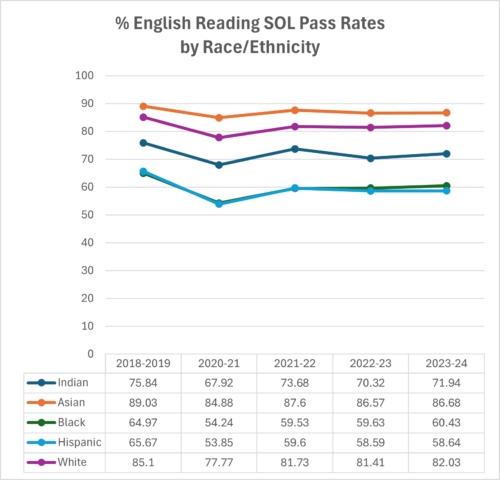
The General Assembly and the Youngkin administration agree on few things, but they did join forces to funnel emergency funds to address the depressing declines in SOL reading scores. Reading is foundational. Falling behind in grade-level reading skills makes it difficult to keep up with other subjects.
Reading improved marginally in 2023-24 for all groups over the previous year but pass rates have made up only half the ground lost since the pre-pandemic days.
Virginia aspires to develop a workforce suitable for an innovative, fast-growing tech-driven economy. That means graduating more college students in the so-called STEM disciplines (science, technology, engineering and math). That won’t be easy given the blast zones that are the math and science SOLs.
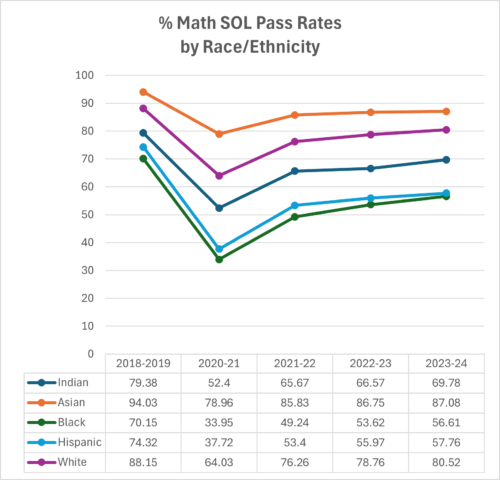
Math pass rates have recovered partially but remain far behind 2018-19. The pass rates for all racial/ethnic groups are pitiful compared to five years ago — even for Asians, the academic standard setters. Pass rates for Asians remain four percentage points lower, for Whites eight points lower, for American Indians ten points, for Blacks 15 points, and for Hispanics 19 points.
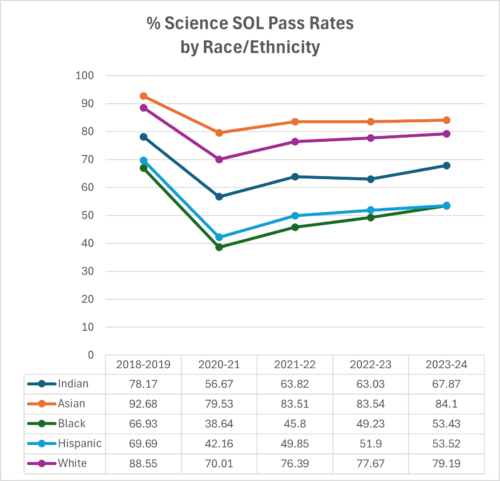
Science pass rates tell a similar story. Asians are down eight percentage points compared to five years ago, Whites down nine points, American Indians down 10, Hispanics down 16, and Blacks down 16.
Hey, Virginia students may not be math and science whizzes, but they can read and write (sort of), so surely they’ve mastered the basics of history and civics. No, sadly, many have not. Asian pass rates are down eight percentage points compared to five years previously, Whites down 13 points, American Indians down 16 points, Blacks down 16 points, and Hispanics down 16.
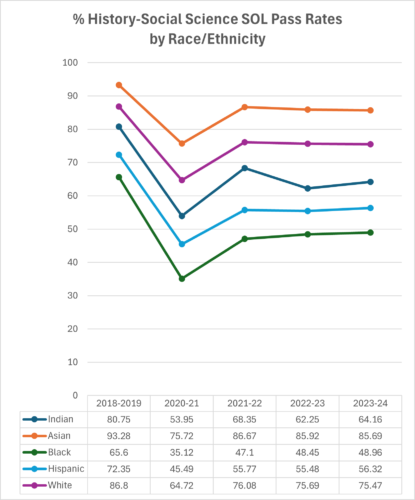
We’re raising a generation of civic illiterates.
That does not bode well for a hyper-polarized society where young people get most of their information from social media that lead people down conspiratorial rabbit holes and push them to ideological extremes.
These results are profoundly depressing. I know it’s hard to play catch up but it’s been three years now. C’mon, man!
There are abundant reasons for pessimism. The teacher shortage is getting worse, not better. Bacon’s Rebellion readers need no reminding of eroding discipline in hallways and classrooms. Wokeness, which instills minority youths with the defeatist belief that the system is racist and stacked against them, is as deeply rooted as ever.
But there are positive signs, too. Absenteeism is down. Schools are moving to restrict cell phone use. Districts are re-instituting phonics to teach reading. The Youngkin administration is trying to raise standards (I say trying because the school districts call the shots) and is trying to put the SOL data in the hands of parents, teachers, and administrators in actionable form.
So, the situation is not entirely hopeless. But absent a big shift in cultural attitudes, the best we can realistically hope for is slow, fitful recovery in educational achievement.
Leave a Reply
You must be logged in to post a comment.