
If the voters were upset with the way things are, it sure didn’t come with an imprimatur for stupid.
by Shaun Kenney
A few key takeaways:
- Virginia Democrats ran on affordability — and will now have to deliver.
- Speaker Don Scott is pledging to govern with restraint; cautions against overreach.
- Virginia Republicans turn in worst gubernatorial result since 1965.
- Fewest number of Republicans in House of Delegates since 1988, which opens up the Virginia GOP to new leadership options in 2027.
- Virginia Republicans will have to find a new leadership cadre repudiating the antisemitic “groyper” right — the serious infection being underreported.
Victory has a thousand fathers and defeat is an orphan. So goes the old saw about who to blame as Virginians have been drowned in a series of self-crafted after-action reports which seek to fix blame rather than fix the problem.
Of course, it’s not terribly hard to decipher what message Virginians were sending and to whom, and why Virginia Republicans struggled got our asses kicked failed to resonate against a national backdrop. Some lessons:
- Leadership matters.
- Campaigning by spreadsheet vs. campaigning by relationships? Relationships win every damn time.
- Republicans were in the White House; the Virginia Curse is still in play.
- 500K Republicans stayed home.
- Trump never came to Virginia to campaign, whether by choice or whether because the president was never asked.
- Meanwhile, Virginia Republicans were staring down a federal government shutdown in Northern Virginia and Hampton Roads.
- SNAP benefits stopped the weekend before the campaign.
- Undecideds broke late and broke hard towards a still-unpopular Democratic Party.
- Democrats campaigned on affordability; Republicans will get to hold them accountable to a campaign promise.
- Ubi deficiunt equi trottant aselli.
Of course, the bloodletting within the Virginia Republican Party will begin in earnest in the hopes that low-hanging fruit will make us feel better.
Advice? It won’t fix a thing.
For those actually inclined to help, there are now at least three and perhaps four congressional seats in VA-01, VA-02, VA-07, and just maybe VA-10 that need strong leadership and your help. Don’t worry about the johnny-come-lately types — we all know what work needs to be done, and no one is coming to our rescue except ourselves.
Republicans have work to do.
Some graphs for the graphically inclined
If one looks at the final totals statewide, it is no longer the I-95 corridor that should bother folks, but rather the crux of both I-95 and I-64 together.
Republican strongholds such as Spotsylvania County, where I had the privilege to serve as unit chairman some 20 years ago, voted Democratic. Fluvanna County, where I presently reside, came within 216 votes of flipping blue. Caroline County, where I was raised, came within 14 votes of turning blue.
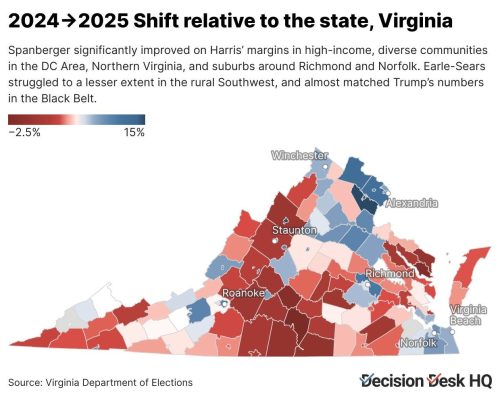
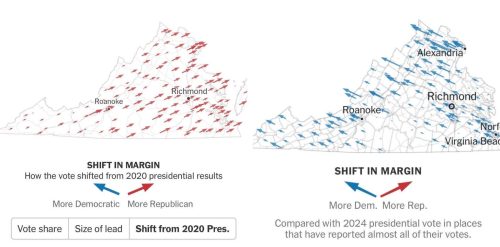
The regional shift was serious and demonstrable, and not localized to places where the federal government holds sway:
What about the polling, you ask? Well — it was good until it wasn’t. Once again, we have the problem of campaigns weaponizing polls in an effort to replicate the ol’ Texas Sharpshooter fallacy, cramming facts into a hypothesis and shaping the public narrative. Yet there’s a deeper problem in the similarities to 2017 that none of the larger and more reliable polling firms could capture.
Another image from Pat Ruffini indicates that the 2025 results were indeed largely modeled off of 2017 results. In short — predictable:
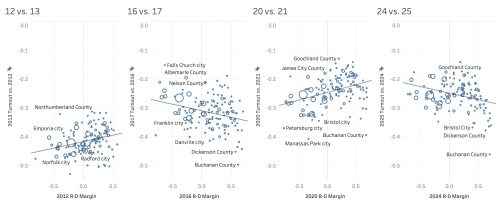
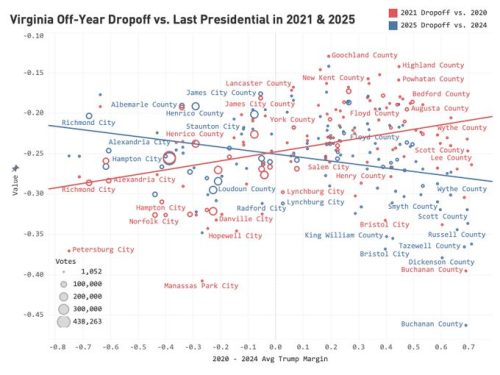
Now lest we dive too deeply into the low-propensity voter problem, it should be noted that this is a perennial problem for both parties in the effort to produce “base elections” and so forth:
How bad was the shift? Two graphics, one from 2024 demonstrating the shift from the 2020 presidential elections, and the more recent results from 2025 detailing the shift from 2024. With the notable exception of heroic Charlotte County — every Virginia locality shifted left:
So, there’s the lay of the land in terms of how we got beat. The answer could be simplistically drawn as that we faced an inevitable Democratic Blue Wave (TM) and nothing more could be done.
Yet if victory has a thousand fathers, it also papers over a lot of strategic flaws that defeat has a habit of exemplifying. Virginia in 2021 had several strategic advantages Republicans did not enjoy in 2017 or 2025 — there was no “Youngkin Miracle” and there was no Youngkin method of winning elections. In fact, if this argument is to be pressed to its very end, the model clearly failed at the top of the ticket — and as pointed out earlier, campaign by spreadsheet utterly failed.
One of Morton Blackwell’s laws of the public policy process is that builders can build faster than destroyers can destroy, which is certainly more true in defeat than it is in victory. Victory makes certain folks complacent, lazy, and entitled — you drink your own Kool Aid and believe it was all your own energies rather than an expression of the public will.
I know this much — there will now be a scramble for leadership of the Virginia Republican Party. One faction will be so odious a tow anchor as to render the party inoperable. Another faction will understand that while the left looks for traitors, conservatives look for converts.
In case it needs to be absolutely clear? There is no room for groypers, neo-fascist, actual fascist, Nazi-sympathizer, blood-and-soil post-liberalism in the Republican Party of Virginia.
Having warned about their presence in 2014, I have consistently beat the drum on this only to be called any series of names to shut down the argument — yet here I am, right once again, and pointing the finger. Antisemitism is an evil and a disease that strikes at the very taproot of Western Civilization. They can use all the magic words — globalist, open borders, liberal, cuckservative — they don’t work anymore. Let’s bring the disease to the sunlight and mock the degenerates in the open.
So, what kind of majority are we looking at in Richmond?
Whether or not the Democrats intend to govern from the center or from the progressive left remains to be seen. In fact, we will find out rather quickly on a series of fronts — and we should wish them every bit of success if for no other reason than such sentiments separate good actors from bad ones.
Yet we can perhaps agree on the salient point of leadership — namely that in order to win campaigns, it is more than just grassroots activism or fundraising capabilities or a small coterie of consultants. Rather, it is the leadership required to seize on all of these things and unite them around a vision that matters to everyday people, especially those who vote in presidential elections.
This work is simple but hard. Yes, it does require precinct level activism that is rarely rewarded. Yes, it will mean some clown in a vest with a high school education will take credit for your work. Yes, it will mean sacrifice and getting along with people you may not necessarily like.
But don’t ignore the salient message Virginia voters sent this election cycle. Despite the fact that Democrats are wildly unpopular nationally, when the impact of inflationary pressures and lack of jobs and a federal government shutdown and furloughs and food bank lines and SNAP funding dissolving the weekend before an election all piles up — Virginians had to send a message somehow.
Does the off-year election put us at a disadvantage? Maybe and maybe not. Yet for those of us who lived through the 2017 elections know, at some point voters have only one tool by which they can send a message to the powers that be. Doesn’t mean that Democrats are popular — they aren’t — but it does mean that Virginians want to work and be able to feed their families.
This is perhaps why you see Governor-elect Spanberger and Virginia House Speaker Don Scott use the word “restraint” as they move forward. They can read polls just as well as we can, and they know that the message sent by voters was a repudiation and not an endorsement.
Of course, the room temperature IQ crowd is going to see this as some sort of mandate. I suppose they can do so, but should they overreach, they will quickly find out that Virginians are out of patience for the chronically stupid. Voter fatigue is one way of stating it. A low tolerance for bullshit might be another.
The good news is this. Virginia Republicans have always been better as a minority party and in the resistance. In 2027 we will have 13 new opportunities for leadership, at least four opportunities to turn the House of Delegates back, and two State Senate seats we can pick up — this on top of our 2026 victories in four congressional seats. The Democrats might outspend us, but we can always outwork them.
For those of us in the trenches, don’t go looking for change in Washington or Richmond quite yet. Instead, organize your precinct and wait for your unit chairman to come to you. Or better still — if your unit committee needs help, get involved or help organize other precincts or serve as a unit chairman yourself.
Whatever the solutions might be, they start with the things we can do. For many of us, that’s working among our friends and neighbors and making it safe to be a Republican — knowing there are friends in the vineyard.
Courage, mon frere… courage!
Note bene: one useful thought
Just in case — as we are going into the silly season before the RPV Advance will all sorts of schemes and ideas to improve the world:
“In the end, a vision without the ability to execute it is probably a hallucination.”
— Steve Case, “The Mind of a CEO” (2001)
Amateurs talk tactics; professionals talk logistics. Food for thought as we move past anger, through bargaining, and past the depression part of this whole election nonsense.
Shaun Kenney is senior advisor to Attorney General Jason Miyares but the views expressed here are his own. This column has been republished with permission from his blog The Republican Standard.
Leave a Reply
You must be logged in to post a comment.