
by Steve Haner

The stories making the round last week about Dominion Energy’s bill increase for fuel were blatantly incomplete, as were Dominion’s communications on the matter. Here is what the utility and the well-tamed Virginia “news” media have not told you.
The $8 per month reported as the impact on a typical residential customer was just a sweetener, a loss leader even. The real pop to your wallet will come later if the State Corporation Commission approves Dominion’s application –- already blessed by the equally well-tamed General Assembly -– to finance the bulk of the unpaid fuel costs with bonds that could take a decade or longer to retire.
This will be the second time in just three years that the utility has taken the money you owe it for fuel and sold it off as a bond, claiming that it is “saving” you money despite the years and years of added interest expense.
Dominion’s application for its second round of “securitization” of uncollected fuel costs would have the additional charge hitting your bills early in 2027. You would be paying for the fuel and purchased power cost of last winter’s bitter cold spell all the way until 2041 under its most expensive proposal, a 15-year payoff. Under that proposal, bankers and bond holders would earn fees and interest (paid by you) of more than $500 million.
The initial increase that went into effect July 1, which was $8 for that typical residential customer using 1,000 kilowatt hours, covered the increased cost for the upcoming 12 months. Dominion split out another $1.1 billion in uncollected fuel costs from the two previous 12-month periods, blaming much of that on the cold winter.
It is that $1.1 billion in uncollected previous costs that the utility wants to spread out into payments over seven, ten or 15 years. The utility recommends no longer than a ten-year bond, which would enrich the bankers and bond holders only $325 million or so at your expense.
But when Dominion first floated the idea of this second fuel bond in May, its initial application focused on a deferral payment of only $1.80 per month on that 1,000-kwh residential bill. The $1.80 payment corresponds to the 15-year payoff and was clearly chosen by the utility to make the idea look less expensive. The half a billion bucks for banks and bondholders was not detailed in that filing.
Absent the deferral, the increase in that average bill on July 1 would have been almost $14 higher, for a total fuel increase of nearly $22 per month. Customer outcry would have been substantial. But the additional $14 for the prior years’ costs would have been on the bill for only 12 months, disappearing again after June 2027.
According to Dominion’s data in the application, the initial monthly cost for the 7-year payoff schedule for that typical residential user will be $3.05 per month, for the ten-year schedule $2.36 per month and for the 15-year paydown $1.81 per month. All assume fixed interest rates of around 5 percent.
So, your choices are paying $166 over one year, $256 over seven years, $283 over ten years or $325 over 15 years. Dominion claims this saves you money (“a positive net present value”) because you could do something productive with the money not spent, like invest it in the stock market or pay off another debt. Hands up if that is what you would do.
The announcement last week that the $8 charge for fuel costs was being added sparked another round of public comment focused on data centers, which have nothing to do with the high cost of fuel (the war on Iran has a bigger impact) or how bloody cold it got. For the environmental crowd, it gave them another reason to tout solar and wind, with plenty of sideswipes at the data centers thrown in.
But news reports did not mention how the added charge was only part of the ultimate cost to consumers nor did anybody raise the question of whether this approach is prudent or wise. Come next year you are likely to have three lines on your monthly bill dedicated to fuel, the current cost and two separate payments for deferred costs. (Are we sure Dominion added enough to the 2026-27 fuel estimate to cover the Fourth of July heat wave?)
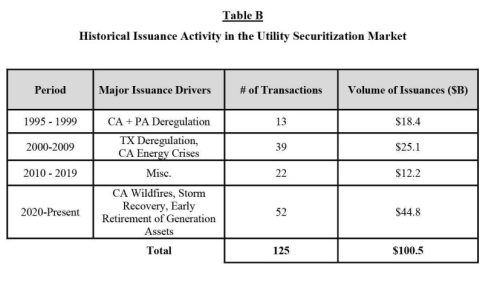
A Citibank managing director named Steffen Lunde filed testimony with the State Corporation Commission focused on this growing trend among utilities to create these deferred cost bonds. More than $100 billion in such bonds have been issued since 1995, mainly for California, Pennsylvania, and Texas utilities but with this case, Dominion will have two such bonds (about $2.5 billion total). Appalachian Power Company has one, $1.375 billion issued in May, also blessed by the Assembly.
Most have not been for fuel. Many have been related to the deregulation process or wildfire recovery. Appalachian is spreading out capital costs related to its aging generation plants and other projects, not fuel expenses. Using this process to cover a one-time consumption expense with no long-term benefit raises a host of fairness issues. People who used the power may be long gone before the debt is paid and people who used none of it will be covering the debt.
From Lunde’s testimony:
This proliferation of applications combined with certain major events — specifically winter storm Uri and wildfires in California — have resulted in the issuance activity growing significantly during the last three years. 2022 was a record year with 20 transactions and a total issuance volume of $22.2 billion – an issuance volume that exceeded the aggregate of the prior sixteen years. The last few years from 2022 to 2026 accounted for 37% of the number of deals and 41% of the issuance volume since inception of this asset class back in 1995.
His summary of the reasons is reproduced from his testimony below.
The General Assembly and Governor Abigail Spanberger were still tinkering with the language on approving this bond process right up to the final budget conference report. One of the final changes picked up language from the 2023 bond proposal that allows the largest users to go ahead and pay over one year, avoiding the long-term fees and interest the rest of us must fork over. (“Different strokes for different folks” is the new state motto, remember?)
Legislators will note, correctly, that the SCC can reject it all and impose the old fuel costs on all of us in a single year. That would happen in 2027, however, when both the House and Senate are on the ballot. Despite their having granted the SCC discretion, the SCC’s case file will fill up with comments from our political leaders praising the bond approach as “affordable.”
Leave a Reply
You must be logged in to post a comment.