
A double standard rankles in the Virginia Museum’s otherwise marvelous exhibit about the Mughal dynasty.
by James A. Bacon
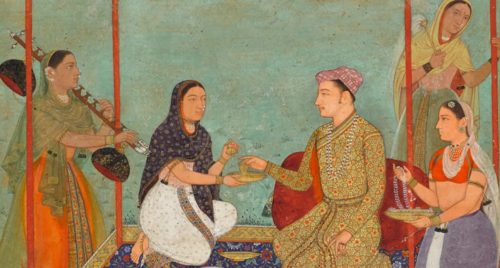
The Virginia Museum of Fine Arts (VMFA) is displaying an extraordinary exhibition of 200 paintings, manuscripts, textiles, furniture, and works of artisanship from the Mughal dynasty, which ruled the northern Indian subcontinent from 1526 to 1857. It is an impressive collection, and it sheds light on a remarkable civilization of which most Americans know little to nothing.
The VMFA is gushing in its description of the artistic achievements of three of the most celebrated Mughal emperors: Akbar, Jahangir, and Shah Jahan.
From the tiniest jeweled objects to the monumental wonder of the Taj Mahal, this highly sophisticated and globally connected empire produced treasures of unparalleled splendor and magnificence.
The extraordinary creative output of the imperial ateliers conveyed the Mughals’ great wealth and power. In addition to glorifying the emperors, these diverse artistic productions also signaled worldliness. Descendants of a Central Asian prince, these cosmopolitan emperors presided over a multicultural court that fused Indian and Iranian cultures and regarded the empire’s array of languages and religions with great interest.
Splendor. Magnificence. Sophistication. Worldliness. Cosmopolitan. Diverse. Multicultural. These are the words the VMFA uses to describe the dynasty.
To anchor the Mughal timeline in a historical context with which most visitors are familiar, placards in the exhibit take note of events taking place in Europe and the Americas. Thus, we are informed that in 1607, the Virginia Company established Jamestown, and two years later an Englishman arrived in the court of Emperor Jahangir to negotiate an agreement for the East India Company.
I found the comparative information to be useful. But then there was this: In 1619, the placard states:
The first enslaved Africans forcibly brought to Virginia arrive in Port Comfort. The brutal transatlantic slave system is fueled, in part, by Indian textiles. Along with other valuable goods, goods originating in the Mughal Empire are used to bankroll the violent capture and mass enslavement of African people.
Now, let us acknowledge that the first enslaved Africans were brought to Virginia in 1619, and that the transatlantic slave system was horribly brutal.
I’m not sure that Mughal cotton textiles could be said to have “bankrolled” the transatlantic slave trade. Rather they were used as trade goods, which European traders purchased from the Mughals (or intermediaries) and bartered with African kingdoms to acquire slaves. Whatever the case, the exhibit implicates Indian textiles in the slave trade, not the Mughals.
The point worth making is that the VMFA curators could not refrain themselves from dragging Virginia’s involvement in the transatlantic slave trade into the exhibition about the Mughal Empire — while studiously ignoring the Mughals’ own involvement in a different slave trade.
The historical reality is that Mughal magnificence was built upon warfare, plunder, enslavement, a caste system, and exploitation of the rural servile class every bit as brutal and cruel as any system of oppression concocted in Western Civilization. I don’t hold out the Mughals for special condemnation — exploitation of the weak by the strong was the near-universal condition of mankind. Rather, I condemn the VMFA curators for noting the cruelties of Western Civilization while giving uncritical praise to a non-Western civilization guilty of the very same abuses.
Islamic Mughals routinely enslaved the peoples of the territories they conquered. Emperor Akbar curtailed the practice of using slavery as an instrument of warfare, but the institution persisted. To feed demand in the Islamic kingdoms, Arab slavers raided populations across eastern Africa and marched their captives hundreds of miles overland to ports on the Mediterranean Sea and Indian Ocean. The death rate was just as appalling as in the transatlantic trade. Slaves were purchased by the Ottomans, the Mughals, and other Islamic potentates as concubines, domestic servants, eunuchs, and palace attendants.
The VMFA exhibit has nothing to say about this.
In the Western Hemisphere, the producers of agricultural products (sugar, rice, indigo, tobacco, cotton, coffee) imported a servile population from Africa to work the plantations. The Mughals didn’t need slaves. They had a vast servile population readily at hand. Peasants paid a large portion of their produce — typically one-third to one-half — to landlords, moneylenders, and the Mughal state. Most lived at a subsistence level. Some became bonded laborers due to unpaid debts. When exploitation became unbearable, they rebelled. The Mughals experienced — and suppressed — numerous agrarian uprisings.
The VMFA exhibit has nothing to say about this.
While the Mughals did indeed rule over a “diverse” and “multicultural” empire, a distinctive aspect of that diversity was the caste system. The Islamic Mughals reinforced traditional Hindu caste hierarchies, recruiting high-caste Brahmins and Rajputs as allies. Although the Mughals admitted some lower castes into administrative ranks and the military, allowing for a modicum of social mobility, the rural caste system affecting the vast majority of subjects became more rigid, and the marginalization of the so-called untouchables deepened.
The VMFA exhibit has nothing to say about this.
Like the VMFA, every art museum I’ve visited in recent years seems eager to draw connections between Western Civilization’s artistic achievements and colonization and/or the slave trade. The glory of the Mughals, by contrast, is depicted as being created by a wave of the scepter, not the exploitation of the population.
I urge everyone to visit the exhibit. The craftsmanship created for the Mughal courts is every bit as worthy of admiration as the art of Venice, the Dutch republic, or the court of Louis XIV. Just beware the curators’ subtle yet tiresome ideological bias.
Leave a Reply
You must be logged in to post a comment.