
by James A. Bacon
Last week I highlighted calls for state-funded grief counseling as an example of the potentially limitless demand for mental health services. If your vision for society is “no more sad people,” that requires an open-ended commitment from the commonwealth. Today I bring your attention to another case of infinitely elastic demand for government succor: free breakfasts for all. Including rich kids.
This initiative, as I shall make clear, is not about addressing hunger. It’s about addressing self-esteem. The vision: no more sad children.
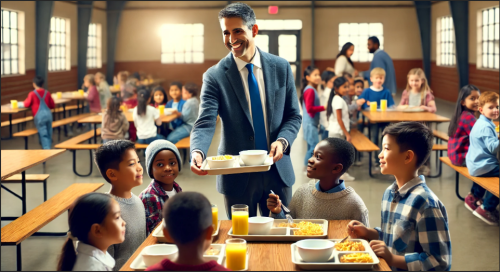
Senator Danica Roem, D-Manassas, and Delegate Elizabeth Bennett-Parker, D-Alexandria, submitted bills to provide free breakfast to public school students across the state, according to The Virginia Mercury. Schools would be required to join the federal National School Lunch and School Breakfast programs administered by the U.S. Department of Agriculture, explains the Mercury. Free breakfast would be offered at no cost to any students who request it.
“Children cannot learn if they are hungry. This bill is an investment in their education and would maximize all of the other education investments we are making,” Bennett-Parker said during a House Education subcommittee meeting Tuesday.
“We know that when a child shows up to school and is able to have a full belly, they are able to learn better,” said Emily Moore, a senior policy analyst for Voices For Virginia’s Children. (This was the same outfit plugging for Medicaid-funded grief counseling.)
No one presented evidence that large numbers of children are experiencing hunger at school. We’re supposed to accept the fact that children are showing up hungry, which makes it harder for them to learn.
We have the Supplemental Nutrition Assistance Program (SNAP). We have the supplemental nutrition program for Women, Infants and Children (WIC). We have food banks and soup kitchens. More to the point, we already have school lunch and breakfast programs serving some 30 million lunches nationally and 15 million breakfasts for free or at reduced prices.
Why dun taxpayers to expand the entitlement to kids from affluent families who don’t need free meals?
As quoted by the Mercury, Senator Mark Peake, R-Lynchburg, at least questioned the logic behind free meals for rich kids.
“I cannot in good conscience support this, and I know they’re going to say, ‘Oh, that mean old Republican wants to starve kids. I don’t want to starve kids, but I don’t want rich parents not taking care of their kids. The money should go to the kids who need it and this does not do that.”
Good point.
But free school lunches for all is not about addressing hunger, although one could forgive Peake for thinking so, given the way Bennett-Parker justified her bill. It’s about eliminating a “stigma.”
What’s the relationship between free school lunches and self-esteem, I asked ChatGPT. The response:
Many children from low-income families may feel embarrassed or singled out if they can’t afford lunch or if their peers are aware of their financial struggles. Universal free lunch programs eliminate this distinction, fostering a sense of equality among students.
And this from Microsoft Copilot:
School lunch programs can sometimes make children feel self-conscious or stigmatized, especially if they are receiving free or reduced-price meals due to their family’s financial situation. This can lead to feelings of embarrassment or shame, which can impact their self-esteem and social interactions.
However, many schools and programs are working to reduce this stigma by implementing universal free meal programs, where all students receive free meals regardless of their financial status. This approach helps to create a more inclusive environment and ensures that no child feels singled out or different because of their economic background.
ChatGPT and Copilot are not “hallucinating” these answers. I asked the question because I had heard this very same logic before and knew what the answers would be.
Roem and Bennett-Parker are being disingenuous by tying their bill to nutrition and health. Their real concern is that poor kids might feel stigmatized. If we want to provide free meals to rich kids so poor kids don’t feel shame, let’s just be honest about it, OK?
Then maybe we could have an honest discussion. Let’s see the evidence that kids get bullied or feel shame. Advocacy groups make the claim based on surveys and focus groups, but they’re not exactly disinterested parties. I’m not convinced that there’s even a problem. And if there is a problem for a small percentage of students, I don’t see why teachers and staff can’t handle it.
The bottom line for taxpayers is that there are no logical limits to the “unmet needs” that progressive advocacy groups and legislators can dream up. Literally no limits. They will always find reasons that other people need your money more than you do.
Leave a Reply
You must be logged in to post a comment.