
Why Virginia’s rural transit subsidies need a reality check
by J.D. Wong
If you live in one of Virginia’s picturesque rural counties, you may have seen a familiar, yet puzzling sight: a large, brightly branded public bus rolling down a country road or regional highway, carrying nothing but a driver and a volume of air.
This phantom fleet is largely funded by the Federal Transit Administration’s Section 5311 program, a well-meaning but economically obsolete initiative that pumps millions of tax dollars into “Formula Grants for Rural Areas.” Administered in the Commonwealth by the Department of Rail and Public Transportation (DRPT), these subsidies are designed to provide mobility to rural residents. But from an economic perspective, we must ask the hard question: Is this a good use of money?
The answer, increasingly, is no. The Section 5311 program represents a classic government failure.
Public transit relies on density to be efficient. In urban centers like Arlington or Richmond, a bus can serve dozens of riders per hour, spreading the operating costs across many riders. In rural Virginia, where population density drops to fewer than 50 people per square mile, the economics of fixed-route transit collapse.
Under the current 5311 framework, taxpayers subsidize buses, not passengers. Whether a bus carries twenty people or zero, the fuel, maintenance, insurance, and driver costs remain the same. In many rural systems, the “cost per ride” can balloon to staggering amounts — sometimes upwards of $30 or $40 per trip — billed largely to the taxpayer, while the rider pays a nominal fare that covers a fraction of the expense.
We are effectively operating a government-owned taxi service using 45-foot buses.
The “Virginia Breeze” paradox
The inefficiency extends beyond local shuttles to the state’s intercity bus program. Federal law (Section 5311(f)) mandates that states spend at least 15% of their rural transit grant on intercity bus transportation unless the Governor certifies that all needs are met. This “use it or lose it” provision incentivizes the state to launch routes regardless of actual market demand. Routes, predictably, become based on politics and vote seeking, not economics.
The results are a case study in government distortion. Politicians rarely realize that travelers prefer north-south routes because of the weather. For instance, Flixbus now offers 22 daily New York-to-Richmond trips, up from 10 in 2019. Business is also booming between Richmond and Atlanta, with 10 trips, up from six in 2019. These routes grew without subsidy because private companies identified profitable lanes and met demand.
In contrast, the popularity of east-west routes has diminished. For instance, buses no longer travel between Richmond and Dallas. In FY2025, Amtrak’s east-west routes lost over $530 million. East-west Amtrak passenger miles have fallen by 20 percent since FY2011.
Meanwhile, the Auto Train (Virginia to Florida) made $9.3 million in profit. Amtrak’s north-south routes have seen an 18 percent bump. In fact, train travelers favor north-south routes over east-west routes by a ratio of three to one. Airlines are seeing the same trend.
Despite the success of unsubsidized routes, politicians continue subsidizing unprofitable ones. In FY2025, Section 5311 subsidies cost taxpayers $838 million, with $19 million allocated for Virginia. Federal subsidies cover 80 percent of capital and 50 percent of operating costs. Local sources pay for the rest.
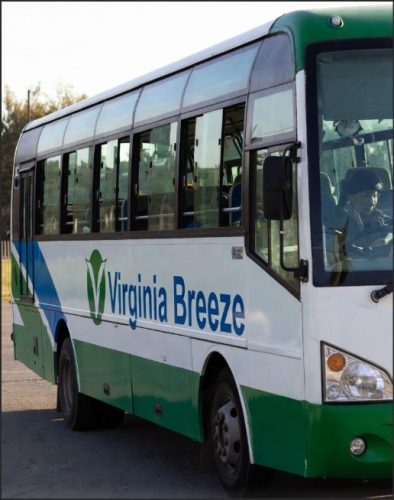
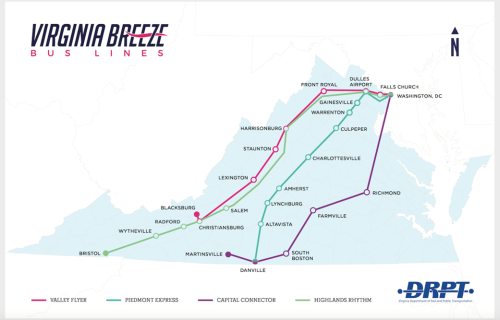
Despite receiving enormous subsidies, Virginia Breeze carried only 67,127 riders in FY2025. The route connecting:
- Washington and Blacksburg carried only 33,741 riders.
- Washington and Bristol carried only 19,330 riders.
- Washington and Danville carried only 7,210 riders.
- Washington and Martinsville carried only 6,846 riders.
Some routes, such as Washington to Blacksburg, compete with unsubsidized routes. Others, such as Washington to Danville, replicate subsidized Amtrak routes. In February, only 345 riders used the Washington to Danville route. Buses averaged less than six passengers per day each way.
Proponents argue these subsidies connect large cities with smaller towns. Yet, there’s no guarantee that subsidized routes wouldn’t be profitable without support or that innovative alternatives wouldn’t find a way to meet the minimal demand in far less expensive ways. It’s also not clear why some routes get subsidies while others do not.
Without subsidies, unsubsidized buses might stop in smaller towns, unprofitable routes might be serviced by micro transit options (think van sharing), or the offering of targeted vouchers may lead to unique alternatives yet to be tried. Instead, political support for Section 5311 subsidies has created a bottomless pit for taxpayer funds.
While proponents of these subsidies argue that subsidized routes connect isolated areas, subsidized intercity buses represent less than 0.001 percent of travel. In fact, Americans travel more miles by bicycle than use these buses.
Virginia Breeze touted a “ridership record” in 2025, but unsubsidized buses might have served those travelers without the subsidized competition. More importantly, the competition may have created even lower fares with more innovative options. For example, with minimal adjustments, profitability of struggling routes could be improved by:
- combining the Washington-to-Blacksburg route with Washington-to -ristol.
- extending the Washington-to-Bristol route to New York and Nashville.
- extending the Washington-to-Danville route to New York and Atlanta.
- discontinuing the Washington-to-Martinsville route.
If lawmakers continue subsidizing buses, their losses will continue to grow. The only way to stop politicians from playing favorites with routes is to cut subsidies to zero. Ending subsidies doesn’t mean the end of underperforming routes. In fact, innovative companies have reduced costs while expanding routes. Flixbus faced criticism for replacing terminals with curbside stops. Yet, this cost-cutting measure helped the company to grow its north-south routes.
Congress should eliminate bus subsidies entirely or at least stop subsidizing intercity buses. Focusing on successful routes is better than bemoaning the end of unprofitable ones. Market-driven services can succeed where subsidized buses fail.
J.D. Wong is a route planner and an expert on the intercity bus industry. As a former independent contractor for Flixbus, he managed operations, logistics, and strategic growth. He has also worked as a route planner, where he optimized routes and enhanced service efficiency.
This column has been republished with permission from the Jefferson Institute for Public Policy.
Leave a Reply
You must be logged in to post a comment.