
by Dick Hall-Sizemore
Pop quiz. Who said the following about assault weapons? “They are military-style weapons designed for sustained combat operations that are ill-suited and disproportionate to the need for self-defense…[and] which have become primary instruments of mass killing and terrorist attacks in the United States?”
- Vice-President Kamala Harris
- Sen. Mark Kelly
- President Joe Biden
- Chris Rock
OK. So, it is a trick question. The correct answer is “none of the above.” The answer is Judge J. Harvie Wilkinson, III, of the Fourth U.S. Circuit Court of Appeals. Wilkinson, from Richmond, is the longest-serving member of the court, having been appointed in 1984. He is well-respected and considered one of the most conservative members of the court. His name was often included in lists of possible appointments to the Supreme Court, and he was interviewed by President George W. Bush for a vacancy.
Wilkinson’s characterization of assault weapons is included in his majority opinion in a recent case, Bianchi v Brown, issued in a 9-6 ruling by the full court upholding Maryland’s law prohibiting assault weapons. Specifically, the Maryland statute prohibits the selling, purchasing, receiving, transporting, transferring, or possessing an assault weapon and authorizes law-enforcement officers to seize and dispose of such weapons sold, purchased, received, transported, transferred, or possessed. (Md. Code Criminal Law Sec. 4-303, et seq.) The Maryland statute goes into some detail defining “assault weapon.” That description is set out in the Bianchi opinion.

Wilkinson goes to great lengths to show that banning assault weapons falls within the parameters set out in the two recent leading Supreme Court cases on gun control, Heller (District of Columbia v Heller, 597 U.S. 1 (2022))and Bruen (New York Rifle & Pistol Ass’n v Bruen, 597 U.S. 580 (2008)).
He describes Heller as holding that the Second Amendment allows individuals to possess firearms for purposes of self-defense. He emphasizes that the Heller opinion stipulated that the Second Amendment does not guarantee “a right to keep and carry any weapon whatsoever in any manner whatsoever and for whatever purpose.” He goes on to point out that the Supreme Court in Heller said that “weapons that are most useful in military service –- M-16 rifles and the like — may be banned.”
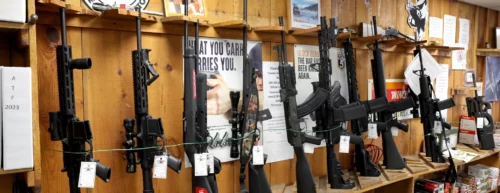
Wilkinson devotes a considerable portion of the opinion to an analysis of the AR-15 rifle, which is the focal point of the case. He concludes:
In sum, the AR-15 — with its military origination, combat-functional features, and extraordinary lethality — has ‘the same characteristics, functionality, capabilities, and potential for injury as the’ M16. And its all too frequent use in terrorism, mass killing, and police murder shows that the AR-15 offers firepower ill-suited and disproportionate to fulfilling the Second Amendment’s purpose of armed self-defense. Therefore, just like the M16, the AR-15 is ‘most useful in military service’ and ‘may be banned’ consistent with the Second Amendment.
Wilkinson then takes note of one of the major arguments of the dissenting members of the court who assert that assault weapons are “bearable arms” that cannot be prohibited because they are in “common use” with “millions of law-abiding citizens choos[ing] to possess” them. He replies, “Just because a weapon happens to be in common use does not guarantee that it falls within the scope of the right to keep and bear arms.”
Using the recent Supreme Court decisions as his basis, Wilkinson concludes that “the Second Amendment protects only those weapons that are typically possessed by average Americans for the purpose of self-preservation and are not ill-suited and disproportionate to achieving that end. As demonstrated above, the AR-15 is a combat rifle that is both ill-suited and disproportionate to self-defense. It thereby lies outside the scope of the Second Amendment.”
Wilkinson could probably have stopped with declaring that the Second Amendment protections do not apply to the AR-15. However, he felt the need to address the Supreme Court’s directive in the Bruen decision.
He explains, “In Bruen, the Supreme Court emphasized the importance of using history and tradition in determining whether a firearms regulation is permissible under the Second Amendment.” Quoting the Bruen decision, he notes that the high court instructed that “when a challenged regulation addresses a general societal problem that has persisted since the 18th century, the lack of a distinctly similar historical regulation addressing that problem is relevant evidence that the challenged regulation is inconsistent with the Second Amendment.” Wilkinson does note, however, that the opinion provides that courts may take “a more nuanced approach” if a case “implicat[es] unprecedented societal concerns or dramatic technological changes.”
“This case calls for such a nuanced approach,” Wilkinson declared. In looking back at the era in which the Second Amendment was adopted, he asks, “What did our forbears have by way of comparison, when they were drafting the Second and Fourteenth Amendments?” His answer: “Nothing even close.” He goes on to declare, “In modern mass shootings involving assault weapons, the death toll is often in the dozens. Rapid advancements in gun technology are a central cause of this mass carnage.”
In a remarkable passage, he describes in graphic detail the “carnage” he is talking about:
Certainly it would have been shocking to the Framers to witness the mass shootings our day, to see children’s bodies ‘stacked up…like cordwood’ on the floor of a church in Sutherland Springs, Texas; to hear a Parkland, Florida high school student describe her classroom as a ‘war zone’ with ‘blood everywhere’; to be at a movie in Aurora, Colorado when suddenly gunfire erupted, leaving ‘bodies’ strewn and ‘blood on seats, blood on the wall, blood on the emergency exit door’; to run past ‘shoes scattered, blood in the street, bodies in the street’ while bullets whizzed through the sky in Dayton, Ohio; to watch law enforcement officers encounter ‘a pile of dead children’ in Sandy Hook, Connecticut; to stand next to one of those officers as he tried to count the dead children, but ‘kept getting confused,’ as his ‘mind would not count beyond the low teens.
He concludes, “These are not our forebears’ arms, and these are not our forebears’ calamities.”
Having established the need for a “nuanced approach”, Wilkinson proceeds to examine the historical record regarding the response of legislatures as technology advanced and produced more and more lethal firearms. He finds, “Throughout this history lies a strong tradition of regulation of those weapons that were invented for offensive purposes and were ultimately proven to pose exceptional dangers to innocent civilians.” In this vein, he declares, “Maryland’s regulation of assault weapons is fully consistent with our nation’s long and dynamic tradition of regulating excessively dangerous weapons whose demonstrable threat to public safety led legislatures to heed their constituents’’ calls for help.”
In summation, he declares, “Following Heller and Bruen, we hold that the Maryland statute is plainly a constitutional enactment.”
As would be expected, the plaintiffs declared they would appeal the decision to the U.S. Supreme Court. If the Court decides to hear the case, it will be fascinating to see how it deals with Wilkinson’s reasoning and conclusions.
Leave a Reply
You must be logged in to post a comment.