
By Steve Haner
If it were my job to pass the bill to eliminate income tax on tips, my first move would be to fill the room where a committee was voting with men and women who depend on tips and who would benefit from the bill. I’d have the legislators considering a no vote looking out at motivated constituents. With some nice signs, maybe, and some speeches at the podium.
But Governor Glenn Youngkin’s proposal to create that tax break for Virginia taxes was rejected Monday afternoon in front of mainly lobbyists. It was “passed by for the day” by House Finance Committee Subcommittee #3, but that includes most of the senior Democrats on the full panel.
Language to eliminate tip income from the list of taxable items is also buried in the Republican Governor’s budget bill. It is too soon to totally write off the idea, given the ebbs and flows of a session and given that at some point it may become federal tax law.
The bill in question, House Bill 1965 offered by Delegate Anne Tata, R-Virginia Beach, initially included two big tax proposals that helped propel Donald Trump into the White House, the tip provision and a provision to eliminate tax on overtime. She reduced the bill to focus only on tips in a substitute. Eliminating taxes on overtime would blow a major hole in the state’s revenue, per the impact statement.
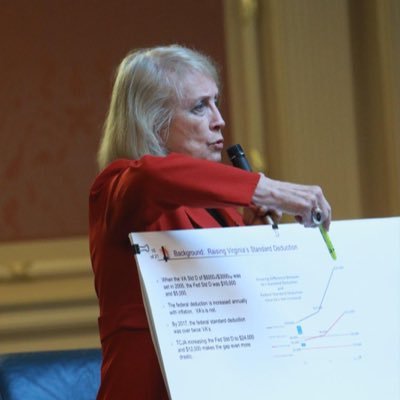
Another, more significant tax cut advanced, however. The subcommittee unanimously endorsed both increasing the state’s standard deduction and to automatically increase it for inflation in future years. That was offered by Delegate Vivian Watts, D-Fairfax, who has long spoken in favor of indexing tax provisions, a taxpayer protection that has long been in federal tax law.
Her House Bill 1754 as introduced also included a major income tax increase, creating a new tax bracket for incomes above $600,000 and imposing a 7% marginal tax on those. Her substitute retreated to just the standard deduction and indexing sections, dumping the income tax hike.
Watts chairs the full Finance Committee so it will pass there, one can assume. But it must go into the clutches of the House Appropriations Committee, which has not previously supported that kind of indexing. Even more of a challenge may come from the Senate Finance and Appropriations Committee, should the full House adopt it. But something worth passing that will lower taxes for millions of Virginians has emerged with bipartisan support. Thank you, Delegate Watts.
Watts’ substitute would increase the standard deduction for 2025 to $9,250 for a single return and $18,500 for a joint return. Then the first round of indexing would begin with the tax year starting in 2026. Remember, most taxpayers at the federal level take the standard deduction there and are therefore forced to take it on their Virginia returns.
Her bill represents a major boost for taxpayers over what was included in Youngkin’s budget. He would continue the standard deduction at the present level of $8,500 per person or $17,000 per couple, but without indexing. However a member of his staff told the committee that should Watts’s proposal survive the legislative process, the Governor would make every effort to find the resources to sign it. Watts said the fiscal impact was probably about $100 million, but no financial estimates had been prepared specifically on her substitute. There was one for her introduced bill.
Keeping tax on tips would cover much of that, of course. Youngkin had also baked that into his budget, assuming the revenue reduction.
Again, as with the tips bill, the standard deduction issue was a discussion among various lobbyists. One lobbyist stood out, representing the Virginia Education Association, which has lost all credibility on education and proves over and over it is only cares about money. VEA stood up to speak against a Republican’s bill that matched the Governor’s policy on the standard deduction – keep it as it is.
The same lobbyist had nothing to say about Watts’ bill. The discrepancy was noted by a Republican on the subcommittee. If VEA was worried that making the standard deduction permanent in the Republican bill was bad, why hadn’t he spoken against Watts’ bill? He hemmed and hawed, said he had no instructions about it, but the obvious reason is they loved her original bill with its nice, big income tax increase. The substitute, a tax cut, not so much.
Leave a Reply
You must be logged in to post a comment.