
EV charging stations as a microcosm of the ineptitude of America’s governing class.
by James A. Bacon
The Federal Highway Administration (FHWA) has granted Virginia $10.8 million to build out its EV charging infrastructure. The goal is to deploy 392 charging ports at “urban and rural tourism destinations across Virginia,” with more than half to be installed in “disadvantaged communities to ensure accessibility for all.”
The grant, dubbed E-Vacation, is part of a larger $635 million program to expand the EV-charging infrastructure nationally. One of the biggest reservations people have about buying electric vehicles is the uncertainty of being able to find locations where they can recharge their cars. The federal program is designed to address it. The program has been mired in federal bureaucracy and red tape, but the funds are finally trickling down to the state level.
Now deployment will get mired in state bureaucracy and red tape.
The Virginia Department of Energy website describes an existing Electric Vehicle Charging Assistance Program (EVCAP), which could be a template for the Electrified Virginia Accessible Charging and Tourism Infrastructure Network getting the $10.8 million grant.
Let’s walk through the requirements of the EVCAP program.
- Awardees must show how they will comply with Presidential Executive Order 14008 Section 223.
- Project recipients must document invoiced work as well as quarterly progress reports summarizing work completed.
- Proposals must provide an analysis of grid capacity prior to initiation of on-site work.
- Each installed port will be a reportable case study with metrics detailed in internal reports and an annual report to be posted on federal websites. Public charging will be detailed on the app “Plugshare,” which will include site photos.
- Grantees will use Census poverty data, the Electric Vehicle Charging Justice40 Map and the EPA EJ40 screening tool to identify and prioritize EVSE siting in high-poverty and EJ40 communities.
- Installation reports shall include cost details, information on addition leveraged funding and a summary of potential economic benefits.
- Details on long-term maintenance and operation plans must be included.
- In a sop to organized labor, awardees will be required to provide documentation of compliance with Build America Buy American Act (BABA) and Davis Bacon Prevailing Wage requirements when requested.
And most importantly, there’s this: EVCAP requires that 40% or more of the benefits go to “disadvantaged communities.” The project team will use “existing partnerships with Justice 40, environmental justice and brownfields communities to advance these priorities.” (Under the new grant, “more than half” will go to disadvantaged zip codes.)
Justice 40? What’s that? The Justice40 Initiative website spells it out, quoting Energy Secretary Jennifer Granholm: “When you hear President Biden say he wants to Build a Better America… he means a more equitable America. A more inclusive America. A more just America. And we’ll build it with clean energy.”
The website elaborates: “All Justice40 covered programs are required to engage in stakeholder consultation and ensure that community stakeholders are meaningfully involved in determining program benefits.”
And what constitutes a disadvantaged community? Team Biden has a tool to help you figure that out: The Climate and Economic Justice Screening Tool. There are 27,259 census tracts in all. You can get a sense of where those tracts are in Virginia from this map.
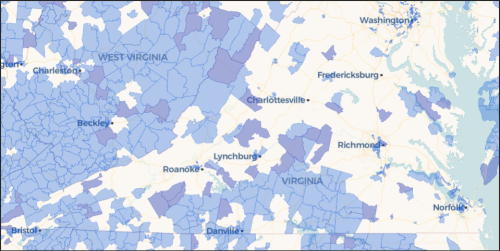
Thus, much of the EVCAP money filters through labor unions and social justice organizations. Presumably, Round 2 has similar requirements. How extensive do those “consultations” with “community stakeholders” have to be? That’s not spelled out.
By the time the state pays for its administrative overhead and favored constituencies take their rake-off, the latest round of funding is expected to average $27,500 per charging port — assuming no delays and cost overruns.
Charging stations in “disadvantaged” areas. One of the stated purposes of locating in disadvantaged areas is “to ensure accessibility for all.” The first obvious question is how many people living in “disadvantaged” areas — inner-city neighborhoods, remote rural areas, Indian reservations — want to drive electric vehicles. Is there really a stifled demand that is being held back by the lack of charging stations?
According to Motor & Wheels, higher-income households (earning more than $100,000 a year) account for 56% of EV owners in the U.S. Only 4% have household incomes of under $25,000. Is the problem here the lack of public charging stations? Or is it that EVs cost thousands of dollars more than comparable gas-fueled cars and, thus, are unaffordable to lower-income Americans? Could another problem be that people living in disadvantaged zip codes are less likely to reside in houses with garages or carports where they can easily recharge their cars? Or could it be that lower-income people are more likely to rent, which means they rely upon their landlords to make the electricity upgrades to their rental units that would enable them to charge a car in the first place?
The fact is that EV buyers are disproportionately affluent, White Democrat urban dwellers, not members of disadvantaged communities. Gaining access to charging ports for EVs they have little desire to own is not a high priority of the people actually living in disadvantaged communities… who tend not to be affluent, White Democrat urban dwellers.
But, but, but… this program isn’t just for the residents of disadvantaged areas, one can argue. It’s for visitors to tourist destinations. If that’s the case, one must ask, what is the purpose of arbitrarily locating more than half of the charging stations in disadvantaged areas? Why not locate the stations at tourist destinations with the most traffic regardless of socioeconomic surroundings? Why have this useless nod to “equity”?
Maintenance and repairs. Another issue dissuading people from relying upon charging stations is that a high percentage of the chargers don’t work. Estimates for non-functional charging ports range from 20% to 25%, depending upon location. Once nonprofit community “stakeholder” groups get their charging stations up and running, who will maintain them? Will the nonprofits do that? With whose money?
It so happens that the geniuses in the Federal Highway Administration actually have thought of that. In FY 2022 and 2023, the Electric Vehicle Charger Reliability and Accessibility Accelerator Program granted $148.8 million grants to 24 applicants nationally to “repair or replace broken or non-operational electric vehicle charging ports.” (None of the recipients were in Virginia.)
The FHWA estimated 4,471 ports would be fixed — a cost of roughly $33,000 per port. In other words, if you believe FHWA numbers, it will cost more to repair these ports than to install them from scratch in Virginia. You can’t make this up.
Private-sector efforts. There is no lack of interest among private-sector companies in building out EV charging infrastructure. The private sector managed to create gasoline-refueling infrastructure (known as gas stations) for automobiles in the early 20th century without government assistance, and there is no reason to believe that the private sector can’t do the same for EV ports.
Tesla has one of the biggest, most robust charging networks in the country — nearly 17,000 superchargers and destination chargers in the U.S. — and it has plenty of competition. Chargepoint, according to U.S. News, has more than 200,00 active public charging ports. EVgo was committed to having 1,800 fast-charging stalls in operation or under construction by the end of 2024. bp pulse aims to deploy more than 3,000 charging points by 2025. Francis Energy wants to install 50,000 ports by 2030. And none of that includes the efforts of Blink Charging Co., EVBox, or Schneider Electric.
I’m fairly confident that these private-sector vendors will pay attention to the little details…. like making sure their charging ports are still operational. As money-grubbing capitalists, they will likely want their charging stations to continue generating revenue.
Furthermore, as greedy profit maximisers, the capitalist roaders will locate the stations where there is most likely to be a demand for them. Will the virtuous, high-minded nonprofits seeking to bring “equity” to disadvantaged zip codes do the same? Or will they take the money, set up the charging stations, and then move on to the next government or foundation grant?
The very concept of “charging-port equity” is a nonsense idea drummed up by “progressives” with no skin in the game. It’s not their money, so they really don’t care if disadvantaged communities want the chargers or not. They’re just trying to reconcile their twin obsessions of “sustainability” and “equity” as not mutually exclusive.
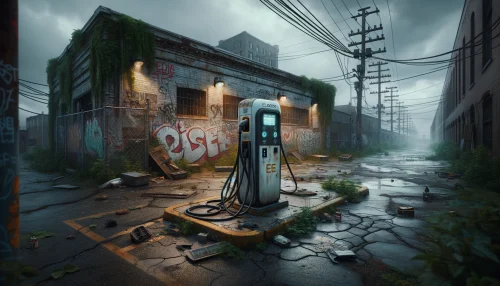
If the past is any guide, EV charging ports in Virginia’s disadvantaged areas under this new program will be under-utilized. Many will wear out, break down, get trashed by vandals, or have their copper ripped out by thieves. Unless someone is actively managing them as a business enterprise — or, as a backup, as a bureaucratic function of government — many will be orphaned and rendered inoperable within a few years.
If there is demand for EV ports at Monticello, Mount Vernon, Assateague, or the Blue Ridge Parkway, I’m pretty sure that Tesla, ChargePoint, EVgo, BP, or one of the others will be eager to meet it. Who would you rather have install, maintain and repair your charging ports? Tesla (if you hate Elon Musk, then substitute ChargePoint)? Or a virtuous, idealistic nonprofit outfit like Sustainable Justice R Us which may or may not be around tomorrow?
The foolishness of pouring millions of dollars into charging infrastructure is compounded by the fact that demand for EVs is growing much slower than hoped, and the Biden administration’s green industrial policy is a disaster zone that could well bankrupt most American-based automobile manufacturers before the EV market has a chance to mature.
Your taxpayer dollars at work… for the benefit of virtue-signaling elites spending other peoples’ money.


Leave a Reply
You must be logged in to post a comment.