
by Dick Hall-Sizemore
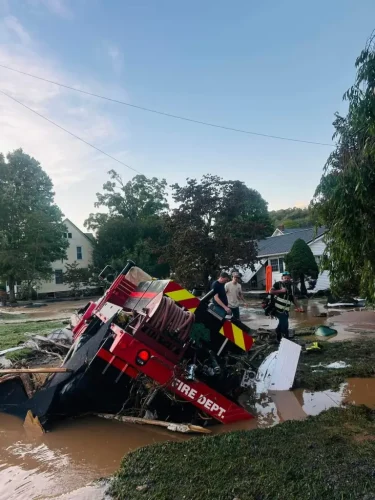
At his press conference in the Virginia Emergency Operation Center last fall in the aftermath of Hurricane Helen, Gov. Glenn Youngkin introduced “my newest best friend”—the representative from the Federal Emergency Management Agency (FEMA). (The “best friend” comment can be found at the 13:15 mark in the video.) When a major disaster occurs in the state this year, it is not certain that the governor’s “best friend” will be around, of if he is, what his role will be.
In January, President Trump declared that he wanted to eliminate FEMA. He issued an executive order establishing the “Federal Emergency Management Review Council.” The function of the Council was “to advise the President…on the existing ability of FEMA to capably and impartially address disasters occurring within the United States and…on all recommended changes related to FEMA to best serve the national interest.” He directed the Council to submit its report within 180 days of its first public meeting. Virginia’s Gov. Youngkin was appointed to be a member of the Council.
The Council had its first meeting on May 20. At that meeting, Secretary of Homeland Security, Kristi Noem seemed modify Trump’s declared wish to eliminate FEMA. As she put it, “The President has said to me many times that he believes FEMA should be eliminated as it exists.” (Emphasis added) She went on to declare “our goal is that states should manage their emergencies and we come in and support them and we’re there in a time of financial crisis.”
The confusing aspect of this scenario is that Noem’s “goal” is already the current role of FEMA. The federal statute underlying the federal disaster management activities, the Stafford Act, makes it clear that federal action is contingent on the request of the governor of the affected state and the federal role is one of coordination and assistance and is available. Such assistance is to be provided only if the federal government determines that “the disaster is of such severity and magnitude that effective response is beyond the capabilities of the State and affected local governments and that Federal assistance is necessary.” Furthermore, federal involvement is solely at the discretion of the President. According to its website, “FEMA coordinates the federal response to disasters that receive a Presidential disaster declaration. We work closely with officials in states, Tribal nations, and territories as they respond to disasters and make requests for federal assistance.”
There are two governors on the Council—Youngkin and Greg Abbott of Texas. During that inaugural meeting, neither governor complained about FEMA usurping the role of the states. Rather, they complained that FEMA is “slow and clunky” and requires “mind-numbing” stacks of paper to be filled out. Youngkin focused on “who’s responsible for what, when, and most importantly, who’s going to pay for it.” He went on to say, “Clarity is so important: How much are the states responsible for, how much is the federal government going to kick in, and how do we have certainty of what that amount is so that we can be ready?” Obviously, the governors do not want to eliminate FEMA; they want to make the process clearer and more efficient.
Nevertheless, Trump seems to have made up his mind, regardless of what the Council reports 16 months from now. “We want to wean off of FEMA and we want to bring it down to the state level,” he said on Tuesday [June 10] during a news briefing in the Oval Office. “We think after the hurricane season we’ll start phasing it out.”
Trump seems focused on the cost of disaster response and recovery to the federal government. At that same news conference on June 10, he complained, “It’s extremely expensive. When you have a tornado or a hurricane or you have a problem of any kind in a state, that’s what you have governors for. They’re supposed to fix those problems.” He went on, ““We’re moving it back to the states, so the governors can handle. That’s why they’re governors. If they can’t handle it, they shouldn’t be governor.”
Through FEMA, the federal government provides two kinds of financial assistance. The first is public assistance. State and local governments, as while as some nonprofit organizations, are eligible for reimbursement of some of the costs of debris removal and some protective measures, as well as for damage to public infrastructure. Generally, the federal share of those costs is 75 percent, although it can be higher under certain circumstances. See here for a summary of the Public Assistance program.
There also is financial assistance to individuals affected by natural disasters. The eligibility criteria and levels of assistance vary within the several programs. See here for summary descriptions of Individual Assistance.
Trump has warned states to expect “less money” from the federal government for disasters. Although he has not been specific, several mechanisms have been suggested to reduce the federal financial assistance. Noem has advocated the use of block grants. There have been internal proposals to increase the minimum criteria used to declare a major disaster.
In addition to warning of less money, Trump said that the money would come directly from his office. That would be a major departure from the current process in which FEMA, based on established criteria, recommends that a major disaster declared and, after the declaration, reimburses governments and individuals based on damage assessments and program criteria.
Regardless of the uncertain future of FEMA, June 1 marked the start of the Atlantic hurricane season. Despite Gov. Youngkin’s assurance that “FEMA’s ready to go to support anybody during hurricane season that needs it,” there is widespread concern that FEMA is not prepared. According to one report, “FEMA has lost about a quarter of its full-time staff, including one-fifth of the coordinating officers who manage responses to large-scale disasters.”
FEMA is without a full-time director. Trump withdrew the nomination of his first nominee the day after he told Congress that he did not think FEMA should be eliminated. The current nominee does not have any experience in disaster management and, according to the Wall Street Journal, was surprised at the breadth of FEMA’s responsibilities. Two weeks before the start of the 2025 hurricane season, the Journal reported, the agency did not have a fully formed disaster-response plan. Later, he told staff that there would be no change in the plan previously used, despite having told them to expect a new plan in late Mary. He reportedly commented that he was unaware that the country had a hurricane season. The agency and administration claimed that he was joking.
There have been defections in the top ranks of the agency. The deputy director resigned. She wrote staff, “I will not be complicit in the dismantling of this agency, and while I would implement change — even radical change — the current approach lacks a clear end state or plan, and has been done recklessly without regard to our current statutory or moral obligations to the American people.” On June 12, the director of the agency’s disaster command center submitted his resignation. According to the New York Times, the center is considered “FEMA’s 24-hour war room, where planning for responses to disasters occurs. It coordinates the federal, state and local responses, handling things like the deployment of search and rescue teams, assisting hospitals that have to evacuate, and shipping food and water to emergency sites.”
Disaster response and recovery directors throughout the country are preparing for the upcoming hurricane season under the assumption that FEMA will not be there for them this year. As one said, “The plan is this: We are planning that FEMA is not coming. We pray that FEMA is. But our contingency plan is that they aren’t. They may not set up disaster recovery centers; they might not go door to door to check on the most vulnerable. We may have to do that.”
For Virginia, the financial stakes are high. In response to a request from Bacon’s Rebellion, the Virginia Department of Emergency Management reported that the administration anticipates receiving $14 million in Individual Assistance funding and $340 million in Public Assistance funding related to damage inflicted by Hurricane Helene last fall. As devastating as the Helene damage was to affected areas, it was confined to a relatively small area of the Commonwealth. Eastern Virginia is highly vulnerable. A recent Old Dominion University report estimated that a class 3 hurricane hitting Hampton Roads would result in $15.6 billion in damage. That would be with a 3.6 feet tidal offset; with a 6.6 feet tidal offset, the damage estimate would more than double. Of that $15.6 billion estimate, damage to public buildings would account for $1.1 billion. In the amendments he proposed to the recent budget bill, Gov. Youngkin included an additional $300 million for the Revenue Reserve Fund. (Amendment no. 86 in the linked document.) The General Assembly accepted that amendment after reducing it to $294.5 million. If the changes to FEMA being threatened by Trump come to pass, the Commonwealth will probably need that extra reserve, and then some, to cope with disasters when they occur.
Leave a Reply
You must be logged in to post a comment.