
Data center demands create headaches for lawmakers
by David J. Toscano
As Donald Trump continues his campaign against offshore wind[1] and encourages the U.S. military to buy expensive, dirty coal[2], state governments are left to manage electricity affordability, reliability, and climate goals on their own.
It is a delicate balance. Consumers naturally want lower rates and reliability. But when it comes to energy policy, there is no free lunch. It is not simply finding the cheapest electrons, but ensuring that they can get to our homes, even if they have been generated from thousands of miles away. This requires transmission and distribution, two costly infrastructural needs whose costs are rising as our demand for electricity soars. When infrastructure is neglected, consumers face higher prices and power outages. Texas learned this lesson the hard way in 2021, when years of underinvestment caused major power outages during a historic winter storm. Today, Texas’s electricity rates and monthly bills exceed those of many states, even those that promote climate change initiatives.
With limited federal leadership, states must decide how to lower bills now without undermining long-term reliability and sustainability—and be honest about who bears the costs.
Rates are rising — and so is demand
Average residential electricity rates have risen 37% nationally since 2020. States investing heavily in infrastructure or lacking easy access to natural gas—such as California, Vermont, and Massachusetts—have seen the sharpest increases. Resource-rich states like Louisiana and South Dakota have experienced smaller hikes.
Rates, however, don’t tell the full story. Usage matters. In Virginia, electric rates remain below the national average, but typical household bills rose 27% between 2021 and 2025, reaching an average of over $167 per month—higher than those in New York and nearly matching Texas and Florida. Low-income households are hit hardest; a recent Virginia study found electricity consuming up to 17.5% of their monthly budgets.
The causes of these increases are numerous and differ from state to state. Hawaii has higher rates because its access to sources of electricity is difficult; Washington’s are lower due to its proximity to hydroelectric power.
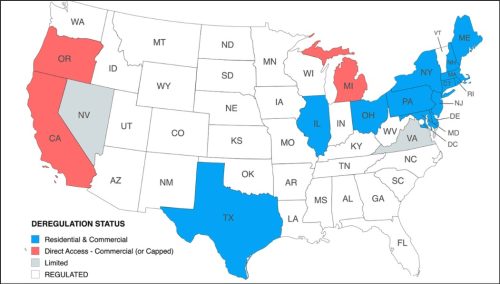
Regulatory conditions also differ. Most states have utility commissions (PUCs), but their roles vary depending on competition in the marketplace. In places like Virginia, where investor-owned utilities like Dominion Energy and Appalachian Power dominate, our PUC, called the State Corporation Commission (SCC), has great power over rates. Other states, primarily in the Northeast, have deregulated systems where consumers can buy their electricity from different providers. But even in these deregulated markets, a utility that has monopoly control over the poles and wires of transmission and distribution is regulated by PUCs to ensure the rates for those services are reasonable and prudent. In all instances, energy providers pass on increasing costs, whether they are derived from the fuel itself, or from maintaining an aging infrastructure.
The disruption of data centers
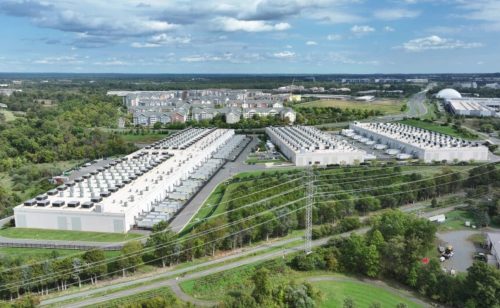
After years of flat demand, U.S. electricity consumption is surging, primarily due to the proliferation of data centers—especially those powering artificial intelligence. These facilities bring economic benefits to states and local communities, but consume enormous amounts of energy, driving up rates and forcing costly grid upgrades that utilities pass on to consumers.
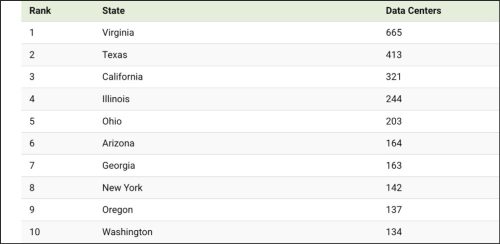
Virginia hosts more data centers than any other state. And more and bigger ones are coming. A single Google facility planned for rural Botetourt County will span nearly 900,000 square feet. In Texas, “Stargate Abilene”—a massive data campus backed by OpenAI, Oracle, and SoftBank—will approach 4 million square feet by 2026.
Electricity use by these facilities has grown exponentially. In 2007, data centers used just 1.5% of U.S. electricity; by 2030, usage is projected to exceed 12%. Utilities are struggling to keep up, not just in the production of energy to feed these behemoths, but the means to transport it.
The U.S. does not presently produce enough electricity to meet this unprecedented need. Yes, we need more wind and solar. But are they scalable quickly enough? The electricity demand will be most acute in states like Virginia and Texas. Virginia Dominion Energy estimates that data centers will drive 85% of Virginia’s new power demand over the next 15 years. And the Electric Power Research Institute projects that data centers in Texas will account for over 10% of that state’s power consumption by 2030, leading rates to almost double in the next five years.
States push back
In the last decade, states began to lure data centers with generous tax breaks—often without anticipating their scale or impact on energy use. Virginia was the first to grant large subsidies. Since the Commonwealth began granting tax exemptions in 2009, over $2.7 billion has been provided, including $1 billion in 2024 alone. Many states followed, and the tax breaks have been hefty. In 2024, Georgia waived $2.3 billion in taxes while Texas subsidies approached $1 billion.
The energy and environmental consequences of more data centers have lawmakers concerned. In New York, Governor Hochul said that data centers should either “pay their fair share” or generate their own power. The new governor of New Jersey, Mikie Sherrill, recently ordered the state’s Board of Public Utilities to provide credits for ratepayers and pause proceedings that could approve new rate increases.
States like Michigan, Pennsylvania, Maine and New Jersey are exploring moratoria on new data centers; others like Oregon, Virginia and Ohio are adopting special rate classes so data centers pay higher rates than residential customers. Virginia legislators are advancing a proposal that would raise data center bills by about 15% while reducing residential bills by roughly $5.50 per month.
Reliability risks
Beyond cost, data centers pose challenges to our electric grid. The North American Electric Reliability Corporation recently warned that their constant, high demand makes it more difficult to sustain sufficient electricity supply under extreme conditions. Fluctuating usage from these centers can create havoc. Unlike traditional industries, data centers can “drop” or “add” massive amounts of electricity to the grid almost instantly.
If several centers temporarily go off line, the grid can be flooded with excess power, overtaxing the system and causing blackouts. In mid-July 2024, data center demand equaling nearly a third of all households in northern Virginia suddenly disappeared from the grid; a disconnection of 60 data centers in northern Virginia caused a 1,500-megawatt power surplus, which forced emergency adjustments to prevent cascading outages. Backup diesel generators further raise environmental and health concerns, and utilities are seeking to build more natural gas peaker plants to address demand.
States are responding by tying subsidies to efficiency standards, cleaner backup power, and on-site generation such as solar and battery storage. One Virginia bill would condition data center subsidies to locating clean energy generation on-site. Alternatives like battery storage could add grid capacity, improve reliability, and help hold down residential rates. Some data center facilities in Texas are including battery storage in their plans; Google’s new data center in Haskell County will be paired with a new solar and battery storage plant.
Keep climate change in mind
Despite the challenges of higher rates brought on by data centers, some lawmakers continue to stress the link between electricity rates and climate goals. One way to dampen electricity costs is to reduce demand by making buildings more efficient. This was one reason why new governor Abigail Spanberger in Virginia decided to rejoin the 10-state consortium called the Regional Greenhouse Gas Initiative (RGGI) after a two-year hiatus. The program is typically viewed as a climate change initiative; carbon emissions declined by 22% during the years Virginia was in the program, only to rise by 20.5% in the two years after Gov. Youngkin removed the state.
But RGGI is more than that! States receive millions of dollars from their participation. Virginia uses one-half of RGGI monies[3] to improve energy efficiency—and reduce bills—for low-income families. Like most states, Virginia utilities are permitted to recapture the costs for RGGI participation from ratepayers—-$2.39 per month for a typical residential customer(the RGGI Rider)when Youngkin took office in 2022. So rejoining will likely mean a small monthly increase for Virginia ratepayers. But a 2023 VCU study found that funds from RGGI monies could provide energy upgrades to as many as 130,000 homes by 2030, creating $89 million in energy savings, an average annual reduction of $676 per household. Unfortunately, nearly $120 million in RGGI housing funds remain unspent due to inaction by the prior administration. One goal of the Spanberger administration is to get these funds into the field.
Leadership is needed
There is no single fix for rising energy costs. Cheap power without investment is an illusion—and the bill always comes due. Who will pay, and when, will determine whether we emerge with resilient energy systems or face recurring crises marked by higher costs, reduced reliability, and diminished public trust. And with little federal leadership, much of the success or failure of this effort will be determined by the states.
David J. Toscano, a former Virginia House Minority Leader, publishes the Fights of Our Lives blog on Substack. This column is republished with his permission.
[1] On Dec. 22, 2025, The Trump administration paused leases for five large-scale offshore wind projects off the East Coast in an effort to prevent their construction or operations. Different federal courts then issued preliminary injunctions allowing each of the five to resume construction. Virginia’s Coastal Virginia Offshore Wind (CVOW) is a 2.6-gigawatt (GW) commercial project, making it the largest in the U.S. and the first owned by an electric utility company, Dominion Energy. It will likely begin producing power in the next several months. The wind turbines will soar 836 feet into the air, and when operating, CVOW will generate enough energy to serve 660,000 homes. Since turbines are located 27 miles offshore, only the upper portions of the are visible from land.
[2] This decision not only harms the climate, but forces the military to spend more for electricity from coal even if cheaper sources such as natural gas and renewables are available. In 2024, 16% of US power generation came from coal, down from 40% in 2014.
[3] The other half is used for storm mitigation and coastal resiliency. During the years prior to Youngkin’s withdrawal from the program, about $832 million in RGGI monies were received by Virginia.
Leave a Reply
You must be logged in to post a comment.