
by Anonymous
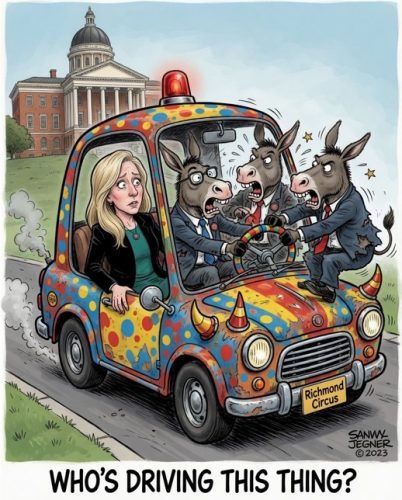
At several key moments, Governor Abigail Spanberger has struggled to define her own agenda.
During the campaign, she emphasized “affordability,” but the rollout leaned more on broad themes than specific, actionable proposals. Historically, new governors tend to anchor their first session with a clear set of priorities—legislation that signals direction and gives their party something concrete to organize around. That kind of defining initiative never fully materialized.
In the absence of that clarity, the General Assembly did what legislatures always do: It filled the space. Lawmakers advanced their own priorities, not all of which aligned with Spanberger’s stated goal of governing from the middle. Once that dynamic takes hold, it becomes difficult for any governor to reassert control.
At the same time, the administration never seemed to fully settle into a rhythm with the press. Previous governors—whether Terry McAuliffe or Glenn Youngkin—were willing to engage consistently, even under pressure, using regular interaction to shape their narrative. By contrast, Spanberger’s approach has been more limited, relying heavily on staged appearances without the same level of sustained policy discussion. In a media environment like Richmond’s, where access and relationships still matter, that choice has consequences.
There is also a structural reality at play that every new governor eventually confronts: the legislature will test the boundaries of executive authority. It’s not personal—it’s institutional. Successful governors typically establish early, unmistakably, that they intend to lead. When that signal is unclear, legislators—regardless of party—tend to assume a larger role.
So far, Spanberger has taken a lighter touch. When major initiatives emerged from her own party that could complicate her moderate positioning, her responses were often muted or delayed. In several high-profile cases, lawmakers declined to adopt her proposed changes and moved forward without them—an unusual dynamic, particularly within a governor’s own party. Over time, that pattern can create the perception that the center of gravity in Richmond lies in the General Assembly, not the Executive Mansion.
The decision to allow a special session to proceed without a clear resolution has only reinforced that perception. Once underway, it shifts leverage toward the legislature and limits a governor’s ability to control timing and outcomes.
Taken together, these choices have left the administration at a crossroads.
One path is to continue working within the current framework—signing most legislation, managing around the edges, and focusing on the traditional tools of the office: administration, appointments, and economic development. That approach would prioritize stability, but it risks cementing the perception that the governor is reacting rather than leading.
The other path is more assertive—using the full scope of executive authority to draw sharper lines and reestablish priorities. That carries its own risks, including conflict with legislative allies and disruption of the party’s broader agenda. But it would also clarify where decisions are ultimately made.
Either way, the underlying challenge is the same: in Richmond, as in any capital, if a governor does not define the agenda early, someone else will.
Leave a Reply
You must be logged in to post a comment.