
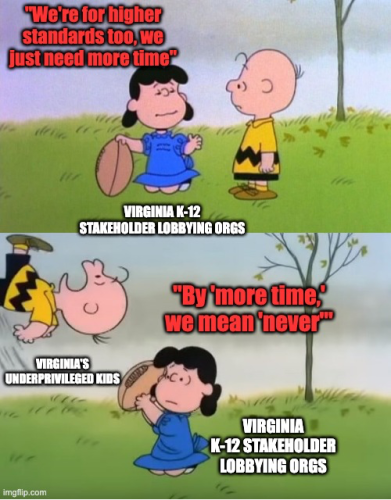
After years of delays, the proposed additional delay sets up a likely strong push for another delay in 2 years by powerful lobbying groups for those who work in the K-12 system…at the expense of Virginia students and parents
As a supporter of Governor Abigail Spanberger, I’ve been impressed by much of the new administration’s promises on the campaign trail and in their first day executive order on higher expectations for Virginia’s public schools.
The administration’s upcoming presentation to the Virginia Board of Education on the Assessment and Accountability Roadmap attempts to confirm this commitment. The presentation lays out their administration’s policy plans in detail, with multiple strong accountability elements and repeatedly affirms a commitment to higher expectations.
Unfortunately, the same presentation’s proposal to delay any increase in the minimum thresholds for “passing” state English and Math standardized tests (“cut scores”) by two more years does the exact opposite. Instead, they propose changing the 4-year gradual cut score hikes scheduled to begin this fall into a single large increase in Fall 2028-2029 to coincide with implementation of accountability changes and new assessments. One can see the “stakeholder” voices—school administrators and teachers associations—almost certainly arguing in a couple years that it’s “too much at once” and lobbying for yet another delay or another long phase-in.
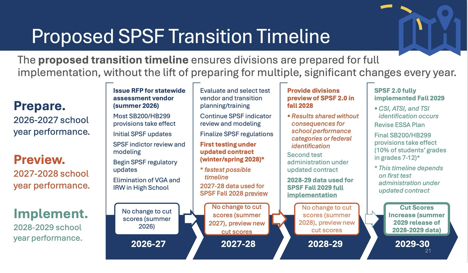
Source: Virginia Department of Education, June 2026
Virginia’s cut scores have embarrassingly remained the lowest in the nation for years, and this proposed move extends that embarrassing distinction even further. In the best-case scenario, the proposal is a politically naïve concession to the powerful K-12 lobby. In the worst-case scenario, it is a policy giveaway to those who are employed by and administer the public school system and their powerful lobbyists. In either case, Virginia students and families will pay the price if such proposal is enacted by the Board in August.
It’s worth noting that the Youngkin administration’s own repeated delays on this issue were also politically naïve (chasing “best practices” from the think tank world, not the real political world) and kicked the can of the tough implementation work to the incoming administration. That was unfair to the new administration.
Yet two more years of the nation’s lowest proficiency bars is far more unfair to
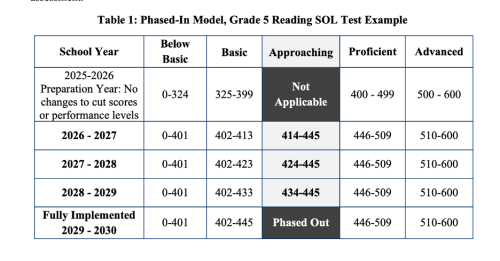
Source: Virginia Department of Education, November 2025
Virginia’s students and parents, especially the least advantaged ones who depend most on strong public schools to close opportunity gaps. The purpose of the public school system is to educate students—its purpose is not to provide jobs or to help those who run them avoid tough conversations.
The Hypocrisy of Selective Stakeholder Opposition: Lowering Standards Went Largely Unchallenged
A 2021 U.S. Department of Education (USED) review ranked Virginia at the
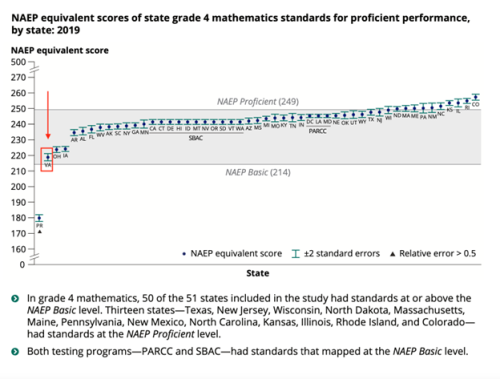
bottom for fourth- and eighth-grade reading and math proficiency thresholds, which USED reconfirmed in 2024. Youngkin campaigned in 2021 on raising them and promised in 2022 to have them raised by Spring 2023, but then his administration dragged the process out for years. After finally proposing last year to raise them effective Fall 2025, the Board of Ed eventually agreed to a four-year gradual increase and a delay of the first increase until Fall 2026 after strong advocacy from stakeholder groups for such delay and phased-in approach.
Major stakeholder groups had advocated for years for delays in accountability changes and cut score increases while continuing to say they support higher standards – a “we’re for higher standards, but not yet” approach. In Fall 2025, the Virginia Association of School Superintendents (VASS) was arguing for an 8-year implementation period for the new higher cut scores (kicking full implementation until Fall 2033, which would have taken place over four gubernatorial administrations). After the Youngkin administration agreed to a 4-year transition, VASS strongly praised the 4-year phase-in for allowing “intentional transition planning.”
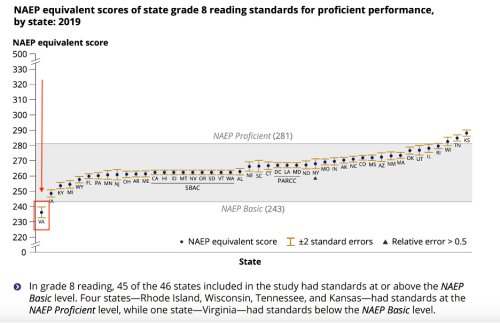
Source: U.S. Department of Education, 2022
The Virginia Education Association similarly urged in Fall 2025 for a pause on “drastic cut score changes until real impact modeling is done” and stated it “does not support changes that would negatively impact students.” It framed reforms as “moving the goalposts midgame.”
The vigorous pushback from stakeholder groups against raising cut scores stands in stark contrast to what happened when Math and English standards were lowered to the lowest in the nation in 2019 and 2020, respectively. Both changes took effect immediately mid-school year. Moreover, this inexplicable lowering of standards took place at the same time other states were dramatically raising their state standards after the federal government was removed from enforcing accountability as part of the 2015 U.S. Every Student Succeeds Act.
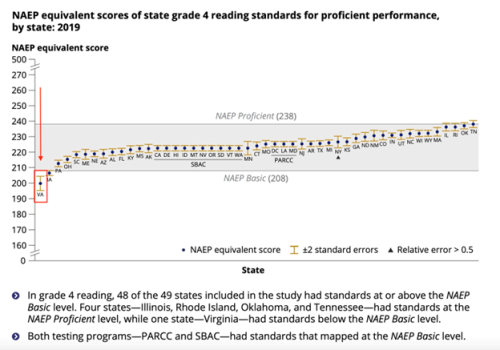
Source: U.S. Department of Education, 2022
The minutes of those 2019 and 2020 Board meetings omit any mention of opposition from major stakeholder groups. None of their representatives were there arguing that the lowering of standards would hurt students or was “too soon” or was “moving the goalposts midgame” or demanded extensive modeling, delays and extended phase-ins, or protections against any negative impacts on workloads.
Louisiana’s Experience Shows Delay Is a Common Maneuver for Stakeholder Groups
This dynamic is not unique to Virginia. Louisiana’s recent accountability overhaul provides a near-perfect parallel. Their then-proposed tougher accountability system had been in the works since at least 2022. It was finally approved by the state board in June 2024 for implementation beginning in the 2025-2026 school year — giving districts roughly two more full years to prepare.
Even with that multi-year runway, an association of Louisiana school superintendents requested extensions and voted to urge postponement. “Slow it down and fix it,” said one superintendent, citing concerns about supposed unrealistic goals and potential drops in school ratings. The pattern is national — K-12 education “stakeholders” verbally say they support higher state standards until the moment they might actually arrive.
The Real Cost: Keeping Rock Bottom Standards Leaves Virginia’s Most Disadvantaged Students Behind
If Virginia stakeholders had prevailed with endless calls for pauses and “protections,” Virginia would still be stuck with the old, inferior accountability system. The review by JLARC—the Joint Legislative Audit and Review Commission, the nonpartisan oversight agency of the Virginia General Assembly—found the new School Performance & Support Framework (SPSF) more effective and useful than the prior system at identifying needs and driving improvement. Restating, the new SPSF is bringing tangible improvements to Virginia schools and students, which would not be happening if the stakeholder groups had gotten their way.
Prolonged low cut scores continue to misinform parents about their children’s actual academic performance and keep the system anchored to weaker metrics. Schools and leaders face less pressure from honest reporting to parents and communities, while students — particularly disadvantaged ones — endure expectations that fail to prepare them adequately for postsecondary success.
What Can You Do?
The Virginia Board of Education will hear this plan at first review on Wednesday and Thursday, and would not vote to approve it (if not modified) until the following Board meeting on August 25. You can submit public comment here to express your objection to the proposal of continuing with the nation’s lowest cut scores for another two years.
Leave a Reply
You must be logged in to post a comment.