
Do Virginia Universities Give Excessive Aid to Out-of-State Students?
Share this article
ADVERTISEMENT
(comments below)
Comments
Comments
7 responses to “Do Virginia Universities Give Excessive Aid to Out-of-State Students?”
-
The great driving force behind this aid to out of state students is William and Mary’s and UVA’s quest to improve their national ratings in US News and World Report rankings and their ilk.
Today these rankings heavily influence most every move that select colleges and universities make, particularly how they spend money. The quest for rankings does great harm to these institutions primary mission, the effective and caring teaching of individual students.
-
If Dominion Power or Washington Gas increased their prices at a rate equal to those of public colleges and universities, the state would be up in arms. It’s a clear case of public institutions operating without regard to their mission – to serve the people of Virginia. We need cost control and more efficiency.
I think it’s a good idea to have some students from other states attend Virginia colleges. Just like it’s a good idea for some our H.S. graduates to attend out-of-state schools. And to this end, it seems reasonable for Virginia schools to offer some financial aid to some non-resident students. But when a majority of the money goes to non-residents, something is out of kilter. A properly managed university would not provoke legislative action.
-
so listening to comments of recent… the sentiment is to have the General Assembly regulate the price of tuition? yes?
-
Larry, I don’t agree that the GA should set the price of tuition directly. I do think they could take steps to improve information, which is necessary to have an effective market. One example of this was getting the institutions to publish a breakdown of fees, which has brought attention to athletic fees in particular. Another would be to get institutions to separate out institutional research expenditures from actual instruction costs. (California included this in legislation.) I know you are skeptical of this, but I believe a huge amount of tuition goes to institutional research and it hidden by the way universities do accounting.
I think student loans are a significant part of the issue, and that is a federal level issue. About 40% of borrowers aren’t making payments or are behind, which could cost taxpayers $30B or more per year. The government needs to put conditions on this how the loans can be applied. For instance, exclude non-core items like athletic fees. That would put some pressure on institutions and perhaps keep debt and default levels lower.
If I could start from scratch, I’d have structured the whole system differently, with any state subsidies going directly to individuals rather than to the state institutions. I don’t think this is going to happen any time soon, though.
-
Actually Izzo , your point about mandatory transparency – I agree with.
It’s akin to the State requiring localities to file their financial reports in a standardized form that allow comparison between the counties on specific revenues and expenditures.
so I agree. how’s that for a shocker?
but to this point – so far – the “comparisons” being made are not clear and not apples-to-apples ….and need to be if we are to make informed judgements.
At this point – I’m suspecting that the bulk of R&D comes from alumni, the Feds, patent income, and the like rather than students because I’m not seeing huge cost differences between research an non-research institutions but totally would support more transparency.
I also suspect student fees for things beyond tuition and other direct academic items is involved.. which we would know also if we had more transparency.
-
Larry,
“At this point – I’m suspecting that the bulk of R&D comes from alumni, the Feds, patent income, and the like rather than students”
I am talking about internally-funded research, not external, and FED is external. PATENT INCOME is only a little over $2B a year ( https://www.bloomberg.com/graphics/2016-university-patents/ ) we are talking about what is about $30B+ per year for all types of internally-funded research. ALUMNI gifts are 80% restricted and not going to cover this.
I suggest you read the following from a former Provost which explains how this works and shows that most internally-funded research is just accounted for and paid for as any other instructional cost:
http://www.changinghighereducation.com/2016/08/the-high-cost-of-funded-research.html
And this, which shows that research universities have much higher costs than non-research, which is one of your core issues:
-
-
-
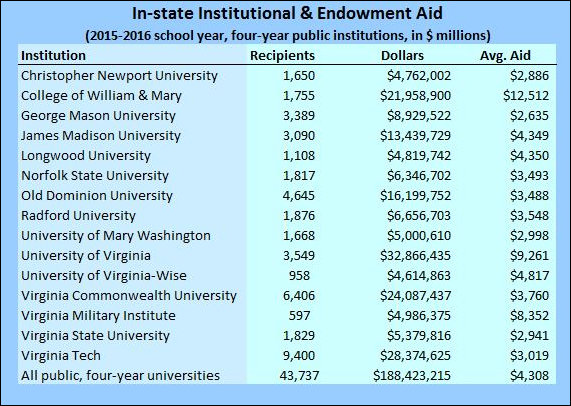
Only UVA, VMI, GMU, and VSU spend more on on of state aid on a total dollar basis. VMI is a small, unique, specialized school and they probably need to do it to maintain a reasonable enrollment. Virginia State as 32% of students from out of state and probably needs them to maintain a reasonable enrollment. UVA is need blind, which probably drives up the amount. The flip side of that is need blind admissions probably drive up out of state applications, which lowers UVA’s overall acceptance rate, which is a benefit in rankings. The acceptance rate would be close to 50% without the out of state applicants. Not sure why GMU would be that high.


Leave a Reply
You must be logged in to post a comment.