
Academic department puts million-dollar mark on football field
by Joe Fitzgerald
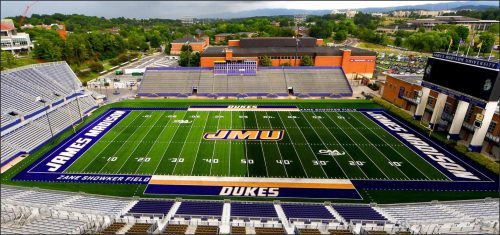
There either is or should be a rule that says if your organization is doing something that makes absolutely no sense to most of the people outside and many of the people inside, you should explain it better or do it differently.
Specifically, if one of your academic departments is paying a million dollars to the athletic department to advertise on the football field, you might want to explain it as more than a partnership. But first, you’d have to figure out what it is.
Paraphrasing the Daily News-Record story, with sponsorship logos on the playing surface now allowed by the NCAA, the JMU School of Professional and Continuing Education had purchased the right to place its logo at each 25-yard line at Bridgeforth Stadium. JMU SPCE will pay JMU athletics $1,066,675 total through the 2028-29 academic year.
Images in JMU’s marketing of this deal show just the name of the SPCE painted on the field. Nothing about what the school does or what it can do for the average football fan. Just the name.
As one official in the SPCE explains it, “This partnership reflects the heart of our mission at SPCE—opening JMU’s doors wider and taller to serve our entire community.”
Wider and taller?
A sports official says in a release, “Not only does this enhance our revenue, which allows us to maximize student-athlete opportunities and enhance the experience we can provide, it is most remarkable in that it is a testament to part of the mission of collegiate athletics, which is to shine a spotlight on the institution and, in this case, promote lifelong educational opportunities for our community.”
Thought exercise. Ask your favorite AI program to parse that sentence.
Let’s think how this works. A fan at a football game, his mind wandering because the Dukes are up by 21 in the second quarter, does not look at the cheerleaders or the view of the Shenandoah Valley from Bridgeforth on the half-shell. Instead he notices the name of the SPCE on the 25-yard line, googles it, and decides to continue his education. Let’s say this happens 25 times a game for a half-dozen home games, and a third of those captivated by the signage sign up for SPCE. The school would then increase its student body by ten percent.
Except it doesn’t really have a student body. It serves a few hundred non-traditional students, with fewer than 100 of them graduating in any given year. These numbers are not exactly guesswork, but they’re not in-depth either. They come from a cursory look at the marketing and advertising sites for the school. Said marketing is able to spend a quarter-million dollars a year for four years to write its name on a football field.
Suggesting graffiti as an alternative would probably be rude.
One has to wonder if that’s the entire marketing budget. Assuming it’s not, what part of the budget is it? Half? A quarter?
From the outside, spray-painting the name on the field reflects the heart of the mission for one JMU department and enhances the experience that another can provide. Their phrasing, not mine. And while that phrasing is not exactly gobbledygook, it also doesn’t escape the vague generalities of marketing copy. How exactly does this transfer of wealth from academics to athletics benefit the student? Does it lower the price of textbooks or underwrite an adjunct’s salary?
There’s a brick circle in the middle of JMU’s Quad. The college I worked for had a round logo, and when putting together a slideshow for new faculty one year, I superimposed the college’s logo on the brick circle on one slide. It was a whimsical thing, and never escaped the auditorium where new folks gathered. In retrospect, it might have been worth a million bucks. But I’m unclear if I would have received the money or had to pay it. Because obviously, I don’t know how these things works or how they make sense. And maybe it’s arrogance on my part to think the problem doesn’t lie with me. If your organization is doing something that makes absolutely no sense to most of the people outside and many of the people inside, you should explain it better or do it differently.
Joe Fitzgerald is a former mayor of the City of Harrisonburg. This column is republished with permission from his blog Still Not Sleeping.
Leave a Reply
You must be logged in to post a comment.