
by Steve Haner
The four-part rate hike hitting Dominion Energy Virginia bills by September 1 is now five parts. The increase of more than $14 on a 1,000-kilowatt hour residential bill will now be just under $17 instead. The price we are paying for Dominion’s offshore wind project is also going up.
The expected additional $2.60 price hike to cover that construction project was mentioned in the earlier article. The State Corporation Commission blessed it with a final order August 11. Rather than reading that, if you really want details read the earlier supportive report from the SCC staff hearing examiner, which summarizes the case record.
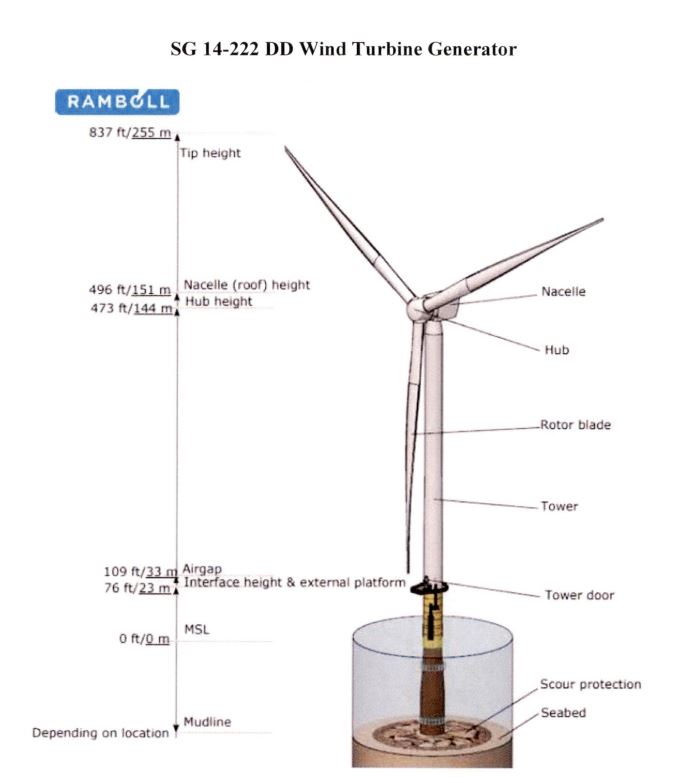
Where credit is earned, it should be given. Dominion’s massive and complex project is proceeding on schedule and largely on budget. Sometime next month people on Virginia Beach may be able to peer out and see the first of the full turbine blades sets installed and towering 840 feet above the sea. Also worth a read is the construction progress update included in the case file.
Yes, Dominion has experienced cost overruns, but they seem to be things Dominion could not control, such as higher transmission charges for interconnecting the facility to the PJM Interconnection grid, and the impact of President Donald Trump’s tariffs. The import taxes remain a moving target, but if he European Union base tariff remains at the current 15% then the full tariff impact could reach $640 million. That is not inconsequential.
Starting September 1, the full cost on residential bills will be $11.23 per 1,000 kWh, with large industrial customers paying $7.96 per 1,000 kWh. Assuming the project stays on budget and begins full operation by the end of 2026, those should be the peak amounts for the Rider OSW that is used to collect the capital costs over time. It should then begin to decline.
The project is one of the few that will still qualify in full for the federal tax credits that existed before Trump’s One Big Beautiful Bill Act. At the beginning, Dominion was planning to claim the investment tax credit (ITC) on its capital costs, but instead now will claim the production tax credit (PTC) on the energy output. Dominion’s introduced evidence said the ITC would save customers about $5.6 billion but the PTC will save $6.6 billion over 30 years.
The cost of the project is going away entirely (perhaps already has) for the subset of Dominion Energy’s customers who are enrolled in a Percentage of Income Payment Plan or PIPP. The SCC has settled a long debate over how to implement the General Assembly’s instruction in 2020 that certain low-income Virginians do not have to pay for the wind farm.
The original Virginia Clean Economy Act, which made this whole project possible, included a provision creating PIPP, which places a cap based on income on how much those low-income customers pay for electricity. The difference is covered by the rest of us. PIPP finally started enrolling Dominion customers in early 2024.
But the original VCEA language dealing with the exemption on the wind project was broader, applying it to all customer households with an income at or below 150% of the federal poverty level. In other places and in other revisions, the exemption was granted to PIPP participants or PIPP-eligible customers. The language was in conflict.
One of the things our courts are supposed to do is clarify what the General Assembly has done when its own words create confusion. Cutting to the chase, the SCC has accepted Dominion’s argument that it has no way to know which of its customers have such low income, but it can get the list of people who have qualified for PIPP from the Department of Social Services. The broader language based on 150% of poverty would have encompassed far more Dominion households.
Should such a household use an average of 1,000 kWh per month, the wind cost exemption with the price increase is worth $140 per year. Coupled with the subsidy granted under PIPP to customers with higher electric bills, the economic incentive to sign up may encourage growing participation.
Leave a Reply
You must be logged in to post a comment.