
by Chap Petersen
I spent this weekend in Charlottesville celebrating the graduation of my daughter Mary Walton. Very proud of her.
In the colonial era, the town of Charlottesville and surrounding Albemarle County was the western frontier of Virginia. Beyond it lay the Blue Ridge mountains, the Shenandoah Valley and the fierce Shawnee Indians.
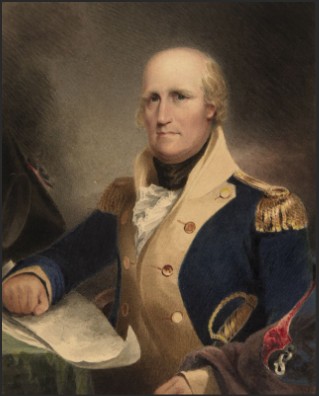
In 1777, in the midst of War with the British King, the Virginia legislature raised an army under George Rogers Clark, a militia captain and noted frontiersman. The mission was simple: protect the American settlers in far western Virginia (modern-day Kentucky) from the pillaging Shawnee, acting at the behest of the British general Henry Hamilton, who was called “the Hair-buyer” due to the sums he paid for American scalps, including women and children.
The ensuing campaign was one of the most impactful in American history. Clark’s small army tramped through the wilderness of western Virginia, then floated up the Ohio River till they reached the Wabash River in the winter of 1778. Deep in enemy country, holding their rifles above the freezing water to keep the powder dry, Clark’s men waded up the river. Reaching Hamilton’s fort at Vincennes, they attacked without warning, driving off the British and capturing the fort. Soon they controlled the entire Northwest Territory, beyond the Ohio River.
Having established his authority, Clark promptly made peace with the Shawnee, who recognized his martial skills by naming him “Long Knife.” That peace preserved the lives of hundreds of frontier settlers. In the Paris Treaty of 1783, the U.S. claimed all the land of the Northwest Territory, later forming the states of Ohio, Indiana, Illinois and Michigan.
The campaign of George Rogers Clark made the fledgling United States a continental power, not just a few coastal colonies. A century later, his achievements were commemorated by a handsome statue along Main Street in Charlottesville, commending him as “Conqueror of the Northwest”.
A generation later, the United States had acquired the Missouri Valley through the Louisiana Purchase, thereby doubling the nation’s size. The territory was vast, lightly inhabited and completely unknown.
President Thomas Jefferson tapped his friend and Albemarle County neighbor, Meriweather Lewis, to lead an exploration and scientific study of the West. Knowing that there would be potential conflict, Lewis chose William Clark, a military officer and younger brother of George Rogers Clark, as his co-captain.
The Lewis and Clark expedition crossed the American continent to the Pacific Ocean while faithfully documenting the wildlife, mountain ranges and Indian tribes. For the first time, Americans visualized a “sea to shining sea” democratic empire. This was not a small thing.
In recognition of this local hero, the City of Charlottesville erected a downtown statue to Lewis and Clark, also depicting Sacajawea, the Shoshone native who joined the expedition and helped them negotiate a fragile truce as they crossed the Rockies. Today, neither statue remains.
Each was deemed to be an example of “white supremacy” in 2021 and thereupon removed by complacent local authorities. (Ironically these same authorities did not remove any statues of Thomas Jefferson or James Madison who both owned slaves and adopted slavery into the U.S. Constitution).
Of course, modern America would not exist but for the efforts of men like Lewis and the Clarks. Empires are not created through philosophy lectures or Tupperware parties. It takes real humans who have a vision, put their lives at risk and impose their will on an uncertain outcome.
The birth of the United States, like every nation, was a violent affair. But it also had an extraordinary impact on world history. It has been the Land of Opportunity for hundreds of millions. It has been a breadbasket for the world’s hungry, a doctor to the world’s sick and a protector of billions faced by Fascism and Communism.
But for Lewis and the Clarks, none of this would have happened.
So why aren’t they recognized in Virginia?
Chap Petersen, a former state senator, practices law in Northern Virginia. This column is republished with permission his newsletter, The Virginia Attorney.
Leave a Reply
You must be logged in to post a comment.