Ranked Choice Voting is Spreading. Do We Like It?

By Steve Haner

Virginia’s experiment with ranked choice voting may soon expand to a second locality, as the Charlottesville City Council is now considering that method for its future local elections. It is time for more people to pay attention to this voting method and decide whether they think it is a good idea.   

The pros and cons are complex, and opinions are strong on both sides. Current Virginia elections allow a victory with a plurality, often far less than a majority of the votes cast. Making voters declare a second or third (or fourth or fifth) choice and continuing to count until a majority is reached is a major shift in our elections.   

Former Virginia Delegate Sally Hudson, a Charlottesville Democrat, is leading one Virginia-based effort to expand the process here, Ranked Choice Virginia. Another, UpVote Virginia touts its bipartisan support, mentioning Congressman Don Beyer (D) and former Governor George Allen (R). The Foundation for Government Accountability, a national group on the other side, considers the idea a disaster.  

It is one thing to use the method in a party nomination contest, as Virginia Republicans did when they chose Glenn Youngkin as their nominee in 2021. It may also be an attractive option when electing a local governing body that runs at-large, say, with ten candidates seeking five seats.   

But would we really want the second-choice votes of Robert F. Kennedy Jr.’s voters determining the outcome of Virginia’s 2024 presidential contest? It is perfectly conceivable that the first-round result would be a close election, neither party nominee with 50%, and then a small handful of RFK voters could flip the outcome and award Virginia’s 13 electoral votes to the person in second place on election night.    

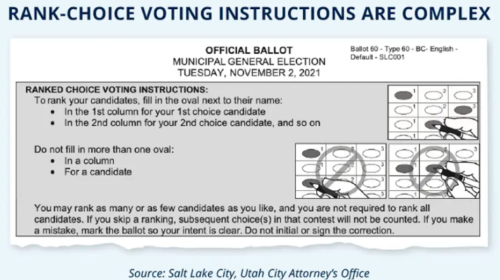
Once you decide that Virginia should make this philosophical shift away from allowing a plurality to prevail, then the technical questions come up. One of the strongest arguments against this new method is its complexity and the likelihood many voters will be confused and even frustrated, especially in those cases where they do have to go beyond just a second choice.  

For several years I have served as the ballot officer in my local precinct, handing out and tracking the paper ballots and dealing with any questions from voters about how to mark them. Every year a fair number spoil their ballots by either using an X or a circle rather than filling in the bubble, or by marking a name they didn’t intend. It is safe to predict that with this method  1) there will be far more spoiled ballots; and 2) voters will be standing longer in the booth to fill them out, adding to the lines.   

But in researching this column and looking at the rules Virginia has already created as Arlington County moved into this brave new world, another of my major concerns is allayed. The State Board of Elections has even posted an instructional video. The election officers at the end of election day will only report the first-round result. If a candidate has achieved a majority, that is the end of it. If not, they aren’t the people who keep counting. 

If a candidate has not achieved a majority after the absentee and provisional ballots are reviewed and added to round one, that is when the second (or third or fourth) round counts proceed. That post-election process becomes far more important.  

But the idea that many elections (perhaps most) would now spark a full recount process, such as the Fifth Congressional District primary just went through, raises its own issues. Cost will be high on the list. The long delays in knowing who won will also frustrate people. Some advocates claim a computer ballot box can do all the counts at once, but those who already doubt the security of the counting machines will double down on their conspiracy theories.   

The most recent Democratic primary in Arlington County took four rounds of counting to reach a result.   

Some complain that the ranked choice voting process will favor one party over the other, but that is not apparent. Using the excuse of COVID, Virginia’s Democrats enacted a host of voting changes that many Republicans opposed. But more and more Republicans are beginning to just take advantage of those rules to boost turnout of their own voters.   

Once political tacticians begin to grasp the ranked voting process, there likely will be changes. More candidates who fail to get the party nomination will still put their names on the ballot. People may be recruited to join the ballot to boost and broaden that party’s turnout. Then as the lesser candidates fall off in subsequent rounds, their second-round votes may shift to the dominant candidate.   

People will begin to consciously campaign to be that second choice and, behind the scenes, a bit of deal-making is easy to predict. Will that lead to more civil discourse in elections? One can dream.   

One major concern raised by the Foundation for Government Accountability rings true. For an individual’s ballot to be counted in all subsequent rounds, they must rank all the candidates. Otherwise, their vote could drop off; it becomes an “exhausted ballot.” But why would you mark your ballot for somebody you truly oppose?   

Is it the case that the final “50 percent plus one” that finally wins does not include the many exhausted ballots, perhaps hundreds of thousands of them in a statewide election? If so, Virginia could be back where it began, allowing a plurality of cast votes to prevail.   

First published today by the Thomas Jefferson Institute for Public Policy. 


ADVERTISEMENT

(comments below)


Comments


Comments

36 responses to “Ranked Choice Voting is Spreading. Do We Like It?”

  1. Lefty665 Avatar

    You stated the fatal issue with ranked choice voting.

    In a close race with no majority why would we want the second choice of a fringe candidate voter to determine the outcome of an election? As you noted that could well put the 2nd place finisher over 50%. Ranked choice is a stinker that gives the opportunity for electoral capriciousness.

    Plurality wins or run offs between top vote candidates both offer reasonable ways to decide elections that allow voters to make an explicit choice. Adding a wild card that can produce bizarre results does not improve our electoral process. That is especially true if a vote is discarded because the voter did not go enough plies down into the process to select someone they would not vote for under any circumstances.

    Imagine if FDR got a plurality, but not a majority, and the major alternative was Hitler with Mussolini and Stalin bringing up the rear with a smattering of votes for Mao. Your 1st choice of Churchill was eliminated, your second choice of Stalin (a WWII ally) did not get a majority, your third round choice of Mao (we supported him against the Japanese) didn't make it and your vote was exhausted. It was discarded because you made no fourth choice. Hitler prevailed although he was behind in the first vote, and would not have prevailed in a runoff, but because he was some of Mussolini and Mao's voters fourth choices. Is that really any way to run elections? I don't think so.

  2. Stephen Haner Avatar
    Stephen Haner

    https://cardinalnews.org/2024/08/19/the-day-that-camilles-deadly-rains-came-down-55-years-ago-today-virginia-held-two-elections-unlike-any-before-or-since/

    Above is a column Dwayne Yancey published today about the Byrd Machine's brief flirtation with actual runoff elections, intended to suppress the left wing of the Democratic party. That had been the conventional wisdom, that runoffs are an impediment to minority candidates or minority points of view. But most of the enthusiasm now is coming from the liberals, it seems.

  3. One gentle reminder..
    one person, one vote.

    1. Teddy007 Avatar

      What about run off elections and what would be different?

      1. Stephen Haner Avatar
        Stephen Haner

        Well, the idea is this is a built-in run off. As Yancey reported, VA has only briefly allowed actual runoffs in the past century. Moving to real runoffs on a second election day is another option.

        1. Teddy007 Avatar

          The question is whether someone winning a primary in a district dominated by one part with 30% of the vote is the best way to do election. Ranked Choice voting allows everyone voting in a primary to also vote in a run off. It also keeps the most extreme 30% from picking the candidate.

    2. Unless you are black and live in a Republicans-controlled state.

  4. Teddy007 Avatar

    Rank choice voting is better than run off elections or having someone elected with 30% of the vote.

  5. James Wyatt Whitehead Avatar
    James Wyatt Whitehead

    I remember that 2021 Republican ranked choice vote for the primary. Only one candidate that I liked won. Winsome Sears. I really liked her. Went all the way to Prince Edward County to hear her speak months before the primary. If a party wants to use this for a primary I would be okay with that.

    But not for the main event. Too many ping pong balls bouncing around in the hopper. To be effective, voters need to be very informed about their choices. I get a sense that many voters do not study the candidates and issues enough to make informed choices.

    1. Kathleen Smith Avatar
      Kathleen Smith

      You and I agree perfectly.

    2. Randy Huffman Avatar
      Randy Huffman

      The 2021 Republican race was a caucus, not a primary, and it was post COVID so rules were very different. I remember I had to drive to a school parking lot where they first gave you a ballot after verifying your eligibility to vote in that caucus. The process was explained in depth by a worker so everyone in the car understood it (I car pooled and had 4 in the car), then you moved aside to fill out the ballots, then drove to another worker who put our ballots in the box. As for the caucus, I thought it worked well due to multiple candidates and every voter was voting the Republican ticket (so might work in a regular primary), but cannot imagine using it in a general election.

      1. James Wyatt Whitehead Avatar
        James Wyatt Whitehead

        Yes. A caucus. I remember that part now. You had to sign up in advance to vote. The drive in voting. That was different. They did a good job where I voted at Madison County High. Very efficient.

        1. Randy Huffman Avatar
          Randy Huffman

          yes that was where I voted too. It was different! Btw, I liked Sears too and voted for her as well.

  6. Alternate Opinion Avatar
    Alternate Opinion

    It's a viable option for primaries and perhaps certain local offices like they are trying to do in C-ville.

    One thing about local races that always come into play when having this discussion is that a locality needs to decide what is most important to them – geographic representation, or just a popularity contest.

    Geographic representation, i.e., Wards and Precincts often ensures people from different socio-economic classes get a seat on Local Government bodies. The ranked choice method at the local level could significantly reduce that.

    Two examples below of when it was used and when it was not used in recent primary elections.

    https://fairvote.org/ranked_choice_voting_used_to_select_republican_nominee_in_va_10/

    https://fairvote.org/key-virginia-candidates-won-primaries-without-majority-support-ranked-choice-voting-can-strengthen-nominees/

    1. Stephen Haner Avatar
      Stephen Haner

      The ranked-choice 10th District R primary produced Cao as the nominee, who lost that race and is now about to lose a second more important election. Not an argument in favor….I remain ambivalent.

    2. Stephen Haner Avatar
      Stephen Haner

      The ranked-choice 10th District R primary produced Cao as the nominee, who lost that race and is now about to lose a second more important election. Not an argument in favor….I remain ambivalent.

    3. Teddy007 Avatar

      Local elections used to be for all city wide councilmen or for county wide supervisors. This was to allow the white majority to elect all of the councilmen or supervisors. The Voting Rights Act pre-approval rule was used to force most places to go to single member districts so that there were be a majority black or majority blue collar district that would elected someone who could not be elected city or county wide. Now that some cities and counties are majority-minority, there is a push to go back to city or county wide elections in order for the non-whites to win all of the seats.

      1. John Harvie Avatar
        John Harvie

        Folks are missing an important point. You don't have to vote for but one, in fact doing so dilutes your vote for your preference. Were I still at The Beach my one vote would go to John Moss.

        1. Teddy007 Avatar

          In all city wide school boards and city council, one got to vote for multiple races since the terms were staggered. It was meant as a way for white to keep control and to keep minorities out of power. In ranked choice voting, one can vote for a minor candidate first and then someone else second to keep the nut case who maxes out at 30% from winning. See Todd Akin’s senate race in 2012 to see what happens when a plurality in a primary is all that is needed. Or Doug Mastriano in Penn. Or Kari Lake in Az. Republicans lose winnable general elections because the craziest candidate gets nominated with less than 50% of the vote.

      2. The John Roberts court gutted the Voting Rights Act.

  7. Lefty665 Avatar

    You stated the fatal issue with ranked choice voting.

    In a close race with no majority why would we want the second choice of a fringe candidate voter to determine the outcome of an election? As you noted that could well put the 2nd place finisher over 50%. Ranked choice is a stinker that gives the opportunity for electoral capriciousness.

    Plurality wins or run offs between top vote candidates both offer reasonable ways to decide elections that allow voters to make an explicit choice. Adding a wild card that can produce bizarre results does not improve our electoral process. That is especially true if a vote is discarded because the voter did not go enough plies down into the process to select someone they would not vote for under any circumstances.

    Imagine if FDR got a plurality, but not a majority, and the major alternative was Hitler with Mussolini and Stalin bringing up the rear with a smattering of votes for Mao. Your 1st choice of Churchill was eliminated, your second choice of Stalin (a WWII ally) did not get a majority, your third round choice of Mao (we supported him against the Japanese) didn't make it and your vote was exhausted. It was discarded because you made no fourth choice. Hitler prevailed although he was behind in the first vote, and would not have prevailed in a runoff, but because he was some of Mussolini and Mao's voters fourth choices. Is that really any way to run elections? I don't think so.

    1. Teddy007 Avatar

      What a stupid example of a test case. A better example is the Democratic Party promoting the worst, most nut case candidate in a crowded primary where the nutcase can win with 30% such as Todd Akin in Missouri or Doug Mastriano, or Kari Lake, or Dr Oz, or the reverse where the Republicans managed to pick Mandela Barnes to run against Ron Johnson.

  8. walter smith Avatar
    walter smith

    Ranked choice is a Uniparty establishment of the professional politicians, to take the edge off of any real insurgency. Fake Republican Lisa Murkowski had it put in in Alaska to rig her win and to rig a win for the Dem against Sarah Palin for the one Alaska House seat. Too many games can be played. Like the current Marxist Save our Democracy crowd's efforts to get Cornel West and Bobby Kennedy off of State ballots. A Bobby Kennedy voter might very well go for Trump second, then the Green party then the Libertarian. England's sytem makes no sense, but we don't have that many parties, yet. If we do anything more, it should be a runoff of the top candidates if the winner was less than 50%. Or, maybe, just first place in a crowded field if above some number like 40%. BUT NO RANKED CHOICE. Give the voters an actual choice.
    And it just adds to distrust as it takes days to work out…like the selection of a new Pope in a closed building…

  9. Lefty665 Avatar

    It also allows the secondary choices of the most extreme to defeat a 30% candidate preferred by the moderates over multiple fragmented extremists. If you don't like a plurality candidate winning, then a run off between the top two candidates to produce a majority winner is a good solution.

    1. Teddy007 Avatar

      One should point out elections where the moderate beat the crazy candidate with 30% of the vote somewhere. The issue is a 4 or 5 person race with two moderate who split the vote. And those who vote in a run off are different than those who voted in the primary. See the issues that Mississippi has had with the run offs.

      1. Lefty665 Avatar

        Both primary and runoff voters are subsets of eligible voters. It can be guaranteed that they will vary. Turnout often determines the outcome of elections. That's why candidates and parties mount get out the vote (GOTV) efforts. Some of us think that voting is not only a right, but an obligation of citizenship, others not so much. That is their choice. Your problem with that determining outcomes is?

      2. Lefty665 Avatar

        Clinton vs Poppy Bush? While Clinton had more than 30%, most of Perot's votes came from Bush. With ranked choice voting Poppy would likely have been re-elected. As it was it was a resounding victory for Clinton with a plurality.

        Both primary and runoff voters are subsets of eligible voters. It can be guaranteed that they will vary. Turnout often determines the outcome of elections. That's why candidates and parties mount get out the vote (GOTV) efforts. Some of us think that voting is not only a right, but an obligation of citizenship, others not so much. That is their choice. Your problem with that determining outcomes is?

  10. William O'Keefe Avatar
    William O'Keefe

    What is wonderful about our system is the states can truly be the laboratories of democracy and time will produce improvements in voting that will be broadly adopted.

  11. LarrytheG Avatar
    LarrytheG

    We already have a fair number of people who think the elections are already corrupted by "computers" so I can't imagine they'll be "ok" with this , especially if their candidate loses after a 2nd or 3rd recount.

  12. Ranked-choice voting instructions are complex.

    I don't see anything particularly complex about those instructions.

      1. Nancy Naive Avatar
        Nancy Naive

        Those that survive must tell others what they thought it meant.

        Reminds me of the instructions for Japanese electronics.

  13. Teddy007 Avatar

    Ranked choice voting in primaries produces fewer Todd Akins. That is the selling point. Gerrymandering with not having run offs is the worst scenario.

  14. Ranked choice voting kept Sarah Palin out of Congress, thus, it's a really good thing.

Leave a Reply


ADVERTISEMENT