
by Dick Hall-Sizemore
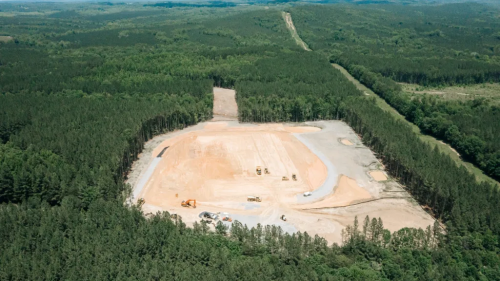
The Colorado-based company, Stack Infrastructure (Stack), has announced that it will move forward with its plans to build a giant data center complex in Pittsylvania County.
As was reported earlier in Bacon’s Rebellion, the company had made its decision to locate in Virginia contingent on the state continuing its exemption of computer equipment purchased by data centers from the Commonwealth’s sales tax. That exemption had been threatened by budget amendments proposed by the State Senate. With the adoption of a budget that leaves the exemption intact, the company will proceed.
This project is of major importance, not only to Pittsylvania County, but to that area of Southside Virginia. In its performance agreement with the regional industrial development authority, the company has pledged to invest at least $100 billion and create at least 2,500 jobs with salaries of at least $80,500 over a 30-year span. Under the provisions of current law, the company will be exempt from the Commonwealth’s sales tax on the purchase of computers and other equipment until at least 2040. That exemption could be extended until 2050 if the company meets certain investment and job creation criteria.
According to the Virginia Economic Development Partnership, the project represents the largest private investment ever announced in Virginia and one of the top five industrial announcements ever made in the United States. One local official declared that the agreement would be “transformational” for the area.
In lieu of repealing the sales tax exemption on data center equipment, the General Assembly created a “Data Center Electricity Consumption Tax,” under which a data center would be required to pay a tax based on the number of kilowatt hours of electricity it used each month. Because that provision is an integral part of the Appropriation Act, rather than a separate piece of legislation amending the Code of Virginia, it will expire when the Appropriation Act expires—June 30, 2028.
Stack expects the first phase of the project to be completed by June 2027, with the other two phases to be completed by June 2031. The company obviously feels that the benefits of the sales tax exemption will outweigh any electricity consumption fee it might have to pay over the next five years.
Pittsylvania’s history with data centers
This is not the first data center proposed for Pittsylvania County. The first one was approved unanimously by the Board of Supervisors in 2024. That project, located in the Ringgold community, involved the rezoning of 946 acres and the investment of up to $5 billion. There was opposition from some residents in the immediate surroundings worried about the light, noise, and traffic that would be generated by the data center. While acknowledging the concerns of residents, the supervisors cited the additional tax revenue for the county that the data center would bring in.
The story was quite different the next year with the second data center proposal. In its original proposal, Balico LLC requested the rezoning of 2,200 acres of agricultural land for the establishment of 84 data center buildings and a 3,500 megawatt power plant powered by natural gas. The reaction was quick and furious. Information meetings and hearings were packed with residents opposing the project. In addition to the usual concerns regarding environmental damage, noise, and traffic, the opponents stressed their strong desire to preserve the rural and agricultural identity of the area. As one speaker at a public hearing put it, “Filling farmland with concrete and pollution is not being a good steward.”
The opponents brought in attorneys from the Southern Environmental Law Center and air pollution researchers from Harvard University to make their case in hearings on the proposal. The controversy raged for six months, “pitting neighbors against neighbors and families against families,” as one resident lamented.
Although Balico significantly decreased its proposal to consist of 750 acres and 12 data center buildings, along with onsite power generation, the Board of Supervisors voted 6-1 against the project.
What Made the Difference with Stack
For the current project proposed by Stack, some residents raised objections to the data center project, but there was not the organized opposition and controversy that arose in reaction to the Balico project. The lack of significant opposition and the board’s receptive attitude was likely due to several factors:
- Location. Rather than plopping a giant data center complex in an empty field across the road from established subdivisions, as has been the case in Loudoun and Prince William counties, or in a rural area zoned for agriculture, as was the case in Pittsylvania, Stack Infrastructures will be building its data centers in a well-established industrial park.
The Southern Virginia Mega Site at Berry Hill (Berry Hill) is jointly owned by Pittsylvania County and the city of Danville. It consists of over 3,500 acres and is the largest mega site in Virginia. Since 2008, more than $217 million in public and private funds have been invested in preparing the site for development. The site has been graded and has gas, water, sewer, electric, and broadband connections. It is “shovel ready.” Stack will be purchasing almost 3,000 acres in the Berry Hill site.
One advantage for the county of this location is that the Stack proposal did not require that any land be rezoned. The industrial park, of course, was rezoned for industrial use many years ago. Residents did not object to a data center being built in that location. In fact, they encouraged it. As one of the opponents to the Balico project explained, “I know there are needs for this, but there’s also places for these things. There are industrial parks that these things need to go in—they don’t need to go up against homes and in residential areas.”
- Jobs. Pittsylvania County has experienced a steady decrease in jobs since the turn of this century, as shown in the graph below.
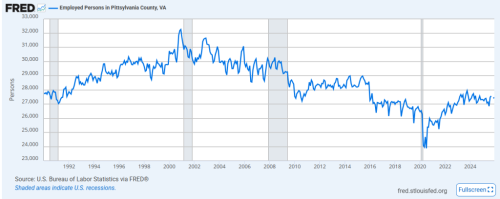
The biggest blow was the closure in 2006 of Dan River Mills, one of the largest textile mills in the South. Stack’s performance agreement includes the creation of at least 2,500 permanent jobs with a salary of at least $80,500. In contrast, Balico projected 300 jobs. Those additional jobs will do much to stimulate the local economy.
- Money. Rather than buying property from private landowners, Stack will be purchasing property owned by the county and city. Based on the performance agreement, it will pay $238,000 per acre, for a total purchase price of $737.8 million, for the almost 3,000 acres. A member of the Danville city council exclaimed, “10 years ago we couldn’t have fathomed that amount of money.” Then, there is the estimated $48.5 million annually in real estate taxes the county would reap.
- Water. In many areas of the state, concern over their need for large quantities of water have fueled some of the opposition to the location of data centers. It has been estimated that a large data center needs “anywhere between 1 million and 5 million gallons of water a day.”
Pittsylvania officials are not concerned about water usage. They note that the industry is moving toward constructing AI data centers, such as the ones that Stack has proposed, to be equipped with closed-loop cooling systems, which significantly decrease water usage. Furthermore, the area has a major water source, the Dan River. The Berry Hill site is served by a pipeline that can provide 7 million gallons of treated water per day. If more water is needed, there is room for expansion. As Matt Rowe, the economic development director for Pittsylvania County explained, “There’s plenty of water going down the Dan River for these types of uses, and that’s evident because we used to have Dan River Mills yanking out 15 million to 17 million gallons of water a day. We had MillerCoors yanking out 10 million gallons of water a day. [Both those facilities have closed.] So no amount of water coming to the mega site will ever equal to what was previously being taken out.” Such declarations of certainty by economic development directors need to be viewed with a degree of skepticism. After all, it is their job to promote industry and business in their jurisdictions. Nevertheless, it does appear that there is sufficient water supply to support the Stack data center project.
- Electricity rates. Recently, much of the concern and controversy surrounding data centers has been the potential for electricity rates to rise due to their large energy needs. The situation regarding the provision of electric power for the Danville/Pittsylvania area and the proposed Stack data center is complex.
Danville is one of 15 towns or cities in Virginia that generate and/or distribute electricity to residents, businesses, and industry. Danville distributes electricity to all Danville residents, the southern third of Pittsylvania County, and portions of adjoining Henry and Halifax counties. Danville Utilities generates, with hydro and solar facilities, a small percentage of the electricity it distributes. The remainder is purchased from a wide variety of sources.
According to Rowe, the Pittsylvania economic development director, the Berry Hill site has been a part of the Appalachian Power service territory since the 2010s. Because it would not be in the Danville Utilities service territory, the Stack data center “cannot have any impact on Danville Utilities, positive or negative,” he asserted. Furthermore, he went on, Stack will enter a service agreement with Appalachian Power wherein the company will pay for “any and all costs associated with providing power to the campus.” Therefore, there should be no impact on Appalachian Power customers, either. Given the complexity of electricity rates and the interconnectedness of power companies on the PJM grid, that claim is open to question.
Leave a Reply
You must be logged in to post a comment.