

By Steve Haner
A Republican leader in the Pennsylvania legislature asked the regional electricity market PJM Interconnect what would happen if that state joined the Regional Greenhouse Gas Initiative. PJM reported it would raise consumer costs but have next to no impact on carbon dioxide emissions.
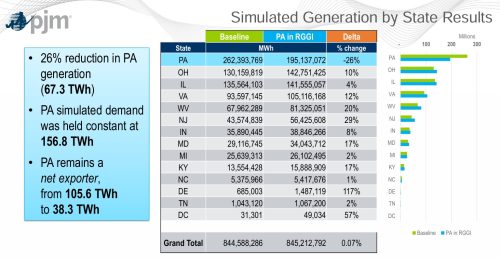
The report, dated April 25 but just shared with Bacon’s Rebellion, demonstrated what likely happened while Virginia belonged to the RGGI carbon tax, cap and trade compact: Virginia’s hydrocarbon generation plants were operating less often but similar plants elsewhere within PJM increased their output. As an effort to reduce CO2 emissions it was a bust.
The political battle over Pennsylvania’s membership in the RGGI compact has paralleled the fight in Virginia, and the issue is pending in an appeals court just like it is in Virginia. In Virginia, RGGI advocates are suing a governor who took the state out of the agreement, while in Pennsylvania Republican legislators are suing a governor who signed up to join RGGI. Both states are outside RGGI at this moment and are not collecting the carbon tax.
Whether or not Virginia belongs within RGGI ought to be a major debate in the 2025 election campaign. It now breaks down largely on a party-line basis and this one issue serves as an excellent proxy for the larger debate over energy, emissions and the claimed climate crisis. To think RGGI makes any sense you must believe that CO2 is driving temperatures to dangerous levels and causing extreme weather.
Pennsylvania is the P in PJM and the P stands for powerhouse. With its internal coal and gas assets, Pennsylvania is a linchpin maintaining the steady grid for the 13-state energy trading region. It exports massive amounts of electricity most days. If it were to join RGGI and add the carbon tax to its prices, those exports would collapse, PJM projected.
When PJM did its analysis, as you can see on the slides, it assumed a RGGI carbon auction price (carbon tax) of more than $21 per ton, and the first two RGGI auctions for 2025 have not reached that level. But the basic conclusions of the report would not change much at the current $20 per ton.
PJM indicated that even with the RGGI-driven drop in energy production at the state’s hydrocarbon plants, the utilities would have to pay $968 million per year for allowances to emit CO2, more than double the annual tax Virginia collected.
The carbon tax is not the only cost imposed by Pennsylvania joining RGGI. PJM also indicates how much more the consumer costs would rise because import transactions between the states, and use of interstate transmission facilities, would also become more common.
Whereas non-RGGI Pennsylvania would export about 106 terawatt hours (106 million megawatt hours) to the other parts of PJM, a Pennsylvania constrained by RGGI would export less than 40 terawatt hours and would end up importing more often. The payments Pennsylvania would make into PJM to import power when needed would rise 13% and the cost per megawatt hour of those imports would also rise. That cost, also passed to consumers eventually, would be another $750 million per year.
Under RGGI, the emissions of carbon dioxide (CO2), nitrous oxide (NOx) and Sulphur dioxide (SO2) would drop precipitously in that state, but power plants ramping up in other PJM states would emit more and the net change would be in the range of 1%. RGGI has never made sense for the PJM states given how easy it is to just move the power across state lines from a non-RGGI state.
The impact on Virginia if Pennsylvania joined? Generation in Virginia would rise 12%, as would emissions of all three of those airborne combustion products and the payments made by Virginia utilities for moving load around within PJM. Even the other PJM states which are within RGGI – Delaware, New Jersey and Maryland – would see their remaining hydrocarbon plants run more often and load sharing costs rise, PJM predicted.
Nothing is gained. This is a shell game, purely a shell game. RGGI accomplishes nothing except the extraction of money from utilities, who then extract those same dollars from their customers. Supporters can say it would be very different if PJM and RGGI fully overlapped, and it would, but they do not overlap, and many PJM states have no interest in joining RGGI. At the federal level, the winds are blowing hard against any such effort in Congress.
A vocabulary note: Blue Virginia taught me a new word yesterday (or reminded me) when an author praised “Pigouvian taxes,” named for an economist. They are taxes on transactions to collect for indirect costs, alleged harms beyond the transaction itself. What is a prime example of a Pigouvian tax, per Wikipedia? Why carbon taxes on fuel, of course. Thanks for the admission, Blue Virginia.Yes, RGGI is a tax.
Leave a Reply
You must be logged in to post a comment.