
by Kenrick Brown
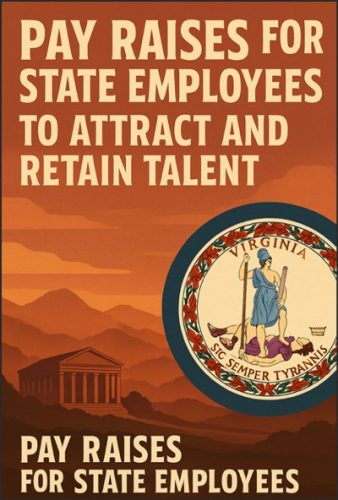
The Governor of Virginia earns $175,000, which is less than the President of UVA, who made $912,200 in 2024. In an age afflicted by crises, chaos, and widespread disorder, this mismatch is not just embarrassing — it’s potentially compromising and destabilizing.
This stark pay disparity underscores a far deeper issue: top-ranking Virginia public officials are grossly under-compensated given the gravity of their work. Notably, senior public sector officials bear greater moral responsibility than the vast majority of their C-suite private sector counterparts. This truth is especially profound as Virginia is home to a wide array of defense, Intelligence Community, and national security facilities and infrastructure. The General Assembly’s refusal to act reflects a terrible moral failing and a direct threat to effective governance. Low compensation weakens ethical standards and erodes governing competence across the Commonwealth. Consider this: it’s easier to bribe an official making $175K than one making $1.75M — or $17.5M.
Not since January 14, 2006 — nearly two decades ago — has gubernatorial compensation been raised.
The Governor of Virginia, vested with power over the state’s National Guard, deserves a high salary befitting high office. It is untenable and unsustainable that a governor should earn less than half the salary of a university administrator. This is the most impactful job in Virginia, commanding a ready and lethal military force. If we are to prevail as a thriving commonwealth, Virginia’s top leader must not be expected to live off what is paid to the president of a public university, even the flagship.
Of course, any discussion of gubernatorial compensation would be wholly incomplete without acknowledging the immense privileges tied to the Governor’s Mansion. The Governor enjoys the Executive Mansion, Virginia State Police protection, and heightened media access — privileges, both symbolic and logistical, far beyond what lesser-ranked politicians could ever command. However, executive privilege is not an income; it simply cannot replace or stand in for financial security.
This context calls for reflection on the true nature of leadership in Richmond. It is worth recognizing that a sitting governor is chief executive of Virginia, the oldest continuous English-speaking settlement in the Western hemisphere. I would argue strongly that higher compensation would allow local senators and delegates — worthy of comparison to the great, patriotic leaders of ancient Rome, dedicated to work, family, and commonwealth—to best serve their constituents.
Fortunately, we don’t have to imagine such a political-economic model in the abstract. As a real-world proof of concept, I would cite Singapore: a nation that, thanks to the wisdom and statesmanship of “Harry” Lee Kuan Yew, successfully implemented a “clean wage” policy. In his book From Third World to First, Lee outlines the financial and ethical rationale that guided Singapore’s compensation reforms, benevolently yet firmly committing his nation to incorruptible governance and world-class public service. This entailed high, transparent salaries for public officials, while decisively outlawing bribery. The policy was formally implemented around 1994. The result was — and remains — a country in which corruption is exceedingly rare, possessing a highly sophisticated and efficient government.
Singapore’s political stability and impressive international rankings underscore the policy’s effectiveness. According to Transparency International’s Corruption Perception Index, Singapore scored the 3rd least corrupt country globally out of 180 nations and territories. It was also ranked as the least corrupt country in the Asia-Pacific region. If we want to attract and retain the highest caliber of leaders — and safeguard our institutions against kleptocracy, decline, and the forces of corruption — we should not hesitate to compensate our public servants accordingly.
Under-compensation of political officials is a global issue, solutions for which can be found at the state level. To achieve this goal worth defending, I propose the following restructured compensation plan:
– The Governor should earn $4 million.
– The Lieutenant Governor should earn $3 million.
– The Attorney General should earn $2 million.
– Virginia’s Supreme Court justices should earn $1 million. Virginia state senators should earn $300,000.
– Virginia Delegates should earn $200,000.
This will accomplish efficient government through competitive compensation.
Great polities do not skimp on their top leaders. They invest in great leadership.
Kenrick Brown is enrolled in the McIntire School of Commerce at the University of Virginia.
Leave a Reply
You must be logged in to post a comment.