
by Kenrick Brown
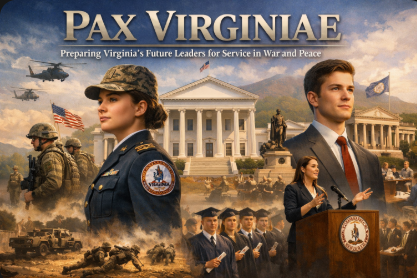
The Washington, D.C.–Maryland–Virginia super-region — amusingly known as the “DMV” — is a vital center of American national security and the Free World’s global governance. If there is a “Pax Americana,” an American-led global order, then the “DMV” is arguably analogous to a modern-day Ancient Rome, but with nice suburban outskirts. How can Virginia’s universities contribute to American national security? Ut Prosim, “That I May Serve,” is the school slogan for Virginia Tech and hints at what is needed. Top universities in Virginia — not just Virginia Tech, but the University of Virginia, the College of William & Mary, Virginia Military Institute (VMI), Washington & Lee, and others — have a moral obligation to prepare future leaders for service to both the country and the commonwealth.
To that end, five reforms described below would help ensure Virginia’s best and brightest schools are strengthening both American national security and the commonwealth’s institutional competence. In practice, that would mean placing greater emphasis in higher education on military, diplomatic, intelligence, and other forms of public service. At present, too many of the most capable and elite graduates enter private-sector paths, such as management consultancies and investment banking.
Rather than sending our smartest graduates out west to Seattle or the Bay Area or up north to New York City, we should retain them in the “DMV” region to protect and defend the Constitution against enemies foreign and domestic. Think Washington, D.C., over Washington State, Virginia over California, and Arlington over Manhattan.
Firstly, Virginia’s university leaders should re-embrace standardized testing for college admissions. During the Tang Dynasty of Imperial China (618–907 A.D.), civil service examinations expanded substantially in both use and political importance. Contemporary China uses the “Gaokao” — the national college entrance examination — as a principal mechanism for determining admission to universities. These include up to the country’s most elite institutions such as Peking and Tsinghua Universities.
In the 21st century, to best compete with America’s sole peer competitor, the People’s Republic of China (PRC), Virginia must restore the SAT and ACT to their former prominence as part of a holistic approach to college admissions. MIT, a fine institution and quintessentially elite university, dropped its SAT/ACT requirement in 2020 and, realizing its error, almost immediately restored it in 2022. Even among America’s most prestigious universities, standardized testing has thus retained real value as a tool for identifying academic aptitude and potential.
Secondly, career services departments at Virginia’s universities should more actively connect talented students with elite opportunities in public service, including internships, fellowships, and leadership-track roles in Washington and Richmond. One helpful step would be to encourage American citizens who did not participate in ROTC (Reserve Officer Training Corps) to consider entering military service through OCS (Officer Candidate School). To help keep the Free World safe, other avenues of service can include other parts of the federal government: the Pentagon (formerly DoD, now the U.S. Department of War), the U.S. Department of State, the U.S. Department of Homeland Security, and numerous agencies in the U.S. Intelligence Community (IC).
Such pathways matter because a quality supply of military officers, diplomats, intelligence professionals, and civil servants would help improve American foreign policy and better equip the United States to stabilize an otherwise chaotic global order. Beyond federal government service, Virginia’s universities should also encourage students to pursue roles in major international institutions and nonprofits — including bodies such as the IMF (International Monetary Fund), World Bank, and WTO (World Trade Organization) — where the talents of Virginia’s college and university graduates can still broadly serve American interests and the Free World.
The aftermath of DOGE and other downsizing efforts of the Trump Administration has reduced overall federal employment, as has a recent mass exodus of older federal employees. At the same time, the United States needs and will continue to need a new generation of public servants. Even in a leaner state, the U.S. government will continue to need highly capable military officers, diplomats, intelligence professionals, national-security specialists, and similar officials. The point is not to produce more bureaucrats for bureaucracy’s sake, but to ensure that the public institutions which remain most vital are staffed by men and women of greater competence, seriousness, and preparation.
Thirdly, there should be a new emphasis at Virginia’s universities on civil discourse, instilling the ability to disagree politely. As a recent UVA graduate, I have seen firsthand the value of civil discourse, as well as the severe potential harm that follows if disagreement degenerates into uncivil discord. Having witnessed significant controversy during my time in Charlottesville, I know how corrosive cancel culture (whether on the political Left or Right), an ideological monoculture, and needless escalation in debate can be.
To that end, Virginia’s top universities should provide greater financial and other support to debate societies, Model United Nations (MUN) programs, and student newspapers. Such institutions cultivate articulate speech, disciplined argument, informed disagreement, and the habits of mind necessary for serious public service.
Fourthly, Virginia’s top universities should expand opportunities for study abroad. Educational travel in strategically important first-tier powers such as China and Russia — and adjacent countries such as Georgia and Taiwan — could be especially valuable. The same can be said for major U.S. strategic partners such as Japan, South Korea, Israel, Saudi Arabia, and Türkiye.
Fifthly, Virginia’s foremost universities should enable future leaders to obtain foreign languages critical to national security: most famously, Chinese, Russian, and Arabic, but also Farsi (used in Iran) and Urdu (used in Pakistan). Additionally, there should be a renewed focus on Area Studies programs, which are useful to the Department of War, Department of State, and IC agencies.
In Fall 2025, the University of Virginia’s College and Graduate School of Arts & Sciences unwisely discontinued its East Asia-focused M.A. program. The People’s Republic of China is the United States’ sole peer competitor, and thus Virginia’s colleges and universities ought to excel at training high quality China-specialized professionals. Some people dismiss Area Studies programs as just another ‘useless’ liberal arts field. They are mistaken.
To understand the rest of the world is one of the most highly effective ways to protect and defend the American homeland and to appreciate cultures, both natively familiar and foreign. To create solutions that fit a modern and globalized war, one must have a solid grasp of history, cultures, polities, and economies to stabilize the global order and international environment. Since the end of World War II, never has diplomacy been more important, given that competitors overseas—including China—are closing military (tactical, strategic, and logistical), technological, economic, and diplomatic gaps.
If implemented correctly and in concert with one another, these major and minor reforms to Virginia’s colleges and universities would both strengthen American national security and help shape the careers of many of the Commonwealth’s smartest graduates.ess.
Kenrick Brown is a recent graduate of the McIntire School of Commerce at the University of Virginia.
Leave a Reply
You must be logged in to post a comment.