• He Who Controls UVAโ€™s Strategic Investment Fund Controls Its Strategic Direction

    This is the first part of a new three-part series exploring the influence of UVA President Ryanโ€™s Strategic Investment Fund.

    by James A. Bacon

    Back in December, University of Virginia President Jim Ryan unveiled a major philanthropic gift at the Board of Visitors meeting: Board member John L. Nau III had committed to donating $20 million to fund fellowships for College of Arts & Sciences graduate students. The sum, Ryan added, would be matched by $10 million from the Universityโ€™s Strategic Investment Fund (SIF). The combined $30 million impact, he said, would support 30 to 35 grad students per year. Fellow board members gave Nau a round of applause.

    The SIF, which is throwing off roughly $65 million a year that the University can spend any way it wants, is UVAโ€™s secret fundraising weapon. It has helped UVA surpass its $5 billion โ€œHonor the Futureโ€ campaign 18 months ahead of schedule. With matching dollars from SIF, Ryan reeled in mega-donations such as a $50 million gift creating the Karsh Institute of Democracy and a $100 million donation launching the Manning Biotech Institute. Few public universities have anything to compare.

    Ironically, during the same meeting in which they lauded Nau for his generosity, some UVA board members made it clear they wanted to exercise tighter control over the SIF. They didnโ€™t take issue with any of Ryanโ€™s decisions on how to spend the income. Indeed, board member Doug Wetmore described the program as โ€œvery successful,โ€ and he said the overwhelming majority of the administrationโ€™s proposals likely would meet board approval. But the board would be failing to exercise its financial duty, he said, if it neglected to review spending of such magnitude.

    What went unsaid during the board meeting is that he who controls the SIF controls the strategic direction of the University of Virginia. 

    (more…)

  • Biting the Steady Hand That Lights Your House

    By Steve Haner

    Three western Virginia politicians have penned a press release masquerading as a serious proposal. They seek to decertify a major monopoly electric utility which serves 540,000 Virginia accounts, the Appalachian Power Company, a division of American Electric Power. ย 

    The letter was sent to the State Corporation Commission and then released, with probably the best coverage provided by the online Cardinal News. It reported:

    Citing โ€œever increasing bills,โ€ Sens. Bill Stanley, R-Franklin County; Todd Pillion, R-Washington County; and Travis Hackworth, R-Tazewell County, said that โ€œour region deserves better than an out-of-state company who doesnโ€™t work with [its] struggling customers and continually works to extract maximum profit for an essential utility service.โ€

    The letter asks a series of questions about how the territory and customers could legally be taken away from the Appalachian Power Company, also known as APCO. But then what? Will APCOโ€™s service territory be given to Dominion Energy instead? Be converted into a very large member-owned cooperative?ย ย How much might Appalachian customers be paying to the AEP shareholders (which include many APCO customers) in compensation for taking their assets and dividends?ย The โ€œbe careful what you ask forโ€ warning has never been more relevant.

    (more…)

  • Jeanine’s Memes

    Sunday Memesโ€“Doesnโ€™t it feel great? โ€“ The Bull Elephant


  • Bacon Meme of the Week


  • Battery Bills Still Charging Toward Passage

    By Steve Haner

    The Virginia General Assembly is still poised to pass a vastly expanded mandate for future utility battery storage systems, but the bills are no longer passing unanimously.  At least some discussion of the ratepayer cost impact has come up in committee and floor discussions since being raised by Baconโ€™s Rebellion.  Most Republicans are now on record as opposed.

    A battery storage facility: not nearly as photogenic as solar panels and wind turbines

    The effort was given a strong cheerleading push from Virginia Mercury in a story Thursday that made no effort to estimate that customer cost (but also no effort to dispute Baconโ€™s Rebellionโ€™s figures.)  The Mercury article also glossed over the incredibly important detail that battery storage in megawatts is a useless measurement, and the real metric is megawatt hours.

    The cost should be calculated in dollars per megawatt hour.  At this point, the legislative histories on the bill still do not show any official estimate of the capital costs or ratepayer impact. On that front, legislators still seem to enjoy not hearing any bad news. 

    The bill is being pushed by Dominion Energy Virginia, among others, and Mercury quoted one of its contract lobbyists saying the bill gives the regulatory State Corporation Commission โ€œfull authority to agree with the targets set in the code or alter them up or down and we think that is the right approach.โ€

    What she ignores, and she avoided this point in committee testimony witnessed by Baconโ€™s Rebellion, is that question is the only discretion being left to the SCC.ย  Elsewhere in the Virginia Clean Economy Act, the regulators are all but mandated to approve the first 3,100 megawatts of battery storage as being โ€œin the public interestโ€ by law.ย  The traditional tests of reasonableness, prudence and necessity are not applied.ย  The General Assembly already decided those questions and didnโ€™t set any cost cap, either.

    (more…)

  • FEI gets DOA

    A once vaunted institution joins the choir invisible.

    by Gordon Morse

    News of the demise of the Federal Executive Institute in Charlottesville arrived on Monday and unexpectedly. What happened there? What sins were committed?”

    According to the executive order signed by President Trump, โ€œbureaucratic leadership over the past half-century has led to Federal policies that enlarge and entrench the Washington, D.C., managerial class, a development that has not benefited the American family. The Federal Executive Institute should therefore be eliminated to refocus Government on serving taxpayers, competence, and dedication to our Constitution, rather than serving the Federal bureaucracy.โ€

    Those are different thoughts welded together to make a point that makes little sense, but welcome to 2025. It doesnโ€™t take much for a federal agency to run afoul of the new mentality. Maybe someone at the Cato Institute called and the FEI hung up the phone on them? That alone would probably do it.

    The Federal Executive Institute has sat on a rise above Route 29, just north of Barracks Road Shopping Center, since the Johnson Administration. Its white arches frame the entrance to what, in 1951, was first opened as the Thomas Jefferson Inn and, as a result, thereโ€™s a pool.

    Pools were important as my brother and I were growing up. No hotels without a pool. Period.

    I knew that road in the 1950s well because it carried us to Amherst and our grandparents. Headed south (there was no bypass then), you would see the hotel โ€“ there were fewer trees then โ€“ to the right up the slope. The shopping center arrived later and all that land, as I recall, sat within Albemarle County. It would be annexed into Charlottesville in the 1960s.

    (more…)

  • A Public Health Crisis in Central Virginia

    A Public Health Crisis in Central Virginia

    by James C. Sherlock

    A terribly injured 33-year-old homeless male schizophrenic recently was found lying hidden in a church in Chesterfield County.

    He was discovered with multiple displaced fractures in the lower pubic bone, a break on the left side of the sacrum (base of the spine), a large amount of blood in his pelvis, a nondisplaced fracture in the back part of the T5-T6 vertebrae and many other serious injuries. He was wearing both a catheter and a colostomy bag.

    He had previously been admitted to and discharged from Virginia Commonwealth University Medical Center (VCU) with those injuries. It is at least unusual, and in most cases prohibited, for nursing homes to accept patients with schizophrenia. Yet upon discharge from VCU, the man had been admitted to and discharged from two skilled nursing facilities, Hanover Health and Rehabilitation Center (Hanover) and Colonial Heights Rehabilitation and Nursing Center (Colonial Heights).

    Each is run by New Jersey-based Medical Facilities of Virginia (MFA). Each, thus unsurprisingly, is rated one star of five by Medicare for staffing. Neither has recently reported having mental health support capabilities.

    The medical journey of that unfortunate patient would be literally unbelievable had it not occurred.

    • He was transferred from VCU to a skilled nursing facility without a history of providing mental health services, from there to another skilled nursing facility with a similar history, and finally discharged from that one onto the street with his horrific and life-threatening injuries;
    • He was not transferred from VCU to Hiram W. Davis Medical Center (Davis) in Petersburg. That state hospital had the distinct advantage of actually being able care for him.

    The Medical Journey of A Patient

    So many questions.

    (more…)


  • Commonwealth on Fence for Transportation Funding

    The U.S. Dept. of Transportation has issued an order that โ€œupdates and resets the principles and standards underpinning U.S.Department of Transportation policies, programs, and activities.โ€ The order provides that all โ€œDOT grants, loans, contracts, and DOT-supported or -assisted State contracts shall proioritize projects and goals that (among other issues) โ€œgive preference to communities with marriage and birth rates higher than the national average.โ€

    The Commonwealth of Virginia may be on the bubble as far as these criteria are concerned.

    Virginians are married at a higher rate than the national average. The Census Bureau defines the marriage rate as the number of women per 1,000 women over the age 15 who were married. In 2022, the national average was 16.7. Virginia was tied for 19th place with a rate of 17.8.

    Birth rate is a different story. In 2022, according to the Centers for Disease Control, the national birth rate (births per 1,000 women) was 11.0. The birth rate for Virginia was 11.0, therefore not โ€œhigher than the national average.โ€ (see table 8 in the publication.)

    The order does not address how priorities are set if a state meets only one of the criteria.


  • The Chainsaw Cometh. Be Not Afraid, Virginia

    Musk the bureaucracy slayer. Image credit: ChaptGPT

    by James A. Bacon

    Over at Cardinal News Dwayne Yancey makes a stab at calculating the economic impact on Virginia if President Trump and his chainsaw-wielding demiurge Elon Musk succeed in their goal of hacking down the size of the federal workforce by 60%. His concern is that two-fifths of Virginia’s personal income tax revenue comes from Northern Virginia, that a significant amount of those funds are redistributed to school districts in his corner of the state, and that, therefore, even Southwest Virginia potentially has a lot to lose.

    Meanwhile, at the Richmond Times-Dispatch columnist Jeff Schapiro explores the political implications as Democrats seek to turn the impending bloodletting to their favor against Virginia Republicans, who seem unable to oppose the draconian Trump-ordered mayhem or articulate a rationale for why the cuts might actually be a good thing for the Old Dominion.

    Adding to Virginia’s peril, suggests Yancey in a line of logic sure to be adopted by Democrats, is that the Muskian chainsaw also could devastate federal contractors who round out most of the Northern Virginia economy not comprised of federal bureaucrats. Factor in the multiplier effect of all those lost jobs and all that lost spending and NoVa could enter into a recession the likes of which it has never seen before and could drag down the rest of Virginia with it.

    Expect apologists for the status quo to elaborate upon that line of argumentation. Virginians will be hearing how economic apocalypse is just around the corner.

    Permit me to spin an alternate scenario. While there will be short-term pain for sure, chain-sawing the federal budget could be the best thing to ever happen to Virginia. It could be just the trauma NoVa needs to emancipate itself from dependence upon federal largesse, deconstruct its cost-plus-contract culture, and develop a truly innovative technology sector.

    (more…)

  • How to Create a Leftist Monoculture: Rising Scholars

    by James A. Bacon

    The University of Virginia’s “Rising Scholars” program in the College of Arts & Sciences, which dispenses graduate fellowships exclusively to racial, ethnic, sexual and gender minority students, has ceased accepting applications, according to a posting on its website.

    The website provides no explanation, but the notice coincides with Trump administration initiatives to terminate Diversity, Equity & Inclusion dictates in federal rules and contracts and to enforce the principle of “colorblind equality before the law” across government and higher education. 

    Funded in part by a university-wide grant from the Mellon Foundation, Rising Scholars recruits graduate students whose research, practice and teaching center “race, justice, and equity, specifically in relation to Black and Indigenous Studies of the United States.” It is consistent with the recommendations of the Racial Equity Task Force, adopted as official policy by the UVA Board of Visitors in 2020, to recruit more minority graduate students and faculty.

    Provost Ian Baucom, who was dean of the College of Arts & Sciences at the time, laid out the thinking behind the program in his “Race, Place and Equity” grant application to the Mellon Foundation, which he submitted in November 2020. It’s worth quoting at some length:

    As UVA commits to graduating students prepared to sustain a flourishing, anti-racist and equity-driven democracy, we also need to play a key role in advancing the research and teaching of race, justice, and equity if we are to advance our vision of becoming a vehicle for social mobility, inclusion, and racial justice, simultaneously changing ourselves and contributing to change nation-wide. …

    (more…)

  • Legislating in the Budget

    by Dick Hall-Sizemore

    The members of the General Assembly money committees have something in common with President Trump. They, like him, love โ€œone big beautiful bill.โ€

    OK, admittedly, that is a little exaggerated. However, those committees have reported out budget bills loaded with non-budget-related items. โ€œLegislating through the budgetโ€ is somewhat of a pejorative term used to describe the inclusion of policy items in the budget bill. However, that term needs some context.

    At its core, the budget bill is a policy document. It does more than appropriate money. It includes language instructing agencies on how that money is to be spent. Although this language is not included in the Code of Virginia, it is law. Sometimes, the language is lengthy, detailed, and specific. One infamous section dealing with the Department of Medical Assistance Services (Medicaid) consumes more than 30 pages of the budget bill.

    (more…)

  • Trump’s Interior Dept. Asked to Stop Dominion Wind Construction

    By Steve Haner

    Part of the $6 billion already spent on CVOW. Dominion photo.

    Citizens and groups who opposed the push to develop offshore wind under former President Joe Biden have now asked President Donald Trump to rescind even the wind projects already under construction.ย  Dominion Energy Virginiaโ€™s $10.7 billion project off Virginia Beach is among those they want to pause and possibly cancel. ย 

    The Thomas Jefferson Institute for Public Policy, an original opponent and continued skeptic of the Dominion project, did not sign the request, which you can read here.ย  With the project close to halfway finished, according to the utility, the amount spent to date exceeds $6 billion and costs would continue even if pending supplier contracts were cancelled.ย  Even a pause will add to costs.ย ย 

    At the time of Trumpโ€™s executive order pausing permit reviews for future projects, many assumed projects already approved and underway would not be affected.ย  That assumption is being tested. This could be very bad news for Dominionโ€™s ratepayers, the reason for Thomas Jefferson Instituteโ€™s reluctance to join the effort.ย ย 

    Under traditional rules for regulation of a monopoly provider like Dominion, the ratepayers could be on the hook for all those stranded costs. With the project cancelled it would be $6 billion for nothing.ย  An independent look at the possible cost of closing the project is needed, probably from the State Corporation Commission.ย ย 

    (more…)


  • Staffing in Selected Nursing Homes in Virginia – a Graphic Comparison

    Staffing in Selected Nursing Homes in Virginia – a Graphic Comparison

    by James C. Sherlock

    The featured graphic above and here is my attempt to produce an infographic without cartographer skills. ย 

    It integrates a lot of information from different sources and internal calculations in an effort to show both:

    1. how nursing home staffing in Virginia varies; and
    2. how it has or has not complied with current federal minimum safe standards. ย I have employed stoplight colors to indicate compliance or lack of same.

    That picture tries to tell a complex and dangerous story. ย 

    We will walk through it and see what we can learn.

    (more…)


  • The End of Science! Lives Will Be Lost!

    Image credit: ChatGPT

    by James A. Bacon

    Don’t question university overhead costs or thousands will die!

    That is essentially the message of Virginia’s big three research universities — Virginia Tech, the University of Virginia and Virginia Commonwealth University — in response to a National Institutes of Health initiative capping reimbursable overhead costs to 15% of the research grants it dispenses.

    And I’m not exaggerating about the “thousands will die” part.

    “Lives will be lost due to the corresponding reduction in the pace of biomedical research,โ€ Tech President Tim Sands actually said Monday. So reported the Richmond Times-Dispatch.

    So, what horrendous thing has NIH done at the behest of DOGE meister Elon Musk? It says that for every $100 of a research grant, only $15 can be diverted to cover the cost of university overhead: buildings, labs, IT support, a swarm of administrative staff, and the like. The rest must go to the scientist actually doing the research.

    Last year, the NIH disbursed $392 million to Virginia colleges for health research, according to an estimate by the nonprofit Education Reform Now. If their “indirect” funds are reduced to 15%, UVA could lose $39 million, VCU $19 million and Virginia Tech $11 million.

    (more…)

  • “Hottest Year Evah!” Must Be Over

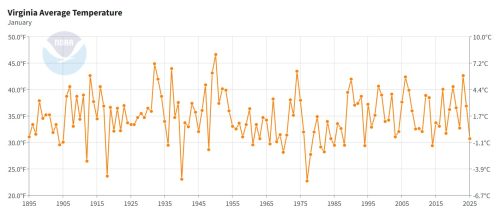
    Each point is the January monthly average for Virginia back to the 1890s, per NOAA.

    You may be starting to pine for a return to the hottest year evah! A recent data dump from the National Oceanographic and Atmospheric Administration confirmed that January 2025 was in the running for one of the coldest Virginia January average temperatures in more than a century.ย  The graph above captured on their tracking website is clear, and the ranking table the search also creates shows only 19 years out of more than 130 tracked Januarys were colder. Too soon to say the temperature spikes in 2023 and 2024, which were real, will be followed by more normal temps. But that is what weather does, it varies. Were January among the warmest the alarmist media would have been all over this, but the unusual cold is not what they are being paid to report. Baconโ€™s Rebellion again fills the gap.

    — SDH