• How Much Is Cuccinelli Costing Taxpayers?


    Sooner or later, someone is going to have to pay for the dogma-saturated legal forays of Kenneth Cuccinelli, Virginia’s firebrand Attorney General.

    It’s a shame because hardly any of Cuccinelli’s high-profile legal actions seem to be worthy cases that protect citizens of the Old Dominion. Instead, his actions are aimed at firing up the hard-right fringes of the Republican Party and maybe dragging some in the center along as congressional elections approach this fall and General Assembly races follow next year.
    Meanwhile, “The Cooch’s” legal initiatives are getting some substantial push-back and they are far from litigation slam-dunks.
    The Feds have come back hard against Cuccinelli’s politically-motivated lawsuit against the health care reform act just passed that ends such one-sided and harmful practices as denying people health insurance because of a “pre-existing” condition as defined by private sector lawyers and insurance bureaucrats. The next shoe to drop comes in federal court in Richmond in August.
    “Cooch” is also getting strong push-back from The University of Virginia as he pursues his fishing trip in the form of “civil investigative demands” to hound a former Hoo professor and global warming researcher Michael Mann.
    To fight off the attorney general, the university’s Board of Visitors has hired a tip-top, white shoe law firm, Hogan Lovells. The firm is the newly-merged entity formed by one of Washington’s most prominent law firms and Lovells of London. The new firm has 2,500 lawyers in 47 countries. I am told they can get up to $1,500 an hour , depending upon how many lawyers they throw on a case. They have been defending U.Va. since May and will deal with some 40 pages of legal papers Cuccinelli has filed. The next court hearing is in August.
    Irrepressible Cuccinelli has been dancing in other courtrooms, too. He has filed an “amicus” brief supporting Arizona as it defends its racist immigration law against federal lawsuits.
    So how much is the busy Cuccinelli going to cost us taxpayers? A spokesman says that in the federal lawsuit case, they paid a $350 filing fee for the lawsuit and than none of the lawyers in the attorney general’s office is being taken off other, routine work. He did not know how much the U.Va. case would cost.
    A university spokeswoman told me that the school is not using public money in the Cuccinelli-Mann matter but has been accepting contributions from alumni and others. One individual, worried about academic freedom issues, stroked a check for $5,000.
    As the struggle goes forward, holes in the “Cooch’s” global warming case are starting to show. He is using evidence that surfaced in a British controversy over the University of East Anglia that caches global warming research for the United Nations. E-mails by some scientists were claimed to prove that some global warming research is fraudulent.
    That claim is red meat for Cuccinelli and he’s trying to pin it to Mann, who left U.Va. for Penn State in 2005 and is involved in some of the East Anglia emails.. A couple of new wrinkles might make that hard. The Union of Concerned Scientists, a lobby group of science researchers, says that some of the emails that Cuccinelli is pursuing have nothing whatsoever to do with Mann. In recent weeks, a British probe has found no evidence of fraud in the East Anglia flap. By the way, Mann was probed and found innocent of any bad science by Penn State.
    This, of course, means nothing to the rightist global warming deniers, including the individual who runs this blog and his allies who take their cues from the Cato and American Enterprise Institutes and other conservative think tanks in the area of Washington which they all claim to so despise.
    One wonders, however, what the legal bill for all of this really is. And if the cases get tossed out of court, a very real possibility, one wonders if the fraud here is really Cuccinelli’s doing.
    Peter Galuszka

  • Boomergeddon Blog Launched

    At long last, the Boomergeddon blog has gone live at its permanent URL address, http://www.boomergeddon.us/. I would have preferred to have nailed down the .com address, but some slimeball snaked it before I could register it, and I refuse to pay money to buy the name. Fortunately, the “.us” domain works in this case — kind of like Boomergeddon USA!

    Now, time for a quick little Q&A.

    You: Gee, what is “Boomergeddon” anyway?

    JAB: To quote from the blog: “Boomergeddon is the day investors stop buying U.S. Treasuries โ€” the day the U.S. government goes into default, the global economy is thrown into turmoil, the American empire begins to crumble, and the social safety net starts to unravel.”

    You: You’ve already written a book, scheduled for publication in August. What’s the point of the blog? Do you have anything new to say?

    JAB: The blog is where I can update developments described in the book and brag about my prescience. For example: When I was writing back in February and March, the general consensus was that the U.S. was entering a solid economic recovery. I stuck to my guns and said it would be a weak recovery. Increasingly, the facts are supporting my position. When people read the book this fall, they won’t appreciate how brilliant I was. The blog will allow me to thump my chest.

    You: What’ll you do when you get stuff wrong?

    JAB: I’ll fess up. But the blog posts will be a lot shorter.

    You: Your thesis sounds so dreary. Why would anybody want to read how the world is going all to hell and there’s nothing we can do to stop it?

    JAB: Because I’ll my best to make it entertaining and funny. I’ll edge my commentary with mordant wit and black humor. Reading Boomergeddon will be like standing on the edge of the Grand Canyon and staring into the abyss and thinking, “I really need to take a step back,” but something in your brain says, “I wonder what it would be like if I jumped….”

    You: Will you make public appearances? I’d really like to buy an autographed copy of your book. I think I could sell it on E-Bay for a lot of money.

    JAB: Yes, I will make public appearances. I’ll keep B.R. readers posted about Virginia events. I hope to see you.

  • Virginia Closes Year with Budget Surplus!

    Virginia closed out the fiscal year with a $220 million budget surplus, no mean accomplishment considering that it faced a $1.8 billion deficit in January. The press release from the Governor’s Office has the details.

    Some of the surplus will be allocated to a bonus for state employees, who have gone without a pay raise for four years, to local school districts, and to Virginia’s Water Quality Fund, with the balance to be divvied up later. A humble suggestion: Start repaying that $650 million owed to the Virginia Retirement System.

    Update: Norm Leahy with Tertium Quids deconstructs the governor’s press release from a fiscally conservative perspective.


  • “A Whale” of a Disappointment

    Time for the Truth Squad.
    Just a couple of weeks ago, The Baconator Himself wrote a scold of President Barack Obama for not using “A Whale,” a massive ship specially designed to skim up spilled oil from the ocean. The 1,100-foot long vessel, a converted bulk carrier, maybe could scoop up 21 million tons of oily water a day from the BP rig disaster.
    Jimbo hit us with accusations of Obama incompetence, creeping Washington-itis, bureaucratic inanity and even (incorrectly as he admits) the Jones Act which is a 1920 law to keep foreign flagged vessels out of the coastal U.S. trade.
    As Bacon wrote:
    “While Obama played golf and the bureaucrats picked their bureaucratic nits, massive quantities of oil, which could have been skimmed or blocked by sand berms, began befouling the marshes and beaches of the Gulf Coast.”
    Well, things haven’t quite turned out per the script of Bacon and his fellow conservative wonks.
    A Whale has made it to the Gulf of Mexico. But it doesn’t seem to work. As the Times Picayune says, the vessel has trouble skimming oil when waves are six-feet or so. That’s not an uncommon occurrence in the Gulf, especially when hurricanes are brewing in the area.
    Tests of the July 4 weekend were “inconclusive” according to the Coast Guard. The billionaire owner of the ship says they experimenting with using the massive bulk of the vessel to calm seas enough for skimming.
    Oh well. I’m sure we can find some kind of profligate federal spending angle in this if we try hard enough.
    Peter Galuszka

  • Start Spending Cash Now!

    Our venerated James A. Bacon had a recent post that had a bunch of charts (where the man gets them no one knows) that stirred quite a bit of discussion about savings and the economy.
    One chart rubbed me the wrong way — one showing how much cash U.S.companies were hording. The Baconaut-in-Chief wrote: “On the positive side, U.S. business is piling up large sums of cash — the most since the 1970s.” To be fair, he did note that this wasn’t creating many jobs but it is obvious where he places his priorities.
    Mr. Bacon is sort of like Mohamed or Martin Luther — the creator of a new religion. In this case, it is the faith of the “Boomergeddon” (bible to be released soon) which warns of hellfire and brimstone unless we stem our profligate ways. In this sense, hording cash is a good thing and as I open my empty desk drawer in my office I see where he may have a point.
    But not really. Hording cash is killing us. This week’s BusinessWeek, my old alma mater, notes that American households are sitting on nearly $8 trillion in cash that’s earning nothing because everyone is so shell-shocked by the 2007-2008 market losses. In this year’s first quarter, non-financial U.S. firms held $1.84 trillion in cash, which is 27 percent more than in early 2007.
    This is NOT good news, despite what you might hear from the High Priest. Not spending cash means that no jobs are being created. Cash cannot do what it is supposed to do — beget more wealth. BW notes shareholders are getting antsy because by hording cash, big companies are not making it work for them. Says on analyst: “Why pay a stock market multiple for a company that is essentially acting like a bank — and a bad one at that?”
    For the impacts of all this, look no further than Richmond. About 25 percent of the houses in the city are in foreclosure. That’s a lot. The reason, the head of a local realtors’ group told me, is that we’re seeing the second in a wave of layoffs and tight money. The first came around 2007-2008 when the financial crisis flared and home borrowers with adjustable rate mortgages got nailed. We’re now in Wave Two which is happening because so many people have either been laid off or have been forced to take lower-paying jobs, meaning they can’t pay their mortgages any more.
    The only way this downward curve can change is if jobs are being created. They won’t be unless some of that precious cash starts circulating. Even more bizarre is that mortgage rates are at incredible lows. Yet with the New Sternness applied by banks and mortgage lenders (who would loan to a dog or a cat three years ago), no one qualifies any more for a loan.
    Now all you Republican yahoos out there are going to blame this all on Obama and Barney Frank’s new, sort-of-tough financial regulation law. I say to you all: “Baloney, Macaroni!” The new law hasn’t even taken effect yet. What we are seeing is those very same financial institutions (you know, the ones too big to fail) beating up on hard-working, frugal Americans as a reaction to their greedy forays into the profitable sub prime market that helped cause the crash in the first place.
    And this, of course, leads us to the elemental point and flaw in the New Frugality being pushed by the Reverend Bacon and others. We’re not out of the recessionary woods. These new-found preachers are testifying to the need for discipline and belt-tightening. If you listen to these piney woods types, we’ll turn a weak recovery into a Great Depression.
    What we need now is spending and releasing some of that cash. We need new trust and new ideas — not GOP-minded naysayers who will do whatever they can to vote out Democrats in November.
    Beware false religions.
    Peter Galuszka
    .

  • The Spies Who Came in From Starbucks


    What’s the world coming to? The Russian SVR, successor to the KGB, has inundated us with long-term moles who are on deep cover and penetration missions of middle school soccer games and “Six Sigma” management principles. Their goal is to infiltrate American ruling and opinion-making circles and wait in place for the big move, if it ever comes.

    Thus, Moscow Center has planted in us the seeds of “Boomergeddon.” This is not the same as “Armageddon” which would involve the spies tipping Lubyanka or Yasenyevo when the president was ready to go to Def Con One, allowing the Kremlin to wipe us off the face of the earth in a cloud of radioactive dust.
    Those were the good old days, you know. When it was the Soviet Union, Moscow had a great reputation with spying. Richard Sorge, their man in Tokyo, was so good that he tipped Stalin off that Hitler was about to void his pact and invade the Soviet Union.Stalin ignored him. Back in the states, Aleksandr Feklisov, assigned to the USSR embassy on 16th Street in DC, had tapped into the Manhattan Project, ran the Rosenbergs and later, using his cover last name of “Fomin,” may have served as the back channel that helped JFK and Khruschev void nuclear exchanges over Cuba.
    Now we have the New Russian Spy working out of suburban Boston or New York or Virginia waiting and watching for their big moment when they can penetrate a think tank or see what the latest trend in hastily-written management books is.
    What does this have to Virginia? The Old Dominion has always been a hotbed of spying. Both the CIA and the Pentagon are technically in Virginia. Agency types tend to live in Virginia because taxes are lower and commutes quicker. “The Farm,” or basic CIA school, is at Camp Peary on the York River near Williamsburg, replete with phony Cold War-style watch towers that trainees have to sneak past in the middle of the night. Department stores in Richmond or Norfolk served as “shake your tail” training grounds.
    But today’s brand of spy has lost a lot of luster. One of this latest batch of long-term “illegals” actually got into a pissing match with Moscow Center over who owned his suburban house.
    The shame! Attitudes like that would have gotten one a 9 mm. slug in the base of the skull in the old days. That’s what happened to Valery Matrynov and Sergei Motorin on home leave in Moscow after FBI turncoat Robert Hanssen betrayed them as having been turned by the Americans. Hanssen later was arrested in Virginia’s Foxstone Park.
    Take me. I first visited the USSR in 1970-71 as a college student and was intrigued by the curiosity about me from Russian students and the walls our handlers put up to prevent us from talking to each other. In 1986, I went to Moscow as a magazine correspondent and three weeks later Nick Daniloff of U.S. News & World Report was snagged by the KGB as part of an elaborate plot to get some human bargaining chip so they could get back a Russian arrested for espionage in New York by the FBI. The Russian had no diplomatic immunity and neither did Daniloff, making a trade possible.
    For the next three years, the KGB was part of my daily life. And when I was later sent to New York as an editor, they reached out to me in the form of “lunch” invitations (using a cover of a Soviet journalist) where they offered to pay my fare to go back to Mother Russia for a reporting trip. I, of course, told my magazine superiors about it and we let it go at that.
    When I returned for a second tour in Moscow in 1993, the Soviet Union had collapsed. When I went to one of the spanking new grocery stores I found that the private security guards called out to me by name. They had been KGB “guards” at my apartment house masquerading as police “militia” four years before. It was like old home week.
    I went to the new KGB museum at Lubyanka where hundreds of Soviet officials were executed during Stalin’s purges. The tour guide was a cold, steel-eyed retired KGB officer. We saw the exhibit of their triumphs over the CIA and other American intelligence. During the early days of the Cold War in the 1950s, the CIA recruited Ukrainians, trained them and then parachuted them inside the USSR’s western borders. Their mission was to blow train bridges and electrical plants should the day come.
    Most were quickly picked up when they hit the ground since they had been turned by the illustrious British spy Kim Philby. Another fatal give-away, the KGB man told us, was that the stupid CIA used stainless steel staples in the terrorists’ fake passports. Anyone who has ever been to Russia knows that their passports have old fashioned steel staples, so there is always a smudge of rust between the pages.
    Being a smart ass, I asked, “Do they still make that mistake?” The KGB man gave me a snake-killing stare for a good minute and then replied, “No, they make others.”
    Of course, we may not know all the circumstances behind this current run of spying. However, it probably reveals the lack of understanding among the “siloviki” related to Vladimir Putin, the former KGB officer turned Russian leader. They can get critical facts and figures for free from Web-based sources, including Bacon’s Rebellion.
    You heard it here first, Volodya!
    Peter Galuszka

  • Savings, Fiscal Sustainability and Environmental Sustainability

    In his previous post, “On the Fourth,” EMR suggested using the metric, “U.S. Net National Savings as a Percentage of GDP,” as an indicator of the extent to which U.S. society is preparing for the future. Why is savings so important? As EMR often says, the benefits of civilization are expensive. We have three choices: (1) Save the capital ourselves to pay for those benefits, (2) borrow the capital from foreigners, or (3) live without the benefits.

    Since the 1980s, the U.S. has chosen Option 2. We can continue borrowing until our level of indebtedness gets so high that foreigners stop lending to us. It is the thesis of “Boomergeddon” that such a day will come, probably some 15 to 20 years from now (although with each passing month I am tempted to advance the date by several years).

    To grasp our sad state of affairs, view the chart (based on OECD data) at the top of this post. That compares the household savings rate (excluding business and government) of the U.S. to that of other nations in the 2006-2007 time frame. Our consumers then were among the most profligate in the world. Since then, the household savings rate has ticked back up to between 3% and 6%, still a fraction of what it will take to pay for all the things that need paying for.

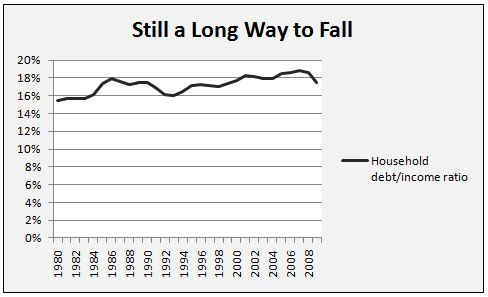
    The good news is that between higher savings and defaults consumers have reduced their liabilities significantly since the Global Financial Crisis, although they still have a long way to go before the household debt/income ratio return to rates prevailing in the early 1980s, as shown in the chart above (based on Federal Reserve Bank data).We can be grateful that consumers are not actively mortgaging the nation’s future. But consumer reluctance to spend does create a short-term problem in an economy in which consumer spending accounts for 70% of all economic activity.

    On the positive side, U.S. business is piling up large sums of cash — the most since the 1970s. (This chart comes from the PIMCO Group website.) On the positive side, U.S. business is strengthening its balance sheets. On the flip side, this helps explain why the rate of job creation is so low. Businesses would rather hang on to their cash than invest in growth. Unfortunately, slower economic growth = lower tax revenues = higher deficits = higher national debt.

    As we all know, the big deficit spender in recent years has been government, especially the federal government. We can argue all day long as to whether deficit spending is needed to spur economic recovery, but the fact remains that the spending is occurring and the deficits are mounting, bringing Boomergeddon — the day the government cannot borrow any longer in public markets — that much closer.

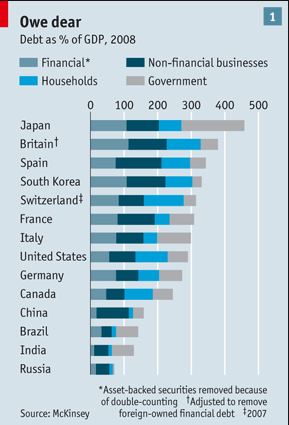
    One last chart. When it comes to total indebtedness, the U.S. is not the most profligate of all advanced nations. As can be seen from chart at left published in the Economist (based on data published by the McKinsey consulting firm), that distinction belongs to Japan.

    Unlike the U.S., however, Japan, Britain, France, Italy and Germany have resolved to shrink their deficits. Whether they will succeed in doing so remains an open question. But having peered into the abyss of sovereign default, the major European countries apparently have made the decision to suffer the pain of a potential double-dip recession today than the conflagration of a meltdown in sovereign debt a decade from now.

    So, how does this tie in to EMR’s discussion of environmental sustainability? It will take mucho dinero to make the transition from our current energy-intensive, natural capital-depleting economy to an economy that is environmentally sustainable. As EMR frequently observes, the window of opportunity to develop efficient human settlement patterns at reasonable expense closed back in the 1980s. It will be far more costly to do so now, even if we were committed to doing so, which we are not.

    Right now, Americans are still enjoying the benefits of a global capital glut, but that inexpensive capital will disappear as the world’s largest economies shift from being net savers to net consumers of capital and as governments commandeer an ever increasing share of that limited supply of capital to cover their deficit spending. In another 15 to 20 years, the window will slam shut — with plywood boarding bolted on, to boot — on any hope of redeveloping our human settlement patterns in more efficient configurations.

    Boomergeddon is going to be a real bummer.


  • ON THE FOURTH

    The Risse Household has celebrated the 4th of July for as long as EMR can recall.

    During WWII there were pot luck barbeques in the live-oak-shaded picnic grove next to the orchard. Households with members serving in the military from that part of the Santa Inez Valley โ€“ some years one or more were home on leave โ€“ and Households stationed at Camp Cook who were living off-post on nearby farms were guests of honor. The first 4th of July after The War ended, there was fireworks at the Lompoc Airport and a lug of cherries – no cherry bombs.

    In the Northern Rocky Mountain Urban Support Region the 4th was often celebrated with fellow trail crew members โ€“ college students who were working for the Park Service for the summer. Home made ice cream and newly ripe Flathead Lake cherries were on the menu. No fireworks, roman candles start forest fires, even in July.

    It was only after THE ESTATES MATRIX was completed that EMR fully realized how profoundly different the world was after 4 July 1776. It was not JUST that date but 4 July 1776 was the most important landmark in the fifty years from 1770 to 1820. This era included the American Revolution, the French Revolution, the Haitian Revolution the Louisiana Purchase and the War of 1812. As documented by THE ESTATES MATRIX, that period witnessed Fundamental Transformations of the Estates that manage human society.

    Now it is time to embrace new set of Fundamental Transformations. These Transformations are required to accommodate what has happened since 1800 with respect to the economic, social and physical context of human existence.

    These Transformations must evolve in a way that preserves the rights of all citizens and not just the privileges of individuals, Agencies, Enterprises and Institutions who have taken control at the top of the Ziggurat.

    Which brings us to 2010 and Baconโ€™s Rebellion.

    Jim, Larry, Groveton and Peter continue to throw rocks at empty pigeon holes.

    Citizen need those rocks โ€“ and all those that are tossing rocks โ€“ to work together to rebuild a foundation that will support a sustainable society now that there are 6.9-Billion humans who are dependent on the remaining Natural Capital.

    Enough of having fun with red meat. It is time to get to work.

    Things are not looking good.

    Groveton may be right that, in light of recent events, the traditional Donkey Clan will not be able to win an election for 20 years, if ever.

    Based on that criteria, it will 40 years, if ever, for the traditional Elephant Clan to win an election. The friends of Big Enterprise are not riding a wave of popularity.

    A recent CNN poll: (โ€œWho is to blame for the current economic conditions?โ€) Donkey Clan 24 percent, Elephant Clan 48 percent, Both 24 percent, Undecided 4 percent.

    On the current trajectory neither Clan will โ€˜win.โ€™ The way the cards are being played, there will again be a 49.9 percent to 51.1 percent split between two coalitions beholden to least-common-denominator platitudes and fueled by The Anger of Ignorance.

    Groveton says the stock market is a โ€˜leading indicatorโ€™ of the economy.

    EMR suggests a better indicator is the US NET National Savings as a percentage of GNP. (See CNNMoneyโ€™s 30 June reprint of a Fortune article โ€œPersonal savings rate: worse than we thought.โ€)

    The stock market is a gambling venue.

    Personal savings rates, and more important the “US NET National Savings as a percentage of GNP,” is an indication of individual and Organizational commitment to preparing for the future.

    Recall Jared Diamondโ€™s the two criteria for avoiding Collapse…

    See โ€œCollapse, An Appreciationโ€ Column # 64, 8 Aug 2005.

    Fundamental Transformations OR count on your fingers the number of times that you will be able to celebrate the 4th of July in public and without guilt.

    Happy Fourth!

    EMR


  • How Not to Treat a Bleeding Patient

    Let’s say you are in an emergency room and you have a patient being wheeled in from the ambulance who is bloody and critically injured.
    The man is in his middle age, he is overweight and has high blood pressure and cholesterol and has diabetes. He’s been in a bad traffic accident and has lost a lot of blood. He’s going into shock.
    In the emergency room are too old pros, Drs. Bacon and Groveton. They are knowledgeable about trauma, but they have attended a lot of continuing education seminars about the problems of patients as they age and what do do about it over the long term.
    What the man needs now is blood, but instead, Drs. Bacon and Groveton immediately lecture him about his sins. Dr. Bacon tells the man: “You are a Boomer and look at you. Fat. Stupid. Lazy. Helpless. You need to go on a strict diet and stop spending so much on Pabst and pork rinds and Kentucky Fried Chicken. Get some exercise, too, and try to get a disciplined outlook on life.”
    The patient, however, continues to bleed. Will he die?
    That’s the nut of the matter now that America’s feeble economic recovery is staggering and may fall backwards. You have Dr. Groveton quoting, of all people, Paul Krugman. And you have Dr. Bacon about to unleash his treatise on the dark futures we spoiled Boomers face. The bug-a-boo is government spending, deficits and debt — the usual conservative litany. And while we’re add, throw in a tax cut. Just in time for house races this fall and General Assembly election sin 2011.
    But consider this passage from today Journal. According to the WSJ column by Thomas Frank:
    “Solve the recession and we’ll eventually bring the deficit back down, too. The real danger is that instead we will decide to regard the deficit as a problem entirely unto itself — a quasi-moral issue that needs to be addressed independently of the larger economy — and that we will proceed to budget-balance ourselves right back into the economic ditch. For a glimpse of how this works, take a look at once-boom Ireland, where a starvation diet designed to control the deficit has made the recession more or less permanent.”
    It is important to remember that, like the pudgy man injured in the traffic wreck, treatment has to be continuous. It just doesn’t stop at one stimulus program after the big drop in GDP. It has to be ongoing. The recovery from the Great Depression staggered and then fell backwards by a host of issues, the lack of proper government stimulus and harsh tariff laws that froze global trading (for quasi-moral and stupid reasons). IN fact, what finally put the spike in thedepression once and for all was the massive government spending for World Warr II (not that we want that again).
    Therein lies the rub. The solution’s name is Keynes. It is time for Drs. Bacon and Groveton to stop lecturing and telephone the blood bank.
    Peter Galuszka

  • EMR’s Worst Nightmare

    Yes… the flying car. Air cruising speed of 115 mph, range of 450 miles. The retail price of 130 quid will give it limited market appeal. Yet… according to this UK news report, 70 people have already forked over a hefty down payment for an advance order.

    I am a great enthusiast for cool technology and alternate modes of transportation — anything to get people off our congested roads. But I have to say, flying cars are not what I had in mind. The only question I have is this: How many of these things will have to crash and burn before they are banned outright?

  • Obama’s looming “Profile in Courage”?

    In 1955, then-Senator John F. Kennedy wrote the book “Profiles in Courage”. The book documents eight US senators who took tremendous political risks by supporting unpopular causes. President Kennedy’s book won the Pulitzer Prize.

    Despite being published 55 years ago I know of no effort to publish a new edition of the book updated with recent biographies of US senators putting themselves at political risk in order to “do the right thing”. I suspect a lack of material. However, that may be about to change. Former Senator (and current President) Barack Obama is about to come face-to-face with an opportunity to be the ninth chapter in the updated “Profiles in Courage”.
    In order to understand President Obama’s looming Kodak moment it might be instructive to look at the actions and commentary of two former US Presidents – Bill Clinton and Herbert Hoover.
    Let’s start with William Jefferson “Slick Willy” Clinton. President Clinton is a bright man and an astute politician. However, in the primary season of 1992 he was the governor of a state generally seen as somewhat backwards and poorly managed. To most, he looked like a long shot to win the nomination let alone unseat the sitting president. However, Clinton had focus. He could boil an issue down to its bones and stay “on message”. The most famous example of this capability was his informal campaign motto – “It’s the economy, stupid”. Certainly, President Obama understands that former President Clinton was quite correct in putting the economy at the top of the electorate’s concerns.
    In 1929 Herbert Hoover had a problem. The stock market completely and totally crashed just seven and a half months after he took the oath of office. His first inclination was to invent New Keynesian economics long before either Paul Krugman or Barack Obama were born. He fired up the printing presses and flooded the economy with money. It was kind of working when a funny thing happened – people started getting very nervous about the deficits. Hoover blinked. The economy really tanked. And FDR became a legend. It’s certainly debatable whether the New Deal really ended the Great Depression. It’s equally debatable whether the high power money hose associated with New Keynesian economics is a good thing or a bad thing. However, what’s less debatable is that Herbert Hoover started down the New Keynesian path, got political cold feet and blinked. For more on this – look here.
    President Obama is in much the same position as Herbert Hoover. He has backed historically unprecedented levels of spending and stimulus. The popular backlash is in full bloom. Congressional elections will be held in just over four months. The Democratic Party faces the harrowing prospect of reversing perhaps all of its recent legislative gains. Obama could help his party by starting to backtrack on the New Keynesian bandwagon. He could start talking about the need for fiscal responsibility now that the worst is over. He could slow down the printing presses. In other words, he could blink.
    I seriously doubt the wisdom of the New Keynesians. However, if I suspend my disbelief for a moment I realize that once you open the door to the money flood you can’t just slam it shut. For better or worse we have opened that door. For better or worse our best chance for a decent future depends on the stimulus continuing for some time to come. Almost nobody wants to hear that – especially not the electorate. As John Kennedy documented, sometimes doing the right thing is unpopular.
    Don’t blink Mr. President.

  • Et tu, Krugman?


    Everybody in America should be quite concerned about Paul Krugman’s most recent Op – Ed piece in the New York Times. Mr. Krugman is a staunch and loyal supporter of Barack Obama. However, Krugman is now saying that the current recovery may very well collapse leaving the economy in what he is calling The Third Depression. His recent Op-Ed piece can be found here.

    In order to understand the magnitude of Krugman’s recent column it’s important to understand a bit about Mr. Krugman himself. Krugman is a Yale and MIT educated economist who won the Nobel Prize in Economics in 2008. His academic credentials are beyond repute.

    However, in addition to being a pre-eminent economist Krugman is also a liberal’s liberal. Like his credentials in economics his credentials in liberalism are also beyond repute. Mr. Krugman writes a twice weekly Op – Ed piece in the New York Times. He is a long time and bitter critic of George W. Bush to the point that he often seems to exhibit Bush Derangement Syndrome (BDS). Finally, he has written what I can only imagine to be the world’s shortest book – The Conscience of a Liberal. If you look up “liberal” in the dictionary you find Nancy Pelosi’s picture next to the definition. However, if you look up “coherent liberal” it will be Krugman’s hirsute likeness next to the definition.

    For the last 18 months Mr. Krugman has been heaping praise on Barack Obama in general and Mr. Obama’s economic policies in particular. Which is why Krugman’s recent Op – Ed piece is so shocking. At first, he seems to be admitting that the New Keynesian economics theory which he and President Obama espouse has failed. However, a closer reading of the Op – Ed piece reveals that Mr. Krugman actually thinks that New Keynesian economics is just what the world needs. Unfortunately, the world is just too dumb to realize the economic healing power of the monetary printing press. Mr. Krugman finds special fault with the recent European belief that endless spending and deficits may actually be harmful. It seems that Krugman and Obama have accomplished the seemingly impossible – they have “out liberaled” Europe.

    Despite all this apparently bad news I see three rays of light in an otherwise jet black sky. First, Bacon’s new book ought to be a best seller if we are really headed for a Third Depression. Hopefully, Mr. Bacon will remember all of us “little people” when we send him e-mails asking, “Hey buddy, can you spare a dime?”. Second, even uber-liberal Paul Krugman has stopped blaming Bush and moved on to the somewhat improbable thesis that it is the Europeans who are the new villains. Finally, Ed Risse’s long running predictions of doom and gloom may be coming true. Perhaps his prescription for reducing the inevitable pain will gain a wider audience.


  • Obama’s Big Fat Nothing

    Hoo-ah! My first column in the online op-ed section of the Washington Times:

    The financial media put a positive spin on a joint statement Sunday by the wealthiest members of the Group of 20 countries that they would halve their deficits by 2013 and stabilize their debt burdens by 2016.

    In the words of the Wall Street Journal’s lead story, the announcement was “a signal to international markets and domestic political audiences” that the G-20 countries “are taking seriously the need to wean themselves from stimulus spending.” Wrote the New York Times: “The action … signaled the determination of many of the wealthiest countries … to now emphasize debt reduction. And it underscored the conviction of European nations in particular that deficits represented the biggest threat to their economic stability.”

    What both newspapers neglected to mention is that the goals require virtually no change in U.S. fiscal policy in the near term and only modest changes by the second half of the decade – at least if you believe the 10-year budget forecast prepared by the Obama administration. For all practical purposes, President Obama could have announced, “The Europeans can do whatever they want. We’re not budging from the status quo.” More.

    Hopefully, there will be more columns to come — addressing less arcane topics than G-20 summit announcements.


  • Where Are the Oil Skimmers?

    How inept has the Obama administration been in responding to the Deepwater Horizon oil gusher? Reports from the field suggest that, nearly 70 days into the crisis, the federal response to the oil clean-up is still in disarray. For evidence, we Virginians need look no farther than the port of Norfolk, where the world’s largest oil skimmer, the “A Whale,” is berthed and waiting for federal authority to proceed to the Gulf of Mexico.

    The Taiwanese-owned, South Korean-built supertanker has 12, 16-foot intake vents designed to skim the oil off the water’s surface. As the Daily Press quotes its owner, Nobu Su, the ship would float across the Gulf “like a lawn mower cutting the grass,” ingesting up to 500,000 barrels of oil-contaminated water a day.

    What’s the hold-up? The big problem appears to be the lack of formal government approval, presumably from the Coast Guard, allowing it to assist in the clean-up. Also complicating matters are the lack of a contract with BP to perform the work (although I’m not sure why that’s an issue if the A Whale is willing to pitch in without a contract), and possible Jones Act restrictions against the operation of foreign-manned vessels in American waters.

    News of the A Whale follows revelations that the Obama administration spurned assistance from the Dutch government to dispatch its own oil-skimming vessels and to prepare for the U.S. a contingency plan to protect Louisiana’s marshlands with sand barriers. According to Canada’s Financial Post, “One Dutch research institute specializing in deltas, coastal areas and rivers, in fact, developed a strategy to begin building 60-mile-long sand dikes within three weeks.” The U.S. response: “Thanks, but no thanks.”

    Unlike the Katrina disaster, where state and local governments resisted Bush administration intervention in the hurricane response, there is no question whatsoever that the federal government is in charge of the clean-up of U.S. territorial waters. It’s bad enough that the Feds were so ill prepared to deal with the disaster — we can forgive them, perhaps, for failing to imagine such a collossal oil spill — but there is no excuse for the inept, bureaucratic response once the magnitude of the disaster became apparent. Seventy days into the event, the pettifogging legalisms continue to hamstring the the clean-up.

    While Obama played golf and the bureaucrats picked their bureaucratic nits, massive quantities of oil, which could have been skimmed or blocked by sand berms, began befouling the marshes and beaches of the Gulf Coast.

    George W. Bush was rightfully pilloried for his lamentable comment, “Brownie, you’re doing a heck of a job,” which showed how out of touch he was from the situation on the ground. But let us remember: Katrina hit Louisiana on Aug. 29, 2005. FEMA Director Michael Brown was fired from on Sept. 12, 2005 — 15 days later. Obama has threatened to “kick ass,” he has declared an offshore drilling moratorium (which was promptly overturned in court), he has initiated criminal investigations into BP, and he has squeezed $20 billion from the oil giant for reparation payments… everything but actually organize a clean up. Nearly 70 days and counting, and Obama has yet to relieve anyone responsible for the disorganized response. Pathetic.

  • Corey Stewart’s Bad Idea


    Three years ago, Prince William County achieved notoriety by adopting legislation that was supposedly designed to stem illegal immigration but in reality harassed Latinos, many of whom are hard-working and law-abiding.

    What goes around comes around. Corey A. Stewart, chairman of the PWC board of supervisors, is beating the drum for Virginia to adopt a statewide anti-illegals ban of the same type as the one Arizona recently adopted which Stewart proudly says is modeled after PWC’s 2007 law.
    Speaking on “fair and balanced’ Fox News, Stewart presented statistics that after the law in Prince William, violent crime dropped 38 percent, English as a Second Language enrollment dropped to zero and most citizens of the predominately white and affluent suburb of Washington, D.C. approved of the law.
    Stewart believes that the 2011 General Assembly session is the perfect time to adopt another version of Arizona’s law which requires police to check the immigration papers of anyone they think might be illegal. He also wants to make it illegal to have day labor centers where one can find temporary workers or the solicit work on roadsides. The timing is right because state elections follow the 2011 session.
    What Stewart doesn’t note is that Arizona’s racist law has been bashed by many throughout the U.S. as a throwback to the country’s tarnished reputation for tolerance when it comes to the white Protestant majority trying to keep out darker-skinned people or those of other religions, notably Catholics, Jews and Muslims. Activist groups have campaigned to stop tour buses and sports teams from stopping in the Copper State.
    Plus, there may be some problem with Stewart’s facts. The advocacy group Media Matters reports that in 2009, after the law was passed in PWC, violent crime actually increased by 10.9 percent. Go figure.
    Another problem is that being a white bedroom community, Prince Williams isn’t exactly a hotbed of rape, murder and robbery that one sees in the District of Columbia, Richmond or the inner cities of Tidewater. Indeed, PWC’s violent crime index, according to a University of Wisconsin study, is only 206 (in crimes per 100,000 population). If you want more crime, look to Portsmouth or Richmond. Much of the crime there is in African-American neighborhoods where drugs are a problem.
    The PWC law was aimed at Hispanics who may or may not have their papers in order and handle much of the hard work that native-born Americans won’t do, such as landscaping, construction or busing restaurant tables. According to Latino activists, all that the law did was annoy Latinos and make them move their work or place of residence to a neighboring, more tolerant and less racist community.
    As for English as a Second Language, one wonders what it is with these neo-Know Nothings like Stewart. Our world, especially that in the D.C. area, is becoming much more global and diverse. One would want new immigrants. They are hard working and some are quite bright. According to London’s Economist, between 2000 and 2004, Americans of Chinese or Indian descent won 14 percent of all patents although they make up less than 5 percent of the population.
    Admittedly, the U.S. needs immigration reform but it must take into account the advantages of having immigrants and how they help solve America’s labor problems. Racist and polarizing initiatives such as Stewart’s need to be dumped, pronto.
    Peter Galuszka