• The Right of Repeal

    Here’s a hot one for you: This January, the General Assembly will consider proposing a constitutional amendment. The so-called “Repeal Amendment” would give two-thirds of the states the power to repeal any federal law or regulation. Here’s the text:

    Any provision of law or regulation of the United States may be repealed by the several states, and such repeal shall be effective when the legislatures of two-thirds of the several states approve resolutions for this purpose that particularly describe the same provision or provisions of law or regulation to be repealed.

    The idea was floated today in an op-ed piece in the Wall Street Journal. The authors were Randy E. Barnett, a Georgetown law professor, and William J. Howell, Virginia’s speaker of the House.

    “At present, the only way for states to contest a federal law or regulation is to bring a constitutional challenge in federal court or seek an amendment to the Constitution,” write Barnett and Howell. “A state repeal power provides a targeted way to reverse particular congressional acts and administrative regulations without relying on federal judges or permanently amending the text of the Constitution to correct a specific abuse.

    Hear! Hear! The nation desperately needs another mechanism to stem the overweening power of the leviathan state. This should make for a rollicking good debate in the blogosphere this fall. What a bold stroke, gentlemen. Let Virginia lead the nation in reclaiming powers rightfully belonging to the states!

  • “Boomergeddon” Hits France


    Boomergeddon” is getting traction in France.

    Today, the lower house of France’ s legislature passed Nicolas Sarkozy’s pension reform package that increases the minimum retirement age to 62 from 60. A vote in the upper house is due Oct.1.
    For the luxury-loving French, called “EuroWeenies” by Boomergeddon author James A. Bacon, the idea of raising the retirement age is bitter medicine. According to Sarkozy, France cannot keep making its earlier-age pension payments, so some sacrifice is required.
    Disgruntled workers more than one million strong have thronged streets to protest advancing the retirement age. A national strike is called for Sept. 23.
    Sarkozy is hanging tough with his reform although a new election will come in 2012.
    The French have been known for eating well, good wine, long vacations and early retirements. They also have been known to take time off around 5 p.m. for sexual trysts.
    Peter Galuszka

  • Executing Teresa Lewis is Wrong


    Barring a legal miracle Teresa Lewis will be killed by the Commonwealth of Virginia on Sept 23. She will be the first woman executed in Virginia in nearly 100 years. One of the few hopes Ms. Lewis has left is a grant of clemency by Gov. Bob McDonnell. I believe Gov. McDonnell should grant clemency.

    Teresa Lewis is a bad woman. On Oct, 30, 2002 two hired killers murdered Ms. Lewis’ husband and stepson. The killers were hired by Teresa Lewis for $1,200 and a promise to split the proceeds of the stepson’s life insurance policy. The murders were premeditated, cold blooded and heinous.

    Teresa Lewis is guilty. In a plot line which could have come from an episode of Law & Order the murders of Julian and CJ Lewis involved sex, drugs and the suicide of one the hit men. However, in stark contrast to a Law & Order show there has never been much doubt about what happened on that October night in 2002. Teresa Lewis hired two men to slaughter her family. A more detailed account can be found here.

    I don’t want McDonnell to offer clemency because Teresa Lewis is a woman. I could care less. I don’t want her life spared because she has an IQ of 70 or because she was addicted to prescription drugs at the time of the murders. I don’t care about the new theory that one of the hit men was the real mastermind and Teresa Lewis was a patsy.

    I want to see Teresa Lewis’ sentence converted to life without parole because I don’t trust the criminal justice system. I don’t trust the lawyers, I don’t trust the judges and I don’t trust the police. At least, I distrust trust enough of the lawyers, judges and police to want to stop the Commonwealth from killing people in my name. My personal disgust with the whole system was born during the first OJ trial. However, that was far from the only miscarriage of justice which ought to give everybody pause.

    In 1984 Earl Washington was convicted of murder and sentenced to death in Virginia. Like Teresa Lewis, Earl Washington’s “crime” was horrible – the rape and murder of a 19 year old mother of three in her home. Like Teresa Lewis, Earl Washington confessed. Like Teresa Lewis, Earl Washington had a very low IQ (in the general range of 69). Like Teresa Lewis today, Earl Washington was within 9 days of being killed by the state. However, Earl Washington did not murder Rebecca Lynn Williams. In fact, he was subsequently eliminated as a suspect in that crime. He was the mentally challenged victim of a rush to judgement which involved a series of abuses by “the system”. Once Earl Washington was exonerated by DNA testing (after 17 years on death row) the real killer was ultimately found. You can read about it here.

    The simple and obvious fact is that Virginia has condemned people to die for murders they did not commit. Can there be any doubt that Virginia has also executed people for murders they did not commit?

    I don’t want Teresa Lewis to get clemency because she’s not guilty. She almost certainly is guilty. I don’t want Teresa Lewis to get clemency because I am a liberal. I’m not. I want Teresa Lewis to get clemency for the most conservative of reasons – I don’t trust the justice system. And neither should Bob McDonnell.


  • Why Government Bailouts Aren’t All Bad

    There’s been quite a bit of spirited debate on the Rebellion about bailouts and federal debt, much of it inspired by Jim Bacon’s new book on the financial problems Baby Boomers will face.
    In the heat of discussions, however, it seems that some key points are being lost.
    As bad as government bailouts are, they often actually work. Governments can be a lender of last resort, loan money that buys time for repairs and then it is repaid. Life and the economy go on. It can’t be a long-term debt for the government since they are paid back.
    There are plenty of examples around the world. One is in Sweden which fell into a severe financial crisis in the late 1980s. True Sweden has a lot more social programs than the U.S., making it quite different. The financial crisis had to deal with some complicated government borrowings related to the Swedish krona. One compex issue affecting the country’s currency was how West Germany managed merging its currency with that of East Germany which it was absorbing after the Sovit Bloc failed.
    During the crisis, two of Sweden’s six largest banks, Forsta Sparbanken and Nordbanken, could no longer meet capital requirements required by Swedish regulations. Stockholm’s government bought Nordbanken and helped Forsta with loan guarantees. The government also picked up a failing bank, Gota Bank. The government ended up owning about 22 per cent of the country’s banking assets according to a report by the Cleveland Federal Reserve Bank.
    Two asset management back, sort of “bad” banks, were set up to pick up the weakened banks’ bad loans, skirt regulations on a part-time basis, and inject equity in the troubled banks. They made it a gradual process to take pressure off short term prices. Within a half a decade, the country’s economy picked up sharply and most of the liquidations had been sorted through at a lower cost than originally fared. Crisis over.
    Looking at the U.S.’s devastated economy, one can see signs of progress. Many folks hated the Troubled Asset Management Program (TARP) which spent nearly $800 billion buying up bad assets and injecting public capital into banks to prop them up in the short term. We will be celebrating the second anniversary of TARP this month.
    So what’s happened since? A number of high flying banks have actually repaid their TARP money, according to Pro Publica. American Express returned $3.3 billion on June 9, 2009. Bank of America paid back $45 billion on Dec. 9, 2009. Goldman Sachs paid back $10 billion on June 9, 2009. On the same day, JPMorgan Chase paid back $25 billion.
    To be sure, according to ProPublica, millions in warrants have to be sorted out. As part of the TARP deals, these give the U.S. government the right to buy bank equity at a set price. After the TARP loans are paid back, the warrants are either sold back to the company or auctioned off.
    The point here is that when we all go running around with our adding machines figuring U.S. debt, one has to deduct the billions of TARP dollars that have already been paid back. I do not have a clear number to date. And as the Swedish example shows, sometimes a government can do the right thing by being a last-resort lender and a problem solver. It could very well be that Secretary of the Treasury Henry Paulson, followed by Timothy Geithner, and both George Bush and Barack Obama may have prevented a truly awful recession turn into the Second Great Depression.
    We won’t know for some years if this was the case. In the meantime, let’s watch that deficit hysteria.
    Peter Galuszka

  • ODEC’s Coal Plant Takes a Powder

    Is the beginning of a big shift in energy use at hand?
    Last week, Old Dominion Electric Cooperative based in Henrico County announced that it was delaying a controversial $6 billion coal-fired generating station in Surry County just an egret’s flight away from Colonial Williamsburg.
    For about two years, ODEC seemed to have been on a roll, sweet-talking residents of the rural county with pig-pickings, throttling reporters who ask too many pesky questions and snagging permit after rezoning ordinance to build its plant in the tiny village of Dendron.
    On Sept. 8, ODEC announced it was “extending its timeline” for building the 1,500 megawatt plant because the “slower than expected growth in the economy” means there’s less demand for electricity. Not to fear, an ODEC spokesman said, there will be growing demand in the future and the delay of up to two years doesn’t change the cooperative’s goal.
    But it seems that ODEC’s announcement is a bit disingenuous. Could it be they can’t line up needed financing?
    Already, consultants have questioned the need for the project and how anxious lending institutions would be to shell out billions. ODEC spokesmen turned aside the concerns.
    Unlike Dominion Virginia Power which has two nuclear statons, a number of coal-fired and gas-fired plants and hydro, ODEC has never built an electric power station of this size before. Its members are a polyglot of small, rural coops from Delaware to Virginia. Its biggest and most urban member, a Northern Virginia coop, left ODEC in a contract dispute a couple of years ago.
    One wonders why ODEC needs such a big slug of power. It could be that ODEC needed to partner with another utility to get loans and failed to do so. There’s no question that enterprises that easily pass the viability test have a hard time getting loans these days after the Big Money banks like Merrill Lynch, Wachovia, and Bank of America all got greedy with dangerous but highly profitable subprime mortgage lending and their derivatives.
    Experienced plant builders and operators like Dominion need either special financial deals worked out through state legislation as was the case with its much smaller Wise County coal-fired plant or federal help. Plans to build another nuclear unit at North Anna won’t fly without massive federal loan guarantees.
    What’s more, Department of Energy figures shows that during the recession, total power demand dropped 4 percent and coal-fired power, which, a few years ago, had supplied more than half of all electricity generated in the country, dropped 11 percent. By contrast, natural gas, hydroelectric and renewable energy sources all showed an increase in the percentage of electricity they generated.
    Could a turning point be in the wind (so to speak)? Or is it just more flotsam from the sinking economy?
    Whatever. With obstacles like these, it’s a wonder ODEC’s plan has survived as long as it has.
    Peter Galuszka

  • Fighting for the Scraps

    As the U.S. economy limps out of recession, lending to business is showing no sign of revival. And that should worry us all. According to Federal Reserve Bank data, business receivables outstanding held by finance companies were less than $470 billion in July, down 22 percent from 2008. New securities issued by corporations are running at an $830 billion annualized rate this year, down from $2 trillion in 2008.

    But thatโ€™s only the beginning of the bad news for small business. To an unprecedented degree in peacetime U.S. history, the federal government dominates the allocation of credit in the economy. As a consequence, politically favored constituencies โ€” real estate, banks, higher education, exports and the green industry, not to mention government itself โ€” are getting all the capital they want (indeed, more than they can profitably use), while everyone else feeds upon the scraps.

    The federal government plays an increasingly intrusive role in the American economy. Federal expenditures account for almost one quarter of the gross domestic product. Meanwhile, government is expanding its regulatory reach over the shrinking portion of the economy not subsumed by government, most recently by means of the Affordable Care Act and the Wall Street Reform and Consumer Protection Act. Less visibly, as I document in my book, โ€œBoomergeddon,โ€ the leviathan state employs a variety of tax incentives, loan guarantees and monetary tricks to ensure that favored industries gain preferential access to capital.

    Uncle Sam has been force-feeding the housing sector like a stuffed goose, even as the other animals on the farm starve. Even before the global financial crisis, the housing industry benefited from deductible interest on loans and federal guarantees for debt issued by Freddie Mac and Fannie Mae. When the housing bubble popped, the Obama administration doubled down by committing $7.4 trillion to more loan guarantees, purchases of mortgage-backed securities, a bailout of Fannie and Freddie and an initiative to rework mortgages for stressed homeowners.

    The banking sector has been another beneficiary of federal favoritism. Over and above the hundreds of billions of dollars funneled to banks by means of the Troubled Asset Relief Program, much of which has been repaid, the Federal Reserve subsidizes the industry on an ongoing basis through its interest rate policies. Thanks to the Fedโ€™s near-zero interest rates, banks can borrow money for nothing and reinvest the funds longer-term in super-safe 10-year Treasuries, around 2.5 percent, pocketing the difference. Easy as pie. Since early 2008, banks have increased their holdings of U.S. securities from $1.1 trillion to more than $1.5 trillion: $400 billion that could have been invested in the private sector. The implied subsidy worth tens of billions of dollars yearly drops straight to the banksโ€™ bottom lines.

    Another privileged sector is higher education. Uncle Sam has guaranteed roughly $850 billion in loans to college students โ€” an indirect subsidy of the higher education industry. The endless supply of credit to students has allowed colleges and universities to jack up tuitions far faster than inflation over the decades. While the higher ed establishment swells in size like a bad bruise, college grads are becoming a new indebted class in American society.

    Municipal governments are another congressional pet. State and local governments have long benefited from the ability to issue tax-free municipal bonds, which lowers the cost of capital not only for building roads and extending sewer lines but also for underwriting convention centers, ballparks and other facilities that hardly rank among the core services of government. But in the recent recession, that advantage was not enough. Congress created a new vehicle for funneling scarce capital to municipal projects: Build America Bonds. The bonds are not tax free, but the feds does pay 35 percent of the interest, resulting in lower interest charges to local government. By the end of 2010, bankers estimate, $150 billion of the bonds will have been sold.

    Whenever Congress wants to bestow benefits on a particular industry without having an embarrassing subsidy showing up as a line item in the budget, a favorite tactic is to create a loan guarantee program. Thus the export-import bank puts the faith and credit of the U.S. government behind big U.S. exporters, while the Department of Energy expedites the flow of capital into everything from nuclear power plants and alternate energy facilities. If you export jet airplanes or build wind power farms, you win the lottery. If not, you must scrounge for money from a smaller pool of capital.

    Who looks out for small business? Well, President Obama has proposed setting aside $30 billion to help fund small businesses, but the sum would replace only a fraction of the cutbacks in bank lending. Moreover, the proposal reinforces a noxious precedent: that the pool of investment capital is something that power brokers in Washington can carve up and dispense as they please. Beneficiaries become supplicants, forced to hire lobbyists and contribute PAC money to keep their fix coming. The politically powerless โ€” small business, foremost among them โ€” fight for the leftovers.

    Originally published in Richmond BizSense, Sept. 20, 2010.

  • Privatization Proves Nettlesome

    There’s news galore all around the privatization front.
    Selling off the state’s huge Tidewater port facilities has been nixed; a bunch of private firms show interest in a partially state-funded new tollway tracking U.S. 460; and Gov. Bob McDonnell has finally unveiled his big idea for selling off the state’s ABC stores.
    The news, however, is both mixed and quite telling. In every case, funding the right price for the project at hand has been a very nebulous exercise. It shows that privatization, which the state jumped into with great fanfare back in the mid 1990s, is not exactly the cut and paste selloff that its proponents would have you believe.
    As the state Department of Transportatin has found out when it considered selling off the gigantic port facilities built with public money over many years, private business people are what they are for a reason. They will but the price squeeze on you. They want a good deal (even better a one-sided one) and could care less about the neo-Jeffersonian nonsense that the usual “think tanks” and blogs and gubernatorial streamlining commission types would have you believe.
    Take a look at the three proposals:
    • Transportation Secretary Sean Connaughton has pulled the plug on three proposals to operate the Virginia Port Authority facilities in Norfolk, Portsmouth and Newport News. Illinois-based CenterPoint Properties, a partnership of Carrix INc. of Seattle and Wall Street giant Goldman Sachs; and Washington-based Caryle Group with tentacles everywhere all had submitted proposals in 2009. Problem was, the proposals were embarrassing low balls figured on 2009 traffic when the Great Recession had crunched cargo traffic. Upfront cash offers ranged from $250 million to $750 million — not exactly big bucks. A later deal by APM Terminals for VPA to lease its $500 million container facility in Portsmouth for 25 years helped seal the others’ doom.
    • McDonnell badly wants a privatized superhighway through the peanut country of Suffolk and other southeastern counties to Petersburg to replace pokey U.S. 460 and offer a safety valve for the clogged U.S. 64 on the Peninusla. Not a bad idea, but McDonnell somehow expected that the state wouldn’t have to poney up any public cash (the usual GOP pipedream). After no bidders showed up, some undisclosed public money was put on the table. Bids are in from 460 Partners, which includes Skanska USA Civil Southeast, AECOM and Bank of America; Multimodal Solutions LLC, including constructon giant Kiewit Cnstructioon, the Louis Berger Group and Autostrade; and finally, Spain’s Cintra Infraestructuras S.A.U., which is one of the leading public-private infrastructure building outfit on the face of the earth (presumably their executives won’t have to monkey with any anti-Hispanic immigration laws that the hard right wing in this state want so badly). It isn’t clear how the financing will work, but proposals in 2006 flopped in part because they would call for tolls of $13 per vehicle to go only 55 miles.
    • Lastly, McDonnell has finally unveiled his selloff plans for ABC stores. He claims selling off 300 or so ABC stores will bring in $500 million and keep pumping in nearly $250 million annually in taxes. Facing hard oppostion from his own party, he dropped his goofy idea to add a 4 percent tax masquerading as a fee on mixed drinks in bars. In its place is a 2.5 percent tax on bars and restaurants that choose to buy liquor from wholesales and not retailers. Plus there’s a $17.50 per gallon excise tax on spirits that would be higher than the national average and higher than neighboring states. Opponents are readying their attack, saying the governor’s numbers are loopy. What’s worse, the last two states to privatize their ABC system — West Virginia and Iowa — did not make nearly the revenue from the sell-off as they initially thought. The plan — and the funny way McDonnell has come up with figures — will not be this a slam dunk.
    This is a lot to absorb, but it is a “teachable moment” as Barack Obama likes to say. Privatization is a lot harder than it looks. Assessing fair values on properties built with the sweat of Virginia taxpayers is not easy not matter what the dogmatists claim. And when you look at all the effort the McDonnell Administration is putting into these privatization things, you have to ask: Why here? Why now? Why isn’t he concentrating directly on jobs?
    Peter Galuszka

  • America’s Competitive Edge Is Eroding

    The United States, once regarded as the most economically competitive nation in the world, has fallen to 4th place, according to the 2010-2011 Global Competitiveness Report published by the World Economic Forum, the folks who organize the prestigious Davos wonk fests.

    Only two years ago, the U.S. ranked No. 1 in the comprehensive assessment of the competitive strengths of all the worldโ€™s nations. In last yearโ€™s report, the U.S. fell to No. 2, surpassed by Switzerland. This year, the worldโ€™s largest economy was humbled yet again, falling behind Sweden and Singapore, with Germany nipping on its heels.

    While the U.S. still possesses great strengths, in particular the size of its domestic economy, the flexibility of its labor markets and its capacity for innovation, major weaknesses have intensified. The report cites growing distrust of politicians, questions about the governmentโ€™s ability to maintain arms-length relationships with the private sector, and the wastefulness of government spending. But dysfunctional macroeconomic policy ranks as the biggest concern of all. States the report:

    A lack of macroeconomic stability continues to be the United Statesโ€™ greatest area of weakness (ranked 87th). Prior to the crisis, the United States had been building up large macroeconomic imbalances, with repeated fiscal deficits leading to burgeoning levels of public indebtedness; this has been exacerbated by significant stimulus spending.

    How does public indebtedness impact national competitiveness? First, it is necessary to understand what the Global Competitiveness Report means by competitiveness: โ€œWe define competitiveness as the set of institutions, policies, and factors that determine the level of productivity of a country.โ€ The level of productivity dictates the level of prosperity that a country can sustain, as well as the rates of return on investments in physical plant, human capital and technology. A more competitive economy will likely grow faster in the medium- to long-run.

    Continued budget deficits and high public debt crimp productivity in several ways. First, they reduce fiscal flexibility. Government has fewer resources to invest in productivity-enhancing infrastructure, education and public health, or to apply as fiscal stimulus during downturns. Second, as governments borrow more, interest rates will tend to rise, thus driving up the cost of capital for private business.

    Also, the report notes, these effects can be exacerbated by consumer and business expectations. โ€œBecause taxes will most likely have to be raised in order to repay debt, economic agents will adapt their growth expectations, investing less and saving more. Taken together those factors may lower growth, making it even more difficult to repay debt in the future and potentially leading to a vicious cycle.โ€

    For those appraising the long-term fiscal viability of the federal government, here is the takeaway: There is a feedback loop between deficits/debt and economic competitiveness. Growing deficits reduce a nationโ€™s productivity and competitiveness over time. Lagging productivity/competitiveness translates into slower economic growth, weaker tax revenues and even more deficits.

    That feedback loop is masked right now because interest rates are so low. But it will kick in full force later this decade as the global capital glut turns to global capital scarcity and interest rates begin to climb.


  • The Taint of Kochs on McDonnell’s Reform Commission

    Is there a Koch connection to Gov. Robert F. McDonnell’s 31-member commission on government streamlining?
    The Kochs are brothers David H. and Charles who run Wichita-based Koch Industries, a petroleum-based conglomerate that is the second-largest privately held company in the United States. They are hard-right political activists with a libertarian, anti-Obama
    bent, who, according to a recent New Yorker profile, “believe in drastically lower personal and corporate taxes, minimal social services for the needy, and much less oversight of industry — especially environmental regulation.”
    Among the Kochs’ many donations are millions of dollars for the Arlington-based Mercatus Center, a “market-oriented” think tank tied to George Mason University. One Democratic strategist has described Mercatus as “ground zero for deregulation policy in Washington.”
    Maurice McTigue, a former New Zealand politician and a vice president at Mercatus is on McDonnell’s commission. McTigue, who was known as a government streamliner in New Zealand, has advised states such as Louisiana on cutting state functions.
    A spokeswoman for Mercatus says that, except for McTigue, there is no direct tie between the McDonnell commission and the think tank. A source close to the commission reports that McTigue sits in on meetings of subcommittees other than his own. Also, correspondence from a McDonnell staffer that was supplied to me by a source suggests that Mercatus is playing a bigger role by helping the commission “flesh out potential recommendations and ideas.”
    The governor’s goal is to cut back on state spending, privatize as many entities as seem appropriate, end redundancies and make state government more transparent. These may seem like worthy goals to some. But one wonders if it really means having the state throttle the poor and sick and let companies have their way with the state’s rivers, lakes and air, along with the Chesapeake Bay. Will consumers be protected from predatory firms? Or would that be off-limits for state regulators?
    Other questions have been raised about the makeup of McDonnell’s commission. It is being chaired by Fred Malek, a former Army Green Beret and Nixon administration staffer who was involved in President Richard Nixon’s efforts to identify Jews at the Bureau of Labor Statistics. Malek has said he did so reluctantly and later apologized.
    Besides Malek, the rest of the McDonnell commission is very lopsided — to the right. Among its members:
    • Alexandra Liddy Bourne, executive director of American Energy Freedom Center, a Northern Virginia outfit that also employs former Republican Gov. George Allen. The conservative energy lobby pushes for oil drilling off of Virginia’s coast and runs through the usual laundry list of opposition to global warming legislation.
    • Commission member Geoff Segal is a vice president of Macquarie Capital, an Australian firm that is very big into privatized road projects — another McDonnell favorite.
    • “Special advisor” is Mike Thompson, chairman and president of the Thomas Jefferson Institute for Public Policy, a right-wing, libertarian outfit that unfortunately took over the old Bacon’s Rebellion e-zine and turned it into an e-rag for Northern Virginia-based lobbyists pushing privatization and limited government.It isn’t exactly the place to turn to to see a wide spectrum of opinion.
    The Kochs however, are much bigger fish and, according to the New Yorker, they have pumped millions to stymie Barack Obama whom they consider a socialist. The conservative movement has had more than its share of Southwestern or Midwestern oil billionaires, such as the Hunt brothers of Texas, who have the deep pockets for their favorite political charities. These are the kinds of people who attacked John F. Kennedy because he was a Catholic and backed Curtis Lemay, the neo-fascist retired Air Force general, for office. The New Yorker says the Kochs are covertly funding the Tea Party movement, which is a curiosity given the Tea Party’s supposed populism.
    But money, especially oil money, talks.
    Peter Galuszka

  • AN IDEA BAD ENOUGH TO RUIN JIM BACON’S HOLIDAY

    Peter posted a very good Labor Day statement concerning The Wealth Gap and here is another transect through that same frightening territory.

    The current administration is proposing a $100 Billion tax break for Enterprise R&D.

    There are four BIG problems here:

    First: The obvious one that Jim Bacon will focus on: It drives the federal deficit even higher. Boomergeddon sooner!

    Second: It puts more big and mid-sized firms on the dole and generates more political contributions for the existing political Clans.

    Third: It will not provide jobs that the folks who Accurate correctly points out are not contributing their fair share of effort and are the ones who NEED jobs.

    Fourth: R&D, if it is โ€˜successful,โ€™ will drive Mass OverConsumption, not REAL conservatism โ€“ aka, conservation.

    The Enterprises that are large enough to qualify to have an R&D program and have cash flow large enough that make tax breaks attractive are NOT the Enterprises needed to get Main Street to work. Picking up on TMTโ€™s point, getting the tax break will justify even higher CEO compensation.

    The US does not need Garmeen Foundation-scale micro loans but it does need Community Supported Enterprise loans. Bacon has done a nice job of pointing out that banks are using the past rounds of ‘incentives’ to improve their bottom line, not make loans.

    Get citizens involved. Investments should be in activities and Enterprises that investors can see and understand, not in Gambling Venues.

    There are a plethora of ideas that we have uncovered while preparing a series of talks on the application of Regional Metrics to Community prosperity. One is that the CSA idea is spreading from Agriculture to Enterprises. But that news is drowned in the Labor Day ads about discounts on goods made in China.

    Time is short and getting out useful information is critical. The Administration is also proposing $50 Billion in new โ€˜infrastructureโ€™ programs. There is a better way to spend some of that money:

    Take the infrastructure money that would otherwise go to subsidize dysfunctional human settlement patterns โ€“ most of it outside the logical locations of The Clear Edges โ€“ and provide it to qualifying Community Colleges for education and information on Community support ideas and programs like CSE.

    What is needed are investments in start-up Neighborhood, Village and Community scale Enterprises.

    Want to support a sustainable economy in your Community, your SubRegion, your Region and by extension in the US?

    Stop reading INC., The Wall Street Journal and The Earth is Flat. Start reading YES, and The Small Mart Revolution.

    Start a study circle in your Cluster around Cheap, The High Cost of Discount Culture and The Story of Stuff. Read The Great Reset but focus on how to make Floridaโ€™s view of change benefit, not pillage, your Village and your Community.

    Small is beautiful.

    Happy Labor Day.

    EMR


  • The Filthy Rich Get Richer


    In “Matewan,” the 1987 film about organizing West Virginia coal miners, union activist Joe Keenehan, played by Chris Cooper, tells a group of dubious miners: “There’s two types of people. Them that work and them that don’t. You work. They don’t.”

    With that as a Labor Day message, let’s consider some very important structural changes in our economy and on that some economists believe is a major reason why we’re not seeing very much of a recovery from recession.
    Wage inequality is a rising phenomenon that has not been dealt with, according to Robert B. Reich, former Secretary of Labor. Despite the entry of women into the labor force in a big way and two wage earners per family in many cases, the purchasing power of average wage-earners has been decreasing over the past several decades. One result is that the middle class no longer has as much dollar clout to buy enough goods to facilitate more production and more jobs. Hence, our unemployment rate hovers at about 9 percent or so without much change.
    How come? One reason is that many of the economic gains over the past several decades have gone to the richest people. Reich writes:
    “In the late 1970s, 1 percent of American families took in about 9 percent of the nation’s income; by 2007, the top 1 percent took in 23.5 percent of total income.”
    Okay. So, the rich are getting a lot richer. But if we believe in trickle down economics a la Arthur Laffer and Ronald Reagan, this is a good thing since everyone will share in the benefit, lower taxes on the rich will generate more wealth and we’ll be very happy.
    Well, not exactly, as Reich notes, the new rich do not spend all that much of what they have. And these days, if they do invest, their money is just as likely to go to the Cayman Island, China, the Isle of Man, Cyprus or anywhere but the U.S.
    The data about the income flows at the top comes from Thomas Piketty and Emmanuel Saez, two Berkeley professors, who have studied income tax returns since the taxes were first levied. Income patterns were fairly similar among the rich of various countries until the 1970s. After that they remained stable in Europe and Japan, but “increased enormously in the United States and other English-speaking countries.”
    The chief reason, they say, is that the pay for top corporate managers suddenly rose exponentially. In fact, According to BusinessWeek (my alma mater), in 1980, the average CEO of a major firm made 42 times the average worker’s pay. That rose to 85 times by 1990. By 2000, it had reached an incredible 531 times that of the average hourly worker.
    Reasons given for this anomaly, according to Saez and Picketty, are that being top boss is a lot harder, but they note it doesn’t explain why CEO pay did not rise by the same rate in countries such as Japan where one might assume running Toyota or Sony is not much easier. A second reason could be that labor unions have been beaten down so much that they no longer can act as a reasonable brake on CEO greed. A third reason could be that CEOs have been allowed to set their own pay terms and “extract rents at the expense of shareholders.”
    The same pattern can be seen on university campuses where being president has gradually become enormously lucrative. John Casteen, the former president of the University of Virginia made $797,048 in 2008 while the median pay for a public university was $427,400. Eugene Trani, former head of Virginia Commonwealth University made $532,000, but that doesn’t include perks such as directorships of corporations. He made $159,000 this year as a director of tobacco firm Universal Corporation.
    This kind of largess has made London’s Economist magazine question if America’s colleges are going the way of car companies. Against a backdrop of such big salaries for top administrators, college fees have soared beyond the ability of many Americans to pay for them. Between 1993 and 2007, administrative costs at Harvard have gone up 300 percent. Does this mean schools are hiring superstar professors? Not really. They tend to spend more on the president’s office or on luxurious dorms or fancy sports stadiums than on actual teaching.
    The libertarians who dominate this blog stick their heads in the sand and choose not to see these harmful trends. Instead, they want more tax cuts for the rich or they want to keep George W. Bush’s tax cuts, which, in a big contradiction, have led to the budget deficits they have recently discovered and despise. If you raise any of these issues, they scream, “income redistribution!” as if it were the Bolshevik Revolution.
    But if you’ve ever visited the Winter Palace in St. Petersburg you might realize that the Bolshies had a point.
    Peter Galuszka

  • Dagong Bangs the Gong on U.S. Debt

    My latest column from the Washington Times:

    The big three credit-rating agencies that totally missed the meltdown of the subprime mortgage market – Moody’s, Standard & Poor’s and Fitch – still give the United States a AAA credit rating. But there’s a newcomer in the credit-rating game – Dagong Global Credit Rating – which has a very different view of the strength of U.S. finances.

    Beijing-headquartered Dagong, the dominant credit agency in China, is pushing into international markets. This summer, it rated the sovereign debt of 50 nations making up 90 percent of the world’s economy. While Americans still tend to regard U.S. Treasuries as the “safest investment in the world,” Dagong gave our debt a mere AA – lower than that of 11 other countries (including China, which it awarded an AA+). To add insult to injury, the firm declared the U.S. outlook to be “negative.”
    Dagong has set off something of a hissy fit in the credit-rating world. “The Western rating agencies are politicized and highly ideological, and they do not adhere to objective standards,” Chairman Guan Jianzhong told the Financial Times in July. The company also accused U.S. agencies, which share an oligopoly enforced by government fiat, of contributing to the 2007-08 financial crisis by applying the coveted AAA rating to loads of junk subprime mortgage debt.
    The chairman of McGraw-Hill, owner of Standard and Poor’s, accused Dagong of pandering to popular prejudice, insisting that S&P and the other agencies have been unfairly targeted by politicians, pundits and competitors. Also, he countered that Dagong lacks transparency in its policies and procedures.
    We can debate forever whether the U.S. agencies employ more analytical rigor in the rating of their sovereign debt than Dagong, but let’s be clear about one thing: Dagong is not a chump outfit. The company boasts of more than 500 employees, including more than 200 analysts with master’s degrees or doctorates and 50 with postdoctorates. The Chinese finance ministry has directed the company to “participate in the construction of [the] Asian bond market.” Read more.

    Bacon bottom line: Major global investors upon whom the United States depends to continue buying our Treasuries have a far less sanguine idea of our fiscal health than we ourselves do. I’m not saying that Dagong is correct and the U.S. rating agencies are wrong, only that the U.S. agencies do not reflect global opinion. I would be interested to know how Dagong might evaluate Virginia’s AAA debt, if it were allowed to participate in the U.S. debt-rating market. I wonder how they might view a state economy so overwhelmingly dependent upon federal government expenditures.

    Note to pre-Boomers:For those who you who miss the allusion to 1970s-era “The Gong Show” edify yourself by clicking here.


  • Virginia’s Modern Day “Know Nothings”

    Here’s some important news from the Pew Hispanic Center.
    The center reports that the number of immigrants entering the United States illegally fell by nearly two-thirds between 2005 to 2009. In the first part of the past decade, the number of undocumented people coming into the country was about 850,000 a year. With recession and harsh laws targeting immigrants, it fell to 300,000 a year between 2007 and 2009. The number of undocumented immigrants estimated to be in the country fell by 1 million to about 11 million, the report says.
    Among states, the biggest declines were in Virginia, Florida and Nevada. In Virginia, the number fell by 60,000 from 2008 to 2009, to an estimated 240,000.
    So, one has to ask: If the number of undocumented workers is falling because of the recession, the crash in housing construction and oppressive laws such as the one Prince William County adopted in 2007, why is there suddenly such a big need for a statewide push against immigrants here illegally?
    Corey A. Stewart, the Prince William Board of County Supervisors chairman who backed his county’s legislation and is leading the charge for a statewide law, has said he is “proud” of the statistics.
    But once again, if the number of undocumented foreigners arriving is dropping, why does Virginia suddenly need to be the next Arizona? Stewart says that if you let up on the pressure, they’ll just come back. This plays well at Glenn Beck rallies.
    It’s hard to fathom this hatred of the foreign-born. It smacks of the “Know-Nothing” movement of the 1840s and 1850s, in which Anglo-Saxon Protestants tried to curb immigration of Catholic Germans and Irish. The newcomers, they said, were unwashed, did not hold American values and committed crimes. Plus, they were controlled by the pope in Rome.
    At one point, the Know-Nothings commanded considerable clout and got the upper hand in elections in northern cities, such as Boston and Salem, Mass., that immigrants favored, and they sometimes resorted to violence. Eventually, they ran out of steam.
    You can see the effects of Prince William’s law. I happened to be in Manassas recently and stopped by Mi Barrio, a Salvadoran-Mexican eatery on Prescott Avenue that caters to Latinos. The owner, Luis Gomez, told me that after the law took effect in 2007, he had to shut down for six months. His customers were afraid to come to the county.
    The law, which authorizes county police to stop anyone they suspect of being an illegal immigrant, resulted in the rousting of dark-skinned people in cars, Gomez said. “If they saw three Spanish-looking people in a car, they’d look for a reason to stop them and then check their IDs,” he said. Eventually, the cops let up, and Gomez returned to his normal operating times.
    It is distressing to think that a county or a state would enact laws designed by their very nature to profile by race and color. Even more absurd is the fact that they are being proposed while the supposed need for a statewide law is going away.
    But who knows, maybe the modern-day nativist movement will go the way of the Know-Nothings.
    Peter Galuszka

  • Remembering Semipalatinsk


    Yesterday, a depressing series of photos lined the second-floor room at the University Club in downtown Washington. They were of the effects of Soviet nuclear weapons testing at Semipalatinsk, a vast and lonely area on the steppes of Kazakhstan.

    I was invited to the event sponsored by Global Green USA and the Embassy of Kazakhstan as throwback to my years covering Central Asia. This may be far afield for usual Bacon Rebellion columns, but it may be worth it.
    The event commemorates two anniversaries. The first, remembering Aug. 29, 1949, was the event code-named “First Lighting.” There, at Semipalatinsk, the Soviets set off their first nuclear bomb. On that windy and cold morning, the sky turned red, the ground trembled and the mushroom cloud appeared.
    Americans were shocked in their arrogance that it would take the backward Russians at least a decade before matching the Trinity test of 1945. A combination of first class espionage and world class science brought the Soviets to the bomb a lot sooner.
    The second anniversary also occurred about the same time of year but about 20 years ago. Nursultan Nazerbayev, the Communist chief of the Republic of Kazakhstan and the president of the newly-independent country after the USSR collapsed, declared Semipalatinsk closed forever to nuclear testing.
    During the years in between, some 456 nuclear blasts were set off, including 86 air bursts and 30 ones on the surface. With their penchant for secrecy, the Soviets built a secret research lab about 45 miles away from ground zero. Called Semipalatinsk 21, it was surrounded by barbed wire and access was strictly controlled.
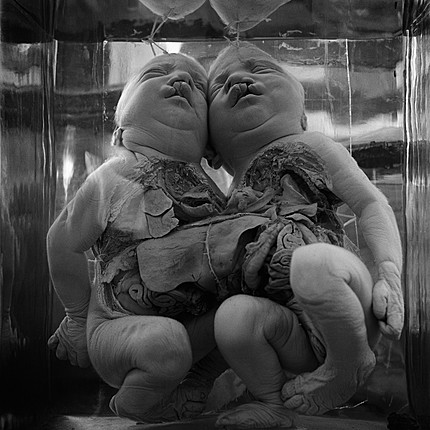
    The same secrecy prevailed as vast areas were contaminated with radioactive fallout. As the photos at the exhibit at the University Club showed, ordinary Kazakhs were afflicted with blood and heart disease, skin cancers, cleft jaws, birth defects, backward limbs and other ailments. Up to 1.5 million people were either sickened or killed. The land was scared as well. The ground bursts of the 1950s and early 1960s until the 1963 nuclear test ban left gigantic lakes filled with rainwater that are still radioactive.
    The point of the exhibit is non-proliferation and to their credit the Kazakhs showed unusual sanity. When the Soviet Union fell apart without warning, they found themselves the proud owners of more nuclear warheads and delivery systems than the U.S., France and China combined. The threat of illegal sale or theft involving terrorists was obvious. Nazerbayev and his officials worked closely with the U.S. in securing and disposing of the weaponry.
    One operation, set up under an anti-weapon program by Sens. Sam Nunn and Richard Lugar, involved CIA-sponsored covert flights of gigantic C-5A Air Force cargo planes flying out dozens of warheads. They ended up in the U.S. where they were disassembled and their enriched fissionable was removed and sent for reprocessing into fuel for commercial nuclear plants.
    The issue now, Paul F. Walker of Global Green USA and Erlan Idrissov, the Kazakh Ambassador to the U.S. said, is to continue the process by getting the U.S. Senate to pass a new U.S.-Russian nuclear arms treaty that continues the weapons reduction process. Each country would be allowed 1,500 deployed warheads, about a 30 percent cut lower than what was allowed by treaty in 2002.
    What is interesting about the Kazakh approach is that they willingly got rid of their nukes, unlike Pakistan, India, Israel, the U.K., France, China, Russia, the U.S. and perhaps South Africa. North Korea has exploded some kind of device and Iran may be on the verge of one as well.
    The exhibit was the polar opposite of what every Hollywood action movie has shown since the fall of the USSR — cheesy former Soviet republics selling off a few megatons for the price of a few BMWs. But then, Hollywood’s “Borat” version of Kazakhstan was so off the mark, it isn’t even worth bringing up.
    Peter Galuszka

  • Mission Not Accomplished


    Now that President Barack Obama has declared U.S. combat operations in Iraq over, it might be useful to remember just how much this effort and the one in Afghanistan cost.

    This is particularly important right now since there is so much hullabaloo over federal spending. The immediate critical question is whether there should be more stimulus spending or not to try to invigorate the stumbling recovery.
    Another curious point is that a good part of the $787 billion American Recovery and Reinvestment Act (stimulus) funds haven’t even been spent yet. In Virginia, for instance only about $3.2 billion of the $5.5 billion in stimulus funding for Virginia had been spent as of Aug. 1. The Wall Street Journal has reported that only a fraction of stimulus funding for such efforts as infrastructure, housing, education and homeland security has been spent.
    This once again puts the cart before the horse. If there’s such an outcry among the right wing, including many bloggers and commenters here, how come they don’t point out that a lot of this infamous money hasn’t even been released yet? Would the recovery be faster if it were? If we had a faster recovery, wouldn’t the supposedly dangerous spiral a la “Boomergeddon” be slowed or set right?
    Let’s talk about the wars. According to the National Priorities Project, $1.09 billion has been allocated to the wars in Iraq and Afghanistan, It isn’t clear how much of this sum has actually been spent yet, but the end of combat operations in Iraq suggests some easing of spending is in the future, although some 50,000 U.S. still will remain in Iraq.
    Afghanistan is anyone’s guess. Obama has made that the strategic U.S. priority in fighting global terror, but faces a corrupt Afghan government and centuries of history in which foreigners could never get their way. My personal experience goes back to the 1980s and the Soviet experience there. I was there in January 1989 when, with great fanfare, columns of Soviet tanks and BTRs (personnel carriers) streamed across the Amu Darya River into Uzbekistan after a futile and bloody decade of fighting.
    As for how much all of this will eventually cost is anyone’s guess. Economist Joseph E. Stiglitz has put the price tag at as much as $3 trillion. As he and Linda J. Bilmes wrote in The Washington Post in 2008, “You can’t spend $3 trillion — yes, $3 trillion — on a failed war abroad and not feel the pain at home.”
    He’s right about the pain. As far as failed, well, it seemed that way in 2008. To his credit, President George W, Bush’s escalation in Iraq did seem to settle things enough to set the stage for a U.S. withdrawal of its combat forces. But the, it was Bush who got us in the probably unnecessary war with Iraq with his bogus intelligence reports of Weapons of Mass Destruction.
    That’s a bit off my point. More on my point is the question: When they moan about spending do the newly-hatched deficit hawks consider the war price tag? Or are they content to blame instead the “socialist” Obama they accuse of profligate spending? It could be that Obama is guilty of not spending enough and not getting the money allocated for recovery out there in time.
    Once again, the cart before the horse.
    Peter Galuszka