• Where Was Bob?

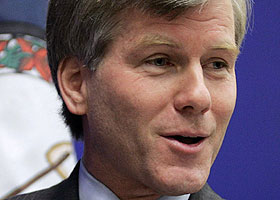
    While Gov. Robert F. McDonnell was attorney general in 2006, he did nothing when informed about serious accusations that eventually led to the conviction and 10-year sentence of John W. Forbes II, a former state finance secretary.

    The accusations come from a front-page article today in the Richmond Times-Dispatch that details efforts to bring to justice Forbes, who was convicted in a $4 million fraud case involving a grant from the Virginia Tobacco Indemnification and Community Revitalization Commission

    Forbes, who served in the cabinet under Republican Gov. Jim Gilmore, used money to set up a program designed to improve adult literacy but instead used a considerable amount of the grant to pay for salaries of himself and his wife and to buy himself a $1 million home.

    The case is one of the biggest corruption scandals in recent Virginia history but as the newspaper reports, McDonnell did nothing when sent a four-page letter in October 2006 detailing concerns of wrong doing from a woman who worked for Forbes and then was abruptly fired when she asked Forbes about financial irregularities.

    Neither McDonnell’s nor the attorney general’s office could find the letter, the newspaper says. Former state Sen. Charles R, Hawkins, R-Pittsylvania, who chaired the tobacco commission, also said he had no recollection of the letter.

    The author of the letter, D.L. Billett Jr. of Chesterfield, whose former wife E. Denise Kent had worked for and had been fired by Forbes, kept pushing for a probe. He told the Times-Dispatch that he spoke with the attorney general’s office after sending the letter in 2006, but was told not to expect much in the way of an investigation. Billett could not remember the name of the official.

    Finally, Billett sent the information to Sen. John C. Watkins, R-Powhatan, other political figures and the Joint Legislative Audit and Review Commission. It finally ended up in the hands of the State Police 14 months ago which launched the probe that led to Forbes’ conviction.

    This sorry chapters raises big questions about McDonnell’s competence, if not his integrity, when he was attorney general. The story seems to be a classic case of sweeping something potentially embarrassing to one’s political party under the rug — in this case than of the Virginia GOP. To their credit, other state Republicans had the integrity to push for a probe.

    The pressure is now on for the General Assembly to create better checks and balances for public bodies such as the tobacco commission that is supposed to use billions in a settlement against major tobacco companies for the public good.

    Another aspect is that many of the same Republicans who apparently refused to check into serious allegations of government misfeasance have no trouble painting Washington and the federal government as the source of all evil.

    Let’s hope the pressure stays on for a reckoning.

    Peter Galuszka

  • Outing Groveton

    Fellow Baconauts.

    Ever wonder who Groveton really is? Since he has become a regular blogger here, I have taken up the science of Grovetonology where I ceaselessly search for identifying clues. But his true identity remains a closely-held mystery.

    My threshold understanding is the following: Groveton is a guy who is some kind of executive with an IT firm. He jets from Auckland and Amsterdam every week from his home somewhere in Northern Virginia. He says he named himself after a high school somewhere near Manassas. To make us sense he’s a regular guy — one you might not mind having a beer with in an airport lounge — he titillates with wistful comments that he’d really like to partake of foreign fleshpots.

    I asked the Big Bacon one day if he could provide any hints as to Groveton’s identity. What does he look like, for instance? Jim said: “Well, he’s a middle aged guy, kind of stocky, beefy, ex-football player type.”

    I chewed on this for a while and then realized it was TBB (Total Bacon Bullshit) designed to throw me off the scent. I mean, he’s clearly a hard conservative. If you broke into the basements of both Bacon’s and Groveton’s homes you’d probably find a high speed telex spitting out daily orders from Cato Central. It wouldn’t surprise me in the least if the disinformation campaign ran really deep.

    I have come up with some other possibilities I’d like to share with you:
    • Groveton is really a skinny nerd with a huge subscription list to hard right magazines and blogs and has ‘fair and balanced” Fox News switched on 24/7.
    • Grovetown isn’t a guy at all, but a woman posing as a guy.
    • Grovetown is really an amalgam of several people. Risse uses this tactic all the time. The “real” Risse identifies himself as “EMR.” That’s simple enough, but he often comments using other names. This is another plot to make us think we are hearing several independent voices. In reality, Risse is a 1950’s style, Kerouac-like subversive who wants to pollute our thought patterns with an enormously complicated vocabulary that he has invented. My advice: Don’t let him inside your head.

    Anyway, the Big Bacon has promised to reveal Groveton’s real identity soon. It is now supposedly a secret because Groveton’s employer might be upset that he’s blogging. But that could be TBB, too.

    Peter Galuszka (aka “Mr. Gooze”)


  • The New Geography of Racism

    Ever wonder why white opposition to darker-skinned immigrants seems to be centered in outer suburbs such as Prince William and Stafford counties? An analysis of new Census data provides the answer.

    The reason, the American Community Survey reports, is that immigrants from Latin America and other places are flocking to small towns and outer suburbs rather than concentrating in the center of large cities, as had been the case for immigrants for the last two centuries.

    According to a New York Times report, Los Angeles County, a traditional Hispanic draw, showed little immigrant growth while immigration exploded in suburban Newton County outside of Atlanta. Closer to home, Stafford County saw its immigrant population triple during the past decade. Other Virginia hot spots are Prince William and Loudoun counties.

    The Times notes that many Hispanics are drawn to outer suburbs by lower living costs, as well as by once-plentiful construction jobs that went bust with the recession.

    This helps to explain why Stafford County is proposing to get tough on illegal immigrants, and why Prince William County, led by board of supervisors chairman and rising state politician Corey A. Stewart, cracked down starting in 2007.

    Prince William’s law prodded many Hispanics to leave the county, regardless of their immigration status or citizenship, because they felt they were being profiled by police. Stewart wants to take the Prince William experience statewide with his “Virginia Rule of Law” campaign.

    The sad truth is that these settlement patterns are sparking racism that had seemed to be abating in America. Just 50 years ago, so-called “blockbusting” led African-Americans into tight, white, ethno-centric neighborhoods of big cities such as Chicago and New York.
    The battleground has since shifted to the wide highways and big-box stores of outer suburbia. But the dynamics are the same. White Americans had felt safe in such places but somehow now feel threatened by new arrivals. The reason? It’s only skin deep.

    Peter Galuszka

  • CRESTFALLEN

    โ€œCrestfallenโ€ is the only way to describe the feeling.

    After ALL THE WORK on AntiPartisan action and AntiPartisanism, and then not get invited to the โ€œNo Labelsโ€ kick off on Monday at Columbia University!!

    There is no question about the need to stop Whack a Mole Politics and to stop Tossing Rocks at Empty Pigeonholes (TRAPE).

    Yes politics IS broken. It has been for at least three decades and becomes more broke with each passing campaign cycle.

    BUT how to fix politics?

    The โ€œFounding Leadersโ€ and the invited guests said all the right things…

    BUT WAIT:

    1,000 people in the audience?

    A slick web site already up?

    They have raised a million dollars BEFORE it was a public activity?

    The โ€œFounding Leadersโ€ are primarily agents and shills who have worked for the two dominate political Clans.

    The only โ€˜nameโ€™ from the Commonwealth has been described as the most craftily partisan politician in the large municipality where he lives and from which he was elected to congress and served as the chair of the Elephant Clan fund raising committee in the House.

    It was pointed out on another Blog that the ONLY โ€˜seniorโ€™ Elephant Clan personalities were FORMER office holders who recently lost a primary to the WingNut / Anger of Ignorance Crowd.

    You have to know โ€˜the systemโ€™ to dismantle โ€˜the systemโ€™ but is this just an attempt to preserve the 19th Century โ€˜Grand Old Two Party Systemโ€™?

    Is there a way forward that does not involve articulating an AGENDA?

    Does it make sense to just raise money to โ€˜protectโ€™ Clan candidates from Right WingNut and Left WingNut attacks?

    After all, the primary DRIVERS of civilizationโ€™s dysfunctions are:

    Unsustainable human settlement patterns,

    A governance structure that does match the economic, social and physical structure of contemporary society, and

    An economic system that lives on Mass OverConsumption, speculation and debt AND

    WAS ALL CREATED AND IMPLEMENTED WHEN THERE WAS A FUNCTIONING AND CIVIL TWO PARTY SYSTEM โ€“ 1950 to 1990.

    How will No Labels produce โ€œwhat citizens wantโ€ when the vast majority of citizens have no idea what the real options are or what would be in their best interest as individuals, for their Households or as members of the hundreds of โ€˜communitiesโ€™ (small โ€˜cโ€™) in which every citizen is trying to exist?

    The answer will be the Agenda No Labels articulates and how well they integrate those who do not care how โ€˜the systemโ€™ worked before it FAILED.

    Perhaps it was not such a bad thing not to be invited…

    EMR


  • What It Is; What It Ain’t

    Conservatives are all thumped up about regarding U.S. District Judge Henry Hudson’s declaring a critical part of Obamacare unconstitutional.

    But before they break out the champagne, they need to consider a few points:

    • The ruling deals only with that part of the health law that has the federal government requiring that all people buy health insurance. While Atty. Gen. Kenneth Cuccinelli won on this point, Hudson did not go along with the Cooch on striking down the law entirely or delaying its implementation until a higher court can rule on an appeal, which the Justice Department has already filed.
    • Two other federal judges have upheld the law, including one in Lynchburg. Both were appointed by a Democrat. Hudson is a Bush appointee.
    • Virginia is not the only state to challenge Obamacare. About 20 attorneys general are suing in Florida. While the Cooch scored some points, he’s just one of many conservatives who dislikes the law. Indeed, my old college roomate, an ecologist-turned-Republican who is a former congressman from New Hampshire, is against it.
    • The “Commerce Clause” aspect which is what Hudson is dwelling upon is a very elastic and flexible concept. It has been used this way and that for years. So while Hudson’s narrow ruling has interpreted the clause one way, it is quite possible an appeals judge might see it differently.

    My personal view is mixed. While I enthusiastically embrace health care reform, I do have some misgivings about being forced to buy something. Yet, I understand that one of the reasons why all need to buy health insurance is that productive tax payers get stuck with the emergency room or other bills of cheapskates who skimp on insurance until they are sick or injured.

    It could very well be that the only solution to this is socialized medicine with a one-payer system. We are perhaps the only advanced industrial country that doesn’t have one. I know several doctors on the front lines of health care who are sick to death of having to deal with for-profit (or even non-profit) insurance companies that game the managed care program set up three decades ago.

    The Dems have suffered a defeat, but it may not last. Meanwhile, I haven’t seen one clear new reform from the GOP or from the naysayers like Jim Bacon who somehow thinks that a medical concierge system might work (sure Jim, if you are rich).

    Peter Galuszka


  • Congratulations, Cooch!

    Attorney General Ken Cuccinelli racked up the biggest legal victory of his career yesterday when a federal judge ruled for Virginia in its legal challenge to the Patient Protection and Affordable Care Act (aka Obamacare). Wrote Federal Judge Henry E. Hudson on the provision that would compel Americans to purchase health insurance or pay a fine:

    Neither the Supreme Court nor any federal circuit court of appeals has extended Commerce Clause powers to compel an individual to involuntarily enter the stream of commerce by purchasing a commodity in the private market. In doing so, enactment of the Minimum Essential Coverage Provision [the individual mandate] exceeds the Commerce Clause powers vested in Congress under Article 1.

    Score one not only for Cuccinelli but for the rollback of the leviathan state. If Hudson’s ruling is upheld by the U.S. Supreme Court, as it undoubtedly will be, an an important limit will be placed upon Congress’ power to regulate and coerce Americans any where, any time, for any reason. The ruling also undermines Obamacare’s effort to restructure the health insurance industry by forcing Americans to purchase insurance. With the blow to this critical piece of Obamacare’s financing, the entire scheme may unravel.

    The only good thing that can be said about Obamacare is that at least the Democrats tried to address runaway medical inflation and shrinking access to the health care system with their own legislative package. Their solution stinks, but they tried. Now that the Republicans have shot it down, let’s see if they come up with anything better.

  • Do You Believe Me Yet?

    For months now, I have been harping on the theme that Virginia faces a challenging fiscal future and that we need to start getting our financial affairs in order now. Two more straws in the wind…

    The combined unfunded liabilities of the Virginia Retirement System and other state-supported pension plans adds up to $17.6 billion, reports the Joint Legislative Audit and Review Commission. (Read the Times-Dispatch article here.) Contributions by state government and municipalities will have to increase significantly in the next budget biennium, said Tracey Smith, a JLARC analyst in a legislative hearing yesterday.

    Meanwhile, Virginia has borrowed $346 million from the federal government since October 2009 to pay unemployment benefits, and is projected to need another $613 million by April 2013. The money will have to come from the General Fund because the state’s unemployment trust fund is insolvent. (Read the Times-Dispatch reporting here.)

    Now, go back and re-read “A Glimpse of Boomergeddon in Virginia’s Future,” which cites a Senate Finance Committee analysis to the effect that Virginia will pay $594 million in interest payments in fiscal 2012 to finance its ever-growing debt. (It’s a short post, so you have no excuse for not reading it.)

    Gov. Bob McDonnell wants to borrow nearly $4 billion to fund road transportation projects? And he calls himself a fiscal conservative?

  • McDonnell Peddling the Transportation Policies of Yesteryear

    Gov. Bob McDonnell has announced a $4 billion transportation plan, most of which would be funded through borrowing. The justification for heaping on new state debt is that building now will prove to be cheaper than building in the future, when construction costs and financing costs rise in tandem with a recovering economy.

    I can see the logic, but I object to the plan on two grounds. First, I believe that human settlement patterns are undergoing a significant alteration — investment and population are flowing back toward the urban core (as reinforced in today’s Wall Street Journal, “Downtowns Get a Fresh Lease“). McDonnell wants to dump billions of dollars into transportation projects geared to the post-World War II paradigm of endlessly expanding the metropolitan frontier rather than the emerging paradigm of retrofitting what we’ve already built. Most of the money will be wasted. Furthermore, $4 billion is a drop in the bucket compared to our transportation needs. We need to conduct a fundamental re-thinking of our transportation policy — which projects we fund, and how we fund them — before putting the state billions of dollars into debt.

    The second reason to object to borrowing more money is that Virginia is already testing the outer limits of its borrowing capacity at a time we need to be shoring up our finances, not borrowing more. State and municipal finances will grow more precarious with each passing year, a fact that will be only partially masked by the anemic economic rebound the country is experiencing.

    Virginia faces many long-term challenges: (1) runaway Medicaid costs, (2) weak growth in sales and property tax revenues, and (3) declining largesse from the federal government. To that list of problems, which I have blogged about previously, let me add one more: a long-term rise in interest rates. Permit me to quote myself from the “Boomergeddon” blog at some length:

    If the economy picks up steam, U.S. interest rates will rise. Even the Obama administration expects 10-year Treasury bonds to reach 5.3% in several years, up from 3.2% Monday, propelling interest payments on the national debt from roughly $200 billion yearly to $800 billion by 2020. If the sovereign debt contagion spills out of Europe, U.S. Treasury rates will rise even higher as investors charge a risk premium. Now comes [the McKinsey Global Institute in a report, “Farewell to Cheap Capital“] arguing that a third force โ€” increased global investment and shrinking global savings โ€” will lead to yet higher interest rates over the next two decades. States the report:

    “Nominal and real interest rates are currently at 30-year lows, but both are likely to rise in coming years. If real long-term interest rates were to return to their 40-year average, they would rise by about 150 basis points from the level seen in the fall of 2010, as we write this report. And they may start moving up within five years.”

    There has been a decades-long glut of capital as the mature economies of industrialized economies experienced slower growth and declining investment, McKinsey contends. Saving rates have dipped, too, especially in the U.S., but not enough to offset the weaker demand for investment capital. Meanwhile, developing countries, China especially, began saving phenomenal amounts of money as their economies took off. This global shift in the supply and demand of capital โ€” not just Federal Reserve monkeying with interest rates โ€” contributed to the global credit bubble of the mid-2000s.

    Now the tide is turning, the report argues. China, India and other developing countries are embarking upon a massive wave of capital investment, much of it driven by infrastructure spending as their societies urbanize. The demand for new roads, rail lines, ports, water and power systems, schools, hospitals and other public infrastructure will reach a fever pitch not seen since the rebuilding of Europe after World War II. McKinsey also predicts massive growth in residential real estate investment to provide better housing for the emerging middle class, as well as strong growth in productive capacity. Global investment could increase from $11 trillion annual today to $24 trillion annually by 2030 (measured in constant 2005 dollars), or from 23.7% of global GDP in 2008 to more than 25% by 2030.

    The surging demand for capital will not be matched by a commensurate increase in savings. The worldโ€™s largest economies are fast aging, and larger retired populations will draw national savings down, not build them up. The shift will be most dramatic in China, where the government is encouraging people to consume more and the one-child policy will lead within a couple of decades to a lopsided demographic profile of too many retirees and too few young workers entering the workforce.

    The shift in the global supply of and demand for capital will likely push up long-term interest rates. And that will present businesses, consumers, investors and governments with very different challenges in the next 30 years.

    Consumers are moving in the right direction โ€” theyโ€™re sloughing off debt. Corporations are saving more, too, if one counts share repurchases as a return of cash to shareholders. But governments are stuck with deep structural deficits. With the national debt as large as it is, roughly 90% of GDP, the U.S. budget is extraordinarily sensitive to increases in interest rates. If economic growth picks back up, the sovereign debt contagion spreads and McKinseyโ€™s looming global capital shortage materializes on schedule, the U.S. could easily see 8% interest rates on its 10-year bonds by 2020. That would boost budget deficits by $500 billion yearly or more above current forecasts โ€” about the same amount we spend today on all discretionary domestic spending.

    In that case, interest rates โ€” not spending, not tax rates โ€” will become the prime driver of U.S. budget deficits.

    We cannot revert to the comfortable nostrums of yesteryear. The real estate bust and ensuing financial crisis of 2007-2008 created a massive discontinuity. The old economic and financial order is passing away. Our public policies must adapt to the new, emerging order, or Virginia will be swept away in the coming cataclysm of Boomergeddon.


  • THE REAGAN SHOW

    ………….

    Note:

    AZA held his annual holiday party at his SoHo loft Friday evening. Most of the team was there, MSM had to regret due to his leadership on the Marcellus Shale Hydrofracking. The host asked guests to bring suggestions for refining Observerโ€™s 7 Dec humorous comment posted on โ€œLies About Federal Workersโ€ concerning โ€œThe Truman Show.โ€ After much discussion, the team voted 7 to 6 (some wanted to toss rocks and whack moles) to request that EMR post the revised version. Observer participated and hearty endorses the refinements.

    ………….

    As intelligent as many of Dr. Baconโ€™s insights are, he may have who is shielding what from whom bass-ackwards:

    Bacon claims that โ€˜The Political Classโ€™ in the National Capital SubRegion is โ€˜insulatedโ€™ from the issues facing citizens and Organizations in the rest of the nation-state.

    That seems to be incorrect:

    โ€œThe rest of the nationโ€ has been intentionally insulated from reality, not the other way around.

    Many believe that what Bacon calls โ€œThe Political Classโ€ is really โ€œThe Business-As-Usual Classโ€ (aka ,The BAU Class).

    The BAU Class is a vast Agency / Enterprise / Institution Complex (aka, conspiracy) that includes:

    1. Governance practitioners in the Agencies at the federal, state and municipal scales โ€“ especially pandering politicians and those who work for them

    2. Entrepreneurs in Enterprises that depend on Mass OverConsumption to raise THEIR boats, THEIR stock, THEIR McMansions…

    3. Leaders of Institutions (political parties, PACs, think tanks, etc.) that depend on the flow of money from Agencies, Enterprises and from those citizens and Households at the top of food chain. Many Institution-supporting entities feed money to Institutions to preserve the status quo because they see no reason to derail their gravy train.

    So the real story is that the BAU Class has INSULATED the citizens and Organizations across the nation โ€“ and across the Planet โ€“ from reality. The reality of finite limits and the pitfalls of jingoism, partisan bickering, xenophobia, the Wealth Gap and YES, deficits are unrecognized. In fact ignorance is glorified in the name of patriotism and freedom.

    Citizens collectively have no idea how to address the objectives and strategies they should be concerned with โ€“ especially the overarching goal:

    Achieving an economic, social and physical trajectory that is sustainable.

    Instead there is The Anger of Ignorance protests, Whack a Mole politics with all sides Tossing Rocks at Empty Pigeonholes (TRAPE).

    The BAU Class is standing in the way of the information that citizens need to make intelligent decisions in the voting booth and in the marketplace. PROPERTY DYNAMICS is one path to follow but even information on this core interest of the vast majority of Households is being distorted and swept under the rug. Thus the need for Citizen Media.

    Without their consent, most citizens are now cast members in a continent-wide, real-time, tragedy โ€œThe Reagan Show.โ€ What exists for most is an updated โ€œThe Truman Storyโ€ that has portrays the life of Reagan Everyman in place of Truman Burbank.

    It was the great communicator himself that convinced citizens that they could have it all because it was Morning in America. Everyone could thrive in Seaside or Celebration โ€“ technicolor versions of โ€œPleasantville.โ€ They could all live where they wanted, drive what they wanted, spend what they wanted. The ever-growing economy, driven by the gracious and altruistic spending of the rich. would raise all boats.

    It was Reagan who tossed a wet blanket on the flickering candle of intelligence that was ignited by understanding of what the 1973 OPEC Oil Embargo REALLY meant.

    For AZA

    (Note: a number of other ideas surfaced at AZAโ€™s fete โ€“ The existence of The Spacial Bipolar Disorder, and others โ€“ that will be included in the survey of Citizen Media, forthcoming.)


  • Bob’s Right: Build Those Roads

    Fellow blog readers and Baconauts. Please help me with this.

    I was just getting over Barack Obama’s surrender to the conservatives on tax cuts when I opened this morning’s newspaper and learned that Republican Gov. Bob McDonnell is really a Keynesian and is willing to blow out the state’s troubled debt obligations to get roads for which two of his previous fund-raising schemes have failed.

    And to think that just two Sunday’s ago, the Right Rev. James A. Bacon was delivering another one of his stern sermons that Virginia will pay an estimated $594 million in 2012 to service its $9 billion tax-supported debt. According to our deficit watchdog, Virginians are paying more to service debt than ever before and the state “cannot afford this nonsense any more.”

    Here’s the new nonsense: McDonnell will ask the state to spend $400 million immediately on roads and bridges while borrowing another $2.9 billion over the next three years for more transportation needs. Of this, some $150 million will come from last year’s budget surplus and $250 million that an audit revealed the Virginia Department of Transportation has already had.

    McDonnell’s justification and that of his transportation chief Sean Connaughton is that construction costs and bond financing is cheaper than it has been in decades and there are bargains to be had.

    Actually, I tend to side with them on this. Virginia’s roads needs are significant if the state is to continue to position itself for growth not just tomorrow but over the coming years and decades.

    Building roads now will mean more jobs now, not some years down the pike. You can’t completely toss John Maynard Keynes out with the baby’s bathwater, anyway. He does make sense.

    The proposals would create a state infrastructure bank with $400 in surplus and other funds. That’s not a bad idea since many countries around the world have created similar institutions to fund transportation needs. Changes in state bond laws would also be needed.

    While I like the idea of stopping moaning about deficits and debts and getting on with projects that create jobs and could enhance the state’s chances for prosperity down the road, there is some concern about McDonnell’s topsey- turvey policy-making. I am not all that concerned about the “New Fru” tut-tutters like the Right Rev. Bacon. If you listen to them, nothing would ever get done besides a bunch of hand wringing.

    But McDonnell’s two previous plans to boost transportation funding — privatizing ABC stores and offshore oil drilling — are kaput. What’s happened is that Connaughton, one of the few serious pros in McDonnell’s administration, has convinced Bob to get off the dime. These inconsistencies are worrying and still show that McDonnell’s is a second-stringer when it comes to governing.

    In any event, I see the news as welcome.

    Peter Galuszka


  • Obama’s Smart Move in Banning Drilling

    The moaning was loud when President Barack Obama last week banned oil drilling offshore of the East Coast until 2017.

    Politicians from Democratic Sen. Mark Warner to Republicans such as Congressman Eric Cantor and Gov. Bob McDonnell decried the move.

    “It demonstrates a complete lack of confidence in (industry’s) ability to fix the problems experienced in the gulf spill, and no confidence in the ability of the U.S. government to better plan for and react to offshore emergencies,” McDonnell cited angrily in a statement. The governor has seen his grand plans to push with offshore drilling to help fund Virginia’s massive transportation problems squashed more than once.

    Obama’s decision, of course, comes after the Deepwater Horizon disaster this past spring and summer which was the worst environmental predicament ever faced in the U.S. Some Virginians had hoped for a 2012 lease sale to exploit oil reserves that may or may not be out there.

    Now comes the Wall Street Journal, not exactly an environmentalist rag, with a front page story that there has been a rash of close calls with offshore oil rigs over the past two years after decades of improving safety records. The Journal reviewed the records of the countries with the most experience with offshore drilling. The United Kingdom saw a 39 percent increase in serious incidents involving North Sea rigs. Australia likewise saw a spike including a near blowout such as the Deepwater Horizon situation. Norway say a 48 percent spike in incidents since 2008.

    How come? The Journal says that there’s a mad rush to deep, offshore drilling because oil from shallow water areas is running out. Yet there aren’t enough experienced workers to handle the extra difficulties of drilling a mile or so down. The demand for profits and spotty enforcement also complicate deep water drilling.

    Experts say that that disasters such as Deepwater Horizon are “low probability” but “high consequence.” “This accident was bound to happen,” says Nancy Leveson, an expert at the Massachusetts Institute of Technology who has studied the BP Deepwater mess.

    The problem with people such as McDonnell and Cantor, and to some extent Warner, is that never seem to go beyond consulting with oil lobbyists when it comes to the dangers of drilling off Virginia. Or, they use data without much thought. McDonnell, for instance, has cited the supposed economic benefits from drilling according to an Old Dominion University report. But the author of that report says it was a quickie job and shouldn’t be taken seriously.

    Virginia has a lot to lose in the event of an offshore rig disaster. Other industries (real ones) affected include seafood, commercial shipping and the military, all of which have questioned the need for drilling when it isn’t even clear the reserves are out there.

    At least Obama has the sense to slow down the parade to offshore drilling.

    Peter Galuszka


  • Lies About Federal Workers

    A certain Bacon’s Rebellion blogger whose initials are “JAB” has just written a book called “Boomergeddon” in which he takes a strong libertarian/conservative /Cato viewpoint to try and scare us into believing that the end is near because of government spending.

    And while I dare not name this individual because it would deeply embarrass him, I feel it necessary to post this column (in part because he came after me on immigration) but I do it feel it necessary to bring to the attention of the BR reading public the obfuscations, if not down-right lies, with which we have been presented.

    If you read this individual’s book “Boomergeddon” who will be treated to a total trash of the federal worker and Washington. The author says such things as “the Imperial City is well insulated from the travails of the general economy.” He claims that while private sector Americans suffered with layoffs and losses, the number of federal workers exploded. The average pay, the author claims, is about $71 K compared with $40K for the average schmo.

    The author does note that federal workers do, on average make less than those in the private sectors. But if we believe his logic (and/or baloney) we are supposed to accept that the national policy of the U.S. is in hostage to a bunch of self-serving, over-paid zealots who all voted to Obama and want to bring us socialism that they control.

    Which is why today’s Washington Post is so interesting. Max Stier, president and CEO of the non-profit Partnership for Public Service, writes about the “Five Myths about Federal Workers.” A few highlights:
    • Fed workers make at least 24 percent less than private sector ones.
    • “Conservative think tanks such as the Cato Institute” (from which much of “Boomergeddon’s” data is drawn) claim otherwise, but they comparing apples an oranges, i.e. the pay of a small practice doc in Iowa as compared to a federal cancer researcher leading 50 people at NIH.
    • The federal workforce is not bigger than ever. Less the postal service, it is about 2.1 million or slightly smaller than it was in 1967 even while the nation’s population has grown much more.
    • You can fire federal workers.
    • Not all feds are paper pushers who die to vote for Obama. Some do real work and have won Nobel Prizes.
    • Barack Obama’s unfortunate federal pay freeze won’t do much to cure budget ills. The savings just ain’t there. Just don’t believe the JABs.

    My advice? Be careful of people who go over the top in using A-bomb bursts as book cover art to make their point. They are selling a tissue of lies.

    Peter Galuszka


  • Quote of the Day: Neal Peirce

    From Peirce’s column on Citiwire.net:

    Citiesโ€™ revenues will plunge sharply as property taxes, in their first year of recession-impacted reassessments, get set to decline deeply in 2011. Local government fiscal shortfalls may total $83 billion, which the League of Cities estimates may force up to 500,000 staff reductions. Basic city services will shrink. Infrastructure projects will get cancelled or postponed.

    These are hard times for Americaโ€™s local governments. Economists may declare the Great Recession is โ€œover,โ€ but localities see a different picture. The federal stimulus monies that helped so many of them balance their budgets runs out December 31. So does Washingtonโ€™s two-year old โ€œBuild Americaโ€ bond program, which has made local infrastructure borrowing more affordable.

    State and municpal governments face nothing but hardship in the years ahead. It’s time for fundamental change, not the usual short-term 3%-budget-cuts-across-the-board belt tightening. If we fail to rise to the occasion, we face a future of entropy and decay.


  • Prince William Policy Vindicated?

    We have read posts filed periodically on this blog by a co-blogger (I won’t mention any names but his initials are PG) about the “xenophobic” motives behind the “wicked brew of discriminatory laws” enacted by the “Know Nothings” of Prince William County. Chief among the ordinances passed back in 2007 and 2008 was a provision that required county police to inquire into the immigration status of people detained for a violation of state or local law.

    The question of how to deal with undocumented workers in Prince William County flared into a heated controversy that not only outraged PG but attracted national attention. With the passage of three years, emotions have settled down. It is now appropriate to ask, how did things work out?

    As it happens, the Center for Survey Research, a unit of the Weldon Cooper Center for the University of Virginia, has just published an exhaustive analysis at the request of the Prince William County Police Department, which funded the study. The report, “Evaluation Study of Prince William County Police Illegal Immigration Enforcement Policy,” provides a nuanced picture that will provide ammunition for both sides of the debate. But proponents of the policy are most likely to feel vindicated. (See the PowerPoint summary here.)

    The seven authors concluded that the policy was “smoothly implemented” and the county experienced few of the dire consequences — overzealous enforcement by police, a flood of litigation — of which opponents warned. Hispanics were not subjected to a wave of invidious racial profiling. Of the roughly 3,000 suspected illegals checked by police between March 2008 and June 2010, 99% were confirmed to be illegal.

    Moreover, the policy had a modestly beneficial effect on the crime rate. In 2009 illegals accounted for for 8% of the arrests for rape, 3% for robbery, 9% for aggravated assault, and 6% for larceny. The biggest impact was on arrests for public drunkenness, 22.4% of which involved illegals. Overall, crime rates trended down slightly in 2008 as compared to 2007. A modest decline in violent crimes departed from the experience of other municipalities in the Washington, D.C. region.

    The numbers do not bear out the prejudices of those who painted illegals as especially inclined toward criminality. But neither do they support claims that undocumented workers are more likely to be law-abiding than native-born citizens.

    The study could document no financial savings to Prince William taxpayers, undermining one of the claims that agitated the send-the-illegals-home movement. The number of English-as-Second-Language students leveled off but did not decline. Most other services are federally regulated or funded, and most are denied to illegal immigrants by federal law or county ordinance.

    As for public nuisances, the experience was a mixed bag. Prince William experienced a dramatic decline in the number of complaints about parking in overcrowded properties — down 38% — and less loitering at day labor sites. Yet weed/tall grass violations doubled between 2006 and 2008.

    To me, the most interesting finding came from polling data that tracked Hispanics’ attitudes toward the county police and the county generally. The percentage of Hispanic respondants who had a favorable view of Prince William’s quality of life and expressed trust in county government took a nose dive between 2007 and 2008, clearly reflecting the fears engendered by the controversy and the wave of accusations that the new policies were motivated by xenophobia, dislike of “brown people,” hostility to Hispanics and so on.

    What is remarkable is how strongly the opinions of Hispanics have bounced back. In 2010, Hispanics were more likely than blacks and others (presumably whites and Asians) to “want to live in PWC 5 years from now.” Admittedly, Hispanics don’t feel as favorably about the county as they did before the controversy erupted, when their views were more positive than those of whites or blacks by an ever higher margin.

    The UVa researchers concluded that “it IS possible for a local government to have an impact on its illegal immigration experience.” Hispanics, for the most part, have gotten over the controversy. Maybe the rest of us should, too.


  • Will Richmonders Subsidize JetBlue?

    It never ceases to amaze how Richmond’s business elite, while espousing free markets, are at heart state capitalists, sort of like Lee Kwan Yew of Singapore.

    The latest ripple: the business community has organized $600,000 in public money to go to a “Save Low Fares Richmond” campaign to keep carriers such as cheap fare carriers as JetBlue and AirTran from continuing to bolt from the capital city’s anemic airport.

    Now comes the latest twist. JetBlue has the chutzpah to ask Greater Richmond to pay subsidies so that JetBlue will restart its now discontinued flights from Richmond to JFK Airport in New York. The carrier ended the flights in November because of low ridership. You heard that right — if Richmonders want cheap air service, the public will have to come up with millions of dollars to bankroll a private air carrier.

    Richmond’s “behind-the-scenes” business elite such as Kim Scheeler, president and CEO of the Greater Richmond Chamber of Commerce, says he wants to sit down and talk with JetBlue whose CEO pitched the goofy subsidy idea. “If someone asked me to raise X million dollars, I’d be hard-pressed to do it, just because of the economy”

    Just because of the economy? Whatever happened to the free market which all these denizens of Adam Smith say brings out the best, the most creative, the most robust ideas? Naturally, the Richmond Times-Dispatch floated the idea as its lead story on its front page to prepare the public for local and regional subsidies.

    After all, its publisher, Thomas A. Silvestri, is also chairman of the Richmond Chamber and loves to work behind the scenes out of public view being a “Leader” and making decisions about public money. If the public has something to say, they can write a letter to the editor or attend one of Silvestri’s gong shows called “Public Square” which is another gimmick to make the public believe they are getting information and their voices are heard. From Silvestri’s point of view, it is a lot cheaper to hold these Oprah shows than hire real reporters to do real reporting given Media General’s penchant for valuing profit margins over public service.

    The giant hypocrisy here is that the Richmond business elite and the politicians they back, such as soon to be House Majority Leader Eric Cantor, are all rock-ribbed, free market Republicans. We get to hear lots of speeches of how capitalism and the survival of the fittest is the best way to go.

    Until it hurts their travel budgets, that is. Air travel in Richmond has been hitting major turbulence. The business elite expanded Richmond International Airport with more than $250 million in new terminals and parking lots. During the go-go economy of George W. Bush, low fare air carriers entered the Richmond market and broke the stranglehold on high prices demanded by U.S. Airways and Delta.

    All was well for a few years. You could fly for a couple of hundred bucks instead of a cool thousand. But then the Bush economy blew up. In Richmond, chip-maker Qimonda shut down because of world chip trends. Bad management folded mass retailer Circuit City. The financial mess imploded LandAmerica. Racked by health-related lawsuits, Philip Morris split itself up into separate domestic and international firms. The former doesn’t travel as much because Philip Morris USA has consolidated cigarette making in Richmond after shutting plants in North Carolina in Kentucky. The international company makes higher tar and nicotine products for unsuspecting foreigners out of Switzerland.

    This is a long winded way of saying that the free market economy, at least in Richmond, knocked the legs out of the rationale for low priced carriers.

    In response, our free market local leadership is considering going the statist route, sort of like the USSR’s former Aeroflot or Lee Kuan Yew’s Singapore Airlines — government subsidies to help out business. They make the same arguments for higher speed rail, which will cost billions of dollars just so executives can zip to D.C.’s Union Station in 90 minutes rather than fight Interstate 95 traffic. And, supposed free market champions like Cantor work behind the scenes to get those government subsidies.

    Another irony is that years ago, before 1978 airline deregulation, airlines had to serve secondary markets like Richmond. The government had some say over airfares. Our “Leadership” is very much against government reg (Cantor is always talking about “getting the government off our back.”) Yet, Richmond’s current predicament is very much a result of dereg and now some out there expect the public to pay subsidies to airlines. The logic here is so skewed it is painful to contemplate.

    Somehow, the public seems left out of the deal-making. But they can always go to a Public Square.

    Peter Galuszka