• The Coronation of Prince Eric

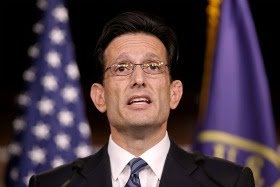
    True to form, the Richmond Times-Disgrace spent about half of its front page this morning toasting the elevation of their hometown favorite, Eric Cantor, to his new position as House Majority Leader, following the GOP rout in November elections.

    None of the major newspapers — the New York Times, Washington Post or Wall Street Journal — afforded the “Young Gun” the same type of type of fawning coverage. But, then, Cantor is exactly what the newspapers owners like, a non-threatening, non-dynamic protector of their business interests, not to mention that his wife is on the board of parent firm Media General (cue disclaimer!).

    Cantor promises the lead the charge to dismantle Obamacare, refusing to believe the Congressional Budget Office’s estimate that it will CUT $140 billion or so from the budget in its first 10 years. Cantor wants weekly budget cutting suggestions from various House committees. One would have to assume, of course, that they wouldn’t involve funding for Rolls Royce North America or any major corporate entity with a headquarters in the Old Dominion.

    Cantor is an icon for what Virginia’s dying oligarchs such as the Stewart Bryan family and others want from their politicians, namely one-sided policies that favor CEOs rather than ordinary people.

    Consider that the late Supreme Court Justice Lewis F. Powell Jr., another member of the Old Richmond elite deified by the Richmond newspaper, was front-and-center pro-business to the point of absurdity.

    According to a New York Times piece on the current pro-business Supreme Court, before he was named to the court, Powell took it upon himself to advise the U.S. Chamber of Commerce to assemble a “highly competent staff of lawyers” to thwart what he saw as a massive legal onslaught against business interests.

    A year later, Powell was named to the Supreme Court and he sure got his wish later with the court of Chief Justice John G. Roberts, which has, according to a study for the Times by Northwestern University and University of Chicago professors, ruled in favor of business interests 61 percent of the time while the previous chief justice’s court so ruled 42 percent of the time.

    And, the U.S. Chamber, housed in a mausoleum-style mansion across Lafayette Park from the White House, has, under its combative president Tom Donohue, aggressively shouted down just about any kind of regulation be it Sarbanes-Oxley, needed after Enron, and the more recent but weak financial industry reforms following the worst crisis since the Great Depression which was caused in large part by the unbridled greed of the Banks of America, Wachovias, Merrill Lynchs, Bear Stearns, Citigroups, and so on.

    It should come as no surprise that Cantor is going after Obamacare and refuting independent and credible analysis suggesting it won’t sink the federal debt as conservatives want you to think it will. The Young Gun is generously funded by the managed care and health industry. For a cool couple K, you can arrange a “coffee with Cantor” at a Starbuck’s on Capitol Hill.

    And speaking of Cantor, he never questioned President George W. Bush’s War in Iraq, which was absolutely unnecessary because the “Weapons of Mass Destruction” that Bush gave as the reason for the war, did not exist. Meanwhile, the war has cost 4,400 Americans killed and 30,000 wounded, 100,000 or so Iraqi casualties, several million refugees and $1 trillion in taxpayer costs that haven’t been paid for, according to Joseph Lelyveld in The New York Review of Books.

    So where’s Eric on this one? If you are stuck in Richmond reading the Times-Disgrace, you will never find out.

    Peter Galuszka

  • Go North, Young Man, Go North

    The Washington Times published this column yesterday. I didn’t expect much attention. But before noon, I had enjoyed my 15 minutes of fame — in Canada. After a PostMedia wire reporter wrote a story… about me writing an op-ed… and distributed it nationally, Toronto’s National Post asked to republish the piece, the director of an Ottowa think tank contacted me, and I landed two radio interviews in British Columbia. I mention all this not to brag but because I am bemused by the attention. (Unfortunately, I don’t think any of the activity sold any books.) The Canadians feel very much ignored by us Yanks, and they perk up when anyone, even someone as obscure as me, has something complimentary to say.

    So, why do I post this on Bacon’s Rebellion. First, to share with my online friends. And second… uh, well, oh, yeah, because Canada is Virginia’s largest trading partner!

    Canada Is Quietly Surpassing the U.S. as the Land of Opportunity

    Unless the Winter Olympics are on television or someone is clubbing baby seals, Americans donโ€™t pay much attention to whatโ€™s happening in Canada. Itโ€™s as if we live in a house with a set of quiet, orderly neighbors on one side and a bachelor pad with drunken parties, girls in the hot tub and occasional gunshot eruptions on the other. To whom would you pay more attention?

    I dare say Americans could correctly name the president of Mexico (Filipe Calderon) over the prime minister of Canada (Stephen Harper) by a margin of 5-to-1. Thatโ€™s too bad. While we have every reason to fear the disorder spilling over from our increasingly lawless neighbor to the south, our well-mannered Canadian neighbors have pulled their act together. We could learn a lot from them.

    Look whatโ€™s not happening in Canada. There is no real estate crisis. There is no banking crisis. There is no unemployment crisis. There is no sovereign debt crisis. Recent reports suggest that consumers are loading up too much debt, but Canada shares that problem with nearly every other country in the industrialized world.

    Among the Group of Seven nations, which also include the United States, France, Japan, Germany, the United Kingdom and Italy, Canadaโ€™s economic activity has come the closest to returning to the pre-recession peak. The country has recovered three-quarters of all jobs it lost. The International Monetary Fund estimates that Canada will be the only country among the G-7 have achieved a balanced budget by 2015.

    Now, instead of expanding Canadaโ€™s welfare state, the conservative government led by Mr. Harper is intent upon building the nationโ€™s global competitiveness. Our friends in the Great White North cut their corporate tax rate to 16.5 percent on Jan. 1 and will see it drop to 15 percent next year. That compares to the current U.S. corporate tax rate of 35 percent. That will give Canada the lowest corporate tax rate among the G-7 nations and an eye-popping advantage for businesses wondering whether to locate on the U.S. or Canadian side of the border.

    The last time Canadians really caught Americansโ€™ eyes was when prime ministers such as Jean Chretien and Paul Martin, both leaders of the Liberal Party, were proving uncooperative in the realm of foreign policy. American media played up disagreements over the invasion of Iraq and Canadian participation in the American National Missile Defense Program, which made President George W. Bush look bad and confirmed the narrative that his cowboy foreign policy had alienated old friends around the world. By contrast, when Canadian soldiers became active combatants in Afghanistan, the American media showed little interest.

    But thatโ€™s nothing new. Except to note how well or how poorly Canadaโ€™s national health care system was working, Americans have paid little heed to news coming out of Ottawa. The titanic effort of both Canadaโ€™s liberal and conservative parties in the 1990s and 2000s to rein in government spending largely escaped our notice. Nor did it ever occur to anyone to wonder why, with our economies so closely entwined, U.S. housing prices were busting through the roof while Canadian houses remained so sensible.

    It turns out that Ottawaโ€™s housing policies and banking regulations tempered the boom in real estate prices. No tax deductions for mortgage interest payments. And get this: Buyers actually had to make down payments on their houses. Because there was no real estate bust, there was no banking crisis. (Indeed, healthy Canadian banks are snapping up U.S. financial assets.) Despite the lack of public policies geared toward stimulating homeownership, Canadian homeownership was 68.4 percent in 2008. That would be a higher number than in the United States , which was 67.4 percent in 2009.

    Lesson to Americans: If you want affordable housing, stop promoting policies to make it more โ€œaffordable.โ€

    Meanwhile, Canada has many of the same assets that Americans like to brag about, such as an immigrant tradition that invites foreigners to live and work in the country. On a per-capita basis, the rate of legal immigration to Canada is comparable to that to the U.S. Settling in world-class, creative cities like Toronto and Vancouver, foreigners add immeasurably to the nationโ€™s wealth-creating capacity.

    Talented Canadians have long regarded the United States as the land of opportunity. It may not be long before Americans see our northern neighbor as the land of the future.


  • Watch Out, Here It Comes!

    It has finally dawned upon the Washington Post news staff that the new crowd of deficit hawks in Congress may not portend well for the regional economy. Indeed, it won’t. The only thing that could be worse than the rough patch we’ll experience if Republicans make good on promises to slash federal spending by $100 billion would be continuing down the budgetary path to Boomergeddon (when Uncle Sam defaults on his debts and investors refuse to lend anymore), in which case the shortfall could exceed $1 trillion.

    Here’s my favorite line in yesterday’s story, “Federal austerity could hit the region’s economy hard“:

    Some forecasts suggest that the growth of federal spending and procurement could plunge to 1 percent or below in 2011 from an average of about 8 percent annually during the past several years. That could hurt even if the local economy benefits from improvements this year in the U.S. economy.

    Oh, horrors, growth in federal spending could slow to one percent? Welcome to our world, Washington!

    Actually, you ain’t seen nothing yet. If Congress does its job and acts to close the budget gap by a full $1 trillion over the next decade or so, Washington could see something unknown along the banks of the Potomac — what a recession feels like. A decade-long recession. Alternatively, we could just conduct business as usual, wait for the government to go into default and see what it feels like to suffer a $1 trillion cutback all at once.

    Federal cutbacks do pose a problem for Virginia conservatives. The federal government is the economic engine for Northern Virginia and Hampton Roads, and the ultimate source of a lot of the commonwealth’s tax revenues…. Which brings us to the point I’ve been hammering on for so long. The joy ride cannot continue forever. Sooner or later, you run out of gas. Virginia absolutely must prepare its own state and municipal budgets for the inevitable adversity to come.

    Some people, like Rodger Provo who alerted me to the WaPo article, find it incomprehensible that conservative Virginians would “continue their assault on the federal government,” the cornerstone of the state economy. I consider it a sign of good sense. First, because growing federal command over the economy through direct spending, regulations and allocation of capital is bad for the economy generally. That would include Virginia. Second, because something that can’t go on forever… won’t. I’d much rather have a prolonged but gradual slowdown that we can adapt to rather than a crash that induces blind, mind-numbing panic.

    In either case, we can only hope that our representatives of the General Assembly see what’s coming and prepare accordingly. That means tightening our belts, eschewing new debt and foregoing the creative accounting.

  • Politics and the Chesapeake Bay – Part 1

    Overview – This is the first in a series of articles about politics and the Chesapeake Bay. While I’d love to present the matter in one article, the topic is simply too broad and complex for a single post.

    In the Beginning – The Chesapeake Bay was formed 18,000 years ago when the glaciers melted and flooded the Susquehanna River valley. 12,000 years ago, mastodons, bison, caribou and mammoths roamed what is now the Chesapeake Bay watershed. 11,000 years ago North American Indians occupied the Chesapeake Bay area. 3,000 years ago the bay reached roughly its present area and boundaries.
    Size and scale – 200 miles long and 35 miles wide at its widest point, the Chesapeake Bay is one of America’s largest bodies of water. The bay and its tributaries occupy 4,500 square miles or 41 million acres. The 18 trillion gallons of water in the bay form 11,700 miles of shoreline. Half the bay’s water is supplied by 150 rivers and creeks which drain from a watershed that spans 64,000 square miles. Despite its impressive size the Chesapeake Bay is shallow – averaging only 21 feet deep.
    Physical forces – The Chesapeake is extremely complex and ever changing. Water temperature and flow change with the seasons. Salinity varies widely from oceanic levels at the mouth to nearly freshwater levels in the upper tributaries. These are apparent forces. Yet there are less obvious forces at play as well. For example, salinity varies by depth across much of the bay. The lighter fresher water floats to the top of the bay and flows to the sea while the heavier, saltier water collects toward the bottom and flows north from the Atlantic with the tide.
    Potential – The extent of the Chesapeake Bay tragedy can only be understood in the context of its present state vs. its potential. That potential is well portrayed in the results of a single hunting party from 1760. The party kills 111 bison, 18 black bear, 114 bobcats, 98 deer, 2 elk, 112 foxes, 109 gray wolves, 41 mountain lions and 500 other unidentified mammals (Source: Chesapeake Bay Blues, page 11, citing Steadman 2001, 99). The Chesapeake Bay Foundation released its annual health index for the bay in 2010. The foundation rated the bay’s health as 31 out of a potential 100. Stunningly, that rating represents a substantial increase over 2009’s rating of 28.
    Next Article: A History of Chesapeake Bay Pollution


  • New Year’s Catnip

    Now that it’s the New Year, what happened to the Sound and the Fury?

    Let me get my nose out of my eggnog. I’m not just talking about a holiday hiatus.

    Where’s the rage over federal debts and deficit spending? Remember all those months of harrumphing about Arma-and Boomer-Geddon? How we are doomed by negating the Protestant Work Ethic? That we, and Obama, are a bunch of spend-thrift, gluttonous slobs?

    Where’s EMR and his Calvinistic lectures on “mass overconsumption.” Where’s Boomer-Jim (although he actually sounded sane on his CNN interview)? Groveton?

    To be sure, the Big Bacon questioned Bob McDonnell in his quest to explain Virginia’s AAA bond rating to the nabobs on Wall Street. I kinda of agreed with the moronic idiocy of this. But then Bob tells the Richmond Times-Disgrace that’s 2011 is going to be a very different kind of year. He’s going to be a take-charge guy. Forget about Deepwater Horizon, ABC stores and Confederate History Month. That’s like, so yesterday.

    But why the silence? Where’s the scolding? I mean, I enjoy not being told once again what kind of free-spending slob I am. Could it be the Republican victory in November? Groveton and Bacon are secret Republicans despite their claims of indepdence. EMR answers to neither clan, I know.

    Just to start the New Year out right, let’s quote from the despised Paul Krugman of The New York Times (in this case, on the tax cuts, which is catnip to the Groveton-Bacons, which may be why they are so asleep on the issue):

    “One day deficits were the great evil and we needed fiscal austerity now now now, never mind the state of the economy. The next day $800 billion in debt financed tax cuts, with the prospect of more to come, was the greatest thing since sliced bread, a triumph of bipartisanship.”

    So what about it, guys?

    Peter Galuszka

  • Can the Boomers Retire?

    Christine Romans interviewed me this morning for CNN American Morning. A one-on-one interview running more than five minutes on a national cable network is a generous allotment of time, but it barely skims the surface of the weighty topics at stake. Still, I can’t complain. The interview provides a nice introduction to the “Boomergeddon” book.

    The Bacon bottom line: 2/3 of Boomers are financially unprepared for retirement (our friend Groveton is a relatively rare exception) and will have to work longer than they ever anticipated. We can’t count on government to act responsibly enough to preserve the integrity of Social Security and Medicare, so we’ll have to add to savings to offset the risk of cutbacks to the retirement safety net.

    And how do we do that? Strip the costs out of our lifestyles to lower our spending profile, pay down debt, become as self reliant as possible — and don’t count on the government to bail you out. You’ve got about 15 years to work on it. Good luck!


  • McDonnell to Defend AAA Rating

    The sleeper story of the season: Gov. Bob McDonnell, staff and senior legislators will be paying calls on rating agencies S&P, Fitch and Moody’s to defend Virginia’s AA rating.

    According to Chelyen Davis with the Free-Lance Star, McDonnell says he has no reason to believe that the AAA is in jeopardy, but he’s never met with the rating analysts and he wants to make sure they “have confidence in what we’re doing.” In particular, he wants to explain how Virginia intends to honor its commitments to the Virginia Retirement System.

    Good luck, governor. Make sure you have an explanation handy for that Senate Finance Committee report that says Virginia cannot borrow any more money if it wants to maintains its self-imposed debt capacity cap of 5% of revenue.


  • Christmas 2.0


  • Good News on the Job Front — But No Reason to Get Complacent

    Gov. Bob McDonnell made a few big promises when he ran for governor. One of those promises, raising more money for transportation, was a bust. Privatizing the state’s ABC stores, collecting royalties from offshore oil drilling and slapping tolls on Interstate highways have crumbled like the asphalt on Interstate 95. But another of his promises, to promote job creation, has panned out pretty well. So far, McDonnell has lived up to his campaign slogan, “Bob’s for Jobs.”

    Virginia’s economic development success garnered attention in today’s Wall Street Journal, which noted that the state’s unemployment fell to 6.8% in October, down from 7.2% in February thanks to the net creation of 55,000 new jobs. That was the third best job-creation rate of any state, noted reporter Jennifer Levitz. And it represented a big improvement from 2009, when Gov. Tim Kaine presided over a performance that ranked 35th.

    Clearly, Virginia benefited from the surge in federal spending last year, but only 2,600 of the new jobs came from additions to the federal payroll, the WSJ noted. (The article offered no numbers for expanded employment by federal contractors, which probably exceeded the number of direct federal jobs.) On the other hand, Virginia benefited relatively little from soaring energy and agricultural prices, as several other top-performing states have. Instead, the Old Dominion has enjoyed a slew of traditional economic development coups in a year when big new corporate expansion announcements were far and few between. The Governor’s office has announced 215 deals so far this year.

    The article points to two differences between Virginia and other states. Even as it was cutting spending by hundreds of millions of dollars, the General Assembly gave McDonnell $57 million in economic development funds to entice new investment to the state. McDonnell also appointed Lt. Gov. Bill Bolling, as “chief job creation officer,” transforming a largely ceremonial position into a high-profile economic development czar.

    Philosophically, I’m opposed to the use of government “incentives” to buy jobs. Business subsidies do not create new jobs, they only transfer them from one state to another. I believe in low corporate tax rates for everyone — and no special deductions, credits, exemptions or subsidies for anyone. Our economic development strategy should be to focus on creating a favorable business climate that helps everyone, not a favored few. That said, as a Virginian, I’d much rather have the jobs here in Virginia. I’d rather live in a state that promotes job creation rather than a state like, say, California, where state policy destroys jobs.

    McDonnell deserves to bask in his job-creation success. And I’m not opposed to his request for an additional $54 million to continue the program. But I would hate for Virginia to get stuck on the idea that buying jobs through incentives is a good long-term formula for prosperity. It’s an economic development philosophy that dates to the 1960s, if not earlier. In the long run, we need to improve K-12 educational performance, achieve productivity breakthroughs in healthcare, patch our crumbling infrastructure, develop more energy-efficient human settlement patterns and build world-class research universities — not by doing things the same old way, as in throwing around money at every desiderata, but by adopting new paradigms for how we deliver and pay for government services.

  • Watch It and Weep!

    The looming insolvency of many states and municipalities is getting more and more attention. CBS’ 60 Minutes highlighted the problem Sunday, and everyone concerned about Virginia public policy needs to watch this video.

    Needless to say, Virginia is in far better shape than Illinois, New Jersey and California, but it would be foolhardy to think that we are immune from their difficulties. The fact is, we don’t have a good handle on the financial strength of all Virginia’s municipalities and all the independent authorities that have issued debt. We don’t know how much publicly backed debt there is, we don’t know what potential liabilities governments are potentially liable for, and we don’t know how well covered the debt is. We don’t know what impact declining property values will have on municipal revenues, what impact consumer deleveraging will have on sales tax revenues or laggardly economic growth will have on income taxes.

    Meanwhile, we face massive cutbacks in federal aid when the “stimulus” package expires, continuing increases in Medicaid spending, and more cuts of unknown magnitude when the newly elected Congress gets serious (or semi-serious) about closing the federal budget gap.

    The 50 states, metropolitan regions and municipalities are coming to the end of an the expansionary era that has prevailed since World War II. Spending will be painful to cut. Much of it is baked into the dysfunctional human settlement patterns — scattered, disconnected, low-density — that we have built over the past 60 years. More spending is tied to our dysfunctional, privately-owned-but-highly-regulated health care system, and yet more is tied to our dysfunctional, hyper-bureaucratized public educational system. The days of blindly shoveling more money at roads, schools and health care are over. We cannot afford this madness anymore.

    Our major public institutions have evolved as far as they can usefully evolve. They have reached a dead end. Collectively, they are nearing collapse. Virginia has been less profligate than other states, so that foundational truth may not yet be self evident to everyone. But the design flaws in our institutions are endemic — Virginia is only a few years behind the rest.

    Government As Usual will not work. We cannot solve our problems by trimming a bit here and there, jacking up taxes and fees but spreading the pain so no one notices, implementing private-sector processes in the search of ephemeral efficiencies, borrowing up to our AAA debt limit, diverting the public’s attention with culture-war issues, and hoping that some economic miracle from source unknown will deliver a revenue windfall from the heavens. No, we must fundamentally re-think the way we deliver and pay for every major public services at the state and municipal level.

    Just as we need a new compact between government and citizen at the federal level, we need a new compact at the state, regional and local level. Either we devise the new compact through a deliberative democratic process informed by reasoned debate, or it will be imposed upon us in a panicked crisis mode by remorseless creditors.


  • Is There A Gun Show Loophole?

    One of the enduring controversies in Virginia involves the so-called “Gun Show Loophole”. I say so-called because the term “gun show loophole” generates intense debate and considerable emotion.

    In fact, this article on the “gun show loophole” was inspired by a Bacon’s Rebellion reader who took exception to a comment I posted about the need to close the “gun show loophole”. As I’ve researched this matter it’s become obvious that there are honest people and honest opinions on both sides of this controversy.

    What’s a gun show anyway? Fundamentally, a gun show is a temporary gathering of firearms enthusiasts. The shows are usually organized by promoters who lease space for the show and then sub-lease display / sale areas (often called tables) to vendors. Most vendors are firearms dealers although there are often people leasing tables and selling knives, jerky, etc. Old Dominion Gun Shows is planning a gun show in mid January in Dale City, VA. You can see their web site here.
    Can you buy guns at a gun show? Yes. Everybody (on all sides of the issue) know and agree that guns are bought and sold at Virginia gun shows. The ATF estimates that there are 5,000 gun shows a year (across the nation) averaging 1,500 – 15,000 attendees per show. Shows vary in size with smaller shows having 50 tables and large shows having 2,000 tables. ATF estimates that 1,000 guns per show are sold at the big shows. As a point of reference, the Old Dominion Gun Show in Dale City will have 175, six foot tables available to lease for $50 each. I’ve never seen the statistic of total guns sold per year at gun shows but I imagine that a million could be possible. That’s a lot of guns.
    Are gun sales at gun shows regulated? Yes, sort of….depends a lot on the state. People and companies engaged in the business of buying and selling guns must have a license from the federal government. These merchants must comply with federal law by completing a background check on a potential buyer using the National Instant Criminal Background Check System. However, that requirement only applies to licensed gun dealers. Private citizens who are not engaged “in the business of dealing” firearms who make only “occasional” sales within their home state are under no requirement to conduct background checks on purchasers. They are legally forbidden from selling to a person who they know is prohibited from buying a gun (such as an ex-felon) but they don’t have to verify anything.
    Gun shows don’t kill people … people kill people. Maybe so but gun shows provide a convenient venue for illegal firearm sales. In fact, there is no doubt that some very questionable gun sales occur during gun shows. One chilling account comes from a young man repeatedly shot during the Virginia Tech massacre. Read his story here.
    It’s always Virginia. Not in this case. While Virginia has very lax private gun sale regulations the Old Dominion is far from alone. Of the 50 states, only 17 have substantial gun show / private gun sale regulations. The other 33 (including Virginia) allow great latitude in the private sale or transfer of firearms – whether within a gun show or somewhere else.
    The bottom line – I am a gun ownership advocate. I believe in the Second Amendment and the Supreme Court interpretation of that amendment in the Heller case. However, there is good reason to perform a background check prior to selling a gun. I support the adoption of Colorado’s regulatory approach. Guns sold at gun shows must be through a registered firearms dealer with a background check. Private sales outside of gun shows are allowed without a background check. I can live with private sales and I can live with firearms shows – just not at the same time.

  • Where Was Bob?

    While Gov. Robert F. McDonnell was attorney general in 2006, he did nothing when informed about serious accusations that eventually led to the conviction and 10-year sentence of John W. Forbes II, a former state finance secretary.

    The accusations come from a front-page article today in the Richmond Times-Dispatch that details efforts to bring to justice Forbes, who was convicted in a $4 million fraud case involving a grant from the Virginia Tobacco Indemnification and Community Revitalization Commission

    Forbes, who served in the cabinet under Republican Gov. Jim Gilmore, used money to set up a program designed to improve adult literacy but instead used a considerable amount of the grant to pay for salaries of himself and his wife and to buy himself a $1 million home.

    The case is one of the biggest corruption scandals in recent Virginia history but as the newspaper reports, McDonnell did nothing when sent a four-page letter in October 2006 detailing concerns of wrong doing from a woman who worked for Forbes and then was abruptly fired when she asked Forbes about financial irregularities.

    Neither McDonnell’s nor the attorney general’s office could find the letter, the newspaper says. Former state Sen. Charles R, Hawkins, R-Pittsylvania, who chaired the tobacco commission, also said he had no recollection of the letter.

    The author of the letter, D.L. Billett Jr. of Chesterfield, whose former wife E. Denise Kent had worked for and had been fired by Forbes, kept pushing for a probe. He told the Times-Dispatch that he spoke with the attorney general’s office after sending the letter in 2006, but was told not to expect much in the way of an investigation. Billett could not remember the name of the official.

    Finally, Billett sent the information to Sen. John C. Watkins, R-Powhatan, other political figures and the Joint Legislative Audit and Review Commission. It finally ended up in the hands of the State Police 14 months ago which launched the probe that led to Forbes’ conviction.

    This sorry chapters raises big questions about McDonnell’s competence, if not his integrity, when he was attorney general. The story seems to be a classic case of sweeping something potentially embarrassing to one’s political party under the rug — in this case than of the Virginia GOP. To their credit, other state Republicans had the integrity to push for a probe.

    The pressure is now on for the General Assembly to create better checks and balances for public bodies such as the tobacco commission that is supposed to use billions in a settlement against major tobacco companies for the public good.

    Another aspect is that many of the same Republicans who apparently refused to check into serious allegations of government misfeasance have no trouble painting Washington and the federal government as the source of all evil.

    Let’s hope the pressure stays on for a reckoning.

    Peter Galuszka

  • Outing Groveton

    Fellow Baconauts.

    Ever wonder who Groveton really is? Since he has become a regular blogger here, I have taken up the science of Grovetonology where I ceaselessly search for identifying clues. But his true identity remains a closely-held mystery.

    My threshold understanding is the following: Groveton is a guy who is some kind of executive with an IT firm. He jets from Auckland and Amsterdam every week from his home somewhere in Northern Virginia. He says he named himself after a high school somewhere near Manassas. To make us sense he’s a regular guy — one you might not mind having a beer with in an airport lounge — he titillates with wistful comments that he’d really like to partake of foreign fleshpots.

    I asked the Big Bacon one day if he could provide any hints as to Groveton’s identity. What does he look like, for instance? Jim said: “Well, he’s a middle aged guy, kind of stocky, beefy, ex-football player type.”

    I chewed on this for a while and then realized it was TBB (Total Bacon Bullshit) designed to throw me off the scent. I mean, he’s clearly a hard conservative. If you broke into the basements of both Bacon’s and Groveton’s homes you’d probably find a high speed telex spitting out daily orders from Cato Central. It wouldn’t surprise me in the least if the disinformation campaign ran really deep.

    I have come up with some other possibilities I’d like to share with you:
    • Groveton is really a skinny nerd with a huge subscription list to hard right magazines and blogs and has ‘fair and balanced” Fox News switched on 24/7.
    • Grovetown isn’t a guy at all, but a woman posing as a guy.
    • Grovetown is really an amalgam of several people. Risse uses this tactic all the time. The “real” Risse identifies himself as “EMR.” That’s simple enough, but he often comments using other names. This is another plot to make us think we are hearing several independent voices. In reality, Risse is a 1950’s style, Kerouac-like subversive who wants to pollute our thought patterns with an enormously complicated vocabulary that he has invented. My advice: Don’t let him inside your head.

    Anyway, the Big Bacon has promised to reveal Groveton’s real identity soon. It is now supposedly a secret because Groveton’s employer might be upset that he’s blogging. But that could be TBB, too.

    Peter Galuszka (aka “Mr. Gooze”)


  • The New Geography of Racism

    Ever wonder why white opposition to darker-skinned immigrants seems to be centered in outer suburbs such as Prince William and Stafford counties? An analysis of new Census data provides the answer.

    The reason, the American Community Survey reports, is that immigrants from Latin America and other places are flocking to small towns and outer suburbs rather than concentrating in the center of large cities, as had been the case for immigrants for the last two centuries.

    According to a New York Times report, Los Angeles County, a traditional Hispanic draw, showed little immigrant growth while immigration exploded in suburban Newton County outside of Atlanta. Closer to home, Stafford County saw its immigrant population triple during the past decade. Other Virginia hot spots are Prince William and Loudoun counties.

    The Times notes that many Hispanics are drawn to outer suburbs by lower living costs, as well as by once-plentiful construction jobs that went bust with the recession.

    This helps to explain why Stafford County is proposing to get tough on illegal immigrants, and why Prince William County, led by board of supervisors chairman and rising state politician Corey A. Stewart, cracked down starting in 2007.

    Prince William’s law prodded many Hispanics to leave the county, regardless of their immigration status or citizenship, because they felt they were being profiled by police. Stewart wants to take the Prince William experience statewide with his “Virginia Rule of Law” campaign.

    The sad truth is that these settlement patterns are sparking racism that had seemed to be abating in America. Just 50 years ago, so-called “blockbusting” led African-Americans into tight, white, ethno-centric neighborhoods of big cities such as Chicago and New York.
    The battleground has since shifted to the wide highways and big-box stores of outer suburbia. But the dynamics are the same. White Americans had felt safe in such places but somehow now feel threatened by new arrivals. The reason? It’s only skin deep.

    Peter Galuszka

  • CRESTFALLEN

    โ€œCrestfallenโ€ is the only way to describe the feeling.

    After ALL THE WORK on AntiPartisan action and AntiPartisanism, and then not get invited to the โ€œNo Labelsโ€ kick off on Monday at Columbia University!!

    There is no question about the need to stop Whack a Mole Politics and to stop Tossing Rocks at Empty Pigeonholes (TRAPE).

    Yes politics IS broken. It has been for at least three decades and becomes more broke with each passing campaign cycle.

    BUT how to fix politics?

    The โ€œFounding Leadersโ€ and the invited guests said all the right things…

    BUT WAIT:

    1,000 people in the audience?

    A slick web site already up?

    They have raised a million dollars BEFORE it was a public activity?

    The โ€œFounding Leadersโ€ are primarily agents and shills who have worked for the two dominate political Clans.

    The only โ€˜nameโ€™ from the Commonwealth has been described as the most craftily partisan politician in the large municipality where he lives and from which he was elected to congress and served as the chair of the Elephant Clan fund raising committee in the House.

    It was pointed out on another Blog that the ONLY โ€˜seniorโ€™ Elephant Clan personalities were FORMER office holders who recently lost a primary to the WingNut / Anger of Ignorance Crowd.

    You have to know โ€˜the systemโ€™ to dismantle โ€˜the systemโ€™ but is this just an attempt to preserve the 19th Century โ€˜Grand Old Two Party Systemโ€™?

    Is there a way forward that does not involve articulating an AGENDA?

    Does it make sense to just raise money to โ€˜protectโ€™ Clan candidates from Right WingNut and Left WingNut attacks?

    After all, the primary DRIVERS of civilizationโ€™s dysfunctions are:

    Unsustainable human settlement patterns,

    A governance structure that does match the economic, social and physical structure of contemporary society, and

    An economic system that lives on Mass OverConsumption, speculation and debt AND

    WAS ALL CREATED AND IMPLEMENTED WHEN THERE WAS A FUNCTIONING AND CIVIL TWO PARTY SYSTEM โ€“ 1950 to 1990.

    How will No Labels produce โ€œwhat citizens wantโ€ when the vast majority of citizens have no idea what the real options are or what would be in their best interest as individuals, for their Households or as members of the hundreds of โ€˜communitiesโ€™ (small โ€˜cโ€™) in which every citizen is trying to exist?

    The answer will be the Agenda No Labels articulates and how well they integrate those who do not care how โ€˜the systemโ€™ worked before it FAILED.

    Perhaps it was not such a bad thing not to be invited…

    EMR