Hat tip to Ray Hyde for the following chart: Inflation in college tuition costs separated from the general Consumer Price Index in the early-mid 1980s and began accelerating in the early 1990s. It would be interesting to know what new legislation, new regulation, or economic/demographic trends accounted for the breakaway. My operating hypothesis is that the super-inflation can be attributed somehow to government policy. Does anyone have any thoughts?
-
Factoid of the Day: Inflation in College Tuition
-
The Wonk Salon: April 14-15, 2011
Innovative Work Roles for Teachers
Center for American Progress
This study advocates alternatives for school staffing that make use of teachers’ outside-the-classroom talents. A program at West Springfield High School in Fairfax County is highlighted.Nonprofit Hospitals More Likely to Sustain Unprofitable Services in Small Town America
National Bureau of Economic Research
For-profit hospitals in rural areas are quicker to cut unprofitable medical services; non-profit hospitals support them longer.A New Way of Looking at the Bay
The Virginia News Letter
The Chesapeake Bay is more than a set of natural processes — it is socio-economic system, which is far more complex.
-
Selling Virginians for Cheap
 Danville in Southside Virginia has been especially hard hit by changing global markets. Once a major textile, tobacco and furniture town, the city has seen its economy decimated as those sectors have taken hits. Moving cut and sew plants to cheaper labor overseas helped shutter such local textile names as Dan River Mills and Tultex, hiking the local unemployment rate.So, it was with great joy that then-Gov. Tim Kaine announced in 2006 that Swedwood, a unit of Swedish furniture giant IKEA would build a $281 million facility with 930,000 square feet to build stylish and affordable furniture for IKEA stores in the U.S., including the D.C. area. State and local officials kicked in $12 million in incentives for the factory that would eventually employ 330 workers. The trade press trumpeted Swedwood’s plans for a “cost-effective, lean production flow.”
And that’s when Virginia’s notoriety for treating its workers shabbily kicked in.
Although IKEA has a good reputation for employee relations and allows unions in Sweden, not so in little Danville. Workers at the plant complain that promised raises don’t materialize and that they often learn on Friday evening that they must work a weekend overtime shift or face penalties, according to a report in The Los Angeles Times. One worker, Kylette Duncan, told the Times she had to cancel medical appointments for her sick husband because of Swedwood’s chaotic work schedules.The International Association of Machinists and Aerospace Workers says it has enough interest at Swedwood to try to organize the factory but the firm won’t let them on the grounds. After all, this is Virginia where the “right to work” anti-union concept is a cherished idea. The firm hired labor-busting law firm Jackson Lewis of Richmond to help blunt organizing efforts.
According to the Times, the story has been all over the media in Sweden but has gotten little attention in the U.S. Small wonder since the unions have faced a bashing, especially from budget-cutting Republicans in states such as Wisconsin.
On oddity is that the official who pushed landing Swedwood is no Republican at all, but former Gov. Tim Kaine who has been head of the national Democratic Party and is running for the U.S. Senate.But then, when it comes to selling Virginia’s cheap labor, it really doesn’t matter which party one belongs to.
Peter Galuszka
-
Benchmarking Recidivism
 In 2008, one in one hundred American adults was behind bars; one in 31 was either incarcerated or on probation or parole. Total state outlays for corrections is $52 billion. Preventing offenders from committing more crime when they are released — reducing the recidivism rate — is one strategy for controlling the second fastest-growing category of state spending after Medicaid.
A new study by the Pew Center on the States, “State of Recidivism: The Revolving Door of America’s Prisons,” provides the first comprehensive state-by-state look at recidivism rates, reporting return-to-prison rates for all inmates released in 1999 and 2004. According to Pew’s data, 45.5% of all inmates nationally were re-incarcerated within three years. “The new figures suggest that despite the massive increase in corrections spending, in many states there has been little improvement in the performance of corrections systems.”
Among inmates released in 2004, Virginia had one of the lowest rates in the country: 28.%. That rate was bested only by Oregon (22.8%), Wyoming (24.8%)and West Virginia (26.8%). And it was significantly better the worst performers, Minnesota (61.2%) and California (57.8%).
Clearly, Virginia, which is often criticized for its large inmate population, is doing something right — at least it’s doing it better than most other states. Now, if only we can figure out what that is and do more of it.
-
The False Promise of Smaller Class Sizes
 Class-size reduction, or CSR, is one of the most popular ideas among parents, teachers and the general public for improving the quality of education in the United States. A recent poll indicated that 77 percent of Americans think that additional educational dollars should be spent on smaller classes rather than higher teacher salaries. In at least 24 states, policy makers have enacted CSR initiatives costing billions of dollars. The number of students per teacher has steadily declined over the past four decades – by 30% in public schools.
But large-scale CSR policies produce benefits that are “modest at best” and “clearly fail any cost-benefit test,” writes Matthew Chingos, in “The False Promise of Class Size Reduction,” after the review of the research. And who is this Matthew Chingos? Is he some small-government, deficit-cutting zealot with the Cato Institute or Heritage Foundation? No, he is affiliated with the Center for American Progress. He apparently recognizes, however, education’s claim upon the public purse is not unlimited and sees a need to optimize the resources we do invest in education.
Small classes may be worthwhile in special cases, says Chingos, as in classes with students with learning disabilities, or when a teacher is inexperienced and needs support in developing skills. Conversely, principals may want to assign larger classes to highly effective veteran teachers, perhaps with some extra compensation. “School districts should encourage this kind of creative management.”
Perhaps public schools in Virginia should re-visit their thinking about the value of class size. If Chingos is right, educational resources could be more profitably invested by improving the level of teacher quality.
-
The Now-You-See-It-Now-You-Don’t Deficit
 Adapted from my op-ed in today’s Washington Times:
President Obama talked a good game in his budget speech Wednesday, promising to close the budget gap by $4 trillion over the next 12 years – matching the $4 trillion in spending cuts proposed by Rep. Paul Ryan of Wisconsin in the Republican Party’s proposed overhaul of the federal budget. The number was identical to Mr. Ryan‘s, but very little else about the competing plans was the same.
The president stated that he offers a very different vision of “the kind of country we want to live in.” In essence, he claimed that his plan would save as much money as Mr. Ryan’s but do so without the cruel cuts to the poor, the elderly, autistic children, the mentally handicapped and other unfortunates who cannot fend for themselves.
But Mr. Obama is a master of misdirection. Don’t follow his patter and stagecraft – watch his hands. There is very little fiscal discipline in Mr. Obama’s plan at all. Much of his plan consists of unverifiable claims and promises. Indeed, Mr. Obama appears to be doing his utmost, given the reality of the nation’s fiscally unsustainable course, to defend the entitlements and domestic spending programs so beloved of big-government liberals.
Just last week, Mr. Obama characterized his fiscal 2011 budget compromise with Republicans as providing “the biggest annual spending cut in history.” Only after reporters and analysts had an opportunity to comb through the details did it emerge that most of the $38 billion in so-called cuts were one-time economies and accounting gimmicks, at most yielding fewer than $15 billion in ongoing savings. (More recently, a Congressional Budget Office analysis determined that, after increases to defense spending, the budget cuts amounted to just $350 million this year (million, with an “m,” reports the Washington Post. – JAB)
Likewise, a close look at Mr. Obama’s plan to match Rep. Ryan’s $4 trillion in budget closing reveals that the president is engaging in more budgetary hocus pocus.
As Mr. Obama summarized the budget plan in his speech, he expects to make $2 trillion in spending cuts, raise $1 trillion by eliminating tax breaks for the rich, and $1 trillion in interest-payments savings.
The most obvious budgetary trick is that the $4 trillion in savings will come over 12 years, not Mr. Ryan’s yardstick of 10 years. That’s two extra years to count his modest spending cuts, tax hikes and savings in interest payments on the debt – or roughly 20 percent of his total.
Mr. Obama proposes to capture $750 billion in savings by building on the budget compromise fashioned with Republicans last week. Locking in domestic spending at fiscal 2011 levels – there’s no talk of retrenching to 2008, pre-recession levels – will give him plenty of boodle to “invest” in green energy, infrastructure, schools, broadband, medical R&D and all the other big-government solutions he proposes.
The president’s budget plan also expects to find additional savings in the defense budget, but he offered no details. He promised only to conduct a “fundamental review of America’s role in the world” that, presumably, would redefine America’s military and national security posture to match its diminished fiscal capacity.
Mr. Obama promises another $500 billion of cuts in health care spending by 2023 – not by restructuring Medicare and Medicaid and creating conditions for market discipline, as Mr. Ryan proposes – but by counting on the Affordable Care Act to institute already-promised cost controls. We will see reductions in erroneous payments, cuts in payments to pharmaceutical companies and new incentives for doctors and hospitals to operate more efficiently and improve outcomes, among other measures, he suggests. But the promised savings are based on blind faith that empowering a command-and-control bureaucracy will bring about gains in productivity and improved medical outcomes.
“If we’re wrong about the savings,” he added, an independent Medicare commission will order the cuts needed to meet budgetary goals. Somehow, those cuts would be less inhumane than anything that Mr. Ryan might propose.
Finally, Mr. Obama made an argument for “shared sacrifice” in which “the rich” would do most of the sacrificing. This the president proposed to accomplish by limiting itemized tax deductions to the wealthiest 2 percent of Americans, netting $320 billion over 10 years. He was less than forthcoming how he would raise the other $680 billion, however, alluding vaguely to eliminating tax loopholes sufficiently to both lower tax rates (not for the rich, one would expect) and increase the tax take. These proposals, we can be assured reflect the long-standing liberal conviction that you can raise rates on the rich and, despite their access to the world’s best CPAs, tax attorneys and tax shelter advisers, they will not redeploy their assets or adjust their income in any way to minimize their tax exposure.
“We do not have to sacrifice the America we believe in,” Mr. Obama promised. No, we just have to sacrifice our common sense and believe the president really can pull doves and scarfs out of his sleeve.
-
The City that Outsourced Everything
Sandy Springs, Ga., city of 100,000 on the fringe of metropolitan Atlanta, provides a fascinating experiment in municipal government outsourcing. Incorporated just five years ago, it outsourced all government functions except public safety. The city contracted with CH2M Hill to manage the sub-contracting of specific functions to other enterprises.
In the first year, according to this Reason TV report, the city paid $25 million to provide services that would have cost $50 million in a traditionally run city. By running more efficiently, Sandy Springs has been able to make capital improvements — like road pavement and a traffic-control system — that Fulton County, of which it is a part, had failed to make over the decades. The city managed to avoid tax increases during the recession, and has built up a reserve fund.
The outsourcing strategy is wildly popular with citizens, who have re-elected incumbent members of City Council by overwhelming margins.
-
States’ Fiscal Outlook Stinks for Decades to Come
Another dose of fiscal reality, this one from the Government Accountability Office: While the fiscal condition of state and local governments has improved slightly over the past year (you call that an improvement?), says the GAO in a new report, “State and Local Governments’ Fiscal Outlook,” the long-term outlook looks as bleak as ever. Rising costs are being driven by health care — Medicaid, medical insurance for public employees, and health insurance benefits for retirees. Absent major policy changes on the part of state/local governments, here is the deficit trajectory (click on chart for more legible image):
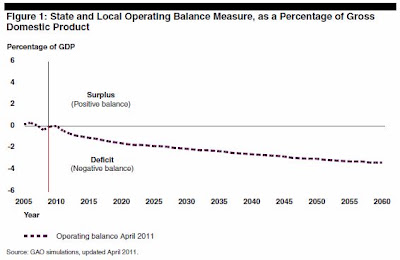
In other words, state and local governments face decades of horrendous fiscal challenges. Please note: This doesn’t come from “Boomer Jim,” the “Baconauts” or some other putatively ideological, Tea Party-tainted source. This comes from the Government Accountability Office… under the Obama administration.Implication for Virginia: We can’t wait for the federal government to enact real health care reform. We need to do whatever lies within our power to transform Virginia’s health care system with the goals of increasing productivity and improving outcomes.
-
The Wonk Salon: April 13, 2011
How the Feds Can Save Failing Schools
Center for American Progress
School systems have proven they can’t turn around failing schools. Turn the job over to the Feds.Ryan Proposal Would Reduce Federal Medicaid Payouts to States
Center on Budget and Policy Priorities
Rep. Paul Ryan wants to convert federal Medicaid dollars to block grants. If his idea had been implemented in 2000, Virginia would have lost $5 billion by 2009.States Unprepared for Nuclear Emergency
New America Foundation
Few states are prepared to cope with a radiation release from a dirty bomb, nuclear plan mishap or any other source.The Electric Grid: a Bottleneck to Renewable Energy
World Resources Institute
Renewable energy is great… except for the fact that the United States electrical grid is totally unprepared to handle it. State renewable portfolio standards need to grapple with hard realities.
-
Wanted: Transportation Entrepreneurs
 It’s hard to take seriously a guy with the name of Wubbo Ockels. (The name does sound better in Dutch than in English.) But I give the Netherlands’ first astronaut credit for dreaming up — and prototyping — a fascinating transportation alternative. His electric-powered superbus can reach a speed of 250 kilometers per hour (about 150 miles per hour). It carries 23 people. (See more in this brief profile in Radio Netherlands Worldwide.) There was no mention of the bus’ range.
Ockels was inspired to develop the superbus by what he deemed to be the inadequacies of trains. “Trains are too slow,” he says, “and they only go from one station to another.”
The economics of the bus are dubious. The bus costs €1 million, or about $1.44 million at current exchange rates. That’s a lot more expensive than a typical motor-coach bus with comparable seating capacity, which runs around $100,000 or so. On the other hand, its fuel costs are considerably lower. And passengers may be willing to pay premium fares to reduce the length of their commute.
The new Dutch government does not seem terribly interested in the bus, but Ockels, whose project was supported by the public Dutch transportation company Connexxion, persists in the hope that he might be able to find foreign markets. I’m wondering: Could the superbus be an economical, money-making alternative for Virginia?
Could HOT lanes be adapted to accommodate the superbus, and how much would that cost? How much of a fare premium would riders pay for a shorter commute? Could the superbus provide an alternative to “high speed rail” as a form of inter-city travel?
We’ll never know as long as mass transit is considered the purview of government-owned and subsidized mass transit systems. Government-owned enterprises are too risk averse. We need entrepreneurs willing to take the risks associated with pioneering a new transportation mode. But one has to wonder, could an entrepreneur even legally operate a superbus in Virginia without violating some law or mass-transit franchise?
(Hat tip: the blogger who goes by “Accurate.”)
-
Wonk Salon: April 12, 2011
Employer-based Insurance and Entrepreneurial Lock
Kauffman-Rand Institute for Entrepreneurship Public Policy
Some would-be entrepreneurs are discouraged from starting their own business because they are worried about losing their employer-based health insurance.
Multi-State Insurance Exchanges
Urban Institute
It might make sense for states to collaborate in creating Obamacare-mandated health exchanges, especially when large metro areas cross state boundaries. Metropolitan Washington, anyone?
-
The Wonk Salon: April 11, 2011
I’m filing this a day late. My apologies. From now on, I will list only those Wonk Salon entries that I have not otherwise highlighted on Bacon’s Rebellion with their own blog posts.
Free the Schools
Heritage Foundation
The federal involvement in K-12 education has been a budget-busting disaster. It’s time to re-think the federal role in education.How to Get Good Teachers and Principals
Center for American Progress
Congress should use its funding “more strategically” to prod/goad/bribe states and local governments to develop a cadre of good teachers and school principals.Who Purchases Long-Term Insurance?
Urban Institute
What a surprise — more affluent Americans purchase long-term care insurance. The rest, presumably, are counting on good fortune or Uncle Same to take care of them.Why Manufacturing Matters
Center for American Progress
Manufacturing is still a pillar of the United States economy. We under-estimate its value at our peril.Does the U.S. Need Foreign Teachers?
Center for Immigration Studies
The H-1B visa system is being used increasingly to hire foreign teachers, taking away opportunities for American teachers.
-
Virginia’s Structural Budget Gap $8 Billion and Counting

Legislators have succeeded the past few years year in balancing Virginia’s budget during trying times without major tax increases (“fees” are a different matter). But a new report by the Commonwealth Institute contends that the current biennial budget falls $8 billion below pre-recession levels once spending is adjusted for the rising cost of providing services to a growing population. Other major conclusions:- Even without adjusting for population and inflation, the General Fund falls $657 million below pre-recession levels.
- The Commonwealth has reduced state support for K-12 education by $2.6 billion over this year and next.
- Virginia faces a $400 million gap in current spending compared with pre-recession levels in Health and Human Services.
Were it not for the recent economic up-tick, which improved the revenue outlook, the gap would have been even larger, the report says. But the authors do not extrapolate from those findings to draw any conclusions.
That won’t stop me from weighing in. Two main points:
First, economic growth generally, and state/local tax revenues specifically, will continue to lag. This is not your father’s economic recovery. This is one of the most anemic business cycles on record, and there is absolutely no reason to think that it is going to get better. That is a non-partisan judgment. It doesn’t matter who occupies the White House. Bottom line: Austerity stinks, but we’d better get used to it.
Second, we need to start thinking radically differently about how government provides core services in Virginia. Sticking with the old model will not work. Raising taxes will not work. Trimming spending and spreading the pain will not work. We need deep-rooted institutional change. We need to ramp up conversations about how to enact balanced, market-driven land use patterns, user-pays transportation, a consumer-responsive education system, and market-driven health care.
Tinkering on the margins of the status quo will take us nowhere.
-
Do Colleges Really Subsidize Tuitions?
 Back to one of my favorite themes… It is an article of faith in the higher education industry that tuition falls far short of what it costs to educate a student. The Dartmouth College Fund, for instance, claimed in fund-raising material that it charged only $49,974 for undergraduate tuition, room and board even though it spends $104,402 per student per year.
The fallacy in that logic, write the authors of “Who Subsidizes Whom? An Analysis of Educational Costs and Revenues,” is that not all college spending is used for instructional purposes. Colleges do many things other than educate their students, most notably conduct research. After adjusting for student aid, the authors estimate that Dartmouth receives $23,079 in tuition-related revenue per student. But after adjusting for the amount of time that professors actually spend teaching, the cost of providing the education is only $13,000 per student (of which only $9,100 can be attributed to faculty compensation).
Conclude the authors: “Between 52% and 60% of students attend institutions that are paid more than they spend to educate them. If wasteful spending is disallowed, the figure rises to 76%. At four-year institutions, it is between 59% and 87%. In other words, not only are most students not being subsidized by their college, but most colleges are able to divert money towards non-educational activities, all the while claiming that this spending is for the benefit of students.”
How does this apply to Virginia institutions of higher education. Frankly, I don’t know. But these are the kinds of questions that members of the General Assembly should be asking — and the State Council for Higher Education in Virginia should be analyzing. There is probably a better match at Virginia’s public universities between what students pay in net tuition and what it costs to educate them than in other university systems. But who knows for sure? How can we hold Virginia colleges and universities accountable unless we find out?
-
All for One (percent)
 In these days of budget buzz and deficit dallying, it is useful to consider just where things are in terms of wealth in the U.S. Nobel prize-winning economist and Columbia University professor Joseph Stiglitz presents some unsettling realities.While the Baconauts and Boomergeddons bemoan their idea that profligate spending and “Mass Overconsumption” (an EMR buzzword) will bring an end to the American dream, Stiglitz says it’s already gone.
He notes some familiar but still vital information that the top 1 percent in terms of personal wealth are taking in 40 percent of income. Twenty-five years ago, it was the top 12 percent taking in 33 percent of income, Stiglitz wrote in a recent Vanity Fair piece.
The usual conservative dogma has it that if you have an extraordinary income, somehow you deserve it. Stiglitz exposes this horrendous myth, nothing that the current income inequality in the U.S. makes old Europe seem far more egalitarian. With wealth distribution numbers like these, the U.S. has more in common with the rulers of Iran or the oligarchs of Russia, which is cold comfort indeed. The American big wigs have been helped along by tax cuts and easy regulation, especially regarding trusts, during Republican administrations.How this new American elite got there is a curious story, basically a tale of tax cuts, overweening self-interest and lobbying and a general change in attitudes. Rather than science or manufacturing, finance is the most popular field for the most talented youth go so they can divvy up and massage the wealth of the tiny rich rather than create new wealth.
The new ultra-rich are inclined to cut public spending for such things as government research that brought us such advantageous innovation as the Internet and breakthoughs in public health. The One Percenters, you see, don’t need public research or public health since they have their ownlabs and their own private doctors. Here in Virginia, there’s even talk about “privatizing” the University of Virginia, a top-rated public university. To get an idea where this comes from, take a peek at the school’s alumni magazine, which I get because I am a U.Va. parent. The back pages are stacked with four-color ads for multi-million-dollar Albemarle County estates. One wonders where their values have gone.Speaking of health, the Baconauts among us cling to the tired idea that private corporations are the only salvation to our health issues. Funny, but Stiglitz points out that with the top 1 percent game plan, the health care market is rigged from the start, meaning there isn’t any market economy that the Baconauts claim is the salvation of all things. Pharmaceutical companies, for instance, are getting a $1 trillion gift from the federal government, which has agreed to not negotiate the prices for drugs of which it is the single largest buyer. Odd, but I thought that negotiating prices was a key part of a market economy.
As the tiny slice of rich even richer, the American middle class is slipping. The number of men with only high school degrees has actually dropped 12 percent in the past 25 years. And if they get their degrees, or even a college sheepskin, their jobs will be easily thrown away by an elite that is more than willing to bargain U.S. employment for cheaper foreign labor since the price is right. I guess that kind of market economics is OK. Congress? They are part of the 1 percent themselves and are funded by it.The problem with the Boomergeddons is that they tend to be upper middle class types or aspire to that group distinction and see a lot of the problems with the greed and irresponsibility of lower income people. This classist, if not racist, view is out of whack since these less wealthy people have responded positively during the Great Recession by cutting back on purchases and paying off credit cards that the 1 percenters and their companies have thrust upon them.
I know Stiglitz isn’t exactly popular reading for the Baconauts. When I wrote a piece a couple of years ago about Stiglitz’s observation that Iraq-Afghanistan will cost is $3 trillion that we haven’t even begun to pay for, I might as well have been put in stocks and pummeled with rotten tomatos. I am sure to be accused of harboring “socialist” views and perhaps I am.But the elite had better pay attention. Watch what is happening in the Middle East against ruling oligarchs. And the rebels won’t exactly be Jefferson-spouting Tea Baggers lecturing about individual freedom.
Peter Galuszka