• Virginia: Home of the Mostly Free

    Good news and bad news from the Mercatus Center if you, like me, lean libertarian in your thinking. In Mercatus’ newly published “Freedom in the Fifty States,” which ranks the states on public policy affecting freedoms in the economic, social and personal spheres, Virginia ranks ninth most free in the country.

    Only ninth? In a state where the motto is “Thus Always to Tyrants?” Yes, only ninth. And we’re heading in the wrong direction. That ranking represents a decline of two slots since the last survey in 2007.

    But we can take some small consolation that we are less beholden to our political and bureaucratic overlords than most states on the East Coast. Remarkably, New Hampshire (motto: “Live Free or Die”) remains the freest state in the country — a beacon of light amidst the smothering Nanny State darkness all around it. Otherwise, the only other states east of the Mississippi that rank in the top 10 freest are Indiana and Virginia. Southern states tend to be free in the economic sphere, but more intrusive in the social and personal realms. Virgina follows that pattern, ranking 5th in economic freedom nationally but only 22 in personal freedom.

    Among the prime offenses in Virginia: aggressive asset-forfeiture laws, high liquor taxes, a high proportion of state/local employees in proportion to state spending, and extensive mandates for health insurance coverage.

    Mercatus’ analysis of Virginia is worth reproducing at some length:

    Virginia is, by our count, the freest state in the South. However, like the other states below the Mason-Dixon line, it fares better in terms of economic freedom (#5) than personal freedom (#22). The tax burden, government spending, and debt are all well below national averages. However, state and local government employment is essentially at the national average.

    Gun laws are decent, with much room for improvement. However, open carry is allowed. Marijuana laws are largely unreformed.

    Virginia is schizophrenic on education, requiring 13 years of mandatory schooling, including kindergarten attendance, and imposing significant standardized-testing and notification requirements on homeschoolers, but otherwise leaving both private and homeschools alone.

    The state has below average numbers of arrests for victimless crimes, and its drug law-enforcement rate is also quite respectable (especially among its Southern peers). However, Virginiaโ€™s asset-forfeiture laws could really be improved.

    As one might expect given its history with tobacco, Virginiaโ€™s cigarette tax is quite low and smoking is not banned in private workplaces. However, it does have some smoking restrictions. Moreover, its spirits tax rate is the third highest in the country. Labor laws are solid.

    Like Hawaii and Pennsylvania, Virginia has no form of community rating for health insurance. However, coverage mandates are extensive. Indeed, Virginia has more than just about any other state, adding significantly to the cost of insurance.

    Natural gas and cable have been โ€œderegulatedโ€ to the consumer. The state has one of the best liability systems in the country, and it has improved on eminent domain since the last edition of the index.


  • The Wonk Salon, June 8, 2011

    How to Rebuild the Institution of Marriage
    Heritage Foundation
    The institution of marriage, critical for raising healthy, productive children, is crumbling throughout the Western World. United States governments need to reform tax and welfare-policy penalties on marriage and promote stable homes instead.

    Natural Disasters Hard on Extended Households
    Rand Corporation
    Hurricane Katrina didn’t just demolish houses: It demolished families, especially the extended families of socioeconomically vulnerable inhabitants.


  • Is Kindergarten More than a Holding Pen for Toddlers?

    Does anyone remember former Gov. Tim Kaine’s push for universal pre-K childhood education in Virginia? I do. The aim was to level the disparities in educational outcomes by ensuring that “at risk” children enjoyed the same kind of early-childhood enrichment as their more privileged peers. It was a noble goal. As it turned out, budget constraints limited the scope of the initiative. But the dreams of Nanny Staters live on.

    Now comes research from Canada that calls into question the underlying assumption that pre-K is a good thing for the little tykes.

    In the early 1990s, the Canadian province of British Columbia conducted what social scientists call a โ€œnatural experiment.โ€ BC mandated a program called โ€œdual entryโ€ in which students would enter school at two different points in the school year rather than all at the same time. BC then abruptly canceled the program, with the result that some students were kept in Kindergarten for as few as 6 months while those only a few months younger were kept for 16 months. As a result, state the authors of a research paper, โ€œThe Long-Run Impacts of early Childhood Education: Evidence from a Failed Policy Experiment,” November-December children effectively started Kindergarten 4 months late while January-April students started 6 months early.

    The authors then tracked the subsequent educational achievement of the two age groups. In findings strikingly at odds with the prevailing sentiment that more early-childhood education is better, they concluded (my emphasis) that โ€œstarting Kindergarten one year late substantially reduces the probability of repeating the third grade, and meaningfully increases tenth grade math and reading scores. Effects are highest for low income students and males. Estimates suggest that entering kindergarten early may have a detrimental effect on future outcomes.โ€

    Further, the authors write:

    [The BC policy] approximate[s] the potential impact of introducing a pre-K program where one did not previously exist. Introducing such a program would increase time spent in school, which comes at the expense of time spent at home, and would also lower a student’s entry age and readiness. For both grade repetition and tenth grade test scores, the estimates imply poorer outcomes for children who participate in such a program.

    Will this research alter the thinking of people who believe as a matter of faith in the power of the state to cure the failings of dysfunctional families? No. But it may give pause to everyone else.


  • The Wonk Salon, June 7, 2011

    Foreclosure’s Forgotten Victims: The Children
    Urban Institute
    Families evicted through foreclosure often wind up in new school districts. Residential instability and school switching among children is associated with lower test scores.


  • Time to Measure “Educational Value Added”

    If a proven entrepreneur comes up with a great new dining concept, he has no problem finding the money to create a chain of restaurants. If a real estate developer discovers a profitable model for erecting shopping centers or residential communities, he can raise hundreds of millions of dollars to build more of the same. But public schools are different. Bad schools don’t go out of business, and good ones don’t grow.

    In the past decade or so, big-league philanthropists have tried to change that dynamic by underwriting promising charter schools with the goal of replicating their educational DNA and reproducing what works. We haven’t seen much of that in Virginia because only four charter schools operate in the state. But perhaps we could learn from the experience of other states.

    One thing we could learn from reading a new Cato Institute report, “The Other Lottery: Are Philanthropists Backing the Best Charter Schools,” is that the philanthropists may not be getting it right either. Focusing on California, which has the largest number of charter schools in the country, Andrew J. Coulson ranks charter school networks by performance in standardized tests (adjusted for student characteristics and peer effects) and the level of philanthropic support they generate. He finds that the three highest-performing networks rank 21st, 27th and 39th in terms of private grant funding out of 68 networks. โ€œThe results are discouraging. There is effectively no correlation between grant funding and charter network performance,โ€ he concludes. Philanthropic funding is like a lottery, with funds distributed randomly.

    Free markets work when failing business models go out of business and successful business models take their place. In public education, failing schools don’t go out of business — they get subsidized — and successful schools have no incentive, or means, to recreate what they do elsewhere. As a result, the system remains static and largely impervious to change. The beauty of charter schools is that they allow experimentation that would not occur otherwise. However, charter schools are hardly a panacea. Some charter experiments are successful, others are not.

    Research sponsored by foes of chartered schools suggests that on average, charter schools add no more value than traditional public schools. Putting the emphasis on average results obscures the fact that some charter schools are very good and others are failed experiments. The goal shouldn’t be to ban all charter schools, it should be to replicate the successes and retire the failures.

    The problem is the lack of a clearly defined “bottom line.” Businesses have a bottom line: Are they making a profit or not? Schools have no bottom line. How does one measure the success of a school? By standardized test scores? That’s not fair because students of diverse cultural and socio-economic backgrounds score differently for reasons that have nothing to do with the school. What schools need is a measure of educational achievement added, which adjusts for the background of its students and allows performance to be compared fairly. But even that is a tricky proposition, for the issues are so complex.

    Computing profits is not an easy thing to do. That’s why businesses have evolved Generally Accepted Accounting Procedures (GAAP). The educational system needs something similar, like Measures of Educational Value Added (MEVA), that has wide buy-in from educators and those who fund them.

    The existence of widely accepted metrics would allow philanthropists to base their funding decisions on more than personal relationships and self-serving data provided by school administrators desiring to look good. Such metrics also would allow state governments to compare the performance of school districts, school boards to compare the performance of schools and principals, and principals to compare the performance of teachers.

    Virginia was a leader in instituting standardized tests. Perhaps we could take the next step and become a leader in measuring educational value added.


  • June 4, 2011

    Integrating Community Colleges into Regional Economic Development
    Brookings Institution
    Regions should develop an integrated workforce and economic development strategy in which community colleges ensure a stable supply of skilled workers for employers.


  • How Land Use Regulation Contributed to the Housing Bubble and the Recession

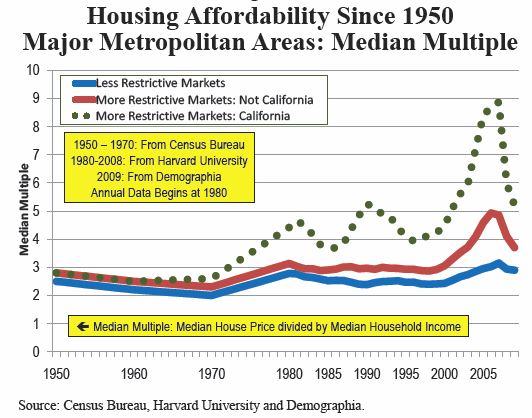
    There is general agreement that the housing bubble of the 2000s was fueled by a relaxation of mortgage loan standards that allowed many families to purchase homes they could not afford. Less well understood is that the housing bubble was not a โ€œmonolithic event,โ€ writes Wendell Cox in a National Center for Policy Analysis report, “The Housing Crash and Smart Growth.” The bubble varied widely by geography: Some markets saw extreme housing value increases, others saw very little at all.

    The key variable, Cox argues, was the extent to which land use regulations prevailed in different markets. By making it expensive to build new housing, regulations created scarcity that drove up house prices, which, when combined with looser lending standards, set off a speculative fever. โ€œAs the housing bubble developed,”he writes, “prescriptively regulated markets, including those in non-major metropolitan markets, accounted for 89% of the aggregate increase in house values. Conversely, 25 percent of homeowners lived in the responsively regulated markets, which accounted for just 11 percent of the aggregate value increases.โ€

    For the most part, Cox makes a sound case. It seems beyond dispute that (1) the intensity and cost of land use regulations varies widely from region to region, that (2) intrusive regulatory regimes make housing more scarce and/or more costly, and that (3) on average, regions where regulations were tightest saw the greatest increases in housing prices. The chart to the left tells the tale. (Click on chart to view more legible version.)

    I have one important bone to pick with Cox: the way he equates intrusive land use regulation with “smart growth.” The fact of the matter is, most heavy-handed land use regulation is the very opposite of smart growth. The dysfunctional human settlement patterns we have in Virginia (and much of the United States) are the direct result of zoning codes and comprehensive plans that mandate scattered, disconnected, low-density development in marked contravention of smart growth principles. Historically, these restrictions here in Virginia were the handiwork of anti-growth boards of supervisors who thought that they could reduce taxes and traffic congestion by smearing growth at low density over wide swaths of land and who resisted re-development in more compact, mixed-use configurations at higher densities.

    There is nothing inherently anti-growth about the smart growth movement, although anti-growth groups do often expropriate smart-growth rhetoric to advance their agendas. Further, I would add, “smart growth” comes in a variety of flavors, with some advocates eager to use the coercive power of government to impose their vision and others, like me, who are more inclined to rely upon market forces.

    With that significant caveat, I do agree with Cox’s conclusion that land use regulation has exacerbated housing scarcity and, accordingly, was an unappreciated contributor to the 2000-era housing boom-bust cycle that left our economy in tatters.

    Update: I hasten to add one more thought. Just as significant as the problem of metropolitan-wide overbuilding is the problem of maldistribution of the houses that are built. As EMR frequently reminds us, developers built too many houses in the wrong location within the region, typically on the metropolitan periphery. The price of those houses have declined the most.


  • The Film Subsidy Flim Flam

    The state of Virginia is spending $3.6 million in public funds and tax credits to lure the production of Steven Spielburg’s production of a movie about Abraham Lincoln to Richmond and Petersburg. State officials justify the subsidies on the grounds that it creates economic activity and jobs. But it may be an argument that fewer states are buying.

    Critics attack state tax credits for films on the grounds that the jobs created are mostly temporary positions, and they are often transplanted from other states. Moreover, a large portion of the benefit goes to the movie industry, not to local businesses or state coffers. In 2010, a record 40 states offered $1.4 billion in film and television tax incentives. But “2010 will likely stand as the peak year,” reports the Tax Foundation, “since many governors and legislators are ending their programs.”

    Eight states — Arizona, Arkansas, Idaho, Iowa, Kansas, Maine, New Jersey and Washington — have either ended, suspended or de-funded their film subsidies this year. Nine other states are scaling back their programs, studying cutbacks or have rejected efforts to expand their programs.

    Virginia is one the very few states to have increased its commitment to film subsidies.

    Hey, it’s fun to have movies filmed in town. I had a bit role as an extra in the filming of Gore Vidal’s Lincoln, starring Sam Waterston as Lincoln, about 23 years ago. (I survived the cutting-room floor. I played an office clerk, appearing in the background of a shot for a full two or three seconds.) But I don’t see any economic justification for the subsidies. Creating temporary film-production jobs does not contribute to long-term economic development, nor does it advance a strategically important industry. This is the kind of program we can do without as the nation slouches toward Boomergeddon.

    Update: I expanded this blog post for a column in Style Magazine. Read “Are we rolling out the red carpet for Spielberg’s ‘Lincoln’ — or are we bribing the producers to come here?”


  • The Wonk Salon, June 3, 2011

    Teacher-Leaders and Collaborative Teaching
    American Enterprise Institute
    Jack D. Dale, superintendent of the Fairfax County Public Schools system, lays out his vision for teacher-leaders and collaborative teaching, and describes a pilot project putting his principles into action.

    How Health IT Can Save the Healthcare System
    Bipartisan Policy Center
    There is a broad bipartisan consensus that health IT can enable desperately needed changes in the U.S. healthcare system, including new delivery models, payment reforms, prevention and wellness programs and insurance market reforms.

    Transforming Labor Relations in Pittsburgh Schools
    Aspen Institute
    Once upon a time, like two or three years ago, the Pittsburgh school system had “traditional, adversarial management-labor relations.” But a new spirit of cooperation reigns.


  • If You Build Prisons, Will they Come?

    News that Virginia is spending $700,000 a year to maintain a new but empty prison in Grayson County built at a cost of $105 million should be attracting the attention of budget cutters in the office of Gov. Robert F. McDonnell.

    The prison is one of 11 that have been shut down in the last few years because of a lack of prisoners. For whatever reason — the bad economy, demographic shifts or better policing — violent crime is down 5.5 percent nationally in the past year. In Richmond, once the
    nationโ€™s homicide capital per capita, crime is down 6.2 percent.

    So how did Virginians get stuck with so many unneeded prisons anyway?

    One place to look is George Allen, the former governor and senator who is now running for his old Senate seat. Back in 1993, Allen, a Republican, was running for governor behind Attorney General. Mary Sue Terry. So, Allen exploited what was seen as a very big issue back then — crime. Allen pressed the idea of making Virginia a tough-on-crime state, and he promised to end parole. And thatโ€™s what he did after he won the election. Plus, he led Virginia on a big prison expansion to handle the stateโ€™s fast-expanding prison population.

    Although the Grayson prison was built after Allen had moved on to the U.S. Senate, it is still part of his legacy.

    Peter Galuszka


  • Games Schools Play

    Are City of Richmond school administrators manipulating the numbers to make it look like they’re doing a better job of running the system than they really are? That’s the conclusion of Del. Joseph D. Morrissey, D-Henrico, who yesterday charged Richmond schools of wrongfully taking credit for the SAT scores of high-performing students at the regional Maggie T. Walker Governor’s School, reports the Times-Dispatch.

    Maggie Walker, which is located inside the Richmond city limits, is a highly selective school filled with some of the brightest students from across the Richmond metropolitan region. Its students get high scores on their SATs — an average of 696 for reading and 683 for math in the 2009-2010 school year.

    By adding the Maggie Walker scores to the city of Richmond scores, which run 200 to 300 points lower, the school system is masking the poor performance at the city’s other eight high schools. Said Morrisey: “It’s not fair for the Richmond Public Schools to take credit for scores … that they have no influence in. They are not hiring the teachers. They are not supervising the teachers. They are not setting policy.”

    Richmond school officials say they are just reporting the data as it is provided by the College Board, which administers the SATs. The College Board reports Maggie Walker’s results to Richmond because the city is the designated fiscal agent for the school.

    What I find interesting about this flap, which otherwise might seem to be a tempest in a teapot, is what it says about the dynamics of school reform. Democrats have long supported the educational status quo, arguing that the only thing schools needed was mo’ money. But that attitude is changing. Morrissey belongs to a new breed of Democrats that appears to recognize that public schools also need to make deep, structural changes to the way they operate, and that school officials need to be held accountable. That’s what this is all about: accountability.

    What makes this mini-controversy all the more interesting is that Morrissey, who is white, is pondering a run against Henry Marsh, who is black, in a heavily black senatorial district. Marsh, a Civil Rights-era hero, is closely associated with Richmond’s African-American political establishment. It appears that Morrissey is betting that school accountability will trump racial loyalty among African-American voters. If Morrissey does decide to run, this will be a very interesting race to watch. It could signal a sea-change in Democratic Party politics.

    Update: Morrissey has announced that he will not run against Marsh.


  • More Koch Kookiness

    “Always follow the Koch money,” opined my esteemed liberal colleague, the Gooze, in a recent post, “Have the Kochs Opened a Back Door for the Cooch?” Well, that’s what Rep. Jim Moran, D-8th, did in a recent rally, when he suggested that the long arm of the conservative Koch brothers extended into the cafeteria of the U.S. House of Representatives.

    Wesley P. Hester with the Times-Dispatch quotes Moran as follows:

    As soon as the Republicans took over the House of Representatives, they threw out all of the biodegradable utensils we were using in the cafeterias and they required us to buy styrofoam cups and plates and so on that are manufactured by Dixie, and, in fact, this is part of Koch Industries. … the CEO was one of the partners of Koch Industries that is now benefiting from what we have to buy because we’re basically a captive audience in the House of Representatives.

    Interesting theory. But Hester takes a wrecking ball to it. First, House Republicans canceled the recycling program because it was costing $475,000 to run and was found to have increased the House’s energy demand — not because they are in thrall to the Koch Brothers. The change had been recommended by outgoing Administration Committee Chairman Robert A. Brady, a Pennsylvania Democrat.

    Second, House Republicans did not recommend the use of Styrofoam. That decision was made by Restaurant Associates, the company that manages the cafeteria.

    Third, while Dixie is a brand owned by Georgia-Pacific, which is owned by Koch Industries, the Styrofoam products are actually manufactured by WinCup, which has no affiliation with Dixie, other than the fact that its owner, George Wurtz, worked for Georgia-Pacific before Koch Industries acquired it in 2005.

    The Kochs represent to the Left what George Soros does to the Right, a malign and shadowy influence whose tendrils reach everywhere. Conspiracy mongering is the American way. Admittedly, conspiracies sometimes do exist. Just insist upon solid proof before believing in them.


  • The Wonk Salon, June 2, 2011

    The Case Against the Cell Phone Tax
    Mercatus Center
    There is no justification for taxing cell phones more than other goods and services. Moreover, the tax runs counter to promoting access to broadband connectivity. (For what it’s worth, Virginia’s cell phone tax rate ranked among the 10 lowest in the country in 2010.)


  • Playing Around with the PLA


    The Metropolitan Washington Airports Authorityโ€™s cursory decision to mandate a union workforce for Phase 2 of Metrorail-to-Dulles potentially exposes the project to hundreds of millions of dollars in higher costs.

    How much will the Project Labor Agreement add to the cost of Phase 2 of the Metrorail-to-Dulles project? Thatโ€™s the $64 (million) question. Supporters of the PLA, which requires contractors to hire a union workforce, say it will reduce the risk of cost overruns by ensuring that the $3 billion-plus construction project runs smoothly. Critics charge that it would add 10% or more to the cost โ€“ as much as $300 million — almost guaranteeing that expenditures exceed projections.

    Finding a credible answer is all the more urgent now that the board of the Metropolitan Washington Airports Authority (MWAA), which is managing construction of the heavy rail project, has voted to build an underground Metro station at Dulles airport costing some $330 million more than an above-ground alternative.

    The board doesnโ€™t have much leeway for error. Escalating costs could derail the complex project financing, which relies upon a combination of special tax districts in Fairfax and Loudoun counties, revenues from massive toll hikes on the Dulles Toll Road and a contribution from MWAA itself. If bond buyers lose confidence in the cost projections and the stability of the funding sources, they may balk at issuing the bonds needed to fund the construction.

    Given the fragility of the Metrorail-to-Dulles financing in the face of mounting cost projections, one would think that the MWAA board would have given careful attention to the question of how much the PLA would affect cost projections. But the board treated the issue very much as an after-thought, deliberating no more than a few minutes before kicking the matter over to the MWAA staff for execution. The cursory handling of that decision calls into question the suitability of the board as a steward of the Metrorail extension project.

    Here is the background. Phase 1 of the project, extending the rail line from the existing Metrorail system to Tysons Corner and somewhat beyond, was contracted to Dulles Transit Partners (DTP), a partnership of construction giants Bechtel Corp. and URS. Both companies do business nationally, which means they work with labor unions on many projects. After winning the Phase 1 contract, DTP voluntarily entered into a Project Labor Agreement to provide a reliable, stable supply of labor, resolve disputes and eliminate the threat of strikes or other work actions in the event of a disagreement. PLAs make sense for companies that choose to use union labor.

    But there was one very important provision that differed from conventional PLAs: It exempted sub-contractors from the requirement to hire union labor. Therefore, DTP was free to hire non-union subs accounting for roughly 80% of the work.

    By all accounts, the PLA covering Phase 1 construction has worked out well so far. DTP had good things to say about the agreement during a meeting of MWAA’s Dulles Corridor Committee, which pondered the measure before it was forwarded to the full board.

    โ€œDulles Transit Partners has recommended to the Authority that a project labor agreement much like the one employed in Phase 1 also be utilized in Phase 2,โ€ asserted the formal resolution passed by the MWAA board in April. The Minutes of the April board meeting also stated that โ€œDulles Transit Partners โ€ฆ could not have been more pleasedโ€ with the PLA. โ€œThey have appeared before the Committee to testify how the agreement had assured both labor peace and a ready supply of the trained and skilled construction craft workers, for substantial savings over the life of the project.โ€

    Michael A. Curto, an attorney with lobbying powerhouse Patton Boggs and appointee of the governor of Maryland, introduced the resolution for the board of directors to approve the PLA. He gave a brief presentation which, according to attendees in the audience, generated minimal discussion. The board adopted the resolution in an 11-2 vote. Only former Virginia Congressman Tom Davis and former North Carolina Congressman William W. Cobey voted against the measure. Among those casting a vote in favor was Dennis L. Martire, a senior executive with the Laborers International Union of North American (LiUNA).

    Martireโ€™s union, which represents semi-skilled construction laborers, stands to gain significantly from an agreement that requires the use of labor workers. The contractor would be required to hire from LiUNA hiring halls, workers would pay 5% union dues, the contractor would pay into a Construction Industry Labor-Management Trust Fund, which provides unspecified โ€œservicesโ€ to union members or employees, and the contractor pays into union pensions which its employees may never benefit from. Martire has been a vocal advocate of PLAs, fighting to put one into place in Montgomery County, Md., and penning a paper on the subject.

    Martire did more than vote in favor of the PLA agreement, says Ben Brubeck, director of labor and federal affairs for Associated Builders & Contractors, an association of non-union or โ€œmerit shopโ€ contractors opposed to the PLA. Martire spoke in favor of the PLA proposal during the Dulles Corridor Committee hearing, and he backed up Curto during his presentation to the full board. In vivid proof that Martire had more than a passing interest in the outcome, LiUNA bused in three busloads of unruly protestors to make their sentiments known during an April press conference called by Rep. Frank Wolf, R-10, to address the escalating costs of Metrorail-to-Dulles. (See a video of the protest.)

    Continue reading article…

    (An aside: While this article is critical of the MWAA for its handling of the PLA, I must give credit to the authority for being very responsive to my request for information. Spokesperson Courtney Mickalonis gave substantive answers to all my queries and did so in a timely basis. Let us hope that the authority remains dedicated to transparency as this controversy unfolds.)


  • The Medicaid Steamroller

    Obamacare is a fiscal juggernaut bearing down on state government. The Patient Protection and Affordable Care Act will expand access to the health care sector by enrolling millions of Americans in Medicaid. In Virginia, Medicaid spending will increase from 14% of General Fund expenditures in 2009 to 21% in 2012, projects the Virginia Hospital and Healthcare Association.

    Obamacare will pay for the expansion of the program for three years but reimbursements will taper off after that to 90%, leaving states with a 10% share. As Larry Sartoris, president of the VHHA, said in a chat with me yesterday, “Even 10 percent is a big number.”

    Many states are turning to managed care as a way to hold down Medicaid costs. The idea is to turn over large populations of patients to private insurers and pay a fixed rate per patient (a capitated rate). The hope is that the Managed Care Organizations (MCOs) will keep patients healthy by encouraging preventive care and contain costs by discouraging unnecessary procedures. (Read this article in Stateline for details.) Unfortunately, MCOs won’t provide much of a buffer from Obamacare in Virginia — the commonwealth has already resorted to managed care as a cost-containment strategy, which is one reason our Medicaid spending is relatively low compared to that of other states.

    As Sartoris explains it, there are three main categories of Medicaid beneficiaries: (1) poor women and children, (2) the blind and disabled, and (3) impoverished elderly in nursing homes. Managed care is most easily implemented for the poor women-and-children category. And about three quarters of that population is already enrolled.

    Few people realize that the most costly piece of Medicaid consists of the blind and disabled, Sartoris says. This group accounts for 20% of the Medicaid population at present but 47% of the cost, as seen in the chart to the right. (Click on chart for more legible image.) A lot of the money is spent on dealing with mental health issues. To date, managed care has made few inroads in this group.

    As Medicaid increasingly stresses state budgets, Sartoris fears that politicians will put the squeeze on hospitals, physicians and other providers. But Medicaid is already a money loser for the medical community. Providers will try to make up the shortfall by jacking up fees to privately insured patients. That will make private insurance more unaffordable, which means more people will drop out. Many of them will wind up on state-subsidized health exchanges or… on Medicaid. And the vicious cycle will spin round and round.