• A deal only a politician could love

    by Norm Leahy

    The news readers on the financial networks this morning were almost giddy. The political class has reached a debt ceiling deal! The futures are up! Now we can get back to the serious business of letting fund managers talk their books!

    This mindless cheerleading will go on for most of the day, or at least until the closing bell. But for those of us who look upon almost anything that oozes out of DC with contempt, there are a few hard facts to know about this “deal.” Fortunately, Cato’s Chris Edwards, again, does the dirty but essential work:

    Spending isnโ€™t being cut at all. The โ€œcutsโ€ in the deal are only cuts from the CBO โ€œbaseline,โ€ which is a Washington construct of ever-rising spending. And even these โ€œcutsโ€ from the baseline include $156 billion of interest savings, which are imaginary because the underlying cuts are imaginary.

    No program or agency terminations are identified in the deal. None of the vast armada of federal subsidies are targeted for elimination. Old folks will continue to gorge themselves on inflated benefits paid for by young families and future generations. None of Senator Tom Coburnโ€™s or Senator Rand Paulโ€™s specific cuts were included.

    The federal government will still run a deficit of $1 trillion next year. This deal will โ€œcutโ€ the 2012 budget of $3.6 trillion by just $22 billion, or less than 1 percent.

    There are those, including many folks I respect, who will call even such lilliputian cuts as these a victory. And they have something of a point: for the last decade, the political class has cut nothing, so even the most modest of cuts, even if they are chained to the ever-rising baseline budget, are at least rhetorically significant. And even more, these pin-pricks have been achieved despite a Democrat-controlled Senate and a Democratic President, both of which were counting on, and campaigning for, higher taxes as part of any deal.

    Fair enough.

    But there’s an old, colorful saying: “Don’t piss on my boots and tell me it’s raining.” This deal is not a solution. Entitlements, war spending, even grants for cowboy poets…they will continue unabated. And far sooner than almost anyone is willing to admit, the bills will come due and the shambling fiscal wreck that is the United States will find itself unable to pay.

    Over the weekend on “The Score” radio show, Jim Bacon and I discussed the debt ceiling follies and what might really be required to set the nation on a sound fiscal course. You can listen to that wonky goodness here.


  • The Wonk Salon, August 1, 2011


    From Plow Horses to Race Horses – the Equine Contribution to Virginia’s Economy

    Weldon Cooper Center for Public Service
    Horse racing and horse shows have spurred the revitalization of Virginia’s equine industry.

    Is Policing Racially Biased? No Easy Answer
    Rand Corporation
    Police agencies are collecting more data than ever on the stops made by their officers. But there is still no definitive way to determine if they engage in racial profiling.

    The Most Effective Schools Excel… at Recruiting Good Teachers
    National Bureau of Economic Education
    Want to improve educational performance at your school? Put into place personnel policies that enable you to recruit the most effective teachers.

    Constraints to Increased Biomass Generation
    Rand Corporation
    Using biomass to generate electricity and reduce greenhouse gas emissions makes the most sense when used in conjunction with coal-fired power plants. But significant constraints limit biomass’ appeal.

    Seven Questions to Ask the People Who Run Your Schools
    Von Mises Institute
    The mass standardization of American public education and the mass of regulation that supports it has been a miserable failure.


  • More Job Destruction Courtesy of Washington, D.C.

    Jim Bacon logging in from Wilkesboro, N.C…. People in the hill country of North Carolina may be forgiven if they don’t believe that the recession is over. Omtron USA, a poultry processing plant, is shutting down its Townsends’ Crestwoods Farms division, eliminating 680 jobs in Siler City and 476 more in Mocksville, reports the Winston-Salem Journal today. That announcement comes on the heels of news that unemployment in the Winston-Salem metropolitan region remained stuck right around 10.0% in May.

    The poultry industry, which has a big presence in the Shenandoah Valley and the Eastern Shore here in Virginia, is hurting right now. Pilgrim’s Pride has announced its intention to close a poultry processing plant in Dallas in September, killing another 1,000 jobs. Google “poultry layoffs” and you will find more stories of a similar nature.

    To some people, the loss of jobs for blue-collar jobs like these represents a failure of the free-market economy that can be fixed only by government intervention such as tariffs, government stimulus spending or the imposition of higher tax rates on greedy “millionaires and billionaires” who “aren’t paying their fair share.” Such commentary is blind to the real causes of job destruction, which in many cases can be traced to some other government intervention designed to solve some other problem.

    In the case of the poultry industry, the primary culprit is the rising price of corn, the food source for chicken, which has shot from $3.41 per barrel in June last year to $6.58 in June this year. That added $1 million a month to the Mocksville plant’s operating expenses. And why has the price of corn shot so high? Rising global demand spurred, in part, by the voracious demand for corn as a feedstock for ethanol. In other words, North Carolina poultry workers are among the victims of the rent-seeking ethanol industry which uses its clout in Washington to create a market for a fuel that cannot compete with gasoline without government support and consumes so much energy in production that environmentalists deem a detriment in the campaign against greenhouse gas emissions.

    In an interesting twist, the two North Carolina plants would have closed earlier this year were it not for the intervention of Ukrainian billionaire Oleg Bakhmatyuk, who purchased the business out of bankruptcy and spent $10 million on plant upgrades. Bakhmatyuk had hoped to import corn from the Ukraine at less than half the price paid in the U.S. but regulatory changes there eliminated the price differential. Bakhmatyuk’s entrepreneurial gamble failed, but you can be sure that if it had paid off, someone would be attacking him for his profits and his greed.

    If we want to jump-start the American economy and reduce the “wealth gap,” much of it caused by rampant unemployment, a good place to start would be to stop bestowing subsidies, tax credits and market preferences upon politically connected corporate interests like the ethanol lobby and stop talk of foisting higher taxes upon risk-taking millionaires and billionaires.


  • The Wonk Salon, July 29, 2011


    Mapping Released Prisoners
    Urban Institute and the Providence Plan
    The police map crime. Why shouldn’t probation officers map the whereabouts of released convicts?

    Cut Federal Red Tape to Improve School Performance
    American Enterprise Institute
    Reforming federal compliance rules could lead to better educational outcomes than throwing more federal money at schools.

    State Education Secretaries as Agents of Change
    Center for American Progress
    The heads of state education agencies have more responsibility than ever before but they are hindered by state and federal regulations. It’s time to cut them loose.


  • Repeal the Mortgage Interest Deduction

    by James A. Bacon

    The deduction of mortgage interest from the federal income tax reduced the United States tax base by about $470 billion in 2008. The tax break is justified as a tool to promote home ownership but, by overwhelmingly favoring upper-income Americans, it mainly encourages them to buy more, or more expensive, houses than they otherwise would. Renters with lower incomes who would like to become homeowners derive minimal benefit because they tend to be in lower tax brackets. So argues “Unmasking the Mortgage Interest Deduction: Who Benefits and by How Much?” published by the Reason Foundation.

    As Congress wrestles with balancing the budget and restructuring the tax system, it should consider eliminating, or at least phasing out, this loophole. Zeroing out the mortgage interest deduction (MID) is certainly preferable to raising general tax rates, as some would like to do. Closing the loophole also would have the salutary effect of reducing the unproductive over-investment in residential real estate.

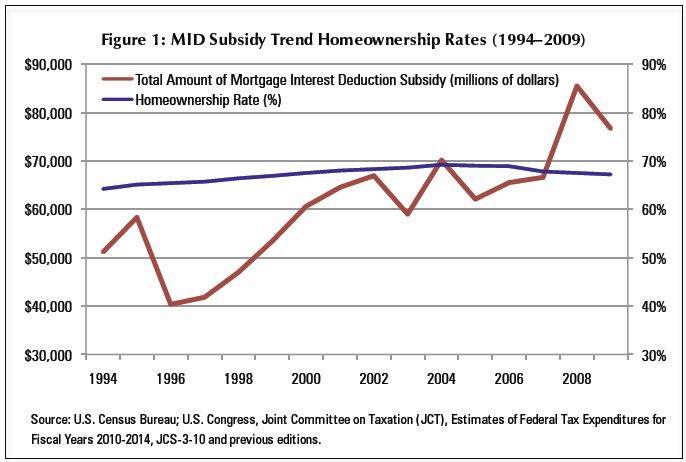
    Authors Dean Stansel and Anthony Randazzo make several important points. The MID does little to promote home ownership. The chart to the left shows virtually no correlation between the MID subsidy and the home ownership rate since 1994. (Click on chart for more legible image.)

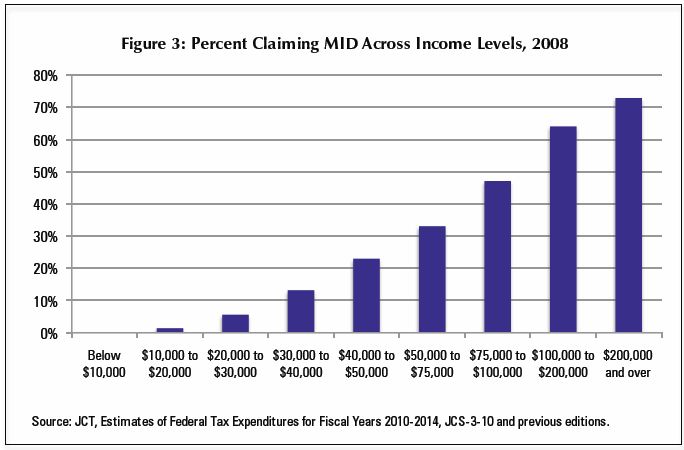
    The reason is that non-homeowners, who tend to be Americans in lower tax brackets, would derive no benefit from the MID if they bought a home. The authors explain: “Lower-income taxpayers are far less likely to itemize deductions because the sum of those deductions would be lower than the standard deduction, and even when they do itemize, the incremental benefit over and above the standard deduction is often quite small. Furthermore, for those who do claim the MID, higher income taxpayers tend to benefit more because they face higher marginal tax rates and tend to have larger mortgages.”

    The chart to the left shows how the benefit from the deductions goes overwhelmingly to the most affluent Americans. (Click on chart for more legible image.)

    Realtors and home builders will defend the MID to the death because the loophole does stimulate the construction of bigger, more expensive houses as well as vacation homes. But no one has yet explained the social benefit of subsidizing the installation of Pella windows, granite counter tops and four-car garages. Nor has anyone articulated a compelling national interest for building more second homes in ecologically fragile beach fronts and wilderness areas.

    Talk of raising the general federal income tax rate on “the rich” without eliminating the MID is just obscene. Such a policy would increase the value of the MID to the wealthiest Americans, encouraging even more over-investment in high-end housing and second homes.

    In Bacon’s ideal world, Congress would figure out how to balance the budget without increasing the overall tax burden of the American people. Elimination of the MID would be offset in a revenue-neutral way by lower general tax rates. If people want to buy million-dollar McMansions or ski chalets in Vail, they’d still be free to. They just wouldn’t be subsidized anymore.


  • Promises, Promises

    The Charlottesville Bypass is a go, thanks to approval by the Charlottesville-Albemarle MPO. But itโ€™s unclear when the money for other promised U.S. 29 corridor improvements will be forthcoming.

    By James A. Bacon

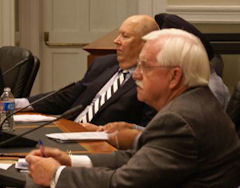
    Duane Snow (left) and Rodney Thomas. Photo credit: Charlottesville Tomorrow

    The Charlottesville region will get $197 million for a western bypass plus $33 million to widen a stretch of U.S 29 north of the city, but citizens may have to wait years before funds come available to build other priority projects in the U.S. 29 corridor.

    In a split decision, the Charlottesville-Albemarle Metropolitan Planning Organization voted to amend its Transportation Improvement Plan to include the two projects but did notย make the approval contingent upon state funding for the other projects, as two MPO board members hadย hinted they might. Instead, the board attached a letter from Transportation Secretary Sean Connaughton that outlined his promise to โ€œrecommendโ€ the improvements to the Commonwealth Transportation Board (CTB) for incorporation into the stateโ€™s Six Year Plan next year.

    The value of the promises in Connaughtonโ€™s letter became the object of contention between MPO board members. โ€œIโ€™ve got the letter that I sought,โ€ declared Albemarle County representative Duane Snow, who also serves on the Albemarle County Board of Supervisors. โ€œWeโ€™ve got two major projects funded. I think Connaughtonโ€™s letter is sufficientโ€ for the rest.

    But Charlottesville representative Kristin Szakos said the letter โ€œdoesnโ€™t offer any concrete assurances.โ€ Moreover, she said, she didnโ€™t like the fact that the letter had been delivered the day of the hearing, giving neither board members nor the public time to examine it carefully.

    Having received approval by the Albemarle County Board of Supervisors, the CTB and the regional MPO, the Charlottesville Bypass is now on the fast track after languishing forย  20 years. But the project has not seen the end of controversy. Before construction begins, the Virginia Department of Transportation (VDOT) will have to conduct an extensive environmental impact study, complete the design, acquire more right of way and bid out the construction contracts. Continue reading.

    (Read related story published by Charlottesville Tomorrow.)


  • The Wonk Salon, July 27, 2011


    Do Gun Law Awareness Campaigns Work?

    Rand Corporation
    In a controlled experiment in Los Angeles gun markets, sending letters to gun purchasers resulted in an increased rate of reporting stolen guns.

    Toward Data-Driven Pediatric Care in Washington, D.C.
    National Academy for State Health Policy
    The District of Columbia medical establishment has an opportunity to improve the quality of pediatric care by adopting electronic health records and the measurement of quality data.

    Impact of School Improvement Grants Uneven
    Government Accountability Office
    The federal School Improvements Grants (SIG) program spent $3.5 billion in the 2010-2011 school year.ย  Short time-frames and differences in local administrative capacity meant that states varied in their ability to implement the program.

    States’ Budget Cuts Harm Education, Health Care, Economy
    Center for Budget and Policy Priorities
    Cumulative state budget cuts over four years have devastated funding for schools and health care, and have harmed state economies.


  • The Terror of Elephants in “Must”

    By Peter Galuszka

    As minutes tick by, the behavior of Republicans in Congress, especially Virginia’s ultra-rogue junior elephant, Eric Cantor, becomes increasingly fascinating.

    They have become, suggests ย David P. Barash, psychology professor at the University of Washington, elephants in “must,” meaning that the usual rules of rationality and brinksmanship have become moot. Mind you, the elephant has long been extremely accurate symbol of the GOP (I don’t go for the “clan” nonsense Risse dishes out any more than I respect his “vocabulary,” hah!)

    It does seem that elephants fit the bill. They are big, ungainly and overfed. They like tax breaks, especially for the fatter elephants. And, from time to time, they get a little ditzy and when they do, brother, watch out!

    This is what has happened. After years of blowing out the federal budget under their Chief Elephant George W. Bush, the herd went nutzy in January 2009 when Barack Obama was inaugurated. We were entering a terrible recession and suddenly, overnight, the elephants got the religion of fiscal discipline. It all became Obama’s fault, the elephants agreed.

    So now comes the debt ceiling. The Elephants want to link that to all kinds of spending cuts. They do not care that by doing so they may well crash our anemic economy back into recession. They forget that the late King of Elephants, Ronald Reagan, raised the debt ceiling 18 times.

    Oh no. They want to stampede. Rationality doesn’t apply. And here’s what psychologist Barash reports will happen. The elephants have reached a state of “must.” It isn’t a pretty picture:

    “It’s a tactic that works surprisingly well, because male elephants can be in fact temporarily “crazy.” One of the most terrifying sights in the animal world is an elephant in a state of must: Huge bulls, oozing a weird, foul-smelling greenish glopย from glands near their eyes, behave with violent abandon, taking risks, and defying the basic rules of pachyderm propriety(and also giving rise to the term “rogue elephant”). Facing an elephant in must, other elephantsย  –not to mention people — are well advised to get out of the way.ย ”

    So you have it from the animal world.


  • A Bridge Too Near

    Thereโ€™s a new wrinkle in the Charlottesville Bypass controversy. The bridge across the Rivanna River may prove to be far more expensive than anyone anticipated.

    By James A. Bacon

    U.S. 29 north of Charlottesville

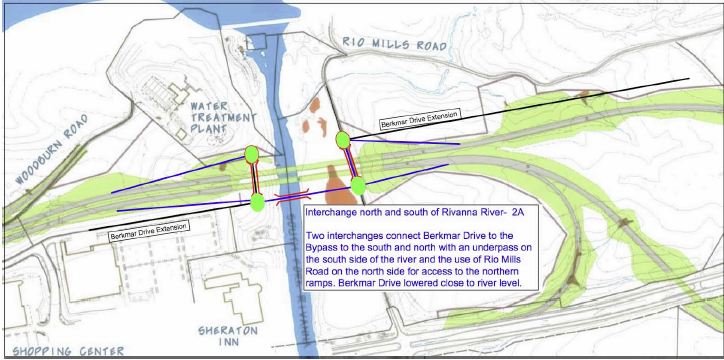
    The Charlottesville Bypass could cost a lot more than the $197 million approved by the Commonwealth Transportation Board (CTB) last week, contends the Southern Environmental Law Center (SELC) in a statement released earlier today. The preliminary design work for the controversial road project, undertaken years ago, did not take into account the fact that the Bypass would cross the Rivanna River at the same spot as a proposed extension of Berkmar Drive.

    SELC based its claim of potential cost overruns on an analysis by Michael J. Wallwork, a professional engineer with Florida-based Alternate Street Design, P.A. Design considerations will be more complex than originally envisioned because the Bypass and the Berkmar extension have to pass through the same chokepoint, threading between U.S. 29, a water treatment plan and a major subdivision. โ€œThe three main options โ€ฆ face significant cost, engineering, and other challenges due to the number and length of bridges and under or overpasses needed,โ€ Wallwork wrote. โ€œThese challenges underscore the need for careful consideration of the costs and impacts of the proposed Bypass on the planned Berkmar Drive Extended.โ€

    Wallwork’s analysis complicates the decision-making of the Charlottesville-Albemarle Metropolitan Planning Organization, the approval of which is needed for the project to proceed. The report highlights the need for additional information rather than rushing the controversial 29 bypass through the approval process, the SELC argues.

    “This is further evidence that the [Albemarle County] Board of Supervisors and MPO are lacking key pieces of information about the bypass and its impacts,” said Morgan Butler, director of SELC’s Charlottesville-Albemarle Project. “The public has been promised that the bypass would help advance Berkmar Drive Extended, a top priority in the county’s Places29 master plan. But today’s report indicates the opposite may be true, even if the two projects share a bridge. Our local leaders need to get a much better grasp on how the bypass would impact Berkmar Drive Extended before they vote on it, not after.”

    The MPO is scheduled to meet Wednesday night to address the western bypass issue.

    One of the bridge scenarios in the Wallwork report.

    The Bypass long existed as a line item in the stateโ€™s Six-Year Plan, but no money was allocated to it and nearly everyone had written it off. Partial rights of way, acquired more than a decade ago, are due to revert to the original owners if construction doesn’t get underway by 2012 — effectively killing the project. But the McDonnell administration surprised the project’s foes by resurrecting the Bypass earlier this month, persuading the Albemarle County supervisors to reverse their previous opposition earlier this month and then gaining the approval of the state transportation board last week.

    Rodney Thomas and Duane Snow, two of the Albemarle supervisors who voted in favor of the project, also sit on the five-person MPO board. A third member is James Utterback, Culpeper district administrator for the Virginia Department of Transportation, answers ultimately to Secretary of Transportation Sean Connaughton, who has worked extensively behind the scenes to move the project forward. The two other board members, who serve on Charlottesville City Council, are widely presumed to oppose the Bypass.

    Between Thomas, Snow and Utterback, the pro-Bypass forces would seem to have a majority on the MPO board. But thereโ€™s a complication. Thomas and Snow say that they switched their opposition to the project only because Connaughton promised them funding for four key U.S. 29 projects โ€“ a widening of the highway north of the proposed Bypass terminus; a new ramp at the interchange of U.S. 29 and U.S. 250 (widely referred to as the Best Buy ramp); completion of Hillsdale Drive, a road running parallel to U.S. 29; and the Berkmar extension, another road running parallel to U.S. 29 โ€“ in addition to the Bypass.

    โ€œWhen Duane Snow and I started on this, we were called by Sean Connaughton to have a meeting,โ€ Thomas explained. โ€œWe were asking for money to widen U.S. 29. He threw the idea of the Bypass on the table. Duane and I looked at each other, โ€˜Hmm, whatโ€™s this?โ€™โ€ Read more.


  • Two More Years of Fiscal Hardship

    by James A. Bacon

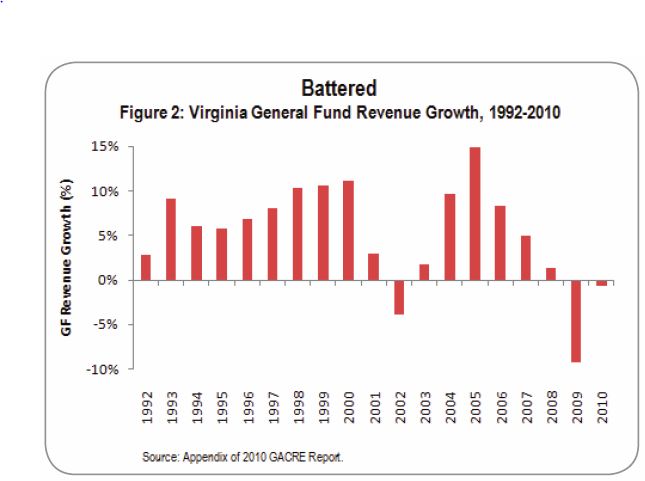
    The Commonwealth Institute has peered into Virginia’s fiscal future and doesn’t like what it sees. The state faces another $500 million budget gap next year, and a $300 million gap the year after that, meaning that the prospects of restoring cuts to education, health care and public safety are bleak.

    Although tax revenues are recovering, they remain below pre-recession levels, write Sara Okos, Laura Goren, and Michael Cassidy in “In the Red: Early Warnings About Virginia’s Fiscal Outlook.(Click chart for more legible image.) Meanwhile, prolonged joblessness and poverty require more spending on social services such as food stamps, Medicaid and Temporary Assistance for Needy Families (TANF).

    Not only is the economic recovery anemic, the state has significant obligations like replenishing the Rainy Day Fund, repaying the Virginia Retirement System funds it borrowed, and repaying the federal government for unemployment-insurance money it borrowed. Also, funds from the federal stimulus package (the American Recovery and Reinvestment Act) will have expired. Write the authors:

    Inadequate revenue growth, coupled with the loss of Recovery Act funds, and increasing other demands on state resources will likely place Virginia on red alert unless action is taken. This could hinder much-needed investments and innovation in public education, health care, public safety, and economic and workforce development.

    I share the Commonwealth Institute that Virginia’s conviction that the fiscal situation looks dire, and I believe the think tank deserves credit for bringing the issue to the public’s attention in a more authoritative way than I have been able to do. However, I do take issue with conclusions it draws from its fiscal analysis.

    The Institute contends that state and local spending cuts and accompanying layoff of 6,000 employees have “impeded” the economic recovery. Not so. Given the reality that state and local governments must balance their budgets, the only alternative to layoffs would have been increasing taxes. Higher taxes would have killed jobs. Moreover, higher taxes kill private-sector jobs, not public jobs. As some commentators on this blog need reminding, private-sector jobs are more valuable fiscally than public-sector jobs because private-sector employers pay taxes — property taxes, BPOL taxes and corporate income taxes — that governments do not. Offsetting the loss of private-sector jobs with public jobs is a sure-fire way to erode the tax base.

    Likewise, the Institute argues that a “cuts-only approach” to balancing the budget will hurt economic recovery. Maybe, but it would hurt less than raising taxes a like amount. The fact is, Virginia is in a fiscal jam and there is no easy way out. Instead of adopting a strategy of spending more money to meet core responsibilities, we should prioritize spending on programs that offer the greatest economic, fiscal and social return on investment.


  • The Wonk Salon, July 25-26


    How to Hold Higher Ed More Accountable
    National Governors Association
    States need to insistย  upon greater productivity at public colleges. A starting point is to track basic data like how many students are graduating, and how well are colleges meeting industry’s needs for an educated workforce?

    How Much Is that College Degree Really Worth?
    National Bureau of Economic Research
    Parents would like to know, and policy makers should know, how much a college education contributes to a students’ future earnings. This study finds that the earnings premium of prestigious state universities is close to zero.

    How Community Colleges Can Help Build a STEM-Savvy Workforce
    National Governors Association
    At least eight million of the jobs available to college graduates in 2018 will be in the science, technology, engineering and mathematics (STEM) professions. States should look to community to colleges to help build that workforce.

    Reengaging College Dropouts
    National Governors Association
    Nearly 400,000 kids drop out of school every year. States need to set goals to reduce the dropout rate, track the data and provide more options for recovered dropouts.

    A Demographic Portrait of Charlottesville
    Weldon Cooper Center for Public Service
    The Demographics and Workforce Group at the Weldon Cooper Center has published a demographic profile of Charlottesville. It’s worth a look to see the analysis of rising housing prices and gentrification.

    The Latest Effort by Wine Wholesalers to Thwart Competition
    Competitive Enterprise Institute
    Recent court rulings have challenged anti-competitive state laws regulating alcohol wholesalers. Now wholesalers are trying are lobbying Congress to allow states to discriminate against out-of-state wineries.

    Tax Holidays Are Poor Public Policy
    Tax Foundation
    Tax holidays like Virginia’s yearly sales tax exemptions for the purchase of back-to-school and hurricane supplies are an ineffective gimmick that distracts lawmakers from fundamental tax reform.

    Should States Exempt Groceries from the Sales Tax?
    American Enterprise Institute
    Virginia is one of 43 states that provides a full or partial exemption for groceries from the sales tax. There are more efficient ways to help the poor.

    Local Law Enforcement Needs to Do a Better Job of Reporting Missing Children
    Government Accountability Office
    Missing children who are not found quickly are at increased risk of victimization. Local law enforcement efforts to report missing children to the national database are patchy.


  • Time For McDonnell to Call Cantor

    By Peter Galuszka

    Moodyโ€™s Investorโ€™s Service has rained on Virginia Gov. Robert F.
    McDonnellโ€™s parade.

    On the day the Republican governor was proudly announcing a $311 million budget surplus with the prospect of being even $40 million more in the black, the ratings service announced that Virginia could be one of five states to see its pristine AAA credit rating tarnished if Congress and President Obama donโ€™t reach a budget deal and raise the federal debt limit by Aug. 3. The news came just as McDonnell was beaming about the surplus, some of which comes such schemes from deferring payments to the state pension system.

    โ€œIโ€™m very unhappy. In fact, weโ€™re furiousโ€ about the ratings problem, he said at a news conference. I guess I can understand why. Virginia has had the best possible credit since 1938. McDonnell has come on strong, rightly or wrongly, as a paragon of fiscal responsibility. This is his party credo and raison dโ€™รชtre. If he goes down in history as the governor on whose watch the stateโ€™s credit rating was downgraded, despite plenty of Democrats having been in the governorโ€™s mansion over the years, well, it wonโ€™t look good.

    Another issue is McDonnellโ€™s stubborn refusal to acknowledge that, whether he likes it or not, Virginia is a major locus of federal jobs. The Old Dominion is chock-a-block with defense and intelligence installations, along with other units such as the Federal Aviation Administration, and so on. This is one of the reasons Moodyโ€™s served notice on such high-government-worker states as Maryland, South Carolina and Tennessee. If the feds lose their AAA credit rating, so, too, will the places where they employ a lot of people.

    In his quest for jobs, McDonnell always puts special emphasis that the ones heโ€™s helped create are โ€œprivate,โ€ as if thatโ€™s somehow more politically correct than having more public-sector jobs. Government work doesnโ€™t fit with current GOP dogma. Apparently, federal workers are less desirable and certainly greedier than their private-sector counterparts.

    Of course, thatโ€™s nonsense, and McDonnell ought of to know it. He grew up in Northern Virginia, a haven for the civil service, and was educated in defense-saturated Hampton Roads. Federal money has saved Virginia from having a much higher unemployment rate than it does.

    If McDonnell is worried about what Moodyโ€™s might do, he does have a
    remedy at hand, though. Itโ€™s simple. Call up his fellow Republican,
    House Majority Leader Eric Cantor, and tell him to stop acting like a
    spoiled kid and work for a bipartisan way out of the federal budget
    mess. Itโ€™s a win-win thing they both should understand.

    (Previously posted and printed in The Washington Post)


  • If the U.S. Defaults, What’s Virginia’s Plan of Action?

    by James A. Bacon

    Gov. Bob McDonnell is chapped that the inability of the buffoons in the nation’s capital to reach a budget deal and raise the debt ceiling could impact negatively on Virginia’s AAA credit rating. He made the comments last week in response to news that Moody’s Investor Service had put the state rating on a review downgrade list because of its reliance on federal funding. (See the Times-Dispatch article.)

    I am sympathetic to a degree. Democrats and Republicans in Washington, D.C., are playing a game of chicken — the car is heading toward a precipice and the first guy to take his hand off the wheel loses. Unfortunately, the American economy is in the back seat. There could be a lot of collateral damage, including Virginia’s AAA rating.

    On the other hand, Virginia’s dependence upon the federal government is no secret. I’ve been harping upon it for a long time on this blog. I’ve also argued, on the grounds that federal default on its debt is highly likely within the next 15 to 20 years as I explained in my book Boomergeddon, we need to get our fiscal house in order while we still can. The first order of business is increasing the strength of the commonwealth’s balance sheet — paying down long-term debt, not adding to it. The second order of business is de-coupling the Virginia economy from its excessive reliance upon federal spending for economic growth.

    What has McDonnell done? Well, he championed a transportation-funding plan built around the borrowing of $3 billion, thus pushing state indebtedness to the limit of what it can handle without jeopardizing its AAA rating. Also, his economic development strategy has emphasized attracting more federal investment in the state, thus making our economy even more dependent upon the fiscal health of the federal government.

    It’s fine to lecture Congress — we all do it! But that’s no substitute for crafting sound fiscal and economic development policy. If the debt ceiling talks do crash, pointing a finger of blame at Congress won’t cut it. Moody’s won’t be impressed. One thing Moody’s will want to know is what contingency plan the governor is developing in case Uncle Sam does run off the cliff. Do we have a plan? If we do, the governor hasn’t made it public. I have submitted an email request to McDonnell spokesman Jeff Caldwell for details.

    Here is Caldwell’s response: “Because we do not know a) if a deal will come together to mitigate the impact, b) what that plan would entail or c) what cuts will be made and how they will be made if no deal is reached, we really cannot ascertain the size or scope of any impact to Virginia. We have been examining areas where we think there could be impacts, but cannot make any firm contingency plans because of the uncertainty of what impacts we may see from the federal government.”

    Fair enough. The uncertainties are massive.


  • Rocking the Supertanker

    by James A. Bacon

    Love ’em or hate ’em, you have to say one thing about Gov. Bob McDonnell and his Transportation Secretary Sean Connaughton: They’re willing to crack heads. The latest evidence is the Friday announcement that the governor had announced the replacement of 10 of the 12 board members of the Virginia Port Authority as well as its chair, John Milliken. Citing the port’s lagging economic performance, McDonnell installed his own slate of board members, all of whom are seasoned business people, many with backgrounds in transportation and logistics… and a track record as contributors to Republican candidates and causes.

    The appointments will take effect at a swearing-in ceremony at Tuesdayโ€™s board meeting. โ€œWeโ€™re the only port on the East Coast that has not recovered to pre-recession levels,โ€ said Connaughton Friday, as quoted by the Virginian-Pilot. “We are in real strong competition, and we need people on that board who are proven business leaders with experience in trade and in transportation and with finance and business practices thatโ€™ll help us recover and take us to the next level.โ€

    “We were looking at the numbers and they’re very clear. Every other port on the East Coast has gotten back to pre-recession (cargo) volumesย  with the exception of one, and that’s us. This is not meant to be negative on the current port board members, but most of them just don’t understand” the business, theย Daily Pressย quoted Connaughton as saying. The Secretary expects new board members “to question everything, to be aggressive and really, really challenge the [port authority] staff.”

    I have not had a chance to analyze theย performance of Virginia’s ports ,ย so I will take Connaughton at his word that the VPA has been under-performing competitors like Savannah and New York. And, for purposes of argument, I will accept the governor’s appraisal that the ports need a change of direction that only a new board can bring about. Give McDonnell and Connaughton credit for being willing to rock the supertanker in order to spark change.

    However, the move does set a potentiallyย dangerous precedent. It has been traditional practice in Virginia for one governor to retain the appointees of previous governors until their terms expire. In a state with a one-term governor, the practice encourages continuity between administrations and minimizes disruption. As a Democratic business executive friend of mine pointed out, if Democrats perceive McDonnell’s action as a partisan maneuver, they might institute their own clean sweep the next time a Democrat takes the governor’s office. And why stop at the VPA? Why not clean house at other key institutions like the Virginia Economic Development Partnership, say, or … the University of Virginia.

    My friend also wondered if there is a hidden agenda. Is McDonnell looking mainly to improve the performance of the VPA, or does he want a board that will prove cooperative should he try to privatize the ports? Others will be asking the same question.

    Update: Doug Koelemay, the Northern Virginia district member of the Commonwealth Transportation Board, added some insight into Connaughton’s action while I was interviewing him for another story. Connaughton served as director of the Maritime Administration in the Bush administration, Koelemay noted. The transportation secretary knows maritime and port issues as well as anyone on the VPA board. “He feels comfortable with what he knows. He doesn’t have the hesitancy to act that someone else might.”


  • What, Medicaid Fraud in Virginia?

    A couple of days ago I caught some flak for daring to suggest that some Virginians drawing public benefits might be committing fraud — failing to report under-the-table income in order to qualify for food snaps, Medicaid, rental assistance or whatever. How beastly of me to cast such aspersions! What proof did I have? (See “Poverty Does Not Mean Destitution.”)

    Heh! The timing couldn’t be better. James O’Keefe, the conservative investigator of ACORN-busting fame, has released a video of one of his accomplices posing as a Russian drug dealer filing for Medicaid benefits for his sister and father. When he asked if he would get in trouble for reporting income from his illegal drug and prostitution businesses, he was instructed, “Just leave that off your application.”

    The fact that an undercover investigator with a preposterous story is given license to cheat doesn’t prove that other people cheat. But the incident certainly does raise issues about how effectively the Medicaid eligibility rules are enforced. Do Medicaid case workers see themselves as advocates for applicants, or as stewards of the taxpayer’s dollar? In this one case, at least, the answer is very clear.