State Should Give Public-Sector Employees a Hybrid Pension Plan Thomas Jefferson Institute for Public Policy
Recent General Assembly reforms aren’t sufficient to keep state pensions actuarially sound. Virginia should institute a hybrid Defined Benefit/Defined Contribution plan.
The Myth of Tax Flight Center on Budget and Policy Priorities
The impact of taxes on the decisions of people to migrate from one state to another are trivial. States can raise taxes without fear that their wealthiest citizens will flee for lower-taxed climes.
Yes, There Is a Big Payoff for College Education Center on Education and the Workforce
The popular wisdom is right: Advanced education does lead to higher incomes on average. There are exceptions. A few high school drop outs earn more money than some college graduates. But overall, education pays.
Digital Education Reforms in Oklahoma Oklahoma Council of Public Affairs
From the Florida Virtual School to the Pennsylvania Cyber Charter School, other states are showing how virtual education can deliver superior results.
If Charlottesville and Albemarle County want millions of dollars for transportation improvements in the U.S. 29 corridor promised to them by the state, they will have to deliver something in return: Implement a credible plan to protect the highway from encroachment by future development.
That’s a message I got loud and clear this morning in an interview with Sean Connaughton. And it’s a message I should have absorbed when I reported a week ago on the discussion of a letter that the state transportation secretary had sent the Charlottesville-Albemarle Metropolitan Planning Organization regarding approval of transportation projects bundled with the Charlottesville Bypass.
In that letter, Connaughton said he would ask the Commonwealth Transportation Board to fund or expedite four projects deemed crucial by Charlottesville and Albemarle County officials. These include three projects within the U.S. 29 corridor — the Berkmar extension, Hillsdale Drive and a new ramp at the intersection of U.S. 29 and U.S. 250 — as well as the Belmont Bridge in the city.
In my article, “Promises, Promises,” I focused on the issue debated by the MPO board members: What stock could local officials could put in Connaughton’s promises? Had he lived up to assurances he had given two MPO board meetings in a previous, private meeting? And was “recommending” something to the CTB as good as promising he would deliver?
As Connaughton pointed out to me this morning, I omitted mention of the last two paragraphs of his letter — the quid pro quo he was asking of local officials. Let me reproduce those paragraphs because they have significance far beyond Charlottesville and Albemarle County:
As you are aware, the CTB has identified Route 29 as one of eleven transportation corridors as Corridors of Statewide Significance (CoSS). The purpose of a CoSS designation is to provide a multimodal vision for the corridors to guide localities in their land use and transportation plans. Without guidance, local decisions can degrade a corridor’s ability to move people and goods, causing bottlenecks and problems that are costly to fix, and undermine economic and quality-of-life goals. As Virginia continues to grow, it must take steps now to ensure the right balance of development, transportation capacity, and natural resources. …
In consideration of the aforementioned transportation investments the Commonwealth is making in your MPO’s area of responsibility, it is our expectation that the MPO will commit to work with the CTB to develop and implement a comprehensive strategy that will protect your segment of the Route 29 Corridor from the types of encroachment that causes the bottlenecks and problems that we are currently planning to fix. We believe that the Albemarle-Charlottesville region has the opportunity to become a leader in this regard and, with your assistance, we look forward to making the CoSS initiative meaningful for localities and the traveling public.
Connaughton paraphrased the thrust of the letter this way: “We’re going to make you the test bed for corridors of statewide significance.” He wants to ensure that Charlottesville and Albemarle County avoid making the same mistakes again “so we don’t have to spend millions of dollars to build another bypass.”
Lesson to other jurisdictions: Connaughton is serious about implementing “access management” strategies in Virginia’s Corridors of Statewide Significance. (For more about access management, see “When Less is More.“) Charlottesville and Albemarle are first. You may be next.
It’s been one hell of a week — with an emphasis on “hell.”
Thursday, stock markets taken more than 500 points following days of disastrous performance. Congress finally passed a bill that would raise the debt ceiling — meaning the U.S. magnanimously agrees that it will pay for money it has borrowed — and we have a new Congressional group that promises to cut federal spending in a way designed to gladden the heart of every little right winger out there.
Now there’s very real concern that the world will slip into a second recession after the recent one that was the worst since the 1930s. There’s all kinds of turmoil about. Debt crises in Portugal, Greece, Italy, and Spain. A boomsey-daisy Chinese economy built on overheated production and lending and artificially valued yuan. The currency in Europe that doesn’t seem to be pegged to anything. It was another sweet dream of the “End of History” types back in the 80s. The Japanese are still trying to crawl out of its “lost decade” more than a decade ago.
So what are we doing? In the words of Washington Post columnist Ezra Klein, “Washington just spent two months arguing over whether it would pay its bills or spark an unnecessary financial crisis.” Taken a step further, it means there’s not much leadership in Washington (Barack Obama included) and the “Boomergeddon” chorus is starting to sing way off tune and it’s getting hoarse.
We can talk all we want about the dire need to tighten our belts and stop spending. Mind you, the people who do most of the talking send their kids to private schools and want the cuts to be put on people not of their social or economic class. Cut tax breaks for the rich? No way! Even Obama is too scared to do that. Meanwhile, we now have old-stand-by George Allen, Mr. Republican, decrying raising the debt ceiling although he supported it with hesitation for years.
So, now, after dodging an artificial financial crisis we are stabilizing into a very real one. The Boomergeddon principles don’t work. That is plain. They were written with an eye towards getting the GOP as far as it could go in last fall’s elections. In other words, the ideals are of, so 2010.
We really need to do something globally and quick. That is going to mean another and bigger stimulus. Spending. Now. If the GOP doesn’t like it, screw ’em! Too bad Obama didn’t have the guts to just didn’t email Boehner and Cantor that, “Buzz off, if you keep on, I’m pulling a 14th Amendment and you can bitch all you want. See ya in court.”
It’s time to start acting and stop philosophizing about cuts, cuts, cuts. We need jobs, not. Polls show that 80 percent of Americans understand that.
A new writer has joined the Bacon’s Rebellion roster — Les Schreiber.
Les was born and raised in Richmond, moved to New York City, where he worked on Wall Street, and then returned to the Holy City to teach economics and political science at the Maggie L. Walker Governor’s School.
I have known Les for nearly 15 years, and I have always enjoyed his acerbic wit. Although he leans Democratic in his sympathies, he is independent in his thinking. He does not suffer fools and incompetents gladly, no matter what their partisan proclivity (although, I would say that he seems to suffer Republican fools less gladly than Democratic ones). He brings his perspective as a former Wall Street bond trader and as an insider in Virginia’s educational establishment.
I have encouraged Les to share his perspectives on K-12 issues — there is no end to the list of follies he has witnessed — because the educational establishment in the Old Dominion desperately needs to change. He is free, of course, to write about anything that suits him. Hopefully, he will share his first post soon.
Oh, and in case you were wondering, Les is likely to take issue with my spin on the issues far more often than not. But that’s OK, no one has a monopoly on the truth at Bacon’s Rebellion.
What Works and What Doesn’t in the War against Obesity Rand Corporation Preventing obesity will save lives and money, but doing so is easier said than done. Ever hear of the idea about putting more supermarkets in poor areas to provide more fresh food? Probably won’t work.
How Rhode Island Pulled Off School Funding Reform Center for American Progress It isn’t easy reforming something that controls as much money as statewide school funding formulas but Rhode Island managed to do it.
Measuring Equity in School Funding Center for American Progress States should embrace metrics that reveal the disparities in state funding between wealth jurisdictions and poor ones.
It’s sales tax holiday time, again, in Virginia. Yes, it’s a special time of year when the state generously lifts its sales tax on certain items, in this case, school supplies, to encourage consumers to get out there and spend.
I’ve written more times than I care to recall about how such holidays are poor policy. But this item in the Fredericksburg paper so neatly captures the muddled thinking behind the holidays, it demands a response. The nut graph runs like this:
The idea of a sales-tax holiday for back-to-school shopping began in New York 15 years ago. And what a boon it is for parents! The days of sending kids back to school with a new lunchbox and a couple of sharpened pencils are long gone. Today’s parents shop from lists that include everything from folders, packs of notebook paper, and boxes of crayons, pens, and pencils to hand sanitizer and tissues. The average consumer spends over $600 outfitting their kids for school, according to the National Retail Federation’s Back-to-School survey. That’s daunting for many families. So 13 states, including Virginia, now help by relaxing retail sales tax rules for a few days.
Unpacking the inanities in this paragraph is difficult. But I’ll focus on the rare use of an exclamation mark in the piece.
Is the back-to-school sales tax holiday a genuine “boon” for parents? Hardly. What the sales tax holiday implies is that the list of supplies required and suggested for returning students has gotten out of hand. I’ve seen the list from my son’s school. It borders on the ridiculous, and includes a list not only of personal supplies, but “shared use” items (all-purpose cleaner? Really?).
But sales tax holidays are also an admission that the state’s overall sales tax is out of whack. As the Tax Foundation has long noted, and does so again here :
Political gimmicks like sales tax holidays distract policymakers and taxpayers from genuine, permanent tax relief. If a state must offer a “holiday” from its tax system, it is a sign that the state’s tax system is uncompetitive. If policymakers want to save money for consumers, then they should cut the sales tax rate year-round.
Exactly. But don’t look for the resident political class to provide such year-round relief any time soon. Providing tax relief to everyone, every day, on every item they purchase, offers only one unique opportunity to issue a self-congratulatory press release. Virginia pols, with three, regularly-scheduled tax holidays, have created the political gift that keeps on giving.
Sometimes, the cure for traffic congestion isn’t more asphalt, it’s less. By managing local vehicular access to state highways, VDOT can increase capacity at lower cost.
By James A. Bacon
U.S. 29 Bypass near Lynchburg
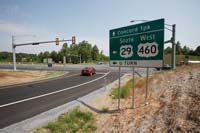
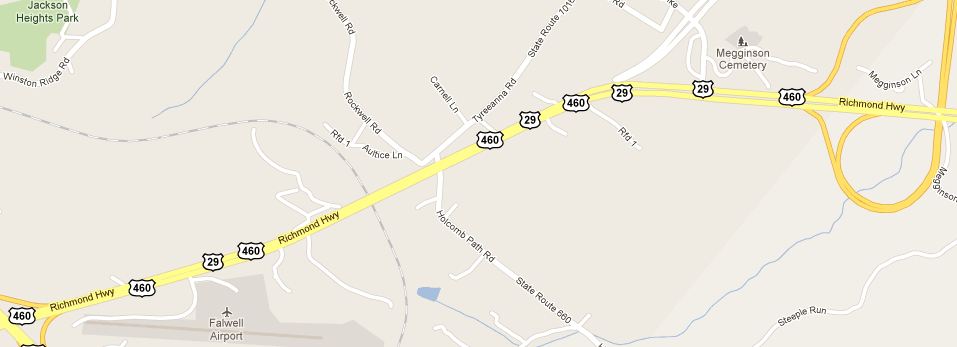
The Virginia Department of Transportation created a problem when it built the U.S. 29 Bypass around Lynchburg, merging it with U.S. 460 for about 10 miles southeast of the city. While most of the shared roadway was limited access, allowing cars and trucks to move freely, a 1.7-mile section near Falwell Airport was used heavily by local traffic.
Vehicles traveling at highway speeds do not mix well with vehicles pulling out of restaurants, driveways and industrial access roads. In the 18 months before the bypass completion, the crash rate on that stretch of road was 16 per one million vehicle miles driven (VMD). In the 18 months following, the crash rate surged to 102 – more than six times higher.
Clearly, something had to be done. Upgrading that 1.7-mile stretch to a full limited access highway with exit ramps would have cost between $50 million and $55 million, says Rob Cary, VDOT’s Lynchburg district administrator. That seemed like a lot of money. Instead, VDOT adopted a strategy of pruning local access points to the highway. Since the completion two months ago of Phase 1 at a cost of $1.5 million, the number of crashes has been… zero. That safety streak won’t last forever, but a second phase costing $11.7 million should make the road even safer. Says Cary: “We get a lot of the benefit for one-third the cost.”
(Click on map for more legible image.)
Access management is not a novel concept, but its application to Virginia roads is relatively new. Only in 2007 did the General Assembly direct VDOT to develop access-management regulations and standards with the goal to reduce traffic congestion, enhance public safety and reduce the need for new highways. The rules cover such aspects of design as the location and spacing of entrances, intersections, median openings and traffic signals. Since 2007, principles of access management have started turning up in VDOT documents such as the U.S. 29 Corridor of Statewide Significance (CoSS) plan.
U.S. 29, known as the Lee Highway in Virginia, stretches 1,000 miles from Pensacola, Fla., to Baltimore. Like other highways across the United States, U.S. 29 attracted commercial and residential development in the metropolitan regions it served as land owners exploited their proximity to a major transportation artery. But each new gas station, fast food outlet, shopping center and cul de sac neighborhood required an access point and an increasing share of the traffic became purely local. With traffic came signaling lights. As ever more vehicles halted at stoplights and pulled into the highway from driveways and store entrances, travel speeds decayed and congestion worsened.
The traditional response to highway congestion in Virginia was the bypass. When highway traffic bogged down on U.S. 29 in Danville, Lynchburg, Charlottesville, Culpeper and Warrenton, VDOT simply ran a new, limited access highway around the congestion. When the bypass got gummed up like the original highway, VDOT build another bypass. Warrenton has two, and Charlottesville is about to get a second one.
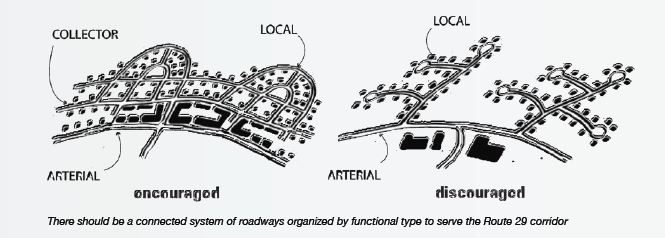
The Rt. 29 Corridor Plan fleshes out the new way of thinking in considerable detail. The vision for the corridor is one that allows access to the highway only at “designated and appropriately spaced locations.” VDOT and local governments along the route can clean up the accumulated detritus through a number of techniques, such as:
• Changing zoning to shift growth pressures away from properties immediately adjacent to Route 29.
• Putting land along the highway into conservation easements.
• Having VDOT purchase access rights-of-way.
• Developing parallel road systems to take local traffic off the highway.
(Click on graphic for more legible image.)
• Employing novel roadway designs such as roundabout crossovers and bowtie U-Turn configurations.
• Requiring plans for any new traffic signal to have an “exit strategy” for removing the signal at some point in the future. Read more.
Here comes another study describing America as “separate and unequal.” White university professors can’t imagine minorities not wanting to live in the same neighborhood as people like themselves.
by James A. Bacon
One of the ways progressives keep the flames of resentment among racial minorities burning white hot is to highlight purported discrimination in every aspect of American society. They don’t have to actually present concrete evidence that discrimination exists, they just conjure up a statistical disparity and label it a social injustice.
With only one exception (the most affluent Asians), minorities at every income level live in poorer neighborhoods than do whites with comparable incomes. Disparities are greatest for the lowest income minorities, and they are much sharper for blacks and Hispanics than for Asians. Affluent blacks and Hispanics live in poorer neighborhoods than whites with working class incomes. There is considerable variation in these patterns across metropolitan regions. But in the 50 metros with the largest black populations, there [are] only two metros where affluent blacks live in neighborhoods that are less poor than those of the average white.
Those, presumably, are the facts. I accept them at face value. What I do not accept is the conclusion drawn from those facts. Going on to argue that poorer neighborhoods tend to have fewer and less desirable amenities than wealthier neighborhoods, Logan implies that the affluent minorities who live in poor neighborhoods are thereby worse off. He obliquely invokes malign influences to explain the disparity (my emphasis):
The low incomes of blacks are not the main source of either residential segregation or disparities in the resources of the neighborhoods where they live. A central new finding is that blacks’ neighborhoods are separate and unequal not because blacks cannot afford homes in better neighborhoods, but because even when they achieve higher incomes they are unable to translate these into residential mobility.
Here’s the worst weasel phrase: “Unable to translate these [higher incomes] into residential mobility.” Logan doesn’t come right out and say that blacks are victims of racial discrimination but he implies it. What other explanation could there be? To twist a turn of phrase from Saturday Night Live’s church lady, “Could it be…. Racism?”
What Logan fails to consider is the possibility that some affluent blacks and Hispanics might choose to live in the neighborhoods they live in, despite the prevalence of poor people. Is it possible that African-Americans prefer to live in their old neighborhoods because — horrors! — they prefer the African-American cultural traits of their neighbors over the cultural traits of white people? Could African-Americans prefer to attend predominantly African-American churches? Could they prefer to patronize restaurants with that serve soul food, hair stylists who specialize in braiding African-American hair and shops that cater to African-American tastes in clothing? Is it conceivable that African-Americans prefer to live near family and friends rather than move to white neighborhoods where they don’t know anyone? In sum, is it possible that racial segregation in American today is — shudder! — overwhelmingly voluntary?
Let’s apply Dr. Logan’s logic to his own institution of higher learning at Brown, an Ivy League university that recruits students nationally. Blacks constitute only 5.8% of Brown’s student body, according to Black Enterprise magazine, even though blacks account for 12.6% of the U.S. population. Clearly, blacks are under-represented at Brown. By Logan’s logic, Brown is a prime example of the “separate and unequal” status of blacks in higher education. The “disparity” must reflect the “inability” to blacks to break into the bastions of progressive white privilege!
Alternatively, let’s play a mental exercise. Let’s imagine that Logan’s results had shown that affluent blacks had moved into affluent white neighborhoods instead of staying in the ‘hood. Would he have stressed the geographic mobility of blacks in American society? Or would he have focused on the fact that the out-migration of affluent blacks rendered poor black neighborhoods even more isolated and poorer than ever, thus highlighting their continued segregation and lack of opportunity? Just a hunch, but I’m betting he would have gone with the interpretation that stresses blacks’ victimhood. It’s what I call the “damned-if-you-do, damned-if-you-don’t” school of thought that predictably extracts from any body of evidence the data that supports the grand narrative of social injustice over data that might undermine it.
If social injustice did not exist, the progressive world view would have to invent it. That’s why you can never take studies like this one at face value.
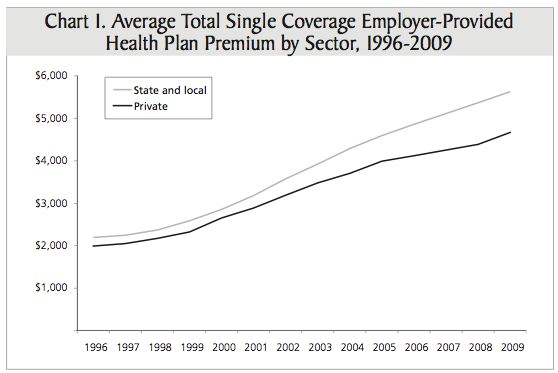
Pension costs aren’t the only public-sector employee benefits that are out of control. A new report by Josh Barro with the Manhattan Institute, “Cadillac Coverage: The High Cost of Public Employee Health Benefits,” contends that public-sector health care costs are outpacing private-sector costs increases, too. This chart tells the story:
The obvious question is, “Why?” Barro gives four reasons: “(1) Public employees contribute only 15% of the cost of their premiums, versus 25% for private-sector employees; (2) public-employee plans offer more generous benefits, including lower co-pays and deductibles; (3) governments require shorter enrollment waiting periods for new employees; and (4) public employees opt in for employer-provided coverage at a higher rate: 84% versus 74% for the private sector.”
Unfortunately, Barro’s report does not provide a state-by-state breakdown, so we can’t see if the national pattern holds true in Virginia. But the report does highlight one area in which the McDonnell administration might find more cost savings in the state budget. Is anyone looking into this? If so, please let me know.
Varied State Oversight for Health Insurance Rates Government Accountability Office
Some states are more aggressive than others in intervening in health care insurance markets. It would be nice to know how Virginia compares but Old Dominion data was not available for this GAO study.
“Small Start” Grant Regs Less Burdensome Government Accountability Office
SAFETEA-LU legislation streamlined regulations for small mass-transit grants. This GAO study found that regulations are, indeed, less burdensome.
Tribal Youth in the Criminal Justice System Urban Institute
Due to a lack of rehabilitative resources and tribal capacity to prosecute, half of all juveniles in the federal criminal justice system are American Indians.
More specifically, the Texas congressman and GOP presidential hopeful has introduced legislation that would cancel the $1.6 trillion in Treasury debt held by the Federal Reserve:
Paul has argued for the last few weeks that the idea represents a quick way to make the growing fiscal crisis more manageable. Under his bill, H.R. 2768, the $1.6 trillion that the Treasury owes to the Federal Reserve would disappear.
The Federal Reserve began buying Treasury bonds in earnest late last year as part of its effort to keep long-term interest rates down. But Paul has argued that Fed purchases of Treasury debt represent a debt that the government owes to itself, and one that also leads to an unwanted and inflationary increase in the money supply.
Paul has also said the Fed is allowing the federal government to continue a spending binge it otherwise would not be able to afford, and is forcing the Fed to print money to keep up.
The Fed carries Treasury notes on its books as assets that it could turn around and sell at some future point. How the bond market would react to such a move isn’t clear to me — one could argue that cancelling debt like this could be read as making the U.S. government an enormous credit risk. That would give the bond vigilantes a fat target (and hold on to your shorts if they get started…they may be all you have left once the posse has left town). And as for our overseas lenders…well. They wouldn’t take such a move lightly, would they?
There’s a degree of logic to Paul’s move in that what the Federal Reserve has been doing is monetizing the nation’s debt, which is just another word for default. Cancelling the debt, then, would be like ripping the bandage off a wound: it’ll hurt like hell, but airing-out that wound will help it heal. But how well a patient can heal when reduced to a diet of gruel and sand is unclear…
And while we’re considering cancelling debts the government owes to itself, how about those IOUs in the Social Security Trust Fund? During the depths of the debt ceiling tussle, the President as much as admitted that the Trust Fund is neither trustworthy nor funded. Using Dr. Paul’s formula, cancelling that debt might also force the government to end the Ponzi scheme (so long as we first pass legislation requiring all seniors, and not a few bankers, foreign and domestic, to be disarmed or, better yet, jailed).
The possibilities are as endless as the consequences.
Which is why this bill isn’t likely to go anywhere, except into a list of Paul talking points and campaign brochures.
In early October, Virginia’s tea party movement was on a roll. Hundreds of supporters crowded the Greater Richmond Convention Center for what was grandly called a “Patriots Convention.” Hallways and auditoriums were chockablock with budget hawks, Patrick Henry re-enactors, booksellers hawking Ayn Rand and middle-aged men packing .45-caliber Colt pistols in Velcro holsters with stickers that said “Guns Save Lives.”
Basking in the glow of the grass-roots protest movement against big government and taxes, Jamie Radtke, a 30-something former Republican political operative, was emerging as a bright new star. She’d pulled together about 300 volunteers and as many as 8,000 sympathizers for the movement. Their clout was felt the following month when Republicans took the House of Representatives in a stunning defeat for President Barack Obama and his Democrats, forcing such congressmen as liberal Tom Perriello out of office.
Fast forward to today. For weeks, the nation has been on a dangerous roller- coaster ride while the GOP-dominated House of Representatives has stubbornly refused to approve raising federal debt limits unless a budget with huge spending cuts goes with it. A breakthrough agreement on raising the federal debt limit appeared imminent Aug. 1 that would cut $2.4 trillion in spending with no tax increases. But the damage has been done in terms of diminishing America’s reputation abroad. China’s Xinhua news agency trashed the United States for “dangerously irresponsible conduct” that could tank not only its economy but also that of the rest of the world.
So how did we get to the precipice? The major reason is the tea party, which seems to have surfaced the day Obama was inaugurated. Eight years of George W. Bush’s blowout spending were forgotten. Jobs to help pull the country out of the worst recession were painted as evil. Government workers became lazy freeloaders. Washington was the focus of everything wrong. Freshmen Republican congressmen elected with tea party backing in 2010 did whatever they could to marginalize Obama and hold the nation’s finances hostage while they pursued their stubborn dogma.
Radtke, who’s running against former Gov. George Allen for the Republican nomination for U.S. Senate in 2012, is partly responsible for the tragedy of the past few weeks although she’s not in office, at least not yet. Like the rest of her gang, she was most willing to trash any chance at compromise. In the words of Washington Post columnist Kathleen Parker, Tea party members like her stood ready to “frag” responsible leaders in her own party just to appear tough.
It’s not the only time Radtke has shown her political immaturity. She made noise over the Metropolitan Washington Airports Authority, which oversees Dulles and Reagan National airports, as well as the expansion of the Metro rail line to Dulles. The authority has come under fire from conservatives because former Democratic Gov. Tim Kaine gave it power over the Dulles rail extension and the Dulles toll road that helps pay for it. Kaine also was blamed because the authority wants to allow labor rules to prevail for rail construction, as they do in most big U.S. cities.
Radtke’s solution was unworkable: to abolish the authority and turn jurisdiction for the Dulles rail line and the airports over to Virginia. Fat chance there. Some of her other positions are also questionable. She opposes Gov. Robert F. McDonnell’s plans to spend $4 billion on the state’s well-worn roads and bridges and opposed having business pay insurance for families with autistic children.
Meanwhile, the no-spending mantra that she espouses presents dangers of a more immediate type. Thanks to House Republicans under the influence of the tea party, funding hasn’t been provided to the Federal Aviation Administration. Some 4,000 furloughs have resulted and plans to upgrade the nation’s overworked air-traffic-control system with badly needed upgrades have been suspended. If your jetliner collides, you may know who to blame. Closer to home, McDonnell was shocked to learn that Virginia could lose its AAA credit rating if there was no deal on the debt ceiling because the state has so many federal workers — a dependence that may be news to Radtke.
In fact, more average voters are catching on to the fatuousness of the tea party. A new Public Policy Poll reports that of 500 Virginians asked this month, 79 percent didn’t have an opinion on Radtke and 16 percent didn’t like her. Only 5 percent supported her. If the upcoming Senate race were between Kaine and Radtke, Kaine would easily win. It would still be pretty much a toss- up if Kaine’s opponent were Allen. Congress is coming off far worse in polls with 77 percent of Americans polled saying they behaved like spoiled children in the run up to the debt deal.
The upshot seems to be that for all of Radtke’s promise at political organizing, Radtke just isn’t ready for prime time. Washington needs mature, thoughtful leaders — not kids on an ego trip. The global stakes are just too high for a bunch of people running around packing heat and playing Patrick Henry.
The great debt deal, which will save the Republic from… something… increasingly resembles a sad joke. Your morning chart, courtesy of Tad DeHaven, offers a sobering look at what the political class and its pilot fish consider a win on spending:
Somewhere, Pyrrhus of Epirus is smiling.
Now here’s another chart to ponder: It plots the price of gold versus hikes in the federal debt ceiling limit since 1994:
There are any number of reasons why gold has risen over the last 17 years — wars, uncertainty, demand, etc. The barbaric relic’s rise, though, does seem to fit neatly with the debt ceiling’s rise. Notice the long, flat period during the late 1990s for both gold and the debt? Those were the salad days, when the feds were running near or in the black. Not surprisingly, those were also the days of divided government, hyper-partisanship and the Clinton impeachment. And a tech bubble.
Oh Pets.com, how could you have gone so wrong?
It all falls apart during the Bush years, particularly in his second term, and becomes almost parabolic during the Obama years… which also coincide with the fed’s furious currency debasement.
Is it all a coincidence? Possibly. But this is the sort of chart that should make you wonder just how long the era of fiat currencies will last. Coupled with the first graph, it makes me wonder if that moment has already arrived.
I hate it when my pet theories don’t work out. But in the cause of evidence-based punditry, I re-evaluate my thinking in light of the latest information available. The latest data compelling an attitude adjustment on my part is a report from the state Bureau of Insurance detailing the pitiful market performance of “mandate-lite” insurance policies.
In 2009 the General Assembly passed legislation allowing insurance companies in Virginia to sell “basic health insurance coverage” to small employers in Virginia. The hope was that exempting these insurance plans from most of Virginia’s mandated health benefits would make medical insurance coverage more affordable and accessible — an idea that I have endorsed for a long time. Displaying extraordinary foresight for a government body, the Assembly asked the Bureau of Insurance to report back on how the idea was working.
Well, the results aren’t anything to write home about. In fact, they’re pitiful. In the report just released, the Bureau of Insurance surveyed 33 insurance carriers offering coverage in the small employer market. Of those, only four had approved mandate-lite plans. As of March 2001, only one insurer had actually sold a mandate-lite plan, and that was to a mere three groups covering 10 employees. That carrier ended sales on July 1, 2011. A second carrier, having sold not a single plan, said that it will stop marketing them as well.
In other words, “mandates lite” has been a total bust.
Some readers of this blog will chortle with satisfaction at the idea that this timid step toward a more free-market approach in health insurance is such an obvious failure. This is proof, they will likely argue, that more government intervention in the insurance marketplace is the solution. They may be proven right, but it’s too early to jump to conclusions.
The passage last year of the Patient Protection and Affordable Care Act, otherwise known as Obamacare, likely undercut the market for the insurance policies. As the Bureau of Insurance report concludes, “The potential conflict between federal legislation and subsequent regulations with current state legislation is a deterrent to the development of mandate-lite plans at this time.”
The federal law requires the states to set up health insurance exchanges by 2013 to provide coverage for those who can’t get it from their employer. The legislation requires “essential benefits” that include hospitalization, ambulatory care, emergency services, maternity and newborn care, mental health and substance-abuse, prescription drugs, rehab, laboratory services, preventive and chronic-disease-management, and pediatric services including oral and vision care.
In 2013, in other words, federal insurance requirements will trump state law, putting the “mandate lite” insurance products out of business. I would conjecture that Virginia insurance carriers concluded that there is no point in investing resources into developing the “mandate lite” market knowing that it is scheduled for extinction. What we don’t know is why the preliminary experience was so disappointing. Was it due to a lack of demand… or a reluctance of insurance carriers, seeing Obamacare coming down the line, to invest meaningful resources? It’s too bad the Bureau of Insurance report didn’t address that question.
Here’s one thing we do know: Obamacare has extinguished any competing vision in Virginia for how health insurance should operate. Marketplace experimentation will cease. Lawmakers, regulators and the special interests who influence them will make the decisions for us.
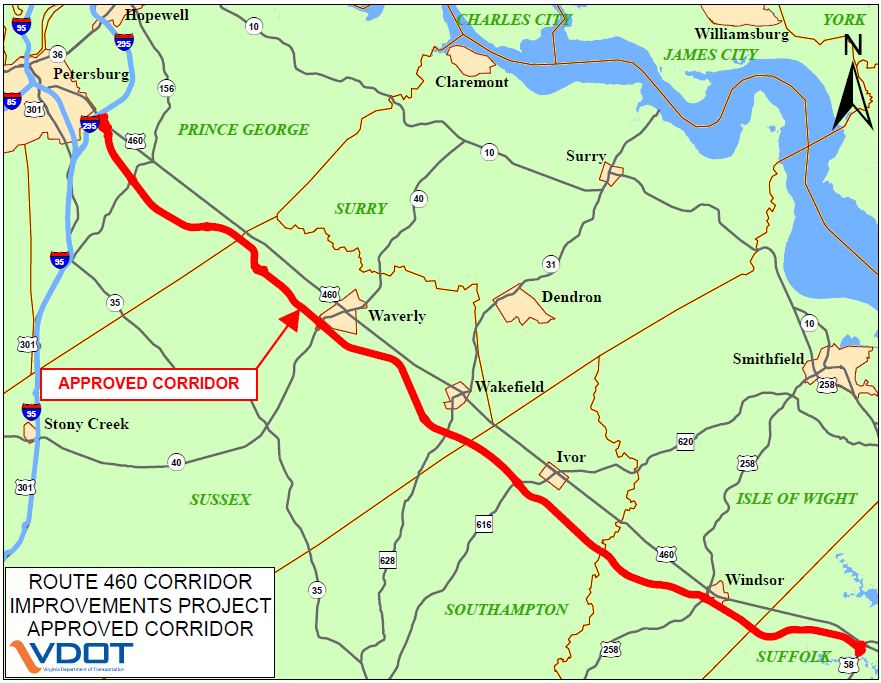
The McDonnell administration is putting the Route 460 project on fast forward. The state has dedicated up to $500 million to support a public-private partnership to rebuild the four-lane road to interstate quality between Suffolk and Petersburg, a job that could run between $1.44 billion to $1.8 billion, reports the Virginian-Pilot.
Meanwhile, the Virginia Department of Transportation has issued a request for detailed proposals from Cintra Infraestructuras S.A.U., 460 Partners, Inc. and Multimodal Solutions LLC, the two firms that have presented conceptual proposals. The project entails the design and construction of 55 miles of new tolled roadway south of the existing Route 460 with seven interchanges to project access to communities along the corridor. (Click on map for more legible image.)
The project will be financed through a combination of public subsidy, private investment and user fees.
“This project is a top priority of the Commonwealth and will provide substantial benefits related to emergency evacuations and enhance the movement of freight to and from the ports,” said VDOT Commissioner Greg Whirley in making the announcement. “Additionally, the new Route 460 will provide greater connectivity between the Richmond/Petersburg and Hampton Roads regions increasing economic development opportunities and job creation.”
I don’t want to pre-judge the value of this project. My only comment at this point is that this massive public investment requires much closer public scrutiny than it has received so far.
The year: 2075. The American colonies on the Moon are getting restless under Washington’s tyrannical rule….
This second edition of “Dust Mites” has a snazzy new cover, includes helpful lunar maps, and is 5,000 words tighter than the original. The sequel, “Trogs,” is scheduled for publication this summer.
Advertisement
Advertisement
Advertisement
Advertisement
About
Bacon’s Rebellion is Virginia’s leading politically non-aligned portal for news, opinions and analysis about state, regional and local public policy. Read more about us here.
Fund the Rebellion
Shake up the status quo! Your contributions will be used to pay for faster download speeds and grow readership. Make a one-time donation by credit card or contribute a small sum monthly.
Can’t wait until tomorrow
For your Bacon’s Rebellion fix?
Enter your email address to receive immediate notifications of new posts by email.
SUBSCRIBE
Search Bacon’s Rebellion
Categories
Archives
The Jefferson Council
Protecting Thomas Jefferson’s Legacy at the University of Virginia
Forgot Your Password?
Shoot me an email and I’ll generate a new password for you.





 In early October, Virginia’s tea party movement was on a roll. Hundreds of supporters crowded the Greater Richmond Convention Center for what was grandly called a “Patriots Convention.” Hallways and auditoriums were chockablock with budget hawks, Patrick Henry re-enactors, booksellers hawking Ayn Rand and middle-aged men packing .45-caliber Colt pistols in Velcro holsters with stickers that said “Guns Save Lives.”