• Good Intentions Bring Terrible Results

    What’s holding back black Americans? Government, not discrimination
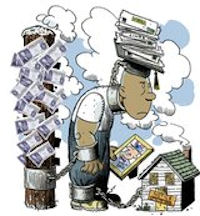
    Image credit: Washington Times

    by James A. Bacon

    After nearly a half-century of government-led exertion to lift black Americans out of poverty, how are they faring? New data and research tell the story. According to census data, 26 percent of blacks, compared with 10 percent of whites, lived in poverty in 2009. The unemployment rate for blacks is 16.7 percent, more than twice the rate for whites. And a study by the Pew Charitable Trusts Economic Mobility Project finds that black men in the middle class are 37 percent more likely than white men to tumble down into the bottom 30 percent of income earners.

    A recent study by the Economic Policy Institute concludes that wealth destruction suffered by Americans during the Great Recession hurt blacks more than others. According to โ€œThe State of Working Americaโ€™s Wealth,โ€ the median net worth of black households slid to $2,200, compared with the median net worth of whites at $97,900. Forty percent of black households had zero or negative net worth.

    Liberals, race hustlers and others committed to the idea that America is an unjust society in need of remediation have a ready explanation: Blacks continue to suffer discrimination. Racism may be more subtle than when Bull Connor unleashed the dogs upon civil rights marchers, they say, but it is still pervasive and damaging. Yet that narrative is getting harder and harder to maintain. Indeed, it is dawning upon many that blacks remain mired in poverty precisely because their political leaders have looked to government for salvation. And government – far from rescuing blacks from poverty – has kept them trapped in it.

    Uncle Sam still transfers hundreds of billions of dollars yearly to the poor and downtrodden in the form of Medicaid, the Childrenโ€™s Health Insurance program, nutritional assistance (food stamps), Temporary Assistance for Needy Families, the Earned Income Tax Credit, fuel assistance and a host of narrow-bore programs aimed at ameliorating the hardships of poverty. Social scientists have long warned of the corrosive effect of welfare upon black Americansโ€™ family structure, self-reliance and initiative.

    If thatโ€™s where government โ€œhelpโ€ ended, the condition of blacks today might not be as dire. But one reason blacks suffered such devastating financial losses in recent years is that much of their net worth was tied up in real estate. When the housing market imploded and equity values collapsed, much of their net worth evaporated. While people of all races experienced equity losses, black homeowners suffered more than others. A 2010 study by the Center for Responsible Lending found that among recent borrowers, 8 percent of blacks and Hispanics, compared with 4.5 percent of whites, had lost their homes to foreclosures. (Of course, the foreclosure crisis is far from over – those percentages have climbed higher since.)

    While the causes of the housing bubble are complex – low interest rates, financial innovations on Wall Street and a general decline in lending standards fed the frenzy – government policy played a supporting role. Under a bipartisan banner of promoting homeownership, government agencies encouraged subprime lending to households that had no business having mortgages. Then, after the crash, Obama administration policy prolonged the financial agonies of homeowners facing foreclosure through a mortgage-modification program that spared some homeowners but caused others to deplete their savings by making payments they couldnโ€™t afford.

    The latest canard is the notion that everyone should be entitled to a college education. President Obama has ramped up loans and grants for college students to unprecedented levels. Unfortunately, no one seems to be checking how many are graduating. Many Americans, including blacks in disproportionate numbers, are not academically prepared for college and never make it through. The result is a silent college dropout crisis. States a recent study from the American Institutes for Research: โ€œMuch of the cost of dropping out is borne by individual students, who may have accumulated large debts in their unsuccessful pursuit of a career.โ€

    In tacit acknowledgment that there is a big problem, the Obama administration is targeting for-profit colleges, where tuition costs and defaults tend to run higher, for criticism. But the underlying premise, that government should help pay for anyone to get a college education, is as flawed as the premise that everyone should own a house. The result of good intentions gone awry is a generation of college dropouts living in modern-day indentured servitude.

    The do-gooders have all the best of intentions, of course. They just donโ€™t pay attention to results. In the name of compassion, they keep blacks hooked on initiative-sapping welfare dependency. In the name of building the American dream, they promote home ownership for people who lack the financial wherewithal to keep up payments. In the name of equal opportunity, they dispense college loans to people who will never graduate. Lord, deliver us from those who would save us.

    This column was published originally in the Washington Times.


  • Kaine leaps into the Ponzi Pool

    By Norm Leahy

    I don’t begrudge Democratic Senate candidate Tim Kaine’s desire to stir-up the base with this meeting, or forum, if you prefer, on Social Security. It is amusing, though, to read the quote Wes Hester pulled from the Kaine campaign’s press release announcing the event:

    A release from Kaineโ€™s campaign announcing the Tuesday morning said that Perry โ€œwill no doubt promote the extreme Republican agenda which labels Social Security a โ€˜Ponziโ€™ scheme and seeks to privatize it.โ€

    Damn those extreme Republicans and their wicked attempts to denigrate the most successful of entitlement programs…it puts them in the same league as that equally nefarious Paul Krugman:

    โ€œIn practice it has turned out to be strongly redistributionist, but only because of its Ponzi game aspect, in which each generation takes more out than it put in. Well, the Ponzi game will soon be over, thanks to changing demographics, so that the typical recipient henceforth will get only about as much as he or she put in.โ€

    One can only imagine what Mr. Kaine will have to say about that…

    (H/T: Don Boudreaux)


  • Norm and Jim on the Score

    Scott Lee with the Score Radio Network interviews Chris Horner with the American Tradition Institute about ATI’s Freedom of Information Act battle with the University of Virginia, Norm Leahy about Eric Cantor’s federal disaster kerfuffle and yours truly about President Obama’s government-centric jobs program. Click here to access the radio clips.

    — Jim Bacon


  • Common Sense or Delaying Tactic?

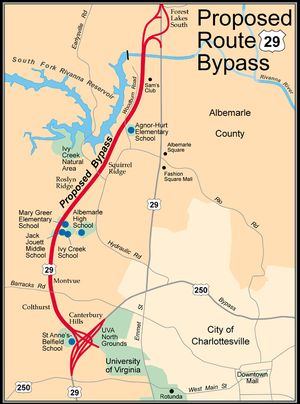
    Map credit: Charlottesville Tomorrow

    Opponents of the Charlottesville Bypass are calling for an update to the project’s 18-year-old environmental impact analysis.

    by James A. Bacon

    How old does a traffic impact analysis for a major highway project have to be before it gets so old that you should throw it out and start over?

    To be more specific, if the traffic analysis contained in the Environmental Impact Statement (EIS) for the Charlottesville Bypass is 18 years old and the supplemental EIS is eight years old,ย should the Virginia Department of Transportationย conduct an updateย before buildingย the controversial, $244 million project?

    Ann H. Mallek and Dennis Rooker, members of the Albemarle County Board of Supervisors think so. And they have submitted a resolution, to be considered Wednesday, for the board to formally request VDOT to update traffic modeling for the bypass and consider new scientific research documenting the effects of highway pollutants on children in nearby schools before awarding a contract.

    The Commonwealth Transportation Board has approved $197 million funding for the project — on top of tens of millions of dollars already spent on right-of-way acquisition and engineering — and is moving expeditiously to get the project underway. However, foes of the project, who insist that the money could be better spent on alternate projects in the U.S. 29 corridor,ย  say that the project “is not a done deal.” (See “Battle over C-ville Bypass Moves to Next Phase.“)

    “Among other items, the traffic modeling, the traffic estimates, the air quality analyses and the noise analyses in the environmental impact statements are now outdated and additional analysis needs to be done,” states the resolution. “There is significant new information that has been developed since the environmental impact statements were prepared, including new scientific research documenting the detrimental effects of highway pollutants on the health of individuals, and children, especially.”

    “There has been tremendous growth around the northern terminus of the Bypass,” says Rooker. The largest residential development in the county, Hollymead, was not fully built out at the time. Hollymead Town Center, one of the county’s biggest shopping centers did not exist. Either did major employment centers such as the National Ground Intelligence Center and the University of Virginia Research Park. Also, although the U.S. 29 corridor was zoned for development in the early 1990s, he says, much of it has been rezoned.

    “You’ve got thousands of people living there that weren’t there,” says Rooker. “You’ve got more vehicles in and around that area now.” Travelers through Charlottesville will encounter miles of stoplights and congestion north of the Bypass, making the project obsolete the day it opens.

    Furthermore, new scientific research has documented the detrimental effect of highway pollutants on the health of children. That point was made repeatedly during public hearings by citizens concerned that the Bypass would run very close to six different schools. “Several states have outlawed the building of highways within 1,000 feet of schools,” Rooker notes.

    The resolution is sure to inspire opposition from supporters of the Charlottesville Bypass, who argue that after nearly two decades of obstruction it’s time to start construction. Neil Williamson, president of the Free Enterprise Forum, sees no point in studying the traffic impact again. What’s it going to change, he asks? A new count showing more commuters than projected two decades ago will provide all the more justification for the bypass.

    “It’s not a huge leap of faith to think that traffic has increased,” he says. Thousands of commuters living north of the Bypass terminus and commuting to the University of Virginia or other Charlottesville destinations will gladly take the bypass to circumvent part of the congestion.

    As for the impact of automobile emissions on child health, Williamson says, the EPA website says that findings should not be used at this time in determining road-siting decisions.


  • The Wonk Salon, September 12, 2011

    How Hospitals Cross-Subsidize Medical Services
    National Bureau of Economic Research
    When hospitals face competition in their profitable medical services, surprise, surprise, profits erode and they respond by curtailing subsidizes of less profitable medical service lines.

    Why Emergency Rooms Are Closing
    Rand Corporation
    Between 1990 and 2009, the number of emergency rooms in the United States declined by 27 percent (from 2,446 to 1,779). Why? This fact sheet doesn’t make it clear but it apparently has something to do with… losing too much money!

    Inadequate Education Hurting Employment in U.S. Metro Areas
    Brookings Institution
    One factor holding back the recovery of employment in some metropolitan regions is a mismatch between the supply of, and demand for, educated labor. Brookings’ solution: More investment, guided by wise liberal elites, into sectors like manufacturing and the “green” economy.


  • Xu Bing’s Tobacco Show

    By Peter Galuszka

    The history of Virginia is intertwined very tightly with that of tobacco.

    The Golden Leaf boosted the two colonies from their earliest days. One of the first acts of the new colonial legislature in the Old Dominion was establishing price supports for tobacco, which was used a currency and was the state’s most important export product. The first machine to roll cigarettes was invented in Richmond, creating an entirely new industry.ย One of the last remaining major cigarette factories is in the capital

    With this history in mind, and if you looking for something to do on a weekend, you might consider driving down to Richmond to see the new “Xu Bing: Tobacco Project” exhibit at the newly renovated Virginia Museum of Fine Art.

    Begun in 2000 when Chinese-born Xu Bing was artist in residence at Duke University, the tobacco project mixes cigarettes, advertising, brand names old books, pay checks and other memorabilia into a highly unusual exhibition exploring the relationship between humans and tobacco.

    One work involves 440,000 cigarettes fashioned into the form a 40-foot-long floor rug shaped like a tiger. A wall is covered with old tobacco advertisements. Another curiosity is a 50-foot-long reproduction of a Zhang Zeduan painting from the 10th century, “Along the River During the Qingming Festival,” that has an extra-long cigarette burned down its center.

    Xu Bing plays with the ironies of tobacco’s deadly nature and its attractiveness to people. Tobacco kills about 400,000 Americans every year and may kill billion globally in this century, according to the World Health Organization. Xu Bing’s father died of tobacco-related lung cancer.

    I asked Xu Bing, who won a MacArthur Foundation “genius” grant in 1999 and who moved to the U.S. in 1990, about this contradiction at a reception this morning. “My show isn’t about propaganda,” he says, “it is about the relationship between tobacco and human beings. It is sort of like love and its effect on people. It is awkward.”

    Curiously, after I first posted this blog item, I saw that the Wall Street Journal had run a similar story on Xu Bing with one important difference. The Journal noted that the artist had gone to Altria, the operator of a huge Philip Morris plant in Richmond, to ask for hundreds of thousands of cigarettes. But Altria, a major donor to the VMFA as it is to many Richmond entities, turned him down. So Xu Bing had to try another route.

    Last Friday, I had asked a VMFA spokeswoman where Xu Bing had found so many cigarettes and she said that the VMFA had helped locate and pay for them. She did not bring up Altria’s role, most likely because of their funding relationship with the museum. I asked her about it today and she said she wouldn’t have volunteered the information because Altria was not involved in this particular exhibit.

    I guess I can understand that, but it does raise many questions, once again, about the tobacco giant’s impact on its new corporate headquarters home of Richmond. Years ago, the American Tobacco Company was such a moneybags that the Medical College of Virginia acted as its chief researcher and promoter. One science historian writing about tobacco research labeled his chapter on the cozy relationship “Sold, American!”

    Later, Virginia Commonwealth University got skewered by entering into secretive research contracts with Philip Morris requiring that the cigarette maker be notified immediately if anyone, especially a news reporter, asked aboutย them. VCU later decided not to get into such contracts again.

    And now, we’re finding tobacco’s stained hands on art in Richmond. It’s really too bad because the Great Recession has killed off several firms that were major benefactors in the city, leaving basically, Altria, Dominion and MeadWestvaco.

    The good news is that Altria’s refusal did not prevent Xu Bing’s show from taking place. It is a good thing that VMFA found another way.ย Given tobacco’s impact on the region’s history, his show, which is free, is worth a look.


  • The Wonk Salon, September 11, 2011

    Free Market Telecom Works in Texas
    Texas Public Policy Foundation
    Texas has deregulated local telephone service and promoted competition in video. Since 2001, the number of broadband subscribers has grown more than 1,015%.

    The Unproven Case for Missouri Aerotropolis
    Show-Me Institute
    Missouri legislation would subsidize the air cargo industry at the St. Louis airport to the tune of $360 million under the guise of creating a globally competitive “aerotropolis.” But if the economic value is there, why doesn’t the private sector make the investment itself?

    The Digital Teacher Corps
    Progressive Policy Institute
    Nothing else seems to be working. Let’s create a Digital Teacher Corps to unleash the untapped power of digital media to boost literacy among our most vulnerable children.

    Oregon’s Adverse Selection Problem
    Oregon Center for Public Policy
    Oregon got off to a fast start in creating a health insurance exchangeย called for by Obamacare. Just one problem:ย Insurance plans in the exchange will be more expensive and less attractive to healthy Oregonians, potentially creating an adverse-selection death spiral.


  • Never Forget


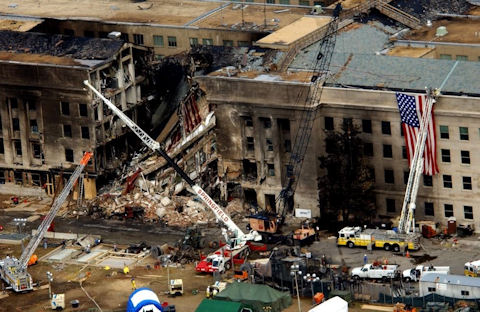
    Oh, yes, 9/11 happened here in Virginia, too. We’ll never forget.


  • Uh, Oh, MWAA Bonds Downgraded

    by James A. Bacon

    As if the Metropolitan Washington Airports Authority didn’t have enough problems with the Rail-to-Dulles project, the Fitch rating service has just downgraded its bonds to AA-. Reports Reuters: “The downgrade reflects Fitch’s view that the authority will maintain a stable yet narrower level of debt service coverage cushion when compared to both its historical performance and previous forecast estimates.”

    The airport still has great strengths, including the strong competitive position of Dulles and National airports in the Washington metropolitan market, well-managed financial operations, a firm airline use-and-lease agreement and traffic volume that has held up well since the recession.

    However, stated Fitch, “The authority’s ongoing use of borrowings in recent years to fund a majority portion of its Capital Construction Program (CCP) has resulted in an elevated debt burden profile and will require increased reliance on airline charges to meet total airport cash flow requirements. In Fitch’s opinion, the rising debt burden places an added measure of risk to the authority’s financial profile given the downward revisions in forecasted traffic growth, especially when compared to earlier projections in prior years. In Fitch’s view, the forecasted financial metrics would no longer be consistent with ‘AA’ rating pursuant to Fitch’s criteria for airports.”

    Fortunately, the authority has nearly completed its $5.1 billion 2001-2016 capital construction. Major projects left within the CCP at Reagan include runway overlay and rehabilitation and in-line baggage screening systems. At Dulles, the remaining projects include an in-line baggage screening system and taxiway Y reconstruction.

    The airports are a critical economic driver for Northern Virginia, so any development that makes it more difficult to finance capital improvements comes as bad news. The reduced financial flexibility also may complicate the bond financing of Phase II of the Rail-to-Dulles project. I’ll provide details as I find out more.


  • Ecologists Need Not Apply

    By Peter Galuszka

    Stacking the deck seems to be the modus operandi of the administration of Virginia Gov. Robert F. McDonnell.

    First, he annihilated nearly the entire board of the Virginia Ports Authority.

    And on Friday, he announced his new picks for the Virginia Coal and Energy Commission. It is a very important decision since the commission will have significant influence on whether the General Assembly decides to end a decades’ long ban on uranium mining and go forward with a proposed and highly controversial operation near Chatham in Southside. Plus, commissioners will influence whether Virginia continues with the highly destructive mountaintop removal method of coal mining in which thousands of areas of mountaintops are destroyed to get at thin coal seams. They also will set policy about how the state deals with hydro-fracking to get at deep natural gas reserves. The method could threaten groundwater with toxic chemicals.

    McDonnell has appointed seven people. All are either energy company executives or lobbyists of some sort of large corporations that use coal, nuclear power or natural gas. Not one is from an environmental group. Not one has a scientific background. Let’s run through the list:

    • Barbara Altizer of Jewell Ridge in the far western coalfields is president and executive director of the Eastern Coal Council.
    • Jodi Gidley of Virginia Beach is president of Virginia Natural Gas.
    • Ken Hutcheson, is a top lobbyist at Williams Mullen, one of Richmond’s most powerful advocacy firms.
    • James K. Martin is a senior executive and lobbyist at Dominion Resources in Richmond. He is also a former executive at Peabody Coal. I had a run-in with Martin at the World Affairs Council of Greater Richmond of which is is president and I am a member. Martin refused to tell me anything about corporate contributions for the non-profit group or any information that is publicly available in their tax filings. I wouldn’t count him as an outspoken advocate of transparency.
    • John Matney of Bristol has been in the coal mining industry since the 1970s besides leasing coal reserves in Kentucky is head of a company that has a big golf course community in Georgia.
    • Donald L. Ratliff of Big Stone Gap is a lobbyist for coal-producer Alpha Natural Resources, which just took over troubled Massey Energy in June. Twenty-nine miners died in an underground mine explosion at a Massey mine in West Virginia in April, 2010 and Massey has been accused to ruining the Appalachians with its mountaintop removal surface mining operations.
    • Rhonnie Smith of Lynchburg is a retired executive from nuclear reactor maker Babock & Wilcox, which has fuel facilities in Lynchburg.

    McDonnell did not choose one person from the Sierra Club, National Resources Defense Council, Union of Concerned Scientists or any of the groups that study the impact of fossil fuel on climate change.

    This is entirely predictable of McDonnell, but the impact of his profound one-sidedness could be felt for years.


  • Warren Buffett on Taxing the Rich

    Warren Buffett

    In response to the post composed by Peter the Menshevik, er, mensch, below, I have dusted off and updated an old column that languished unpublished in my files. JAB

    When President Obama justifies raising taxes on โ€œthe richโ€ โ€“ billionaires, millionaires and anyone making more than $250,000 a year โ€“ he cites as a moral authority no less than the second richest man in America. โ€œWarren Buffett doesnโ€™t need another tax cut,โ€ the president said earlier this year. โ€œNot if we have to pay for it by making seniors pay more for Medicare. Or by cutting kids from Head Start. Or by taking away college scholarships that I wouldnโ€™t be here without. โ€ฆ And I believe that most wealthy Americans would agree with me.โ€

    Setting aside the fact that no one is talking about giving Warren Buffett a tax cut โ€“ it is a rhetorical tic of the president to equate not raising taxes with actually cutting them — let us focus a moment upon the idea of Buffett as moral exemplar.

    In an interview with ABC last fall, Buffett said that rich people should pay more in taxes and that Bush-era tax cuts for top earners should be allowed to expire. โ€œI think that people at the high end โ€“ people like myself โ€“ should be paying a lot more in taxes.โ€

    The oracle of Omaha has been sounding the same theme for years. Speaking at a $4,600-a-seat fundraiser for Senator Hillary Clinton in 2007, he famously criticized the U.S. tax system for allowing him to pay a lower tax rate than his secretary. He was taxed 17.7% on the $46 million he made the previous year, he said, while his secretary, who earned $60,000, was taxed at a top rate of 30%. He also took a swipe at Republicans who wanted to reduce the inheritance tax.

    Why Buffett has any more moral authority on the subject than anyone else is beyond me. Jacking up the top tax bracket for households earning $250,000 or more in salary, bonuses, tips, interest and dividends would have zero impact on him. A notorious tightwad, Buffett pockets a nominal salary of $100,000 from his company, Berkshire Hathaway. And he collects no dividend income from the company because Berkshire Hathaway doesnโ€™t pay dividends. I admire him for his parsimony โ€“ itโ€™s refreshing in this era of lavishly compensated CEOs โ€“ and I think he sets a positive example. But letโ€™s be honest here. Reversing the Bush-era tax cuts would raise other peoplesโ€™ taxes, not his.

    The reason Buffett is taxed so little is that he reports his income as capital gains. When he needs a few million dollars in pocket money, he sells some of his Berkshire Hathaway share — a totally discretionary act. According to an op-ed piece he ran in the New York Times last month, he paid $6.9 million last year on a sum that can be calculated to be $39 million. In other words, his taxable income constituted less than 1/1,000th of his $45 billion net worth. By holding onto the overwhelming majority of his Berkshire Hathaway stock, he incurred no taxable obligations he wasn’t willing to pay.

    Buffet does go against his narrow self interest by saying the United States should tax capital gains at a higher rate. In the NYT column, he advocated raising the tax rate (he didn’t say how much), including for dividends and capital gains, on income exceeding $1 million, and an even higher rate for anyone making more than $10 million. If he still supported repealing the Bush tax cuts, he did not say. But President Obama please take note: His $1 million threshold would apply to only 237,000 households — far fewer than the 3.2 million that would be affected by your call to raise taxes on everyone making $250,000ย  ($200,000 for singles) or more.

    If Mr. Obama’s aim is to strike empty poses against the rich, then by all means he should raise the capital gains tax. He just shouldn’t delude himself into thinking he will actually collect more taxes that way. Historically, raising the capital-gains tax rate has not raised the sum of money collected. For most people, the tax is entirely discretionary, just like it is for Mr. Buffett. If Uncle Sam raised the tax from 17% to, say, 35%, a lot of people would balk at paying the higher taxes and never execute taxable transactions.

    While Buffett might not mind forking over tax dollars, some people do. For an extreme example, read the story in today’s Wall Street Journal about William H. Millard. The founder of the ComputerLand retail chain, who has been found living in Grand Cayman, dodged a$100 million tax bill for the past 20 years by means of 50 shell companies, trusts and bank accounts.

    Buffett also supports a higher tax on inherited estates. But that wouldnโ€™t affect him either. Opposing โ€œdynasties of wealth,โ€ he plans to give away 99% of his fortune to philanthropy. Very noble. What he doesnโ€™t oppose is putting his wealth in tax-sheltered foundations that endow social causes that he believes in. Apparently, he thinks he can put those billions of dollars to better use than the government can. I donโ€™t blame him. I’m just not impressed by his moral authority on the subject. If he really believes rich people ought to pay more, maybe he could stroke a check to Uncle Sam and set an example for others to follow. As President Obama might say, he can afford it.

    In the meantime, Mr. Obama might query the sage of of the sagebrush why he would apply the higher taxes only on income over $1 million — four times the level he proposes. And he should stop invoking Buffett’s name in support of a tax policy that he apparently no longer advocates.


  • Thanks, Monsieur Warbucks!

    By Peter Galuszka

    Sometimes there are enlightened people out there.

    This is point to shake up the Baconauts and Boomergeddons, but the New York Times has an editorial this morning about the enlightened rich.

    Following the lead of Warren Buffett, the investment Sage of Oamaha who says he should pay more taxes: “Sixteen of France’s wealthiest individuals urged the government to raise their taxes. The Italian Formula One magnate Luca di Montezemolo publicly backed Mr. Buffett’s idea ‘for reasons of fairness and solidarity.’ About 50 of Germany’s richest people have been campaigning for a higher top tax rate since 2009.”

    Now before the Chief Baconaut emerges from his cave-like basement office, and, scratching his eyes like a groundhog, starts to retort, let’s explain more from the Times editorial. These folk are motivated by “enlightened self-interest” besides true altruism.

    Austerity, of the very type the Baconauts scream for, “is already economic economic growth on both sides of the Atlantic.” True Euro-Weenies, as the Chief Baconaut dubs them, are more inclined to protest than we stoic Americans, but the day could be coming with the overburdened poor and middle class start indicating they’ve had enough with cutting their kids education and their roads.

    So, it’s something to think about. Policy should be taken away from the “I got mine now get away!” crowd. We should look at the good and needs of all.


  • Why Dulles Will Never Have $17 Tolls

    Patrick Forrest, a Republican attorney running for Janet Howell’s state senate seat in the Reston area, speaks for the common man in Northern Virginia on the inevitable increases in the Dulles Toll Road tariff. The top toll, $2 today, could reach $17 per trip, if the Metropolitan Washington Airports Authority can’t find some other pot of money to pay for the Rail-to-Dulles heavy rail project.

    For years, Northern Virginians vaguely approved of the heavy rail project but didn’t pay close attention to how it would be financed. Only recently has it become clear that cost overruns would be borne by the hundreds of thousands of commuters who use the Dulles Toll Road and could cost those who travel the full distance as much as $7,500 a year!

    Admittedly, the $17 toll is roughly 30 years away, so many commuters paying $2 today will have moved to Sun City or checked into the Pearly Gates by then. Still, I’d hate to be the politician who has to explain that nuance to voters when dissembling over why he (or she) did nothing to halt the rate hikes even as big engineering/construction firms and landowners with commercial property around the Metro stations raked in the big bucks.

    Dulles Toll Road commuters represent an enormous constituency and the projected toll increases are big enough to propel them to the polls. I have no idea if Forrest has a chance of beating Howell or not, but it almost doesn’t matter. If she hangs onto her seat, she’ll get the message.

    (Hat tip: LarryG.)

    — James A. Bacon


  • About those 100,000 Extra College Degrees…

    by James A. Bacon

    Gov. Bob McDonnell has set a goal for Virginia institutions of higher learning to award 100,000 more degrees in the next 15 years. “In this increasingly interconnected global economy a world-class education is the key to economic growth in our communities and personal success for our citizens,” he said last year when touting the Higher Education Opportunity Act. “A well-educated citizenry is what companies are looking for when they are deciding where to locate and expand. I want Virginia to be a magnet for the high-paying jobs of the 21st century.”

    In so speaking, the governor articulated one of the few truths that resonate across regions, political parties and special interest groups. In setting the 1000,000-degrees goal, McDonnell employed logic very similar to that of President Obama, who espouses the ideal that everyone who wants to go to college should be able to. Few would disagree.

    This trope in American political discourse does have some justification. Higher levels of education are correlated with higher levels of income — for individuals, for racial and ethnic groups, even for nations. But that broad truth obscures as much as it reveals. It is easy to oversell the value of educational investment. There is a risk that Virginians will spend more on higher education than can be rationally justified.

    The governor cited a study by the Cooper Center at the University of Virginia, which concludes that awarding 100,000 more degrees would create $39.5 billion more in Virginia’s Gross Domestic Product by 2025, $36 billion in increased personal income and $4.1 billion in new tax revenues. “In short,” he said, “Virginians will be more prosperous and Virginia will be more competitive.”

    Two points are worth making. First, not all college degrees are created equal. Some provide skills that are more highly valued and more highly compensated in the marketplace than other degrees. According to “What’s It Worth?“, a publication of Georgetown University’s Center on Education and the Workforce, those who hold degrees in petroleum engineering have median earnings of $120,000, while those who earned degrees in counseling/psychology have median earnings of only $29,000. Thus, it very much matters which disciplines those 100,000 extra degrees are in. (It is reassuring to see that McDonnell’s Commission on Higher Education Reform is giving special attention to the so-called STEM degrees — science, technology, engineering and mathematics but there is no assurance that those are disciplines that Virginians will choose to master.)

    Second, the fact that the average earnings of people with college degrees is $46,000 doesn’t mean that the median earnings of those 100,000 additional degree holders will be $46,000. Americans most likely to hold college degrees also are Americans who (a) come from families that placed a greater emphasis on academic achievement, (b) were better educated in high school, (c) are more highly motivated and self disciplined, and/or (d) are just plain smarter. Dipping deeper into the talent pool for the purpose of increasing college enrollments will not yield the same caliber of student. It is foolhardy for public policy makers to expect that these students have the same earnings prospects as those who started with more advantages in life — and it’s cruel to the students who will rack up large educational debts only to discover themselves earning less than expected.

    Just as citizens must demand that lawmakers prioritize dollars invested in transportation and infrastructure by Return on Investment, we should insist that our dollars we spend on education be spent the same way. High-blown rhetoric may stir the soul but it won’t change the reality that we cannot afford to squander scarce public dollars.


  • The Wonk Salon, September 9, 2011


    Drugs in the Drinking Water
    Government Accountability Office
    Pharmaceuticals are being discovered in measurable quantities in the drinking water of some metropolitan areas. Federal agencies need to do a better job of monitoring the trend and reporting to the public.

    Which Comes First: Poverty or Decline in Marriage?
    Economic Policy Institute
    Hispanics and African-Americans aren’t poor because they are less likely to be married. They are less likely to be married because they are poor.

    The Unraveling of the American Middle Class
    Demos
    Stagnant wages, unaffordable housing, rising health care costs, increasing cost of college — it ain’t easy being a middle-class American anymore.

    How Obama’s Health Reform Pays for Itself
    Century Foundation
    Sure, Obama care will cost $940 over the first 10 years, but it will more than pay for itself through higher taxes and fees, select program cuts, and efficiencies in the health care system.