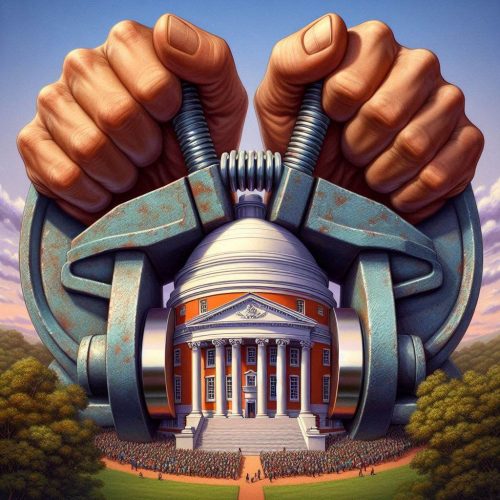
Now you see it, now you don’t.

by James A. Bacon
The push is on around Virginia and the U.S. as a whole to eliminate Diversity, Equity & Inclusion in higher education. The first line of defense among DEI preservationists is to give new titles to employees, rename departments, and shuffle around boxes on the org chart. Advocates of dismantling DEI content say such an exercise is disingenuous. There’s more to DEI than that. But what, exactly?
Any discussion quickly breaks down in arguments over semantics. Bureaucrat X, we hear, engages in “community outreach,” not DEI. Apparatchik Y runs a program ensuring that members of disadvantaged groups feel a sense of “belonging.” Functionary Z oversees programs for dormitory residents that teach them about their “identity.”
DEI means whatever the people running universities want it to mean, and it excludes whatever they want to exclude.
In 2023 University of Virginia President Jim Ryan defined DEI as equality of opportunity, not equality of outcome. And he couldn’t understand how anyone could think otherwise.
“I have no idea where this notion came from, but it ought to be rejected out of hand,” he wrote in an essay published in The Chronicle of Higher Education. “I know of no college that guarantees equal outcomes. A more accurate and appropriate definition of equity is an effort to ensure equal opportunity, not equal results.”
The term “equal opportunity,” he asserted, “recognizes that not everyone starts in the same place or is in the same circumstances, so treating people exactly alike is not always fair — and not always consistent with providing equal opportunities. How far a college goes to remove barriers to success will always be subject to debate, but the basic idea should not be controversial.”
“Removing barriers to success” is not terribly controversial. But it bears little resemblance to how DEI is actually practiced at the University of Virginia — or any other public university in Virginia. DEI is the name given to a bureaucratic apparatus charged with executing a social-justice philosophy inspired by critical theory and the oppressor-oppressed paradigm. If you remove the apparatus, the underlying philosophy remains, and the practices continue.
Now you see it, now you don’t.