• The Metro Premium

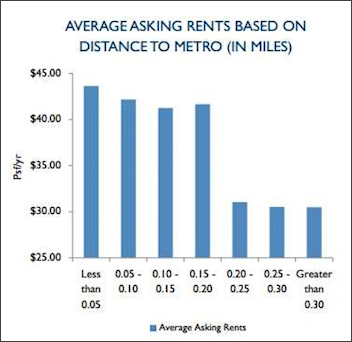
    How much is a location near a Metro station worth? In a fall 2013 study examining the economic impact of the Silver line on Tysons, researchers Cushman & Wakefield took a look at rents paid for commercial real estate and multifamily residences in Arlington County’s Rosslyn-Ballston corridor. The answer: Office tenants pay as much as a 30% premium for Metro access, while renters pay as much as 23% more.
    Credit: Cushman & Wakefield
    Commercial rents per square foot. Graphic credit: Cushman & Wakefield

    Of the 101 office properties along the corridor, rents were highest for buildings located within one-twentieth of a mile from a Metro station. The price per square foot declined slightly for offices at a greater distance to one-fifth of a mile, then dropped sharply for offices at greater distances. The findings dramatically confirmed the old planning rule of thumb that people are willing to walk a quarter mile to avail themselves of mass transit but not much more.
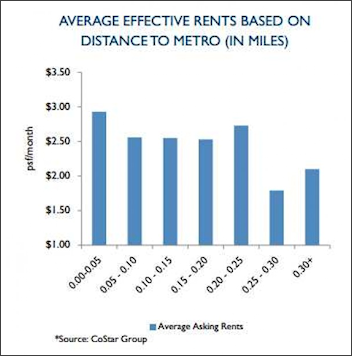
    Multifamily rents. Graphic credit: Cushman & Wakefield.
    Multifamily rents. Graphic credit: Cushman & Wakefield.

    A similar pattern prevailed for multifamily apartments, although the preferences aren’t quite as stark. States the report: “Properties within 0.05 miles of a Metro stop were able to command up to a 23% premium over average effective rents.”

    Fairfax County is adopting a similar strategy to Arlington County for redeveloping property along its new, Silver Line metro stations: planning for walkable, mixed-use development and encouraging residents and workers to walk, not drive, to the Metro. Fairfax hopes to reap comparable gains as employers and renters pay a premium to enjoy the Metro access. Tysons enjoys a big advantage over Rosslyn-Ballston in re-development, states Cushman & Wakefield: While Rosslyn-Ballston commenced its great experiment as a dreary and declining retail strip, Tysons starts out as home to the largest concentration of office space in Northern Virginia.

    On the other hand, the price differential for Metro versus non-Metro space in Arlington comes after 40 years of painstaking attention to creating walkable urban spaces. When it comes to creating a walkable urban grid, Fairfax planners expect Tysons to take decades to get to where Arlington is today. Until the urban fabric of Tysons resembles that of Arlington, proximity to the Metro is not likely to command the same price premium.

    The good news here is that new Metro lines can create an extraordinary amount of economic value. The study provides concrete evidence that, if the surrounding land uses and the quality of urban design meet Arlington standards, heavy rail can bolster the tax base. The bad news is that commercial property owners appear to reaping the windfall gains, not the taxpayer chumps who pay for the rail line.

    A digression into a Bacon obsession:ย Here at the Bacon’s Rebellion command bunker in lovely western Henrico County, we’re always asking how growth can pay its own way. I’m a big believer in “value capture” as a tool to finance construction of projects like Rail-to-Dulles, as an alternative to pillaging unrelated parties like Dulles Toll Road commuters and Virginia taxpayers.

    While I love free markets and making profits, I have a huge problem with crony capitalism and rent seeking. And I have a sneaking suspicion that the big property owners in Tysons, though they are paying a sliver of the cost of building the Silver Line through a special tax assessment, are making out like bandits.

    Tysons property owners get a double windfall from the Silver Line: (1) the rent premium from access to the Metro, and (2) permission to build at higher densities. The Silver Line will cost $5 billion to $7 billion to build (depending on what you include in the project cost). Fares paid by riders will not cover one dime of that amount. Could more of that value have been extracted from property owners?

    Commercial properties make up about 83% of the Tysons district’s almost $11.5 billion in total assessed value, according to this county document. For purposes of argument, let’s say one-third of that commercial assessed value is located within a quarter-mile radius of one of the four Metro stops. That would represent about $3.2 billion worth of property.

    A 30% increase in rents due to Metro access would increase property values by about $1 billion, to a total of $4.2 billion. Now, let’s say the Fairfax board allowed property owners to double density. That would add another $4.2 billion in value for a total net value creation for property owners of $5.2 billion. In January, the Fairfax County Board of Supervisors set up a Tysons service district to pay for $3.1 billion for a new street grid, sidewalks and bike paths, expanded transit, and improved roads. Two funds are expected to collect a total of $557 million over the next 40 years (over and above what property owners will pay through normal property taxes) — or about 18% of the cost of the improvements.

    By my rough calculations Tysons property owners will contribute only one ninth or tenth of their windfall gains in property value toward the public improvements that make those gains possible. (And I’m not even including the cost of building the Metro itself!) Now, I’m the first to admit that my numbers are the roughest of rough estimates, and all figures and assumptions need to be validated. But this is the kind of exercise, using validated numbers, that we need to engage in.

    If it turns out that property owners are reaping billion-dollar windfalls while taxpayers get stuck with most of the bill, well, I have a problem with that. And so, I surmise, would a lot of taxpayers.

  • Mental Health: McDonnell’s Small Gesture

    virginia-tech-shooting-police-norris-halljpg-9159f659b05b0b6e_largeBy Peter Galuszka

    It seems so little so late.

    Gov. Robert F. McDonnell, apparently trying to get some 11th hour positive spin, has announced that he wants to put $38.3 million over two years to improve the stateโ€™s mental health system. He also wants to expand the amount of time an individual can be held for initial psychiatric evaluation.

    While any money for Virginiaโ€™s sagging mental health system is welcome, McDonnellโ€™s beau geste is suspect, coming just three weeks after a tragedy in which state Sen. Creigh Deeds was seriously wounded by his son who killed himself after a psychiatric bed wasnโ€™t found for him.

    McDonnell has never had a history of providing much support for the mentally ill and, in fact, last year, suggested cutting $1.5 million in support. Incredibly, this was about the time of the mass shootings at the Sandy Hook Elementary School in Connecticut last December.

    This time, McDonnell says that his budget recommendation isnโ€™t directly related to the Deeds affair, but comes after the state studied the Sandy Hook massacre of 2012.

    In other words, it has taken McDonnell an entire year to study the Connecticut bloodletting and come up with recommendation. Sounds like a truly strong personal priority.

    Moreover, the $38.3 million does not represent any new ground being broken at least in terms of mental health spending.

    In fact, it merely takes Virginia back to the post Virginia Tech days. After a disturbed student methodically shot and killed 32 students and teachers and then himself in 2007, the state boosted mental health funding by $42 million. But about $37 million of that flittered away when tax revenues dropped in 2009 and 2010 because of the recession.

    In other words, McDonnell is merely taking us back to where we were about three years ago.

    Now thatโ€™s enlightened leadership.


  • Time for Some Tactical Suburbanism

    by James A. Bacon

    Tactical urbanism is the term used to describe small, inexpensive, often temporary, urban improvements that make life more colorful, fun or livable. They include such things as guerilla gardening, parklets, pavement to parks, pop-up retail, pavement-to-plaza, de-paving and chair bombing (the latter would be the creation of public seating, not the destruction of it). See the Tactical Urbanism manual for details.

    Tactical urbanism is spreading, and it’s making cities more fun places to live. As far as I’ve seen, there is no comparable movement for the suburbs. If suburban neighborhoods and business districts are to remain competitive places to live, work and play, someone needs to develop a Tactical Suburbanism manual. County governments and civic groups need a playbook for making the suburban environment more colorful, playful and livable.

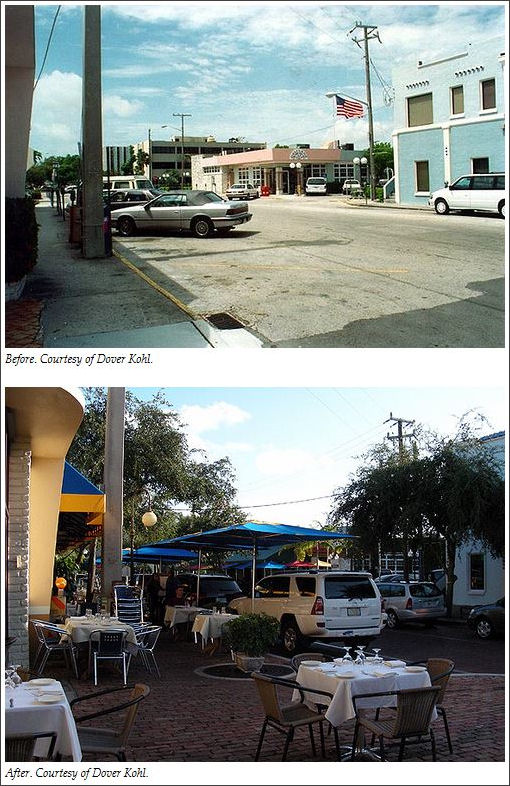
    A recent article in Atlantic Cities recounts a move in the right direction. Although it describes changes that are larger than those prescribed by tactical urbanism, they are relatively small scale, requiring modest investment, and they can be readily replicated if successful. Here’s an example of how the City of South Miami (which, despite it’s name is suburban in design) transformed one particularly dreary block:

    Photo credits: Dover Kohl, by way of Atlantic Cities

    Which of the two versions would you prefer to spend more of your time? Which would you rather have in your neighborhood? Which one does more to enhance property values and tax revenues? Not much of a contest, is it?

    Here’s the beauty of small-scale change — it doesn’t have to cost a lot of money. Just reallocate money already dedicated to public works improvements. Let me give you an example from my home locality, Henrico County. A major arterial, Parham Road,ย runs between my neighborhood and Interstate 64. A median strip divides the north-bound lanes from the south-bound lanes. Earlier this year, the county ripped up several hundred yards of concrete median and replaced it with a concrete-bounded grass median. I don’t know how much money the county spent — tens of thousands of dollars, surely — but the net result is a marginal improvement over what had been there previously. The median strip was transformed from ugly to merely bland. In a month’s time, no one will notice the change. Nobody’s property values improved. No one was induced to invest more private money.

    County funds could have been spent far more productively elsewhere.ย There are hundreds of locations in Henrico where small public improvements would have a transformative effect at the micro-level, ideally even inspiring property owners to invest their own money to dress up their buildings and the public spaces around them. There is minimal creativity devoted to the public domain in Henrico, minimal attention paid to the art of place making. That needs to change.

    I’ll have more to say about this shortly in a soon-to-be-published article, which I will re-post on this blog.


  • No Easy Answers for NoVa’s I-95 Corridor

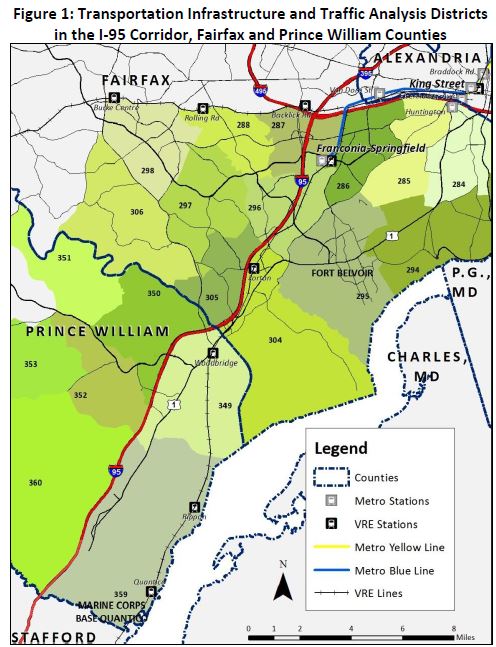
    Map credit:  (Click for larger image.)
    Map credit: (Click for larger image.)

    Traffic flow in the Interstate 95 corridor in Northern Virginia has improved since completion of the “Mixing Bowl” project (at the intersection with the Interstate 495 Capital Beltway) and travelers could see even more improvements when the I-95 express lane projects open for service. But several sections of I-95 still will operate at failing levels of service, while continued population and job growth in the corridor will keep the transportation infrastructure under continued stress.

    So concludes a new report, “Outlook for the I-95 Corridor in Fairfax and Prince William Counties,” by David E. Versel, senior research associate at George Mason University’s Center for Regional Analysis.

    The population along the 21-mile area under study amounted to 566,000 in 2010. The highway segment is one of the most heavily congested stretches of interstate in the United States; the arterials and collector roads feeding the interstate are highly congested as well. Metro, Virginia Railway Express (VRE) and local bus services carry roughly 27,000 riders daily but there is no easy way to add new capacity. Meanwhile, carpooling is declining, “likely due to a shift away from the historic model of large numbers of Federal employees who travel to the same destinations each day.” With the VRE already operating on a “standing room only” basis, there isn’t any slack in the rail system. Yet populations forecasts anticipate growth to 692,000 by 2030.

    So, what do we do about it? While Versel sketches the challenges facing this critical region, he doesn’t offer much in the way of remedies. Such was not his aim. But the question remains, how does the region, already teetering on the edge of transportation dysfunction, absorb 125,000 more inhabitants in an era of chronically constrained state and local-government resources?

    A couple of observations… First, a huge number of workers are commuting to jobs in Arlington, Alexandria and Washington, D.C. In other words, the total lack of balance between jobs and housing causes people to commute long distances to reach the major metropolitan job centers. Much of the solution resides in Arlington, Alexandria and D.C., which, in an ideal world, would make more land available at greater density for residential development. While re-developing is occurring, there are institutional constraints to how rapidly these urban-core jurisdictions can bring new housing online. For all practical purposes, Fairfax and Prince William are on their own.

    Second, what Fairfax and Prince William can influence is where the new growth goes. If they allow growth to be smeared across the countryside at low densities, they will create massive congestion headaches for local roads. It makes far more sense to encourage balanced, higher-density development in nodes along I-95 that minimize the impact on local roads and create a market for commuter bus services.

    Third, pray for technological deliverance. If smart-road technologies, driverless vehicles and the platooning of cars (moving very close together at high speeds) become a reality within a decade, perhaps technology can increase the highway’s capacity at modest cost. Otherwise, there’s no un-breaking the egg. The area’s dysfunctional land use patterns consign it to decades of transportation purgatory.

    — JAB


  • New Questions about the Shockoe Stadium Proposal

    Source: "Revitalize RVA: An Economic Development Plan for Shockoe Bottom and the Boulevard." (Click for larger image.)
    Source: “Revitalize RVA: An Economic Development Plan for Shockoe Bottom and the Boulevard.” (Click for larger image.)

    by James A. Bacon

    I’m heartened to see someone on the Richmond City Council ask tough questions about big headline-grabbing deals. Councilman Jon Baliles (son of the former governor) has raised substantive issues about Mayor Dwight Jones’ proposal to build a new baseball stadium for the Flying Squirrels in Shockoe Bottom. In particular, the analysis upon which the mayor’s proposal is based makes different assumptions about parking, a major public expense, when contrasting competing stadium locations on the Boulevard, where the current, aging stadium is located, and in Shockoe Bottom.

    In announcing the proposal last month, Jones contended that putting the stadium in Shockoe Bottom would trigger significant development in Shockoe Bottom and free up space on the Boulevard for re-development. All told, he said, the project could generate up to $187 million in property and sales tax revenues over 20 years, far more than the $80 million public investment required to build the new stadium, structured parking and flood-drainage improvements.

    Baliles addressed several concerns Friday in a letter to the mayor. ย The Times-Dispatch then devoted major coverage to Baliles’ critique in its Saturday coverage here and here. In the main article, reporter Graham Moomaw focused on the parking issue. The mayor’s analysis of the development potential of the Boulevard site, just off Interstate 95, assumes that placing the ballpark there would consume 29 acres of available land for the parking lot, leaving only 32 acres for development.ย Yet the Shockoe Bottom plan calls for building structured parking for the stadium on only seven acres.

    If the Shockoe location can support structured parking on seven acres, why couldn’t the Boulevard location? After all, the city’s vision is to develop 960,000 square feet of office space, 780,000 square feet of retail and entertainment, plus medical offices, a conference center, a hotel and 1,048 apartments on the Boulevard.ย ย Says Baliles: “You could have a parking deck that served the business world during the day and sports fans, shoppers and residents in the evening.”ย Could that mixed-use development not support structured parking in the same way that mixed-use development in Shockoe Bottom could?

    The question goes to the heart of the Boulevard proposal: If structured parking were feasible on the Boulevard, that would free up an extra 20 acres or so for re-development, making the location far more lucrative for the city than under the surface-parking scenario.

    Chief Administrative Officer Byron C. Marshall told Moomaw that the city had considered a parking deck on the Boulevar but concluded that it would have to build the deck itself at substantial cost or wait for a private developer to do it. The latter option would likely push out of reach the city’s goal of building the new stadium by 2016. “At full build-out,” he said, “if you could get an office tenant and even maybe a mixed-use tenant in that southwest portion, you could, at that point, use less acreage. … The question is when? Who? That’s conceptual. We actually have a concrete plan for the Bottom. That’s the difference.”

    Excuse me, but the mayor’s plan calls for building a stadium in Shockoe at substantial cost, too. If the stadium is to be built by 2016 in order to keep the Flying Squirrels happy, the city will have to build the structured parking either way. What’s missing from the mayor’s analysis is an apples-to-apples comparison of the Boulevard and Shockoe Bottom sites using the same parking scenario.

    Perhaps an apples-to-apples analysis still would show Shockoe to be the preferred. I’m totally OK with that. Unlike an apparent majority of Richmond metro residents, whom polls show favor the current stadium location, I really don’t care. I just want to maximize the return on investment of taxpayer dollars. City Hall needs to analyze comparable scenarios for both locations. Then let the best site win. Kudos to Baliles for digging into the numbers and demanding answers.


  • VCU: Prime Candidate for a MOOCing

    The VCU value proposition: a Top 25 basketball team
    The VCU value proposition: a Top 25 basketball team

    by James A. Bacon

    I often wonder if higher-education board members can see the forest for the trees. In my mind’s eye, I see university administrations sharing huge volumes of reports and data in thick notebooks — no one can accuse them of a lack of full disclosure. And I imagine most board members (with a handful of notable exceptions) taking the information exactly as given, focusing on the nits and lice, never quite grasping the big picture.

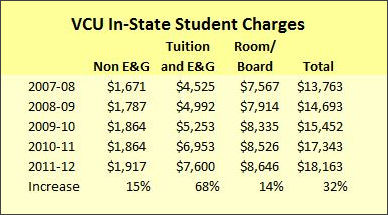
    For example, do you think the Virginia Commonwealth University administration would ever present the following data to its Board of Visitors — or anyone on the board would ask for it to be presented this way?

    Consumer Price Index (2008-2012): up 6.6%
    Virginia median household income (2008-2012): down 5.5%
    VCU in-state tuition and fees (2008-1202): up 32%
    Average VCU student debt upon graduation: $28,889*

    Here’s where the money is coming from:

    Source: State Council on Higher Education in Virginia
    Source: State Council on Higher Education in Virginia. Note: E&G stands for “Education and General”

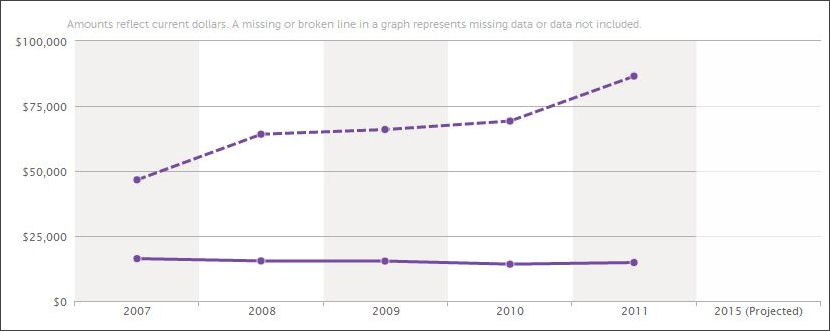
    Here’s where the money is going:

    Source: Knight Foundation on Intercollegiate Athletics
    Source: Knight Foundation on Intercollegiate Athletics

    The solid line shows average spending per full-time-equivalent student. Hmmm. It trended slightly down. The dotted line shows average spending per athlete. Hmmm. It trended dramatically higher. Let’s summarize:

    • Virginians’ median household incomes down by about 5.5%
    • VCU tuition and fees up 32%
    • Academic spending per full-time student down 9.2%
    • Athletic spending per athlete up $40,000 up 86%

    What are VCU students getting for their massive increases for tuition and fees? The privilege of rooting for a Top 25 basketball team. Anything else? Better academic quality? More prestigious, better paid professors? (Hah!) Better career prospects?

    Looks to me like VCU is a prime candidate for being dismembered by Massively Open Online Courses (MOOCs) or other variants of online- and technology-based education. At the end of the day VCU has a solid medical school and a few pockets of excellence like the advertising Brand Center and a top-tier art school. ย How long will students for other programs be willing to pay VCU tuition and fees for the value they’re getting in return?

    ———————————
    * Average debt for the 63% of graduates who carried debt. Does not include the debt incurred by those who did not graduate.


  • A Closer Look at Virginia Auto Ownership Patterns

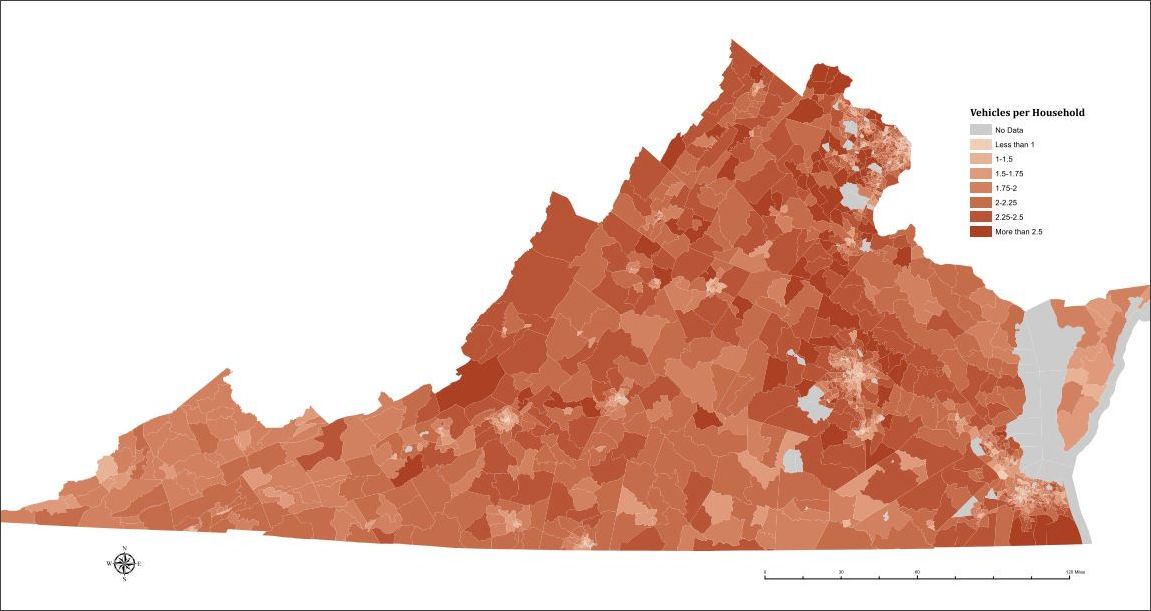
    Vehicles per household. (Click for more legible image.)
    Vehicles per household. (Click for more legible image.)

    Last week I published maps produced by the Vizual Statistix blog showing the breakdown of car ownership per household across the United States. Virginia appeared as the only East Coast hot spot on the map, with exceptionally high rates of automobile ownership compared to other states. Only limited conclusions could be drawn, I lamented, because the granularity of the data was so rough.

    Well, thanks to Luke Juday, a Master’s student in urban planning at the University of Virginia architecture school, we can take a closer look. Juday, who goes by New Virginian on this blog, broke down car ownership by census tract, as shown above.

    The super-high car ownership of more than two cars per household is mainly a phenomenon of auto-centric exurban counties ringing the state’s urban cores. There is a significant overlap of household car ownership with related metrics such as:

    Cars per person
    Carsย per worker
    Drive alone to work
    Household income
    Drives alone to work
    Vehicle miles traveled

    Juday also graphs the data and, not surprisingly, shows strong correlations between the number of adults and the number of cars in the household, as well as between the number of cars and household income.

    Looking at density, Juday shows a correlation between density and car ownership (low density means more cars), and miles driven to work and density (low density means more miles driven).

    The question I originally asked was, why does Virginia appear to be such an anomaly in the East Coast? Juday’s data gets us closer to an answer — the Old Dominion appears to have a combination of extensive sprawl and higher incomes. Sprawl means more car dependency, and higher incomes afford households the ability to buy and maintain more cars.

    — JAB


  • Bye, Bye, ‘Burbie

    Out: Nerdistans
    Out: Nerdistans

    Here’s a trend that ought to set government officials in larger suburban counties across Virginia on edge. U.S. businesses, declares the Wall Street Journal, have entered a new era of “corporate urbanism.” In a reverse of the post-World War II flight from the city to the suburbs, Motorola, United Continental Holdings, Hillshire Brands and other corporate giants are relocating their headquarters to urban centers or setting up high-profile satellite offices there.

    “The showcase headquarters of the past, the beautiful suburban campuses — that’s a very obsolete model now,” Patrick Phillips, CEO of the Urban Land Institute, told the Journal.

    The driving force: Corporations are going where the talent is, and Millennials with skills, talent and education increasingly prefer to live in urban centers.ย Plenty of corporations are staying put. The movement has not become a reverse exodus. But it seems clear which way things are moving. In the economic development game, the balance between city and suburbs has shifted.

    In: city life
    In: city life

    Once upon a time, when the suburbs were new, they offered Americans an escape from the turmoil of inner cities with their crime, poverty, terrible schools and high taxes. But crime has declined dramatically; the fear factor is not driving people out of the central cities any more. Poverty is dispersing, too. While much of it remains concentrated in inner cities, poor people are being displaced by gentrification and they’re moving to the cheapest (because they’re the least desirable) neighborhoods in their regions, which tend to be the aging, ’50s- and ’60s-era neighborhoods in suburban counties. As poverty suburbanizes, it brings the social pathologies of poverty to suburban schools. Decades into the Post World War II suburban experiment, many ‘burbs have lost their disposable newness. Meanwhile, a generation of young people is discovering an appreciation for the authentic and walkable urbanism of the older cities.

    Lesson to Virginia’s urban-core localities: Hang tough, things are going your way. Build on what you’ve got. Scrap those stupid suburban-inspired zoning codes you adopted in the ’70s and foster more walkable, bikeable urbanism. Don’t screw things up by raising taxes, your primary competitive disadvantage.

    Lesson to Virginia’s suburban counties: Whether you recognize it or not, you have a big problem. Your traditional advantages are eroding. People like your lower taxes, but that’s not all they’re looking for. People do like your public schools, but the majority of new households being created are childless. You’ve got to reinvent yourselves.

    — JAB


  • Can McAuliffe Thread the U.S. 460 Needle?

    Layne (left) and McAuliffe. Photo credit: WAVY.com
    Layne (left) and McAuliffe. Photo credit: WAVY.com

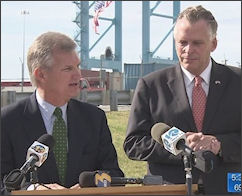
    Will Gov.-elect Terry McAuliffe reverse one of the biggest legacies of the McDonnell administration, construction of the new U.S. 460 between Petersburg and Suffolk?

    The $1.4-billion, Interstate-grade highway, upon which the McDonnell administration has already lavished $200 million, has cleared all significant hurdles but one: approval by the Army Corps of Engineers. But the project would impact 480 acres of wetlands, and the Corps has warned that the state is proceeding at its own risk.

    McAuliffe told the Virginian-Pilotย Wednesday that the state shouldn’t spend money on the project until it was “100 percent sure” the federal permit would be issued. Even if the feds do approve the project, he said, he’s still not firmly committed to the project. “I’m going to take a hard look.”

    It’s difficult to know how seriously to take McAuliffe. On the one hand, he is deeply indebted to environmental groups, who contributed more campaign cash than any other industry or advocacy group. On the other, it’s hard to square cancellation of U.S. 460 with the selection of Aubrey L. Layne, a Hampton Roads businessman, as secretary of transportation. Layne worked for years to get the U.S. 460 project built and now chairs the funding authority for it!

    As a member of the Commonwealth Transportation Board under McDonnell, Layne made the case that the highway would provide an alternate hurricane evacuation route for Hampton Roads and a second outlet for freight-laden trucks out of Virginia’s ports. The ports are expected to be a major beneficiary when the Panama Canal widening project is completed in 2015.

    Would Layne really have signed up for the top transportation job if he thought McAuliffe would pull the rug from the project? Is McAuliffe just making noises to appease the environmentalist lobby? It will be fun to watch how the governor-elect wiggles his way out of this one.

    — JAB


  • The Disruption of Higher Education

    end_of_universityNathan Harden sees the future of higher education in America — and it’s very much like the future that I see for Virginia’s colleges and universities –except in this essay, “The End of the University as We Know It,” published in The American Interest, he describes it better. Here are some excerpts:

    Resist or not, major change is coming. The live lecture will be replaced by streaming video. The administration of exams and exchange of coursework over the internet will become the norm. The push and pull of academic exchange will take place mainly in interactive online spaces, occupied by a new generation of tablet-toting, hyper-connected youth who already spend much of their lives online. Universities will extend their reach to students around the world, unbounded by geography or even by time zones. All of this will be on offer, too, at a fraction of the cost of a traditional college education.

    How do I know this will happen? Because recent history shows us that the internet is a great destroyer of any traditional business that relies on the sale of information. …

    The higher-ed business is in for a lot of pain as a new era of creative destruction produces a merciless shakeout of those institutions that adapt and prosper from those that stall and die. Meanwhile, students themselves are in for a golden age, characterized by near-universal access to the highest quality teaching and scholarship at a minimal cost. …

    Prestigious institutions, especially those few extremely well-endowed ones with money to buffer and finance change, will be in a position to dominate this virtual, global educational marketplace. The bottom feedersโ€”the for-profit colleges and low-level public and non-profit collegesโ€”will disappear or turn into the equivalent of vocational training institutes. Universities of all ranks below the very top will engage each other in an all-out war of survival. In this war, big-budget universities carrying large transactional costs stand to lose the most. Smaller, more nimble institutions with sound leadership will do best.ย …

    Harvard and MITโ€™s multi-billion dollar endowments enable them to support a residential college system alongside the virtually free online platforms of the future, but for other universities online education poses a real threat to the residential model. Why, after all, would someone pay tens of thousands of dollars to attend Nowhere State University when he or she can attend an online version of MIT or Harvard practically for free?

    This is why those middle-tier universities that have spent the past few decades spending tens or even hundreds of millions to offer students the Disneyland for Geeks experience are going to find themselves in real trouble. Along with luxury dorms and dining halls, vast athletic facilities, state of the art game rooms, theaters and student centers have come layers of staff and non-teaching administrators, all of which drives up the cost of the college degree without enhancing student learning. The biggest mistake a non-ultra-elite university could make today is to spend lavishly to expand its physical space.

    Read the whole thing. (Hat tip: Reed Fawell.)

    — JAB


  • How to Get a Meals Tax Passed

    Image credit: Henrico Monthly
    Image credit: Henrico Monthly

    by James A. Bacon

    This past April the Richmond Association of Realtors commissioned a poll to assess the views of Henrico County voters toward a proposed 4% meals tax. When CEO Laura Lafayette reviewed the results, she knew the pro-tax forces faced a major challenge in getting the tax enacted. Respondents opposed the idea 67% to 32%.

    But on election day, the meals tax passed with a two-point margin of victory. Writing in Henrico Monthly, Greg Weatherford provides the behind-the-scenes story of how the Axis of Taxes got the job done.

    The simple explanation is that the taxers out-spent the anti-taxers by 16 to one. Yes 4 Henrico’s Kids, a pro-tax advocacy group backed by the Realtors and other business interests, pumped $197,000 into the campaign. Henrico County spent another $46,000 on a website and mailers. And those numbers under-state the resources invested. County administrators dedicated hundreds, if not thousands, of hours of staff time to delivering the pro-tax sales pitch under the guise of “informational” presentations at dozens of public hearings.

    By contrast, Sidney Gunst, the most visible of the anti-tax activists, spent $15,000 of his own money for a website, stickers, Val-Pak inserts and limited advertising.

    The really interesting story, though, is the strategy behind the spending. A trio of political consultants active in Democratic Party campaigns — Abbi Easter, Michael Brown and Rhett Walker — formed a brain trust for the Realtors. The “three amigos” came up with one key insight that decided the outcome: While the county’s substantial black population regarded the meals tax as regressive, hitting them disproportionately, they were receptive to the idea that the meals tax would prevent cuts to Henrico County Public Schools, which would impact poor, black-majority schools in the county’s East End the hardest. By framing the issue as one of protecting public schools from cuts, the pro-taxers won decisive support from black voters.

    Weatherford describes a meeting in early October in which Varina District Supervisor Tyrone Nelson and about 15 ministers, mostly African-Americans, met with County Manager John Vithoulkas. The Rev. Marcus Martin, writes Weatherford, “came away from the meeting convinced that sharp cuts in the schools budget would fall hardest on poor students, whose parents can’t afford to pay for services not provided through the school.” Without the tax, said Martin, schools faced “catastrophic cuts.”

    Gunst and other anti-tax voices (including me) argued that the threat of catastrophic cuts to schools was a scare tactic. First, we noted,ย property values were booming and the county would enjoy a windfall increase in real estate property tax revenues that had not been anticipated in budget forecasts. Second, we suggested ways the county could find money for schools from general government funding.

    But as Weatherford notes, “Opposing voices were drowned out. The well-organized county management and the efficient work of the Richmond Association of Realtors and its team of political consultants were driving home their points.”

    The county public relations staff worked all out to line up community meetings, where Vithoulkas, Budget Director Brandon Hinton and other officials could make the case. At the public hearings, county officials refused to debate the opponents on the grounds that they weren’t taking sides, they were simply presenting “the facts,” and therefore there was no one to debate. The format left county officials firmly in control of the hearings. While they did take questions from opponents, administrators could rebut them at length and cut them off at will.

    Meanwhile, Yes 4 Henrico’s Kids ramped up its own website, hit the school-disparity issue with a mailer and organized a get-out-the-event drive in which 1,500 school children knocked on doors in the Fairfield district on election day to get out the vote.

    It wasn’t easy changing the minds of nearly 20% of voters from opponents from “no” to “yes,” but the pro-taxers pulled it off. They deserve a grudging respect for their political acumen. But the battle is not over. The meals tax is a short-term palliative that will not address Henrico’s long-term fiscal and educational challenges. In the absence of fundamental reform — and there is no evidence that any such reform is contemplated — budget pressures will mount, school performance will continue to underwhelm and the Axis of Taxes will come back for more.


  • The Zany, Crazy Cold War Days Return

    โ€œGive me back the Berlin wall b52
    give me Stalin and St Paul
    I’ve seen the future, brother:
    it is murder.โ€ Leonard Cohen

    ย By Peter Galuszka

    The other night I watched Dr. Strangelove, one of my favorite movies. Then I read the headlines.

    China is cracking down on U.S. journalists, especially those representing The New York Times and Bloomberg, by threatening their visa renewals if they keep reporting about the corrupt ties between Communist party officials and business.

    Presidentย  Barack Obama orders two unarmed B-52s to fly smack down the middle of a โ€œno flyโ€ zone recently declared by China as a diplomatic move against Japan and Taiwan over some rocky islands.

    Meanwhile, back in Russia, my old stomping grounds, President Vladimir Putin is celebrating Ukraineโ€™s decision to stick with Mother Russia in an economic union that should help keep alive the memory of empire.

    Gee, it sounds like old times.

    As bad as it seems, I am more concerned about whatโ€™s going on with China and how it is being ignored by most Americans outside of big financial and media centers like New York. China is playing its economic hole card to force America to go along with its mossback ways involving freedom of speech and force projection.

    On this score, we always give the Chinese a free pass because we like their cheap goods and also because they hold a lot of their debt. Back in the Cold War, threatening the visas of a couple of dozen U.S. journalists would have been headline news. Not anymore and thatโ€™s worrisome.

    The Times won a Pulitzer last year for its coverage of the shady and endlessly complex relations between Party members, their wives and children, and various businesses. After the Party announced an internal crackdown on scams, the government last summer promptly started hassling foreign, including U.S., companies with SWAT teams of accountants and court orders for their books.

    Iโ€™m not a China Hand but the tonality is very different now. It seems bitter. Chinaโ€™s old guard clings to control. Wealth has spawned expectations that seem to be met only with Web crackdowns and gobs of air pollution. Military threats are more common. A comeuppance seems inevitable.

    What does it mean to Virginia? China is Virginiaโ€™s top importer, double the level of Brazil, the next highest. Top imports are machinery, furniture and salt. Virginiaโ€™s export โ€“ coals โ€“ far outdistances its Chinese imports in volume by many times. And Chinaโ€™s going to keep needing coal, especially the metallurgical type.

    In terms of the defense industry, angrier showdowns with China will hurt the state, since the Navy will move assets to the Pacific from places like Hampton Roads which were major staging areas for the decadesโ€™ long wars in Iraq and Afghanistan. Obama is already putting a small contingent of Marines in Australia.

    Concerns remain about Chinaโ€™s alleged cyberattacks on U.S. data centers and surveillance. It could be that the highly questionable scope of U.S. spying by the National Security Agency could be more directed at China than at Middle Eastern terrorists, but itโ€™s all part of a troublesome mix.

    Yearsย  ago when I was Moscow bureau chief for a large business magazine, I was constantly annoyed when my New York editors always seemed to hold China in higher regard as a potential reformer than the Soviet Union. Money talks and I think they liked the advertising potential that never would be realized with the Russians.

    History would prove them right on the money. But pre-Putin, Russians did enjoy a number of years of remarkable freedom of expression. Sadly, thatโ€™s over (as well as the lives of several of my Russian journalist friends who were either murdered or have died suspiciously).

    Yet China never seems to have made all that much of a transition when it comes to freedoms. It has plenty of people in jail for saying what they think and they target websites, shutting many down.

    On that score, my New York editors, it turns out, were wrong on both counts. At the moment, though, it’s back to the future.


  • Mobility and the Metropolis

    pew_study

    If you were born poor in Hampton Roads, you have better odds of rising out of poverty than if you were born into a low-income family in the Washington metro area.

    Economic segregation varies widely across metro regions in the United States, and so does economic mobility, argues a report published by the Pew Charitable Trusts, “Mobility and the Metropolis: How Communities Factor into Economic Mobility.”

    “American metros with distinct pockets of concentrated wealth and concentrated poverty have lower mobility than places in which the wealthy and poor are more integrated,” concludes the report, which was based upon an analysis of 34 metro areas chosen from the 50 largest in the United states. “Descendants of poor families living in low-mobility metro areas will take four generations to reach their metro area’s mean income, while descendants of poor families living in high-mobility metro areas will need only three.”

    Of the two Virginia metro areas included in the study, the Washington MSA was by far the more segregated, with a Neighborhood Sorting Index of 29.1%, making it third most segregated, behind New York City and Newark, N.J., of the 34 regions studied. Hampton Roads had one of the lower indices, at 18.0%, making it the seventh least segregated.

    The Washington MSA also ranked below average in economic mobility, with a mobility score of 0.71 (in a scale in which 1 indicates zero mobility and 0 perfect mobility). Hampton Roads scored a 0.22 in mobility.

    What do do about it. Most discussion of poverty has focused on federal policies relating to education, taxation and the economy, observes the Pew report. The metropolitan-level data suggests that local factors are important as well. So far, so good. But when it comes to concrete solutions, the report has nothing to offer but the same warmed-over staple of liberal social policies: Expand mixed-income development, develop “synchronized, area-wide plans for transportation, housing, education and economic development,” invest in early childhood development and education.

    The problem with “mixed-income development” is that the non-poor aren’t particularly excited about mixing elbows with the poor. The upwardly mobile want to escape the social disorder associated with poverty. There is a free-market analogue to mixed-income development — it’s called gentrification. Gentrification, which occurs house by house rather than in huge, government-sponsored projects, creates mixed-income neighborhoods, but liberals often don’t like this kind of income mixing because it supposedly displaces the poor. (Whether gentrification actually does displace the poor is a question we can discuss another time.)

    As for pumping more money into schools in poor neighborhoods, we’re already doing that in Virginia and the results are less than stellar. The City of Richmond, for instance, spends way more money per student than, say, neighboring Henrico County, which has plenty of poor students itself. Arguably, the concentration of poverty in Richmond accounts for the low student achievement and the low likelihood of escaping poverty that the Pew study highlights. But I’m not convinced that spending even more money is the solution. As a practical matter, good luck persuading middle-class families that they should pay higher taxes in order to spend more money not on their own kids but on poor kids across town who are already getting a disproportionate share of resources.

    Pew does sing one note on-key: It points to the role of exclusionary zoning in perpetuating income segregation. There, the solution isn’t more money. The solution is relaxing zoning codes that violate the right of property owners to develop land as they please, even if it means catering to lower-income families. Loosen up real estate markets, and poor people will have more options where to live.

    — JAB


  • The Man Who Changed Dominion Virginia Power

    vepco_headline2
    by Peter Galuszka

    Back in the 1970s, Virginia Electric & Power Co. was a mess. Its corporate culture was insular and hostile to public input. Its troubled nuclear reactors at North Anna and Surry had major design and safety problems. Their constant outages and big fines brought on the wary eyes of Wall Street.

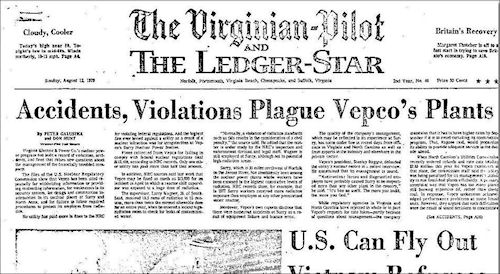
    Back in the summer of 1979, I was a 26-year-old reporter at The Virginian-Pilot, which then had a different attitude about expending resources for investigative reporting. They put another reporter and me up for about a month in the Washington area so we could pore over files at the U.S. Nuclear Regulatory Commission. It was tough work and the material was hard to understand. But we muddled through and on Aug. 12, 1979 ran a front page report, “Accidents, Violations Plague Vepco’s Plants.”

    The essence: “The files of the U.S. Nuclear Regulatory Commission show that Vepco has been cited repeatedly for withholding information or providing misleading information, for weaknesses in its security system, for design and construction inadequacies at Surry and North Anna, for for failure to follow required procedures to protect employees from radiation.”

    At the time, Vepco had been fined more than any other nuclear utility in the country by the NRC. The biggest single fines then had been against Vepco.

    Enter Jack. H. Ferguson. After a year or so after our story ran, Vepco hired Ferguson who had grown up on a Colorado farm and had done poorly in school. Eventually he earned a mechanical engineering degree and had worked with such engineering powerhouses as General Electric and Westinghouse. The Navy veteran of the Korean War was hired as a ringer to help pull Vepco out of its morass.

    Not only were its nukes all screwed up, it had shifted some of its electricity production to oil since Virginia was blessed with coastal import facilities. It happened just as the Arab Oil embargo erupted in 1973-74 sending Vepco fleeing to coal. It didn’t run many of its plants well and had a venomous inner culture that was by turns macho, Nuke Navy and anti-public. Outside comment on any issue be it a power line or a malfunctioning nuclear reactor was seen as a security threat that might be directed by the international Communism movement.

    Ferguson changed all of that. He broke down the Old Boy culture and ruled by engineering — “it runs or it don’t and if it don’t, fix it.” His attitude towards the public was a lot more open Westerner (he was once a cowboy) than “us against them” retiree of the Silent Service of the Navy nuclear submarine fleet. Ferguson’s approached worked. Vepco, which changed its named to Dominion, became a much more efficient and professional company. It still has its problems, to be sure, but nothing on the level of the 1960s and 1970s.

    This is a credit to former Virginia Power President Ferguson, who died at his home in Richmond Nov. 26 at age 82.


  • Tiny Homes, Meet Mobile Homes

    Photo credit: Atlantic Cities
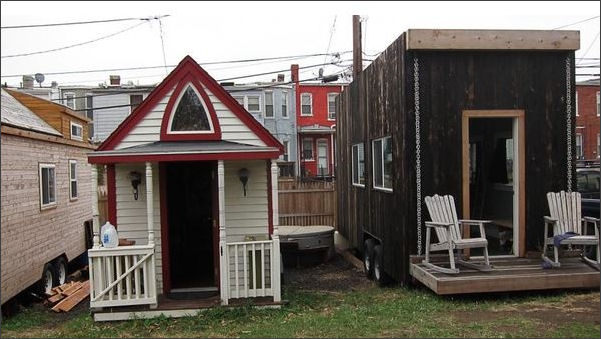
    Tiny homes in Washington, D.C. Photo credit: Atlantic Cities

    by James A. Bacon

    I am tickled by the “tiny homes” movement, which the urbanist blogs treat with a certain reverence. To be sure, tiny homes (under 500 square feet) address a real problem: the unaffordability of real estate in some of the nation’s most desirable metropolitan areas. Tapping creativity and ingenuity to stretch the boundaries of design is vastly preferable to addressing the problem throughย coercion and wealth transfers, as the political class is inclined to do. Still, it amuses me that Millennial creative-class types get so much attention while a rural, blue-collar alternative — the mobile home — gets no respect at all.

    A recent case in point is a profile, published yesterday in Atlantic Cities, of four tiny homes built on a single lot in the Northeast quadrant of Washington, D.C. Housing in the rapidly gentrifying District is unaffordable for many residents. By one estimate, the housing supply for low-income renters falls 30,000 units short. ย Writes Nancy Cook:

    This is where evangelists for the tiny-house movement come in. Proponents of this small-space living say these houses can help fill the void. They can be built in vacant urban lots, allowing residents to reuse space in dense areas. More important, the tiny houses offer a cheaper alternative to buying a condo or a single-family house. Tenants of the Evarts Street lot in Northeast Washingtonโ€”a community the owners call Boneyard Studiosโ€”built their houses for about $35,000 to $40,000; that is less than the down payment required to buy many D.C. homes.

    The author describes the house of 24-year-old Jay Austin as having a “cool minimalist design” along with solar panels and a tank to collect rain water for use in his kitchen sink. Alas, the house “still lacks a shower or toilet.” On the other hand, the houses are built on trailers. “If [the owners] ever decide to leave the city,” writes Cook, “they can simply bring their homes along.

    Hold that thought: a 140-square-foot house with wheels — no toilet, no shower — built for $35,000 to $40,000 exerts a hold on the imagination of young urbanists. Now, compare and contrast to housing innovations coming out of places like Rocky Mount, Va., home to Fleetwood Homes, or Martinsville, Va., home of Nationwide Homes.

    kitchenette

    Factory Expo Mobile Homes, a distributor that ships to seven states in the Mid-Atlantic region, offers an Annual Year End Sale selling a “micro” mobile home for $17,900. The 373-square foot structure contains a bedroom, living/dining room, kitchenette and a bathroom with working shower and toilet. It may not have solar panels, but it does have thermal insulation. It may not have a tank that collects rain water, but it does have a 30-gallon electric hot water heater. It also comes equipped with things like a refrigerator, electric range, light fixtures, plumbing and an electric furnace.

    I’ll admit, this sucker is pretty ugly — the unadorned vinyl exterior has as much charm as a pair of old sweat socks. But when you’re paying down an $18,000 loan over 15 ย years at 3.5% interest rates — about $150 per month — you might have a little money left over to dress it up. And it’s a whole lot roomier than Jay Austin’s tiny home. Price is the big advantage that manufactured housing has over hand-crafted housing. (Finding land and utility hook-ups for either tiny homes or mobile homes is a separate issue.)

    kingletIf you’re looking for something more stylish, consider the “Kinglet” eco-cottage manufactured by Nationwide Homes. ย This bad boy packs a bedroom, living room, bathroom and kitchen into 475 square feet. It sells for about $54,000.

    Mobile home parks have a lousy reputation — but that’s mostly because of the poor and disorderly people who live in them. I’ve seen mobile-home subdivisions on the beach in North Carolina that were nicely kept up. Their owners added decks, porches and manicured gardens. The problem is that many municipalities have zoned mobile-home parks out of existence. It isn’t the housing they object to — it’s the poor people who live in them. But if you’re looking for a solution to the affordable housing crunch, mobile homes and manufactured housing should be part of the mix.