• Chart of the Day: Quantitative Easing and the 1%

    progress

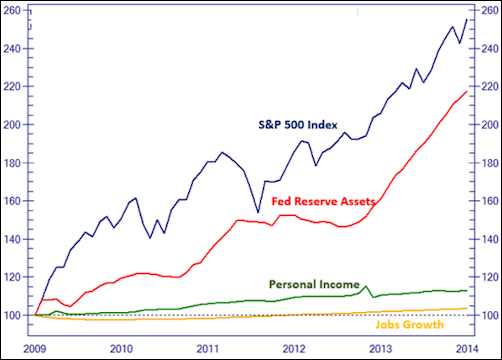
    Back to one of my favorite themes… If you want to understand the increase in income inequality over the past few years, look no further than this chart (which I have taken from Zero Hedge). For those who don’t intuitively draw the obvious conclusions, let me spell it out for you. Quantitative easing (as reflected in Federal Reserve assets) drives up stock and bond prices. The Top 1% own the vast majority of stocks and bonds; they enjoy major capital gains, which they report as income. The rich get richer. But QE represses interest rates, which punishes small savers with money in banks and money market funds. The middle class and working class get zilch. Actually, they get less than zilch. A 1% interest payment on a bank CD lags the inflation rate. The little guy actually loses wealth.

    Can we please stop pretending that the answer is higher tax rates and Congressionally designed wealth transfers? The biggest wealth transfer of all is staring us in the face. Wind that down, and you’ll see a big reduction in income inequality.

    — JAB


  • Cars, User Fees and the Intransigence of Human Nature

    Image credit: Thinking Highways
    Image credit: Thinking Highways

    by James A. Bacon

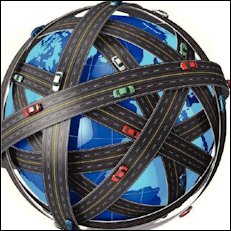
    Bern Grush has been promoting Mileage Based User Fees (MBUFs) as a mechanism for financing roads and highways since 2002 or so. The Toronto native was one of the earliest evangelists of the concept of charging trucks and cars by the mile to raise money to build and maintain roads. The movement built a head of steam in the mid-2000s but it has fizzled since. “I’m finished with the dream,” a frustrated Grush told me in an interview yesterday while we were discussing an essay, “Social Evolution and Road Pricing,” he had written for Thinking Highways.

    Well, he’s not really finished with the dream, but Grush does realize that MBUF proponents must adopt a radically different approach.ย Reformers wishing to alter the auto-centric transportation and land use policies have been flapping their jaws literally and figuratively for years in conferences, debates, presentations, academic journals, textbooks and mass media. Other than a mileage-based tax on heavy trucks in a couple of European countries, it has amounted to naught, Grush lamented in the essay.

    Arguments appealing to fairness and economic rationality just won’t work, he says. “People are just stubborn. It’s not that they’re dumb, they don’t get it or they’re Tea Party. They’re responding to their DNA.”

    We are biased for automobility by the reproductive advantages that superior autonomous mobility granted ancestral social groups of human nomads, gatherers, hunters, scavengers, warriors and conquerors. Any individual group or group of humans that could travel faster, carry more, range farther, and kill more would tend to eat more, live longer, keep more wives and produce more offspring. This generalized automobility, entrenched long before Karl Benz or Henry Ford, was triggered by the domestication of donkey, horse, camel and elephant. The advantage of superior, power-assisted automobility has been wired into humans for at least 7,000 years.

    The desire for autonomous travel operates at the same biological level as our evolutionary proclivity to wage group war and our deep social inclination to engage with religion. … When we ask drivers to use an alternative to the personal car, we are asking something more fundamental than most of us realize.

    Cars allow people to drive where they want, when they want. People in cars can travel alone, with passengers or loaded up with grocery bags or loot from Wal-Mart. People can choose whom they travel with. They can cocoon themselves in privacy and listen to music, talk radio or books on tape. At a more fundamental level, cars expand an individual’s range, allowing them to reach more potential work, more potential mates and more goods and services.

    As critics of the auto-centric society have pointed out, there are drawbacks to automobility as well. Cars create pollution, kill thousands in accidents, spew CO2 emissions (a concern to those who worry about catastrophic global warming), and create a hostile environment for those who would travel by other means. Ironically, when too many people own cars, the congestion they cause limits the very range and reach they covet when they purchase their cars.

    Cultural determinists, who believe that human behavior is infinitely malleable, will object to this way of thinking. But they have to reckon with the fact that in every society on the planet, humans invest personal resources to increase their personal mobility — bicycles in poor countries, motorcycles in somewhat wealthier countries, and automobiles in wealthier countries. They even drive cars in cities where traffic conditions are far more congested and hellish than in the United States. Whenever a human proclivity is universal across all societies, that’s a pretty good indication that it stems from what we colloquially refer to as human nature.

    But genes are not destiny. Warlike impulses are embedded in the genome but humans, endowed with the faculty of reason, have created institutions that have drastically reduced the incidence and severity of violence and war compared to that of our primitive forebears. Grush believes the same thing is possible with automobility. Autonomous or Self-Driving Cars, he says, may be the technology that allows us to reconcile our personal need for mobility with our social need to dampen congestion, pollution and the other externalities associated with too many cars.

    Many technology trends increasingly push services into the cloud, and away from physicality and ownership. Bus, taxi and carshare are forms of transportation as a service, but each are flawed. The bus is a far cry from automobility, the taxi is expensive and often uncertain, a car-share vehicle still needs the user to operate it. Large, variegated fleets of autonomous vehicles can provide true transportation as a service (TaaS). TaaS from the AV can be far more personalized than bus or tax and somewhat more than the current carshare fleet. And the AV can reach a far larger portion of people requiring automobility than can bus or carshare and much more cheaply and safely than a taxi. … (more…)


  • How to Cut Auto Usage without Social Engineering

    prying_cars
    Most Americans resist social engineering to pry them out of their cars.

    Emily Badger, a perceptive writer for the Atlantic Cities blog, makes a number of excellent points in aย commentaryย published today but manages to confirm conservatives’ worst fears that liberals and progressives are engaged in a war against cars. The libs may say they are “pro-transit,” “pro-bicycle” and “pro-transportation choice,” but when you scratch the surface, their real goal is to get people out of cars. It may be politically inexpedient to say so out loud — too many people like their cars — but that’s where liberals’ social-engineering instincts take them.

    In the piece, Badger discusses the many trade-offs that Americans make when deciding which transportation mode to use on any given day. The implicit goal is to shift commuters out of single-occupancy vehicles and into other modes of transportation such as biking, car pooling, walking or transit. “We can incentivize transit by making all of those other options more attractive,” she writes. “Or we can disincentivize driving by making it less so. What’s become increasingly apparent in the United States is that we’ll only get so far playing to the first strategy without incorporating the second.” Then she writes:

    The question is really how far we can get down the path of least resistance, pursuing only the politically easy tactics. If the goal at the end of the day is changing behavior, how much can you really achieve by showing people a nice new bike lane?

    Ka-boom! With one phrase — “if the goal is changing behavior” — Badger triggers conservatives’ reptilian fight-or-flight instinct. You don’t change anyone’s behavior through the political process except by mobilizing the coercive power of government. In other words, Badger wants to force me to change my behavior to advance her vision of society.

    Ironically, Badger dances along the edge of true insight. She alludes to important ways in which federal, state and local governments subsidize automobility — particularly through so-called “free” parking and gas taxes that fail to cover the full cost of building and maintaining roads. Then, for a brief, flickering moment, she really gets it:

    “Behavior change” sounds vaguely manipulative. … But in this context, the disincentives are really about removing subsidies and distortions from the market.

    Bingo! If Badger and her allies would re-frame the debate along those lines, they would make much bigger inroads with moderates, conservatives and others who resist social engineering at the hand of liberals. A couple of pointers for making Smart Growth palatable to conservatives:

    Adopt mode agnosticism. Don’t make “getting people out of their cars” the foundational goal of transportation policy. People like their cars, and for good reason — they offer flexibility, convenience and privacy. Instead, make transportation policy mode-agnostic. Create a level playing field between cars, transit, bikes and walking by eliminating governmental carrots and sticks altogether.ย The message: You’re welcome to drive your car if that’s what you prefer — just don’t expect us to subsidize your preference.

    End free parking.ย The way to curtail excessive car usage shouldn’t be to create artificial scarcities of parking, it should be to cease creating artificial surpluses of parking. Municipal policy subsidizes parking in many ways: mandating that property owners provide parking spaces, using tax-free municipal bonds to erect new parking garages and providing on-street parking for free, to name a few. Eliminating parking mandates and subsidies will increase the cost of car ownership, achieving liberal-progressive ends, but will do so in a way that deprives conservatives any philosophical basis for objecting. (more…)


  • Fixing Our Compromised Interstates and Highways

    29north
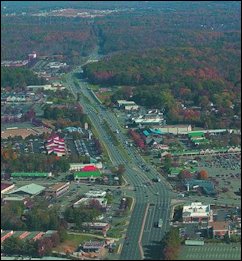
    U.S. 29 north of Charlottesville. Once upon a time, this was a highway. (Photo credit: C-ville.com.)

    Over on Strong Towns Chuck Marohn is running a five-part series on how to restructure transportation policy in his home state of Minnesota. Despite a different state/local government structure and different spheres of authority for the two states’ transportation departments, many of his proposals carry over to Virginia. In today’s missive, he tackles three issues that seem particularly pertinent to the Old Dominion.

    Interstate highways. Marohn outlines his idea of a “base” Interstate system, which performs the function for which it was originally designed of connecting major cities, or centers of economic activity. A base of two lanes (each direction) should be maintained by federal gas-tax dollars for the purpose of “making high speed connections between productive places.” The purpose of the Interstate system is to move people, goods and materials as quickly and efficiently as possible between economic centers, not moving them as fast as possible within economic centers.

    Marohn does not say so explicitly but his commentary implies it: Any lanes built beyond that two-lane base are required for local or regional connectivity, hence, should be the responsibility of state, regional or local authorities, not the federal government. He then suggests that these lanes be subject to congestion pricing. “The revenue from this fee will … be sequestered to fund maintenance of the extra capacity and, where needed, future expansion of the corridor (by whatever mode is most feasible).”

    Interstate exchanges. Interstate exchanges should be built and paid for with federal dollars at the rate of no more than one interchange per six miles outside a municipality. Their maintenance should be paid for with the federal gas tax. If someone wants to build additional interchanges, construction should be financed by means of “value capture,” a tax assessment on property owners whose values would rise as a result of the improvement. If value-capture financing cannot support the cost of constructing the interchange, there is no economic justification for it, and building it represents nothing but a wealth transfer from the general public to private property owners.

    State highways. Marohn suggests that federal funds should be applied to maintaining the equivalent of one lane (each way) for state highways, with additional lanes to be maintained and expanded as needed by means of congestion charges. That’s an elegant idea in theory but I worry about its applicability in the real world. Not only are there costs associated with administering congestion charges but it would be prohibitively expensive to segregate individual lanes on state highways, especially where those highways have been co-opted by urban transportation systems with lots of traffic lights, cut-throughs, driveways and entry points. I’ll set that aside as a utopian ideal for the moment to focus on what I think is an economically feasible idea.

    Under Marohn’s scheme, any private access to a state highway where the speed limit is set at 30 m.p.h. or greater should be subject to an annual access fee.

    The fee will be based on a ratio of the traffic on the highway versus the traffic accessing the highway, using methodology currently applied in signal placing and benefit/cost analysis. Under such a system, a farmer with a driveway on a remote state highway might pay $25 per year since the impact of a single home on a low volume roadway would be minimal. A strip mall on a congested corridor may pay thousands (or more) to offset the cost of slowing traffic on the highway. The access fee is compensation to the general taxpayer for degradation of the highwayโ€™s capacity, which the general taxpayer funded.

    That seems eminently doable. I would argue that existing access points should be grand-fathered, otherwise the political hue and cry would be so deafening that it would be impossible to pass legislation to put the idea into effect. But at the very least, Virginia should begin charging for new access to state highways.

    Marohn proposes a more complicated mechanism for urbanized areas where highways have been compromised by a profusion of intersecting streets, traffic signals, cut-throughs, curb-cuts and the like.

    Within cities, in areas where the speed limit is less than 30 mph, all properties within half a mile of the highway (measured perpendicularly) shall have a highway surcharge on their property tax. The surcharge will be based on the value of the land (higher valued land will pay more, note it is the land only and not the total improved property value) and is meant to pay for (a) the added costs of constructing and maintaining an urban highway, and (b) compensation to the general taxpayer (who funded the system) for degradation to the highwayโ€™s capacity. It should likewise be sequestered for this purpose. (more…)


  • Coal Giant Alpha Pays Biggest Water Fine Ever

    MTRBy Peter Galuszka

    Alpha Natural Resources of Bristol, the coal giant that took over troubled Massey Energy of Richmond in 2011, has the dubious honor paying the highest fines ever of $27.5 million for water pollution violations at its coal mining operations in five Appalachian states, including Virginia.

    Massey Energy, the owner of the Upper Big Branch mine in West Virginia where an explosion killed 29 miners in the worst such disaster in the U.S. in 40 years, held the previous water pollution fine record of $20 million issued in 2008.

    The Environmental Protection Agency says that from 2006 to 2013, Alpha and its subsidiaries violated water pollution permits 6,000 times and allowed toxic materials such as heavy metals into streams and the watersheds of Tennessee, West Virginia, Kentucky and Pennsylvania besides Virginia. The firm will also pay $200 million to reduce such toxic discharges.

    The settlement comes after a pair of unrelated water pollution situations involving coal in West Virginia and North Carolina. Some 300,000 residents of the Charleston area went without drinking water for several days when a toxic chemical used to treat coal leaked into a river. Duke Energy faces fines in North Carolina for improperly maintaining its coal ash storage facilities, leading to a substantial spill into the Dan River which provides drinking water for Danville and eventually, Virginia Beach.

    Alpha has touted its โ€œRunning Rightโ€ safety and management program as it absorbed Massey Energy and its rich coal reserves in a $7 billion deal. Alpha said it was retraining Massey workers who had suffered from Masseyโ€™s abusive corporate culture that cut corners on mine safety and environmental control, regulators say.

    Alpha had agreed to pay $200 million in a deal with the U.S. Attorneyโ€™s Office of Southern West Virginia to cover violations from the Upper Big Branch which it bought and closed after acquiring Massey. Alpha later settled a number of shareholder lawsuits for $265 million. Some of the payout funding had factored into funds set up by Massey before the acquisition by Alpha.

    Like most Appalachian coal producers, Alpha has been taking hits with soft markets for steam and metallurgical coal. Its 2013 revenues were $5 billion compared with $7 billion the year before.

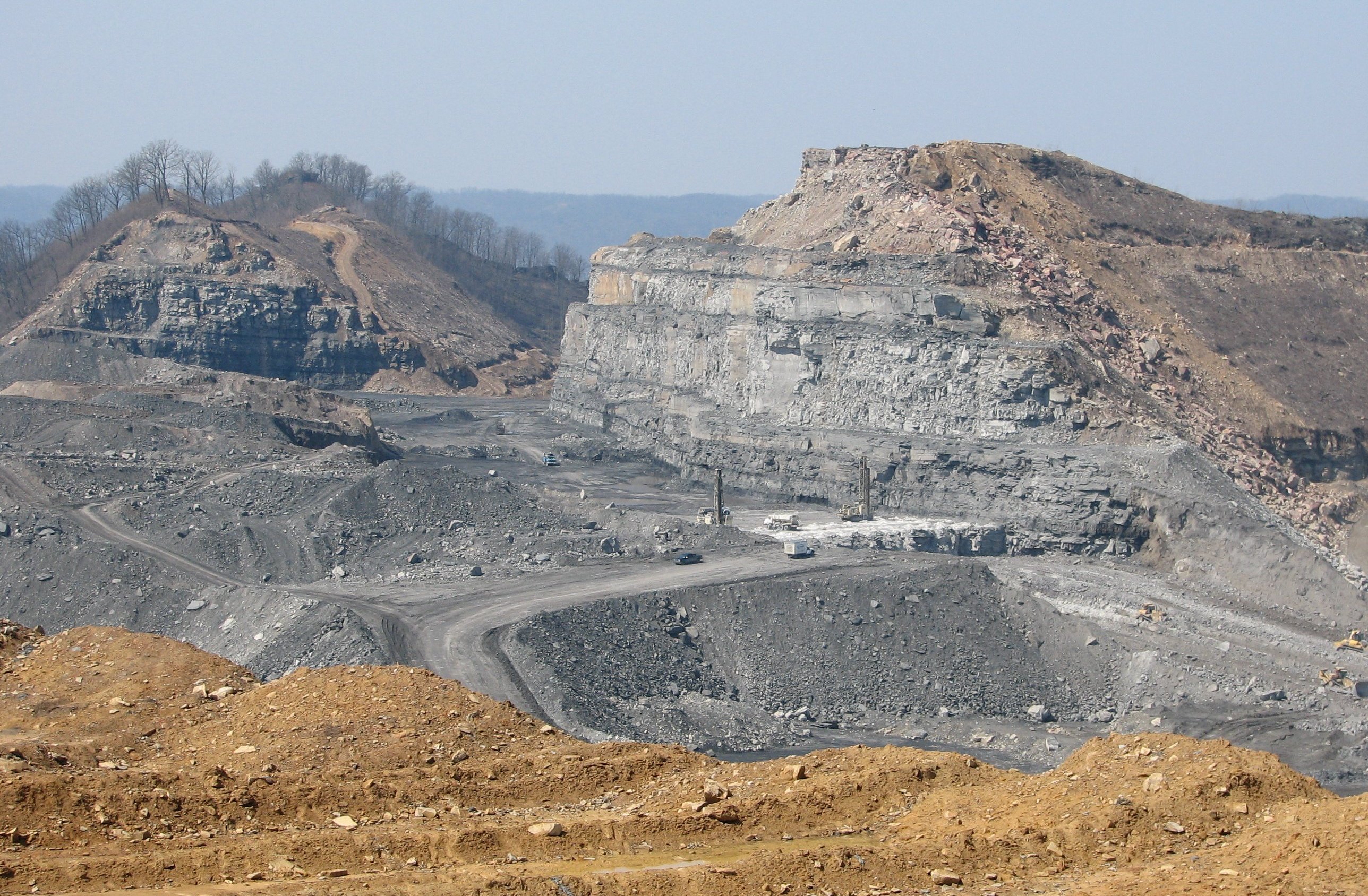
    Environmentalists say that Alphaโ€™s fine does not address the massive ecological destruction of mountaintop removal strip mining which they say should be stopped at the permit stage. Alpha operates a number of such mines.

    The latest fines involve 79 active coal mines and 25 coal processing plants.

    Federal investigators are still probing Massey for violations of safety laws related to the operation of Upper Big Branch where the explosion occurred April 5, 2010 and other mines. So far, three former employees have been convicted and Masseyโ€™s former CEO Don Blankenship is said to be a target of the probe. There is also a suggestion that Alpha is cooperating with federal investigators in the investigation.


  • The Surreal Tensions With Russia

    soldier in crimeaBy Peter Galuszka

    Back in the 1950s, when I was a little kid living in North Carolina or the Washington area, our family would take a semi-annual trip to visit my father’s relatives in western Massachusetts. My grandparents lived in a nice two-story house with an old-style brick barbecue in the back but that wasn’t the thrill for me.

    The reason I loved visiting was because of Westover Air Force Base, a Strategic Air Command facility on constant hair-trigger alert to blow the Soviet Union to kingdom come.

    Gigantic B-52s would drill, roaring over the house on takeoff, sometimes in the middle of the night. Interspersed among them would be KC-135 tankers modeled on Boeing 707 jetliners. They would thunder over the house, shaking everything, at intervals of 30 seconds or maybe a couple of minutes. I was too young to understand but the reason they took off that way was to get the bombs in the air before the Russians could nuke the entire area, including my family and me. Use ’em or lose ’em.

    So, more than 50 years later, it is bizarre to see Russia and the U.S. in their worst conflict since the 1962 Cuban Missile Crisis over Ukraine and Crimea. There are actually serious and intensely hedged think pieces online outlining what a modern day war between Moscow and Washington would look like. It could be a proxy war,ย  an air war but an ocean war is unlikely since the Black Sea is a bathtub and an American ship would be easy meat. The most likely worst case would be a NATO member on the border somehow getting involved and then we go in because we have to by treaty. If things ramp up, military-heavy Old Virginny will be high on the hit parade of love.

    Every morning, I go through the surreal headlines about what seems to be Vladimir Putin’s shameless land grab. I agree with analysts who say this is time for firmness but patience. Conservative yahoos should chill their stupid upbraiding of Obama. He didn’t do this. In fact, he’s been much tougher with Putin than George W. ever was. And, there isn’t much he can do. Any doubts, look at a convenient map.

    A few takeaways:

    • Putin’s not doing this to win over the Russian people. A poll shows that 73 percent of them want no part of military operations against Ukraine or Crimea.
    • It’s not clear that Putin is doing this to reinstate Viktor Yanukovich who was ousted as Ukrainian president in a street putsch in Kieva couple of weeks ago. Writing in today’s New York Times, Ruslan Pukhov of the Center for Analysis of Strategies and Technologies says that Putin actually favored former Ukrainian leader Yulia Tymoshenko, a darling of the West, who was released from prison when Yanukovich was ousted. This is not to say that Putin’s squeaky clean. He’s put plenty of people in prison, including, recently, Boris Nemtsov, a Russian liberal reformer.
    • The global economy can work against Putin. One of my biggest disappointments with the failure of 1980s and 1990s Russian reforms is that they have done little if anything to transform themselves from a fossil fuel kleptocracy into something more economically viable. They have enormous brainpower available but have squandered it. They need to get with the program and/or find someone to buy their oil and gas. The buyer doesn’t necessarily have to be Europe.
    • It’s awfully quiet there. There have been few if any reports of violence since the Crimea incursion began. That’s a far cry from a couple of weeks ago in Kiev. If he withdraws the extra forces, Putin can keep his Crimean bases anyway.

    Somehow, I have faith that the fortitude and common sense of ordinary Russians and Ukrainians will prevail. They did when I witnessed, up front and personal, my very own coup in 1993 in Moscow that killed a few hundred (including almost me a couple of times) and wounded thousands. The skinhead guys in the camo fatigues running around with AKs looked very much like some of the characters I saw on TV in Kiev. If they can be kept at bay, the U.S. doesn’t overplay its hand and ignorant American conservatives shut their yap, maybe this madness will end.


  • Bacon Bits: Bicycles and Baseball Stadiums

    bacon_bitsThe Easy Out. Writing in Henrico Monthly John Gerner, a Richmond-based leisure industry consultant, takes Richmond City Hall’s assumption that building a new baseball stadium requires public funding. Ballparks are often built with little or no public funding, he writes:

    Greensboroโ€™s privately financed ballpark that was built to accommodate a AA minor league baseball team, just like the Richmond Flying Squirrels. There are other ballparks currently being planned elsewhere in Virginia, but only Richmondโ€™s would be publicly funded. Often, the development costs are lower when stadiums are privately financed. The developer takes the risks. If it doesnโ€™t work, the private developer takes the hit financially. If it does work, the developer keeps the cost savings.

    A privately financed ballpark in Richmond would likely return its location back to the Boulevard, where the region wants it. For the long-term viability of baseball in Richmond, it needs regional support. Most of the fans come from outside the city, primarily from Chesterfield and Henrico. Political leaders in the suburbs know this. If the location were shifted back to the Boulevard, there would likely be another opportunity to forge a regional effort there through shared incentives for this privately financed ballpark.

    Huh? Life-Cycle Costs? Meanwhile, in his WTVR blog, Paul Goldman points out a flaw in City Hall’s proposed financing for the proposed Shockoe Bottom location of the stadium. The city’s bond financing will stretch 30 years. That makes sense, if you believe the city’s assertion that the stadium will have a useful life of 35 years. Just one problem, Goldman points out: No stadium has a useful life of 35 years.

    The Diamond opened in 1985. Twenty-nine years later, it’s supposedly obsolete. Writes Goldman:

    “After 20 years, technology advances, changing fan demands, local business needs, and more makes a Stadium obsolete. This is why we have seen all those new stadiums around the country in the last 20 years!

    Within the 30-year lease signed by the Squirrels, the โ€œnewโ€ stadium is going to be in need of hugely expensive renovations unless Mayor Jonesโ€™ secret plan is to build a new one back on the Boulevard!

    Won’t it be fun 20 years from now if the Richmond Flying Squirrels proclaim the “new” Shockoe stadium to be obsolete and asks the city to make millions of dollars in renovations…. or else. Just one problem — Richmond still will have 10 years to run on its bonds for the old ballpark!

    You’re Busting my Bikes! Writing on his blog, “Mapping the Commonwealth,” Luke Juday is all fired up by the large fines and penalties his Charlottesville friends are paying for traffic infractions. He offers four reasons why the system is a bad one:

    1. The cost of a ticket is disproportionate to the cost of owning and riding a bicycle.

    2. Bicycles are not 2-ton hunks of metal that go 70 m.p.h. and kill thousands of people a year. It is often difficult or impossible for bicyclists to follow the rules safely.

    4. Motorists are rarely held responsible for collisions with bicycles, making it awfully hypocritical to charge them as if they are equals on the road.

    I’m all in favor of making our streets “complete streets” shared by cars, pedestrians and bicycles. We need to shift the “rules of the road” in city streets back in favor of bikes and pedestrians. But in fairness, automobiles do not normally travel 70 m.p.h. in 25 m.p.h. speed zones. And many bicyclists often do behave recklessly (not Luke’s friends, of course, but other cyclists). I suspect we’re facing years of trench warfare between drivers and cyclists before we reach a new equilibrium.

    — JAB


  • Map of the Day: Where the Immigrants Settle

    foreign_born

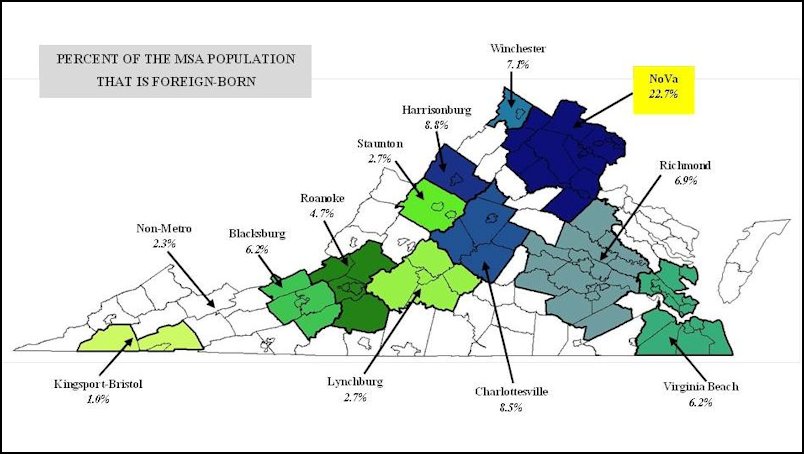
    Foreign-born immigrants now comprise 10% of the Commonwealth’s population. Eighty percent of Virginia immigrants originate from Asia or Latin America. The top five countries of origin are (in order) El Salvador, India, Mexico, Philippines and Korea. Sixty-eight percent of all the state’s immigrants reside in Northern Virginia. So reports the Weldon Cooper Center’s StatsChat blog from which this map was taken.

    — JAB


  • Value Capture vs. Slush Funds as Transportation Funding Tool

    transcontinental_railroad
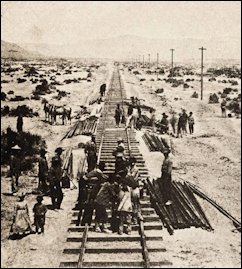
    America’s trans-continental railroads were financed through value-capture.

    by James A. Bacon

    Charles Marohn at Strong Towns has penned a fascinating piece comparing the financing of America’s railroad system in the 19th century with the construction of the nation’s Interstate highway system in the 20th. (Read the essay on the Smart Growth for Conservatives blog.) The railroads used a form of “value capture,” which worked extraordinarily well, while the Interstates used public funds, which, in hindsight, we can see hasn’t worked out so well.

    The federal government gave trans-continental railroads land along their routes. It was easy to give away — no one lived there (other than the Indians, and they didn’t count back then) so it had no value. Railroads created the value, and they sold off that value in the form of lots and parcels to pay off the railroad bonds they used to finance construction. By contrast, the federal government employed a motor fuels tax to finance construction of the Interstate system. While the tax at least was a rough user-pays system, it created a pool of money — Marohn calls it a “slush fund” — which politicians could allocate without regard to the economic viability of particular projects.

    Marohn argues that the 20th-century transportation-funding system created two travesties. First, it severed the correlation between supply and demand.

    We all subtly pay into a giant slush fund and then we all expect that slush fund to deliver on its promise and meet our insatiable demand. Members of the engineering professionย have called taxpayers โ€œwhinersโ€ย for not wanting to pay more, but why would anyone pay more for something they donโ€™t really value?

    … People do value transportation, but at what price? Nobody really knows. Time and again we see that, when prices are not hidden in a slush fund but instead are paid by the user at the time of consumption, demand drops. For a government-led transportation system, a drop in demand is devastating. Put a toll on that road priced for current usage and fewer people will use it. The drop in demand forces an increase in the toll if the same revenue is to be sustained. An increase in the toll further depresses demand and on and on and onโ€ฆ

    The second travesty is that the funding system eliminates valuable feedback regarding a project’s economic viability.

    In the railroad era, private investment always led public investment. The railroads would construct the lines, build the towns and the town itself would be somewhat established before any public investments were made. …ย In the automobile era, the risk taking is reversed. For all but the most local of transportation improvements, governments front the investment capital and take the risk. …

    What happened when the private railroad companies overbuilt their system? What happened when they got out in front of market and had too much supply without enough demand? They, of course, got the painful feedback of losing money and watching their assets drop in value. Sometimes entire companies went out of business.

    What happens when the government, operating in the automobile era, overbuilds? What happens when we create so much supply, so many miles of roadway, that demand canโ€™t possibly utilize it effectively? Well, the feedback isnโ€™t quite so direct. Budgets start to be frayed. Obligations go unfulfilled. There isnโ€™t enough return on these government investments and so there ultimately isnโ€™t enough money to care for them. These things can be attributed to many causes, of course, most of which appeal to our psyche more than the idea that weโ€™ve overbuilt.

    Contrary to the protestations of the special pleaders, who maintain Virginia has an unfunded backlog of tens of billions of dollars of transportation needs and the nation has an underfunded backlog hundreds of billions, Marohn contends that the United States has built more road and highway infrastructure than it can effectively maintain.

    Our solution, bizarrely, is to build more.ย So long as the government has the money to avoid the hardest decisions, any uncomfortable response โ€“ land use changes, shifting from automobile trips to walking or biking or modifications to the tax code, to name just three โ€“ will remain off the table, or at least relegated to the fringe. More money doesnโ€™t solve any problems. It just forestalls the pain of transition, compounding the imbalances in the process.

    Well done, Charles. Very well done.


  • Roanoke Experiments with Paid Parking

    roanoke
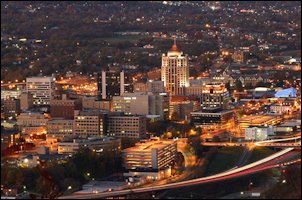
    Downtown Roanoke

    by James A. Bacon

    In 1999 the City of Roanoke went socialist with its on-street parking downtown — it removed the last of its parking meters with the idea of making downtown more “hospitable” to visitors. Fifteen years later, city officials are planning to experiment with free markets and actually use price as a rationing mechanism for scarce on-street parking spaces — but only on a 90-day pilot basis.

    Whether the meters stay will depend on how they are received, said Assistant City Manager Brian Townsend, as quoted by the Roanoke Times.ย โ€œIf we find thereโ€™s not general acceptance by the public, then, no, we wonโ€™t proceed.โ€

    That’s not especially reassuring. The general public generally likes things for free. If you take the free things away, they get unhappy. Therefore, I don’t expect Roanoke’s experiment with market economics to end well. But at least I give the city fathers credit for trying.

    The initiative is aimed at correcting what Parking Administrator Debbie Moses terms an upside down parking system in which the highest-demand spaces in the downtown core are free while less popular spaces in parking garages charge a fee. The article doesn’t say so explicitly, but it’s easy to predict that when people don’t have to pay for premium parking spaces, they are less cognizant of time and will occupy the spaces longer than they would otherwise. Premium spaces should turn over rapidly; “free” parking turns over slowly. (I put “free” in quotation marks because free parking really isn’t free. Downtown parking spaces have economic value. On-street parking spaces could be converted to bike lanes, car lanes, wider sidewalks or other uses.)

    Roanoke officials will use the latest technology. The new meters will take cash, credit and debit cards as well as payment by smartphone. They will notify users by text message when their time is about to expire and allow them to extend time remotely. (While that’s great for people who own smart phones, it may not be so great for the old geezer who want to put a quarter in the slot. That’s why I expect the new parking spaces to lose the geezer vote.)

    City officials position the initiative as creating more choices for people who work downtown and patronize businesses there. They pay a premium price for the most convenient, on-street parking. They pay less for moderately convenient parking garages. And they get two-hour free parking if they are willing to walk a few blocks to parking lots on the downtown periphery.

    The article did not address one really important question: Will the prices be fixed, will they vary according toย day of the week and time of day, or will they vary according to supply-and-demand conditions?ย The latest thinking suggests that prices should be set high enough to aim for 85% occupancy, a level that maximizes revenue while ensuring that someone looking for a space always will be able to find one.ย Also, the writer made no mention as to whether Roanokers would be able to use smart-phone apps to find vacant parking spaces.ย 

    Taking away peoples’ “free” parking is hard, just like taking away their right to use the roads for “free” — i.e. taxing someone else pay to pay for building and maintaining them — is difficult. But it is a small but necessary step toward making downtown Roanoke more fiscally sustainable and economically viable.


  • A Distracting Doctrine

    agenda21Instead of fixating on the United Nationโ€™s Agenda 21 as a threat to American liberties, conservatives should articulate fiscally responsible, market-driven policies to address the very real challenges facing local governments in the United States.

    by James A. Bacon

    The anti-Agenda 21 movement, which views the United Nations as the prime mover behind local sustainability initiatives, is a growing force in many states and local governments across the United States. While anti-Agenda 21 theorists share some of the same language and principles as mainstream conservatives, they have little meaningful to contribute to the debate over environmental, transportation, land-use and property-rights issues. Their ill-documented conspiracy talk distracts from the kind of discussions that conservatives should be having. To govern effectively, conservative elected officials need to re-frame the debate over growth and development in a way that is forward-looking, grounded in hard facts and in line with conservative values.

    The Anti-Agenda 21 Movement

    Over the past few years, the anti-Agenda 21 cause has emerged from obscurity into a force capable of pushing resolutions through state legislatures. The movement is populist and decentralized — many adherents are ordinary citizens whose passions have been inflamed in local land-use disputes — although it does have the backing of the John Birch Society and talk show personality Glen Beck. In some states, Anti-Agenda 21 partisans have leveraged their influence by co-opting local Tea Parties and other groups sympathetic to property rights and limited government. Sometimes they find a sympathetic ear among conservative elected officials. But they also use aggressive means โ€“ packing public meetings, singling out politicians for vocal criticism โ€“ to intimidate local officials with more moderate views into going along.

    Activists disseminate their views by means of speeches, books, websites, fliers, YouTube videos and social media. There is no definitive source for the anti-Agenda 21 movement. Most writing is impressionistic and scattershot. However, several themes do appear repeatedly in the literature.

    (1) The Agenda 21 agreement adopted at the 1992 United Nations conference in Rio de Janeiro is the fountainhead of the global sustainability movement. The document provides a comprehensive plan for achieving โ€œenvironmental sustainabilityโ€ and โ€œsocial justiceโ€ at the expense of property rights and individual liberties.

    (2) Agenda 21 provides a blueprint for a radical restructuring of the American way of life. Social-engineering goals include returning much of North America back to a wild and natural state, herding Americans into dense urban centers, replacing single family dwellings with multifamily housing and phasing out the automobile in favor of bicycles and mass transit.

    To read the full white paper, click here.


  • Dominion Benefits As Renewables Struggle

    North Anna PixBy Peter Galuszka

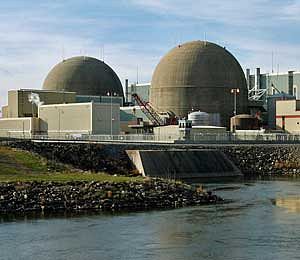
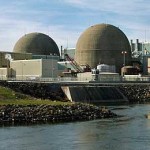
    Dominion Virginia Power, as is its style, has achieved a quiet but far-reaching regulatory victory. The General Assembly has passed a complicated bill that would help Dominion write off costs for a new nuclear reactor while avoiding giving potential refunds or rate cuts to customers.

    The bill, which easily sailed through the legislature, has drawn attention to whether the utility really will build a third nuclear unit at North Anna and why bills to help smaller players trying to create renewable sources of energy seem to get nowhere in Virginia.

    Dominion will be allowed to deduct $400 million from its profits in a scheme that allows it to count as costs the nuclear research it does. This will likely help it avoid paying rebates to consumers the next time the State Corporation Commission considers its rates.

    There are several curiosities with the scheme. For one, although Dominion filed early plans for a third reactor about a decade ago, the project hasnโ€™t seemed to move very far. The disaster at the Fukushima plant in Japan in 2011 forced a rethink of how the U.S. plans its new reactors. Another problem is that North Anna suffered a major setback later in 2011 when an earthquake forced a shutdown at that station and pushed reactors past their design limits.

    The danger is hardly news but may be largely forgotten. In the 1970s, Virginia Electric & Power Co., Dominion’s predecessor, was fined by federal regulators for knowing and lying about some aspects of a geological fault line that runs under the North Anna area when it planned the nuclear power station in the 1960s.

    I have visited North Anna in recent years and have asked Dominion about how they plan to pay for a third reactor. Some estimate it may cost about $10 billion. Many reactors on the drawing boards canโ€™t be built without federal loan guarantees. Dominion has said it wonโ€™t need such guarantees.

    Last month, the Department of Energy announced that the federal government will provide $6.5 billion in federal loan guarantees for two new reactors planned by the Southern Company in Vogtle, Ga. They are the first in such government backing.

    A big question is how far along is the third unit at North Anna and why the General Assembly felt comfortable about making such beneficial moves if thereโ€™s any question about it.

    Meanwhile, Bill Sizemore at The Virginian-Pilot has an intriguing story about how Dominion, which gave $1 million to Virginia politicians last year, has little trouble with its laws while smaller fry in the renewable energy sector struggle.

    They have failed at getting the General Assembly to push tax credits to help install solar, wind and other, non-fossil and non-nuclear forms of power. Originally, the proposal called for $100 million in tax credits a year but that was pared down to $10 million and then was put off for consideration next year.

    Virginia has voluntary Renewable Portfolio Standards calling for a percentage of new power generation to come from renewable sources. The approach favors large utilities such as Dominion and Appalachian Power. Neighboring states North Carolina and Maryland have mandatory standards and that may be one reason why Virginia has only 5 percent of North Carolinaโ€™s solar power capacity.

    Dominion points out that it has renewable projects such as solar powered panels at a university and has plans for offshore wind, but these efforts are relatively modest.

    One irony with the current situation involving renewables is that conservatives argue that their promoters must meet strict free market tests. If solar and wind and other sources can expand, they need to make it without government help based on their ability to innovate and market salable products. But the traditional, large utilities have no trouble getting billions in government help in federal loan guarantees or in rate write offs that Dominion will enjoy.

    So, it seems the fix is in for traditional power in Virginia. That was certainly the case with former Gov. Robert F. McDonnell who wanted to make Virginia โ€œthe energy capital of the East Coast.โ€ He strongly backed offshore drilling. Incoming Gov. Terry McAuliffe had been suspicious of offshore drilling in 2009 when he first ran for governor but has since changed his position to the consternation of environmentalists.

    โ€œWeโ€™re really disappointed but not surprised,โ€ says Glen Besa, head of the Sierra Clubโ€™s Virginia chapter.


  • Has It Really Come to This?

    Photo credit: EveryJoe.
    Nicole Coon. Photo credit: EveryJoe.

    I do admire Nicole Coon for her bravery in stepping forward to promote passage of the so-called “revenge porn” bill that now awaits Governor Terry McAuliffe’s signature. The pretty nursing student had sent an, um, embarrassing video to a boyfriend who, presumably when he was no longer a boyfriend, posted it on a website that demanded $500 for its removal. Coon risked public ridicule to correct an obvious wrong. Good for her!

    According to the Washington Post, the bill would make it a misdemeanor to “maliciously” distribute a nude or sexual photograph of another person with “intent to coerce, harass or intimidate” without license. Maryland is considering a similar bill.

    Clearly, such behavior is despicable and deserves to be punished. But, holy moly, do I really have to say this? What was she thinking? What’s with the Millennial generation? What’s with all this selfie business? Why the necessity to share intimate images? Can’t young people wait until they see each other in the flesh to bare all? Did America’s youth learn absolutely nothing from Anthony Wiener?

    I have two daughters. Girls, if you’re reading this, pay attention: If your photo ends up on a revenge porn site, you’ll get zero sympathy from me!! Zero!!

    And one more thing. Besides passing a law, perhaps we should set up a retaliatory site — www.scumbag.com — to show photographs of the jerks and cads who post their ex-girlfriends on revenge porn websites. Not only should such dirtballs face fines, they should be exposed to scorn and ostracism for being the contemptible scum buckets that they are. I also have a son. If you’re reading this, be forewarned: Pull a revenge-porn stunt, and I’m throwing you out of the house!

    The younger generation… Jeesh!

    — JAB


  • Second Map of the Day: Where the Young People Are Going

    Source: Weldon Cooper Center for Public Service
    Source: Weldon Cooper Center for Public Service

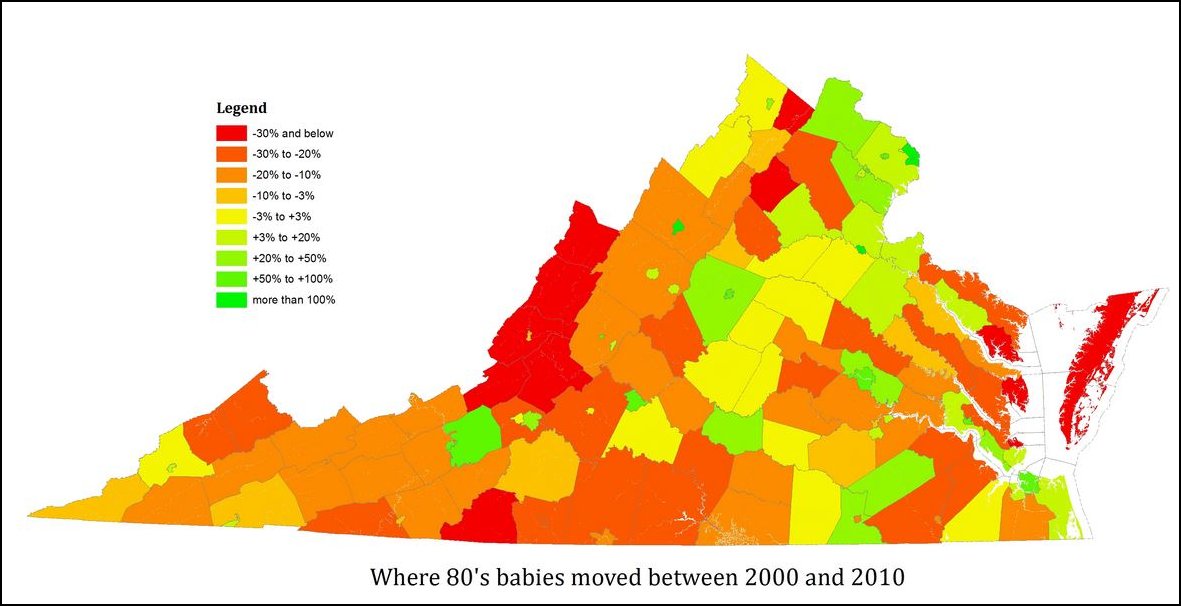
    If the future of Virginia resides with its young people, we can see from the map above that some regions are a lot better off than others.

    Luke Juday, several of whose maps I have re-published on Bacon’s Rebellion, has moved to the Weldon Cooper Center for Public Service, where he has begun posting on the Demographics Research Group’s StatChat blog. In this map, he shows where the Millennials moved between their teen years and their 20s by showing in tan/brown/red the localities that exported young people and in green the localities that imported them. (Yellow jurisdictions were a wash.)

    The big gainers: Northern Virginia, urban-core cities and college towns. The losers: most everybody else.

    — JAB


  • Map of the Day: Lightning Fatalities

    lightning

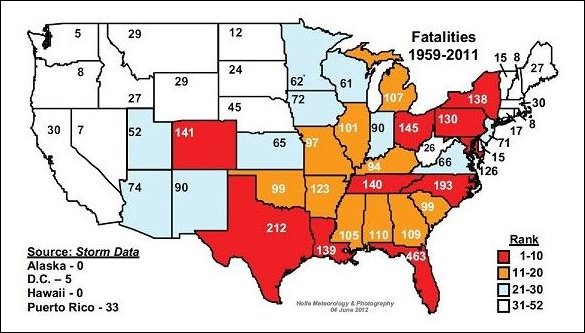
    If you’re afraid of lightning, you’re way better off in Virginia than in North Carolina or Maryland!

    Source: The Atlantic Cities blog.

    — JAB