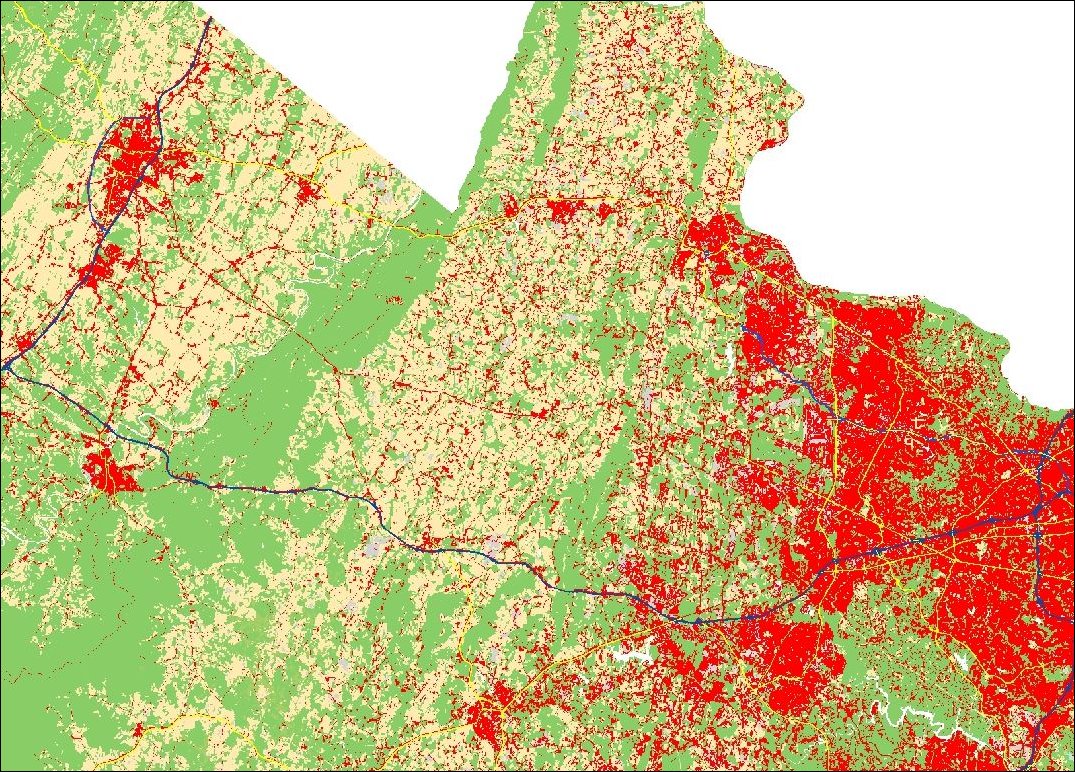
2006 population distribution, Beltway to Winchester.
Luke Juday is using his mapping tools over at the Weldon Cooper Center for Public Policy to project what Virginia’s population distribution could look like 25 years from now and 50 years from now. You can see those maps here. We’ve re-published many of his maps here at Bacon’s Rebellion, so you may find them familiar. But Juday is always tweaking, and always looking for more geographic databases to play with, and he has done something really new: He shows how conservation easements in Loudoun and Fauquier counties could shape Northern Virginia’s growth trajectory over the next half century.
Beltway to Winchester 50 years from now — conservation easements in blue.
As Juday writes, “Conservation easements matter”… at least when they achieve critical mass, as they have done in the Middleburg-Upperville hunt country area. The easements could play a major role in blocking the western advance of the Washington metropolitan region, forcing development south toward Fredericksburg.
Please note that Juday does not describe these maps as a “forecast” or “projection.” Rather, they are a visualization of how population would be distributed if (a) Weldon Cooper’s planning district-level population projects prove accurate, (b) no “game-changer” roads are built such as the Prince William Bi-County Parkway and (c) regions develop at their current level of density. The visualizations ignore zoning, which is too complex to include in his mapping routine, and it does not reflect the very real possibility that Americans (and Virginians) are driving less, with the implication that trend would have for greater urban density and infill. Finally, I would add, the map doesn’t consider the likelihood that northern Piedmont landowners will continue to place land in conservation easements, meaning that the swaths of blue will get even thicker and more formidable.
Even with all those caveats, the visualization shows how, over a long period of time, conservation easements could become as important as rivers, bays and Interstate highways in shaping Northern Virginia’s future.
A generation ago, liberals mocked the so-called “trickle-down economics” of the Reagan administration, the idea that creating wealth for the rich would trickle down to the less affluent by way of expanded economic activity. While Reagan himself never used that term, his economic philosophy of tax cuts, tax-code reform and restrained federal spending did work as advertised. The 1980s were a period of great prosperity in which all income groups and ethnicities shared. The irony is that the trickle-down economics is a label more aptly applied to the policies of President Barack Obama. During O’s five years in office, the rich have gotten richer while the poor have fed on scraps. But you’ll never hear the term “trickle down” applied to Obama’s monetary policies.
There are many winners from the low interest rate policy implemented by the Federal Reserve Board with the full support of the Obama administration — most of them wealthy. One group is the “millionaires and billionaires” who benefit from rising stock and bond prices. Another is the owners of mortgages who have refinanced their debt at lower interest rates, in many cases saving hundreds of dollars a month. Needless to say, those with the highest incomes who can afford the most expensive houses benefit the most. The biggest beneficiary, of course, is the federal government, the world’s largest debtor, which saves on the order of $200 billion to $300 billion a year in interest payments on its $17 trillion debt. Finally, there is a modest trickle-down effect in the form of job creation in interest rate-sensitive industries like construction.
Of course, there are many losers, too — a mega-narrative that has gone largely unreported by the mainstream media. One group of losers is small business, which finds it more difficult to gain access to capital (it’s easier for banks to lend to the government). Another group consists of state and local governments whose retirement funds no longer generate the returns they were several years ago and now face chronic fiscal stress as they struggle to make up the difference. Fifteen years ago, for example, the Virginia pension system was fully funded. Today, even after major structural reforms, Virginia and its local governments still owe billions.
Then there are the little guys, especially the Baby Boomers who accumulated modest nest eggs to help support them in retirement. I have fulminated on this topic on and off since writing “Boomergeddon,” frustrated that the issue has drawn so little attention. But a Bloomberg News article published today in the Times-Dispatch (sorry, can’t find the link) shows the full dimension of the problem. Some key points:
A 65-year-old who wanted to pay for retirement with annuities tied to bonds needed 24% more wealth in 2013 than in 2005. National Bureau of economic Research President James Potera calculated in a research paper released in February. …
U.S. Treasury yields are at least 2 percentage points less than what they would be otherwise because of the Fed’s low-rate policies and stimulus programs, said William Ford, former Atlanta Fed president who wrote a 2011 paper estimating the impact on savers of monetary easing. That reduces their income by at least $280 billion annually, his analysis shows.
“The cost of low interest rates are being ignored,” Ford said. “It is killing savers, elderly savers who are living on life savings that have been conservatively invested.”
The Fed is engineering one of the greatest wealth transfers in American history — from the working-class and middle-class to the rich. The stock market has never been higher.Wall Street is doing better than ever. Bankers are still getting their big bonuses. And the little guys with meager savings are watching their pathetic little nest eggs lose value as inflation exceeds the income they can generate.
The extraordinary thing is that Obama then turns around and castigates the economic system for inequalities in wealth — the very same inequalities that he and former Fed Chairman Ben Bernanke (it’s too early to pin any blame on Janet Yellen yet) did to aggravate. Rather than undo the harm he has inflicted, Obama ask Americans to entrust him with even more power to “help” the poor and downtrodden. What I find mind-boggling is that this is not the delusion of a single man — it’s that liberals and leftists have so uniformly and gullibly bought into the delusion. They have become apologists for the very evil, income inequality, that they decry.
I suppose that’s inevitable. The political class always gravitates to “solutions” that entail the accumulation of more power for the political class. In Virginia, liberals’ idea is to expand the Medicaid entitlement, paid for the federal government with borrowed money. Why not? It’s “free” money. But it’s really not. Every billion dollars borrowed by the federal government requires more financial repression and more wealth transfer from savers to favored classes of borrowers, the foremost of which is the U.S. government. The favored classes do not include the poor and middle-class who rack up credit card debt, typically charges around 13% to 15%.
Liberals prattle about “social justice” and lobby for distractions like a higher minimum wage (which raises pay for some and destroys jobs for others) while aiding and abetting the trickle-down economics that leaves America’s less well-off with crumbs. The hypocrisy is almost too much to bear.
About 32 years ago, I was driving my dark green Audi Fox through Virginia’s lush horse country near Middleburg in search of a 350-acre farm owned by Harry Rositzke, author, educator and linguist. He also was one of the highest ranking spies in the Central Intelligence Agency which ran secret operations against Ukraine and other Soviet republics from 1949 to 1954.
Rositzke, who died in 2002, seemed an odd prospect for gentleman farmer. He had been born in Brooklyn and sounded like it. He had an extreme sense of street smarts, as I found when I was working on a newspaper story on spying in Virginia.
From what I remember of my interview — I lost my notes years ago — I had no real idea just how active the CIA had been in actually recruiting local language speakers, often displaced persons or recent emigres, giving them a smattering of training and then kicking them out the side door of a dark-colored C-47 at night onto the potato fields of Ukraine, the Baltic States and also Russia.
Mind you, these black drops were just a few years after the Soviet Union and the U.S. were suspicious allies who had helped defeat Germany, Japan and Italy. Things turned nasty very quickly and, as history moves forward, we seem back where we were 60 plus years ago.
Today, Vladimir Putin is massing Russian troops on the Ukraine border after annexing Crimea. He claims that America has a history of meddling in Ukraine, an independent nation since the 1991 split up of the U.S.S.R. The ironies are delicious. Putin, a former KGB spy in East Germany, is right.
The spy acronym for the early Cold War infiltration efforts was REDSOX, according to espionage historian Matthew Aim. The specific ones against Ukraine were labelled AERODYNAMIC with others being AEROOT (Estonia), AEQUOR (Byelorussia), AECOB (Latvia), AEGEAN (Lithuania) and AESAURUS (inside Russia itself).
The operations were run out of a CIA base in Munich and were headed in 1951 to 1954 by Rositzke. “We were sending people into the Ukraine, people forget that there was an active resistance movement there… We’d fly them in and parachute them from C-47s. We never lost a plane. We were pleased to see how inefficient the anti-aircraft sources were,” he told The Washington Post.
Aim believes that up to 85 agents were air dropped in denied areas of Eastern and Central Europe from 1949 to 1954. The British MI6 intelligence group likewise sent agents there.
It isn’t clear what their missions were, but reconnaissance, establishing covert networks and sabotage are possibilities. The strange part is that anywhere from 75 to 100 percent of the air drop covert missions were failures, according to Aim and others.
One problem is that the American spymasters probably didn’t know what they were getting into. It wasn’t the same as setting up French underground groups during World War II; émigré groups fought each other and many if not all of the missions had been thoroughly compromised by Soviet counter-intelligence before they ever got off the ground.
According to Aim, one British agent named Myron Matviyenko had been in command of three teams of MI6 infiltrators who had jumped into Western Ukraine and Poland but turned them all in to the Soviets. Another theory is that Soviet super spy H.A. R. “Kim” Philby had learned of many of the missions while a British Embassy official in Washington and quickly passed the information along. Many of the agents simply vanished.
Rositzke at one point is quoted as saying that the missions were so rushed that the CIA hadn’t had time to vet the agents. In any event, he bought his farm near Middleburg in 1955 as a place to retire and eventually did. Little did I know as I was driving away from Rositzke’s estate with the big oak trees that I would be working in the Soviet Union myself as a news correspondent four years later. I ended up doing two tours of three years there.
In 1996, as I was preparing to leave Moscow for the last time, I went to a new museum opened by the KGB at their famous Lybyanka Headquarters. The guide was an elderly, grey haired man with ice cold blue eyes, sort of Putin-like. He was a retired KGB officer and I was mesmerized that their exhibit had photos and relics from compromised American and British covert ops in Ukraine and the Baltics.
One dead giveaway was that the CIA was dumb enough to use stainless steel staples in the fake passports it made, the guide said. Everyone knows that true Soviet passport staples are old-style iron and they always smudge the paper with rust. This could be easily spotted by checking a passport. No smudge? Instant spy!
I asked if the CIA still made the same mistake after all these years. He stared at me coldly for more than a minute before responding: “No, they make others.”
Medicaid reform? We don’t need no stinking Medicaid reform.
by James A. Bacon
Let me get this straight. Virginia Democrats in the General Assembly are saying that they will not pass a state budget until they get Medicaid expansion?
“We won’t vote for a budget — and I can’t be emphatic enough — we will not vote for a budget, nor will the governor sign a budget that doesn’t have some form of expansion,” Senate Democratic Leader Richard L. Saslaw, D-Fairfax, said during a brief conference call. So reports the Times-Dispatch.
The only possible conclusion to draw from that statement is that the Dems are willing to shut down state government (and much of local government) in order to get their way. Hmmm… Who does that sound like? Oh, I don’t know… maybe Congressional Republicans in the debt-ceiling debate with President Obama? The same Republicans whom the Dems denounced as maniacally irresponsible and willing to destroy the country in order to save it?
I’ve heard a lot of reasons why state Dems support Medicaid expansion: The money would come from Uncle Sam, it would expand health coverage for thousands of Virginians and it would pump up the state’s economy. These are not unreasonable arguments.
Here’s what I have not heard: why Democrats refuse to join with Republicans in pushing for Medicaid reforms. If Governor Terry McAuliffe and other Dems joined Republicans in petitioning the Obama administration, there is every reason to think the state could get the waivers and exemptions they’re asking for. President Obama has waived just about every other provision of Obamacare, why not this?
I truly don’t understand why the Dems can’t join the GOP in presenting a united front to extract Medicaid reforms from the Obama administration. They’ll get what they want, an expanded Medicaid program. It’ll just be a little leaner and more fiscally sustainable than what they’re asking for now. Are they really willing to shut down government over that? Who are the intransigents now?
American society is buckling under the strain of health care costs. The debate, as I have often opined, is stuck on the question of who pays those costs rather than how we can bring costs down. Improving Americans’ health is not a job we can should relegate to Congress and the General Assembly. It is a job for all Virginians — including the real estate industry, as Maureen McAvey with the Urban Land Institute noted at a meeting of ULI’s Richmond branch Wednesday morning.
Chronic diseases such as obesity, heart disease and diabetes reflect 21st century lifestyles marked by too many calories and too little exercise. Exhorting the populace to work out more has not proven terribly successful. But there is a growing conviction that we can design our communities to make moderate activity a routine aspect of our lives. During her presentation, McAvey hit the highlights of a recent ULI publication, “Ten Principles for Building Health Places,” which outlined several approaches to making our communities more hospitable to healthy living.
The publication contains many ideas that should appeal to fiscal conservatives and free-marketeers allergic to the social engineering impulses of the do-gooders who normally champion such things. Designing communities to encourage people to get more exercise should not be an ideological issue. If anything, conservatives should applaud any approach that encourages individuals to assume more responsibility for their own health.
Here are some of the ideas I plucked from the publication and McAvey’s remarks that philosophical conservatives should embrace.
Build complete streets. Conceptually speaking, there is a critical difference between roads and streets. It is OK to design roads with the primacy of the automobile in mind; their function is to increase mobility between cities, towns and major activity centers, which is usually best accomplished with cars. Streets should be designed with the idea of accommodating pedestrians, bicycles and motor scooters in addition to cars for the purpose of providing local access. Reconfiguring the public right of way in accordance with “complete streets” principles makes it safer and more convenient for people to conduct more of their business and run more of their errands on foot. Not only does that take cars off the streets, it builds light exercise into peoples’ daily routine.
Mix it up. Mixed-use development combines the functions of daily life in a concentrated area rather than mandating the separation of housing, jobs and amenities in separate pods. As the report states, “ULI has concluded that mixed-use development makes people much more likely to walk or use transit to run errands, go shopping, or go to lunch than does spread-out, automobile-oriented, single-use development.” Combine mixed-use development with complete streets and mass transit, and you get a winning formula for getting people to walk more.
Conservatives, please note: No one is talking about shutting down the suburbs and herding people into buses and apartment complexes. All we need here is for local governments to meet the large unmet demand for walkable communities. The idea here is to allow more freedom, not less, by freeing builders and developers from restrictions imposed by local zoning codes in order to build the kinds of communities people want to live in.
Ensure equitable access. Cars are expensive. Not everyone can afford them, and not everyone can drive them. Children under 16 cannot drive. Many elderly and handicapped people cannot drive. Many poor people cannot afford to own a car. Conservatives should aspire to build communities that allow more people to be more self reliant and not to rely upon others for their transportation. People who use mass transit also walk. By necessity, if you ride the bus, you walk to the bus stop.
Another note to conservatives: Supporting mass transit through complete streets and mixed-use development need not entail writing a blank check to money-losing municipal transit authorities. Rather than abandoning the idea of mass transit, we should strip away the subsidies, regulations and politicized decision-making that makes mass transit a financial loser. Conservatives should champion profitable, self-supporting mass transit.
Energize shared spaces. Humans are social creatures and they like to socialize. Creating great public spaces encourages people to get outside, walk and mingle with others. As ULI explains, “the residential street should be regarded as a primary public space, not merely a conduit to meet travel needs. A living street is a street … where people can meet and children can play safely and legally.” Best practices include zero-grade separations between sidewalk and street to create a plaza-like feel, wide sidewalks, installation of trees, planters, public art and ground-level retail. (more…)
Investing $284 million in a streetcar system along Columbia Pike would generate between $3.2 billion and $4.4 billion in net tax revenue for Arlington and Fairfax Counties, over and above capital and operating costs, over 30 years, according to a new analysis by HR&A Advisors prepared for Arlington County.
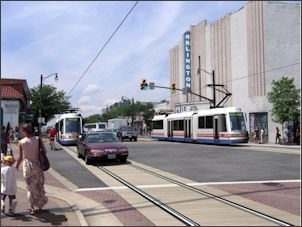
The street car system — 14 streetcars stopping every quarter- to half-mile — would run between Bailey’s Crossroads in Fairfax and Pentagon City in Arlington. Travel time between the two points would be 23 minutes, only one minute longer than for the buses, but the street cars would carry 3,200 more passengers daily and would generate more real estate investment along the corridor, concludes “Columbia Pike Transit Initiative: Comparative Return on Investment Study.”
“This study further demonstrates that streetcar is the right investment for Arlington,” said Arlington Board Chairman Jay Fisette in announcing the study.
Streetcar opponents had argued that the streetcar would cost far more than upgrading the bus system to 60-foot, articulated buses. The capital cost (in 2014 dollars) would be only $67 million for the buses compared to $284 million for the streetcars, while buses would cost only $140 million to operate and maintain over 30 years compared to $230 million for the streetcars. Total difference between buses and streetcars: $217 million over 30 years, averaging $7.1 million a year (assuming no adjustment for net present value).
But HR&A’s survey of the literature and in-depth analysis of four streetcar case studies suggests that the perceived permanence and desirability of the streetcar would induce significantly more real estate investment along the corridor and create more jobs. Currently, properties in the corridor have a total assessed value of $7.8 billion and generate $78.2 million a year in property tax revenue. While improved bus service would bolster property values, a streetcar line would boost them even more, yielding a 6% differential in residential property values for streetcar over bus, a 5% premium for retail property and a 6% premium for office property after 10 years.
While the Pentagon City sub-market is likely to be fully built out within 30 years under any transportation scenario, a streetcar line would turbo-charge construction along Columbia Pike and in Bailey’s Crossroads, where current property values do not support the more expensive concrete construction required for higher-density infill and redevelopment.
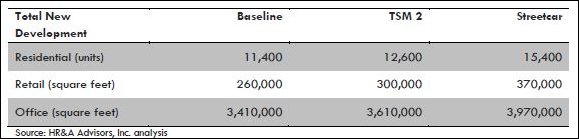
The chart below compares the baseline development (no transportation investment) scenario with the improved bus line (TSM 2) and streetcar scenarios:
HR&A interviews with 10 developers and property owners and six retailers active in the corridor found that a majority (“most”) confirmed that a streetcar would appeal more to riders, lead to a growth in rental and lease rates, and support greater development density. Some (“a smaller number”) worried that only a Metro-level investment would have a meaningful impact on property values, and that fragmented property ownership along the corridor would pose a major obstacle to redevelopment.
The study pointed to another big advantage of streetcars.
Transit has the potential to not only increase the value and quantity of real estate development, but alter its form by promoting compact development and walkability. Recent research from the George Washington University School of Business has found that walkability is a critical neighborhood amenity in the DC region; areas identified as “WalkUPs” because they are walkable command significant premiums over non-walkable places (as high as 75 percent for office and 71 percent for for-sale housing) and are also attracting an increaseing share of the region’s development. … (more…)
Here’s the good news on the transparency of health care prices in Virginia: The Old Dominion is one of the five top-rated states in the country rated by the “Report Card on State Transparency Laws” for its laws and regulations.
Here’s the bad news: We rated a C. We look good only because 45 other states scored F. Maine and Massachusetts laws rated the highest, with Bs.
Price transparency for medical procedures is fundamental for a market-based health care system: Without prices, a market cannot function; consumers cannot shop for medical services. What we have in the United States, and Virginia, may be described as a non-governmental health care system but it is not a market-based system.
The way we frame the debate over healthcare in the United States largely determines the policy outcome. Obamacare has sucked up all the oxygen in the room. Here in Virginia, the healthcare debate has fixated on the Medicaid expansion envisioned by Obamacare. Maybe we’ll get a bigger Medicaid program, maybe we’ll get bigger subsidies for poor peoples’ health plans. Whatever the result, the focus is on who pays and how much. It’s a zero-sum game: Some people win and others lose. The debate is not how to empower consumers to become better buyers of healthcare. The debate is not about how to improve the productivity and quality of Virginia’s healthcare system.
We Virginians lack the imagination and creativity to come up with anything better. I guess we get the government and health care system we deserve.
The Koch brothers are back in the bucolic suburban tracts of Chesterfield County.
This time, their national group, Americans for Prosperity, has launched a robocall campaign to oppose a proposed real estate tax hike of 4.6 cents to help pay for $304 million renovations to schools or perhaps hire more teachers to bring classroom sizes back to pre-recession levels.
It’s apparently the second time that Americans for Prosperity have been on their case in Chesterfield. Last year, the hard-right group sent out bizarre “report cards” to ordinary citizens bashing them for not registering to vote.
In one famous local case, a recipient was actually a registered and active voter and greatly resented the idea that a multi-million dollar national outfit like the Americans for Prosperity was trying to monitor his personal business.
This time, Sean Lansing, the group’s Virginia director told the Richmond Times-Dispatch, the goal is to “educate” residents on the issues, as if they are too stupid to understand local tax and classroom size problems that they probably know far better than some AEP appartchiki.
Chesterfield has caught itself in a bind because it hasn’t raised real estate taxes since 1990 despite its brisk growth rate. Voters in November voted down a 2 percent meals tax that could have raised money for schools. Henrico County voters, by contrast, narrowly approved a 4 percent meals tax and thus have no budget crisis that another tax hike is needed to resolve.
Admittedly, one of Chesterfield’s problems is bad planning. The staunchly Republican county has a long history of being very friendly to developers. Consequently, the county is in a constant service “catch up” mode. Need schools, such as Cosby High near some of the county’s largest residential developments, was already way overcrowded before it was finished a few years ago.
What is puzzling is what the Koch brothers are so interested in Chesterfield. It is hardly an election battleground. There is no strong Democratic or other opposing party. Yet with consummate arrogance, this cabal believes that residents need robocalls to “educate” them.
“Educate” them for what? If you want good schools and other services, someone has to pay for them. And as a Chesterfield resident for nearly 14 years, I can attest that taxes here are considerably lower than other places I have lived as an adult (Washington, New York, Chicago, suburban Cleveland, etc.).
Whoah! Why so many old people hanging out at the University of Richmond?
by James A. Bacon
As Baby Boomers reach their retirement years, the Age Wave is washing over the country. The big push among the G.I. Generation and the Silent Generation was to head south, settling in Florida and Arizona. But Boomers have other ideas. They are more inclined to age in place. And if they do decide to move, they’re less likely to head to the old retirement havens. New regions are emerging as retirement hot spots.
Nerdwallet ranked the nation’s 75 largest metropolitan areas by growth in the 65+ population as a percentage of total population between 2007 and 2012. The result was a real grab-bag of communities, only two of which, Phoenix and Jacksonville, are located in Florida or Arizona. Rainy, overcast Portland, Ore., ranked No. 2 on the list (microbreweries and golf courses) and Detroit No. 5. (Livonia, a large suburb, has large retirement communities).
Then at No. 9, there’s good ol’ RVA. States Nerdwallet: “Retirees in Richmond enjoy the area’s rich history, architecture and cultural offerings, which include a symphony, ballet, orchestra and many theaters and art galleries. The University of Richmond … hosts the Osher Lifelong Learning Institute, providing local residents over the age of 50 with access to learning opportunities regardless of their educational background.”
I doubt the author of the piece has any first-hand familiarity with the Richmond — I’m guessing he checked the web for local amenities — but I’ll say that he hit close to the mark. Richmond does attract the culturally inclined. It’s difficult to enjoy the rich array of activities while working and raising children but when we retire a few years from now, my wife and I are looking forward to living here. We hope to travel a lot, but Richmond makes a wonderful base of operations. (In our discussions, we never even considered the Osher Institute. But UR is a five-minute drive from our house — that could be a significant added attraction).
Charlottesville and Williamsburg are up-and-coming retirement destinations, too. They didn’t make the list because the Charlottesville MSA was too small to be included in the survey and Williamsburg was submerged in the much larger Hampton Roads MSA. But quality universities are magnets for both communities.
The type of retiree who is inclined to move to Virginia because of its cultural offerings is precisely the kind of person we want coming here. People who patronize the ballet, visit art museums and audit college classes are far more likely to be educated and affluent. Educated retirees are the demographic flip side of educated young people that so many regions covet. Those in the 65 set may no longer be in the entrepreneurial stage of their lives but they have more disposable income and they have more time to get involved in the community.
Richmond BizSense published a story this morning about an unnamed New Jersey couple moving to Richmond that just purchased a magnificent house on Monument Ave. for $1.52 million. For a modest price (compared to New Jersey) they get a 7,760-square-foot house with marble bathrooms and one of the premium street addresses in the city. The new homeowner was quoted as saying, “I’m moving to Virginia and I want to have a house that shows off the history of the South because I’ve never lived in the South.”
Welcome to the South, honey, I’m sure you’ll love it here. And we’ll be happy to have you.
Last Wednesday Richard Sarles, chief executive officer of the Washington Metropolitan Area Transit Authority (WMATA), appeared in Richmond to brief the Commonwealth Transportation Board (CTB) on the transit authority’s plans to meet the transportation needs of the fast-growing Washington region, including Northern Virginia, through 2025.
Sarles did not provide a specific figure that WMATA will be asking of Virginia and the localities served by the Metro and bus lines but he indicated that system-wide, the Momentum plan calls for boosting capital spending by $400 million to $500 million yearly above the $900 million a year it already spends. That sum would be divvied up between Maryland, Washington, D.C., and the federal government.
The pitch was pure economic development. “We’ve looked at what we need to do to provide for growth over the next 15 to 20 years — it’s the equivalent of the City of Houston moving to the region,” Sarles said. “If we did nothing, the area would become so congested that economic development would stagnate.”
In his presentation, Sarles focused mainly on plans to upgrade the length of Metro trains to eight, the longest possible, by acquiring additional cars, power capacity and rail car storage. That one initiative would allow the system to carry 35,000 more passengers per hour during rush hour — the equivalent, he said, of building 18 new lanes of highways into the district.
The presentation was purely informational, to acquaint the CTB with WMATA’s plans and the need for state support. In separate remarks to the CTB, Jennifer Mitchell, director of Virginia’s Department of Rail and Public Transit, said the state already contributes $50 million a year to WMATA’s program to bring the aging and problem-plagued system to a condition of good repair. Additionally, Governor Terry McAuliffe has promised a $25 million down payment to the Momentum expansion program, matched by equal sums from Maryland and D.C. “The goal will be working on a long-term funding agreement defining the state’s long-term funding commitment.”
WMATA trains and buses take 1.2 million trips off the road each weekday, said Sarles, relieving local jurisdictions of the need to construct at least 1,000 lane-miles of road and tens of thousands of parking spaces. Without Metro, Virginia would have to spend $1.3 billion on roads and $358 million on parking, he said. (Editorial comment: The sum for roads seems way low — could that be $1.3 billion per year on roads?)
A WMATA handout summarized the key components of WMATA’s expansion plan:
Eight-car trains. Expand the length of trains to eight cars, which will carry 35,000 more passengers per hour during rush hour.
Upgraded rail stations. Expand high-volume rail transfer stations in the Metro system core to ease congestion and accommodate new riders. This will include building underground pedestrian connections between select stations such as Farragut and Metro Center/Gallery Place in D.C. so riders can walk between stations rather than transfer on trains.
Priority corridor network (PCN). Completing the PCN will allow buses to bypass traffic congestion, moving 50% faster, saving passengers 3 to 4 minutes per trip and eliminating an additional 100,000 trips from roadways.
Blue line service. Restore peak-period Blue Line service between the Pentagon and Rosslyn stations through the construction of underground tracks. Adding five more trains per hour during the peak period will provide capacity for at least 4,000 passenger per direction.
Better information. Create one-stop information shopping so riders can plan, pay for and take transit trips seamlessly across the region. Also, stations will provide real-time travel information.
Bus fleet. Expand the bus fleet and maintenance facilities, enabling an extra 40,000 bus trips per day. (Yes, the document says bus trips, not bus passengers. Presumably, each trip would carry multiple passengers.)
New rail infrastructure. Build pocket tracks and crossovers to provide more flexibility to the system and respond to service disruptions. This investment could reduce operating costs to local jurisdictions. (more…)
One of the serious problems in this state that has been called the “Mother of Presidents” is that its electoral process is in many ways anything but a democracy.
In far too many districts, especially rural and suburban ones, gerrymandering and autocratic party diktat mean that the races are utterly non-competitive and devoid of much debate on issues essential for the state’s well-being.
In 2013, for instance, only 12 or 14 of the 100 races for the House of Delegates were actually competitive, according to the Sorenson Institute for Political Leadership at the University of Virginia. That’s an odd fact to ponder.
And that is why you get unneeded legislative sessions such as the one starting today to try and sort out Medicaid expansion and a $96 billion, two year budget. My view is that both the expansion and the budget are being held hostage by hard-line social and fiscal conservatives who are unwilling to consider the needs of moderates or even their own constituents, many of whom are receiving Medicaid or who benefit by its expansion. Indeed, polls show that more Virginians are in favor of expanding Medicaid. A broad coalition of activists, Democrats, business executives and moderate Republicans favors it.
The bottom line is that Virginia is changing but how fast is held in check by engineered voting districts. More people from other states or countries are moving here and that is certain to shake up the old ways of doing business. More millennials are leaving rural areas for cities where there are more jobs and progressive ideas. Eventually, their voices will be heard but not until there’s a level playing field.
According to Leigh Middleditch, a Charlottesville lawyer and Sorenson founder, a crucial task for the Old Dominion is to address redistricting issues. He’s part of the bipartisan Virginia Redistricting Reform Coalition, to bring elections back into balance. As he notes, they’re getting the money and haven’t given themselves six years to complete the job.
I wish them well. If that happens you won’t have a tiny, hard-right cadre representing maybe three percent of the eligible electorate dictating who the candidate is because they only have to worry about a primary in a rigged district.
Mercedies Harris, speaking to the Times-Dispatch, came as close as anyone to summing up what Virginia’s Medicaid debate is all about: “The system is crazy. They have got to stop worrying about what is going to happen tomorrow and deal with the people who need help today.”
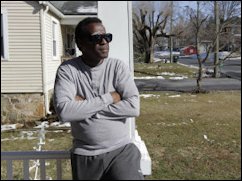
The 53-year-old veteran and Waynesboro resident suffers from glaucoma, which, if it goes untreated, likely will lead to blindness. Harris has spent his meager savings, and he’s about to lose the house where he lives with his wife and a step-son who suffers from seizures. He applied for Medicaid but was turned down because he works and his income — $8.88 an hour — is too high. But he would qualify if Virginia expanded the program, as allowed by the Affordable Care Act and as proposed by Governor Terry McAuliffe and General Assembly Democrats.
With the federal government promising to pay 90% of the cost of Medicaid expansion, it is hard to tell someone like Harris — who served his country in the military and, to all appearances, remains a contributing member of society — that, no, we can’t help you. And the idea of letting him go blind, so that he, too, becomes a total ward of the state, seems the height of folly.
Republicans insist that Medicaid must be modernized before expanding the program. To buttress their argument, they have nothing comparable to the stories of real-live people like Harris, just bloodless numbers. That’s why they could well lose the debate and McAuliffe could well get his way. But that doesn’t mean the Republicans are wrong. Someone has to worry about tomorrow.
The nation and the Commonwealth of Virginia cannot continue expanding the social safety net forever. Even after an increase in the federal income tax and even after the budget cuts imposed by sequestration, the federal budget is on a trajectory to hell. Here is the Congressional Budget Office‘s take on the next 10 years:
After [2015] deficits are projected to start rising—both in dollar terms and relative to the size of the economy—because revenues are expected to grow at roughly the same pace as GDP whereas spending is expected to grow more rapidly than GDP. In CBO’s baseline, spending is boosted by the aging of the population, the expansion of federal subsidies for health insurance, rising health care costs per beneficiary, and mounting interest costs on federal debt. By contrast, all federal spending apart from outlays for Social Security, major health care programs, and net interest payments is projected to drop to its lowest percentage of GDP since 1940.
And that’s an optimistic scenario. It assumes that the economy continues to grow in a slow-but-steady fashion without recession for what would amount to the longest business cycle in U.S. history. The longest recorded business cycle lasted less than 11 years. The current business cycle is almost five years old — another 10 years would make it the Methuselah of economic expansions. History suggests that the U.S. will suffer another recession and revenues, prone to wild gyrations due to its highly progressive structure, will plunge. The question then will be, can a president and Congress facing a fiscal crisis in 2024 be entrusted to keep the promises made by the president and Congress in 2014?
Without major policy changes, according to the CBO, the situation in 2024 will be dire: The deficit will exceed $1 trillion in a non-recessionary scenario. (One can only speculate what the deficit would be in a recession; it could exceed the $1.6 trillion-a-year level seen in the dark days of the last recession.) Ten years from now the national debt will blow past $21.6 trillion, interest payments on the debt will run $880 billion yearly, and the Social Security trust fund will be roughly seven years away from exhaustion. While entitlements and interest payments on the debt now amount to 66% of the budget, they will consume 77% in ten years (again, assuming no recession).
If a recession occurs in the early 2020s, the fiscal landscape will be far worse than it was in 2008 when the economy cratered. The United States will be forced either to cut discretionary spending (which includes the vast regulatory apparatus of the federal government plus the military), cut entitlements or cut both. The only way to avoid that fate in 2024 will be to start cutting entitlements sooner, not later. (more…)
Why do bus lines so consistently lose money? One reason is that transit companies, out of concern for the poor, keep fares too low. Another is that politics dictate that money-losing bus routes stay open. A third reason is that federal regulations effectively require transit companies to purchase American-manufactured buses that cost more while providing lower gas mileage.
The stock response of the state and local political systems across the United States — and no exception here in Virginia — is to increase subsidies for a failed business model. There is little constituency, it appears, for reforming mass transit to operate more efficiently.
“U.S. public transit agencies pay more for buses than they would have if there had been free international trade in buses,” the authors write. “The domestic bus makers supply a small number of differentiated bus models. The lack of competition could retard incentives to develop more fuel-efficient buses.”
With $55 billion in annual revenue in 2011, public transit agencies spent about $2.5 billion on new buses and $3.5 billion to maintain the existing stock. Nationally, more than 60,000 transit buses were in operation across the country.
Private vehicle owners factor in gas prices in their decisions when to keep an existing vehicle or upgrade to a new one, and they enjoy a wider range of choices when they do upgrade. Likewise, overseas transit companies enjoy the benefit of a highly competitive bus-manufacturing industry across Europe and Asia. But the U.S. public bus fleet is produced mainly by small domestic sellers that don’t enjoy the economies of scale that some international bus makers do.
Thanks to the Buy America mandate, U.S. bus manufacturing industry faces no meaningful foreign competition. Foreign makes account for 1.5% of all U.S. public-transport buses.
For a variety of complex reasons, the authors write, U.S. transit operations also are “non-responsive” to fuel prices and fuel efficiency. The result: the U.S. bus fleet averages lower gas mileage — 3.54 miles per gallon in the U.S. compared to 4.74 mpg in Tokyo and 5.05 mpg for diesel buses in Seoul. As a result, capital and operating costs are higher.
Conclude the authors: “The subsidy on domestic buses and the lack of international competition imply that U.S. taxpayers face a higher price for urban bus services and U.S. owners of the domestic firms that produce the buses gain some monopoly rents.”
The McAuliffe administration is generating big headlines by re-thinking mega-projects like the Charlottesville Bypass and the U.S. 460 Connector favored by the previous administration. Those projects came to the fore because federal regulatory authorities made it clear they had major problems with them, leaving Transportation Secretary Aubrey Layne scrambling to keep ahead of the situation. But if you want clues to what long-term transportation strategy will look like under Governor Terry McAuliffe, the man to watch yesterday was Nicholas Donohue, the deputy secretary of transportation.
Donohue briefed the Commonwealth Transportation Board (CTB) about VTrans, Virginia’s long-term transportation planning process, explaining how the McAuliffe team would take a different approach to forecasting travel demand and how the process for allocating road dollars would be subjected to a more rigorous cost-benefit analysis.
Layne underlined the importance of Donohue’s academic-sounding digressions into the flaws of the “Travel Time Index” and the impact of mass transit on property values. “How we look at projects and analyze them will change substantially,” he said. “The intent is to make decisions less political. … This is the beginning of a really significant change in how we allocate monies in the commonwealth.”
Donohue is the policy wonk who exercises influence behind the scenes. A Virginia Commonwealth University graduate in urban studies, he served as assistant secretary of transportation under Governor Tim Kaine. During the Republican interregnum, he joined Transportation for America in Washington, D.C., an advocacy organization closely affiliated with Smart Growth America. In 2011, he co-wrote an op-ed piece published by the Reason Foundation advocating tolled HOT lanes, Bus Rapid Transit, smart transportation systems, private inter-city bus service and improved connectivity for secondary roads.
Yesterday, Donohue calmly dismantled core assumptions that have long underpinned transportation planning in Virginia. Under the aegis of VTrans, previous governors have forecast long-term travel demand and estimated the transportation funding needs based on that forecast. Traditionally, the VTrans product has emphasized vast funding shortfalls, in the tens of billions of dollars, over the following 20 years. One thing the McAuliffe administration wants to do, said Donohue, is to ask, “What did we say before, and did it happen?”
As it turns out, federal forecasts were pretty bad, he said, showing the following chart showing how they consistently overshot the mark:
Virginia’s forecasts suffered from similar biases in the past, he said. Now VTrans will begin considering non-traditional indicators of travel demand. For example, Donohue said, the number of 20- to 34-year-olds not getting their licenses has edged up from about 10% in 2000 to 15% today. A National Association of Realtors (NAR) survey found that a majority of respondents indicated a preference to live in walkable communities with mixed-use development. More families are moving into multifamily housing. And a NAR analysis found that the sales prices of houses located near transit out-performed other housing by 41% over the last five years.
Once the state has a more realistic view of transportation demand, the next step is identifying the most cost-effective projects. Federal law requires states to adopt performance-based planning. “Under performance-based programming,” he explained, “you have to say what you think is going to happen, and then you compare back, so you can see if you get the results you thought you were going to get.”
“The [performance] measures we pick are really, really important,” he said. “Sometimes, measures we thought got to the issue may not fully capture it.”
Donohue took exception to the “Travel Time Index” metric, devised by the Texas Transportation Institute, commonly used in transportation analysis. That metric measures how long it takes, on average, for someone to drive to work during peak congestion compared to how long it takes during normal hours. Thus, in Chicago, if it takes 35.6 minutes to get to work during rush hour compared to 24.9 minutes to take the same trip in off hours, the trip takes 43% longer, giving Chicago a Travel Time Index of 1.43. By that measure, he explained, Chicago has worse congestion than Atlanta with a Travel Time Index of 1.35.
That metric has its uses but it can also be deceptive, Donohue argued. Atlantans may experience less rush-hour delay but they tend to live so far from their workplaces that they still spend more time commuting than their counterparts in Chicago: 57.4 minutes compared to 35.6 minutes. Congestion may be worse in Chicago but the commute is 20 minutes shorter. Who is better off? (more…)
One way to clip the wings of Russian President Vladimir Putin and his aggressive land grabs, says U.S. Sen. Mark Warner who is running for reelection, is to expedite permitting of the 20 or so proposals to export liquefied natural gas, including one by Richmond-based Dominion Resources.
“Most of Europe and Ukraine are heavily dependent on Russian gas in particular for their energy use,” Warner told reporters. Europe depends on Russia for 30 percent of its gas.
It is true that hydraulic fracking has turned the oil and gas business in the U.S. upside down by creating such a flood of products that the U.S. may not only become energy independent but in a position to export. Environmentalists point out that fracking has its dangers but the remarkable change in energy dynamics plays to the producers’ hands.
The big problems with Warner’s proposal are that exporting LNG to Europe will be more time-consuming and costly than he might imagine. It also does nothing to address the climate change issues that gas contributes to, albeit not as much as coal.
One reason why Warner may be so interested in the issue — House Speaker John Boehner, a Republican, is making exactly the same proposal — is because of Dominion. The utility plans a $3.8 billion expansion of its Cove Point, Md. LNG import facility on Chesapeake Bay so that it can export LNG as well. Some of that gas could very well come from fracking operations in the Marcellus Shale fields of Pennsylvania and West Virginia along with the Gulf Coast.
Dominion is in the permitting process – perhaps No. 3 or 4 in line – for Cove Point. It has the gear to take super cold gas pf about minus 265 degrees and warm it up to a gaseous state so it can be sent through pipelines. Now it wants equipment to reverse the process – take gas and chill it into shippable LNG. Dominion has everything else it needs – a water terminal, tanks, and so on.
Warner, of course, gets lots of campaign money from Dominion and has just brought on as his campaign manager Eva Teig Hardy, who retired as one of Dominion’s top lobbyists and public affairs executives. I have known Eva since the 1970s and can attest that she is supremely competent.
There’s nothing wrong with Warner’s ties to Dominion although they should be known. What is troublesome is that his plan may not work.
Take Dominion. If Dominion gets its permits, it won’t be able to export LNG for maybe three years. By that time Putin will either have calmed down or gone beyond Crimea to conquer Europe as far as the Czech Republic or maybe France.
Dominion already has customers lined up for its LNG and they aren’t in Europe. They are utilities in India and Japan – which are the markets of choice for many of the American export hopefuls.
And as Steve Mufson of The Washington Post points out, while Russia exports gas via pipelines to Europe, it still isn’t as big a supplier as Norway. In fact, Cove Point used to see the odd tanker full of Norwegian LNG pull up at its bay terminal. Why can’t Norway increase its sales on the Continent?
Europe would have to build more LNG import facilities and that may take a few years. Meanwhile, the global money seems to be on sending LNG to Asia. (more…)
The year: 2075. The American colonies on the Moon are getting restless under Washington’s tyrannical rule….
This second edition of “Dust Mites” has a snazzy new cover, includes helpful lunar maps, and is 5,000 words tighter than the original. The sequel, “Trogs,” is scheduled for publication this summer.
Advertisement
Advertisement
Advertisement
Advertisement
About
Bacon’s Rebellion is Virginia’s leading politically non-aligned portal for news, opinions and analysis about state, regional and local public policy. Read more about us here.
Fund the Rebellion
Shake up the status quo! Your contributions will be used to pay for faster download speeds and grow readership. Make a one-time donation by credit card or contribute a small sum monthly.
Can’t wait until tomorrow
For your Bacon’s Rebellion fix?
Enter your email address to receive immediate notifications of new posts by email.
SUBSCRIBE
Search Bacon’s Rebellion
Categories
Archives
The Jefferson Council
Protecting Thomas Jefferson’s Legacy at the University of Virginia
Forgot Your Password?
Shoot me an email and I’ll generate a new password for you.